Exploration

Journey to the stars: the 2026 RCGS Geographica Gala celebrates Canada’s legacy of space exploration

Highlights of the Royal Canadian Geographical Society’s 97th annual gala included the announcement of the next president of the Canadian Space Agency and the awarding of the Society’s Gold Medal to former astronaut Julie Payette

  • Nov 05, 2026
  • 1,735 words
  • 7 minutes
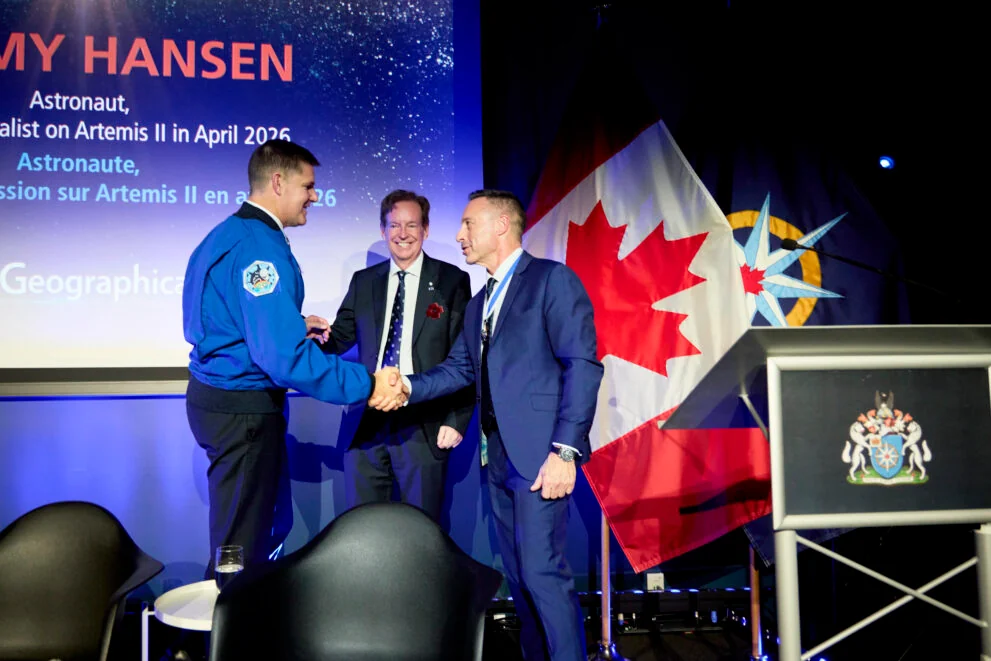
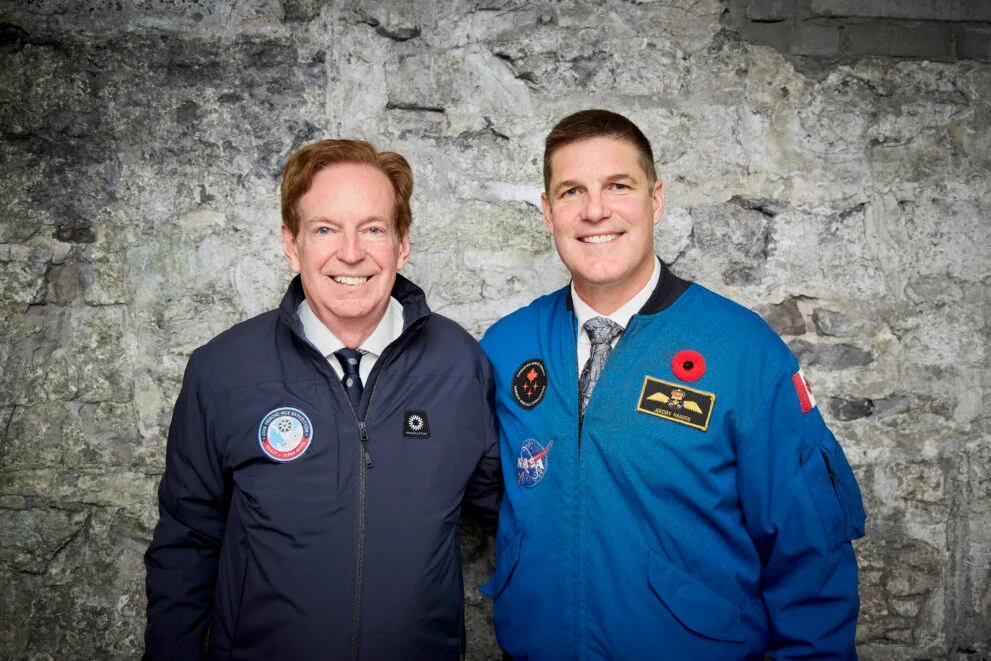
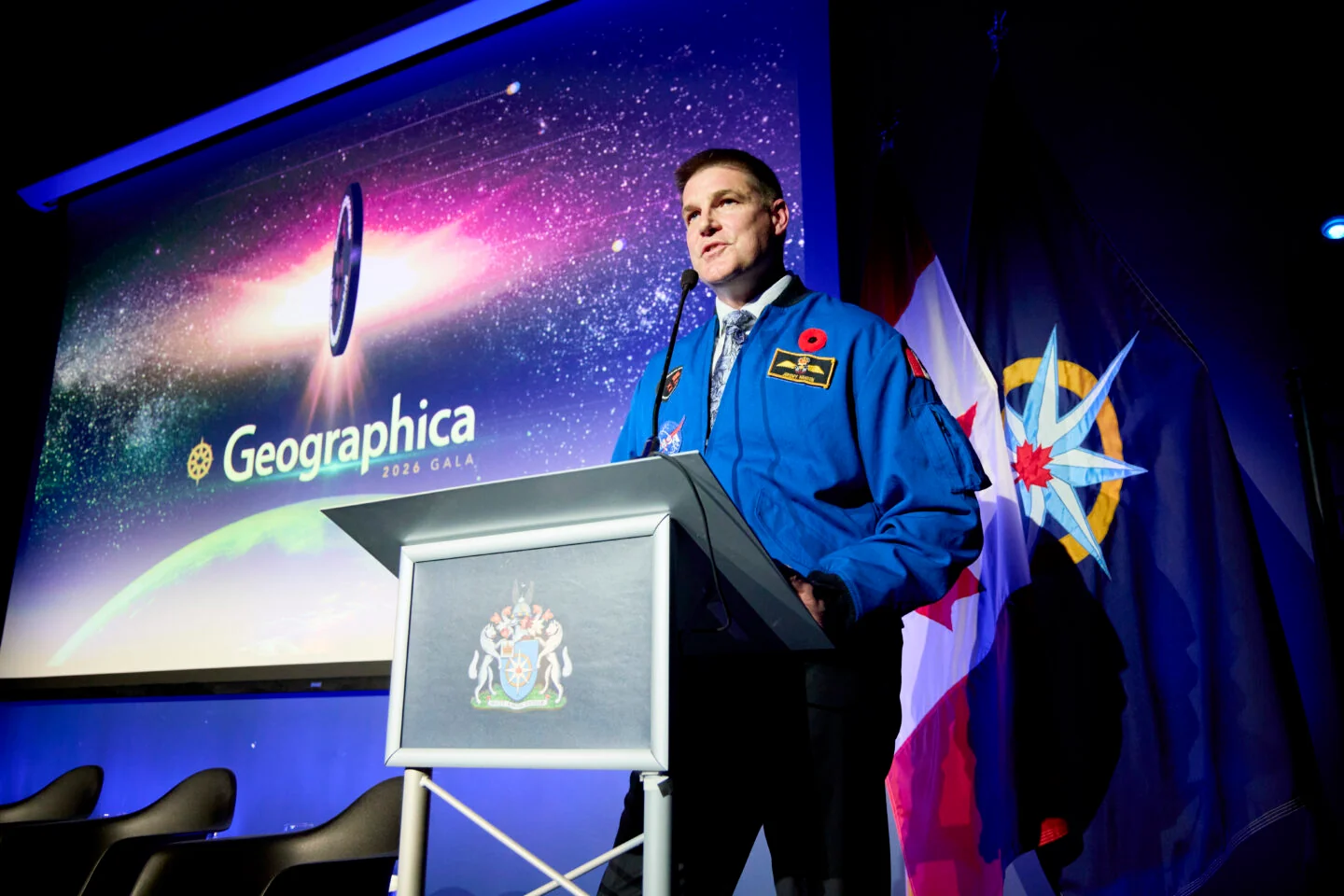
Canadian Space Agency astronaut Jeremy Hansen speaks at the Royal Canadian Geographical Society’s 97th Geographica gala in Ottawa on Nov. 4, 2026. (Photo: Melody Maloney/Can Geo)
Expand Image
Advertisement
Advertisement
Advertisement

On a night that evoked wonder and awe at the extent of human achievement, the Royal Canadian Geographical Society’s 97th annual Geographica gala took more than 400 attendees on a “journey to the stars.” The evening was a celebration of Canada’s space exploration legacy, in particular paying tribute to the late Marc Garneau, the first Canadian to go to space. 

All three floors of the Society’s headquarters at 50 Sussex Drive in Ottawa were transformed into a cosmic showcase with a prototype lunar rover parked outside the front doors, Garneau memorabilia on display and a timeline of Canadian spaceflight leading guests to the Alex Trebek Theatre, where the walls sparkled with a projection of stars. Local vendors served up Canadian fare, including tourtière, lobster rolls and oysters from Atlantic Canada, while the bars were stocked with made-in-Canada spirits, wine and beer. Notable guests in attendance included Marc Miller, Minister of Canadian Identity and Culture; Karim Bardeesy, Parliamentary Secretary to the Minister of Industry; Mona Fortier, Member of Parliament for Ottawa—Vanier—Gloucester; and Mike Bonner, head of personal and business banking at BMO.

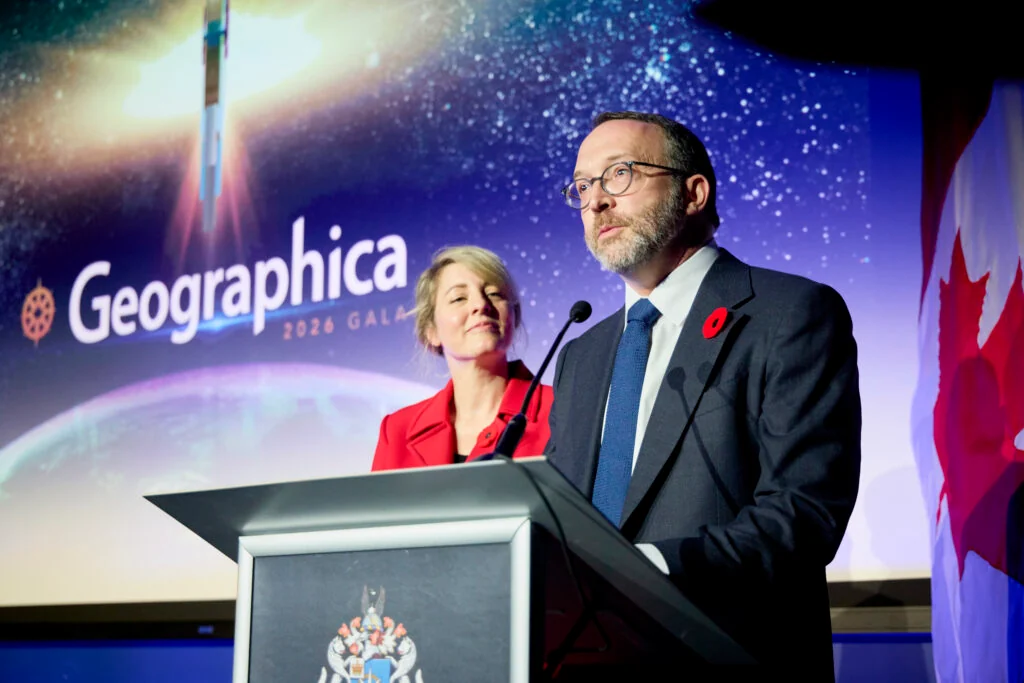
The evening saw Mélanie Joly, Canada’s Minister of Industry, surprise attendees with two big announcements. The first: that Alexander MacDonald, formerly NASA’s first chief economist, will be the next president of the Canadian Space Agency. MacDonald, an internationally-recognized space policy and economics expert who helped establish NASA’s Moon to Mars strategy and the Artemis program, then took to the stage.

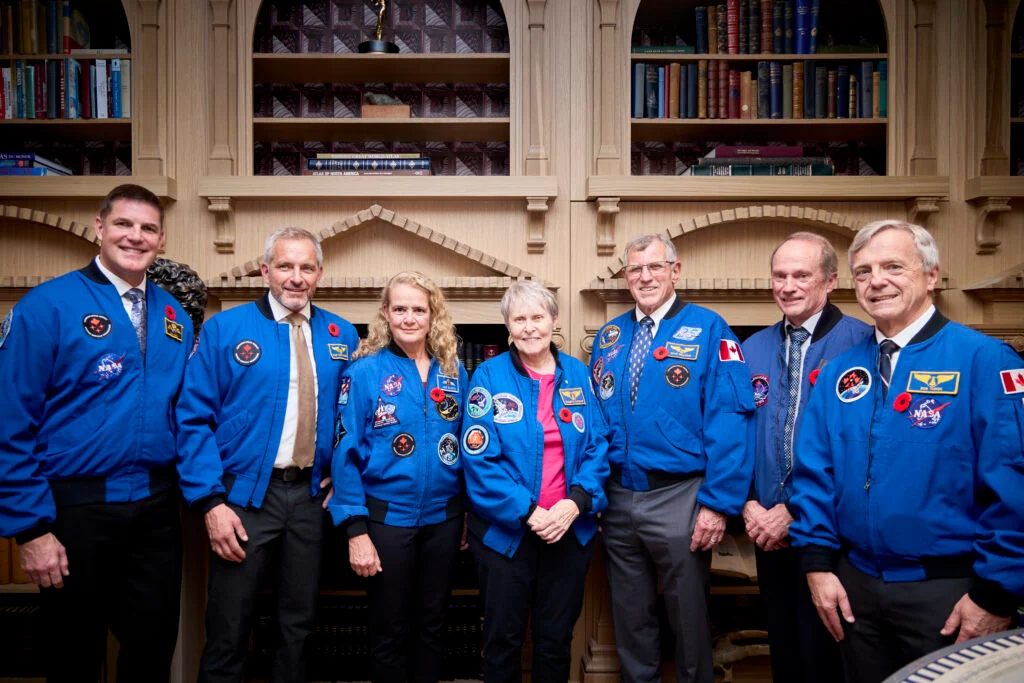
Canadian Space Agency astronauts (left to right) Jeremy Hansen, David Saint-Jacques, Julie Payette, Roberta Bondar, Dave Williams, Steve MacLean, and Bob Thirsk in the Sir Christopher Ondaatje Reading Room at 50 Sussex. (Photo: Melody Maloney/Can Geo)
Expand Image
Mélanie Joly, left, Canada’s Minister of Industry, announced Alexander MacDonald, former chief economist at NASA, as the next president of the Canadian Space Agency. (Photo: Melody Maloney/Can Geo)
Expand Image

“Space has never been more important for the strength and future of Canada, and never before has the world looked to Canada more for global leadership in the space domain,” MacDonald told a rapt audience. “It is my further commitment to work to build to a new level of Canadian space exploration — one that would make Marc Garneau proud.”

Joly also announced her ambition to have Spaceport Nova Scotia, Canada’s first commercial space launch facility located near Canso, N.S., named in Garneau’s honour.

Reflections on Garneau’s life and legacy were woven throughout the evening’s program, beginning with a stirring video showing the space shuttle Challenger blasting off on the mission that would see Garneau become the first Canadian to go to space.

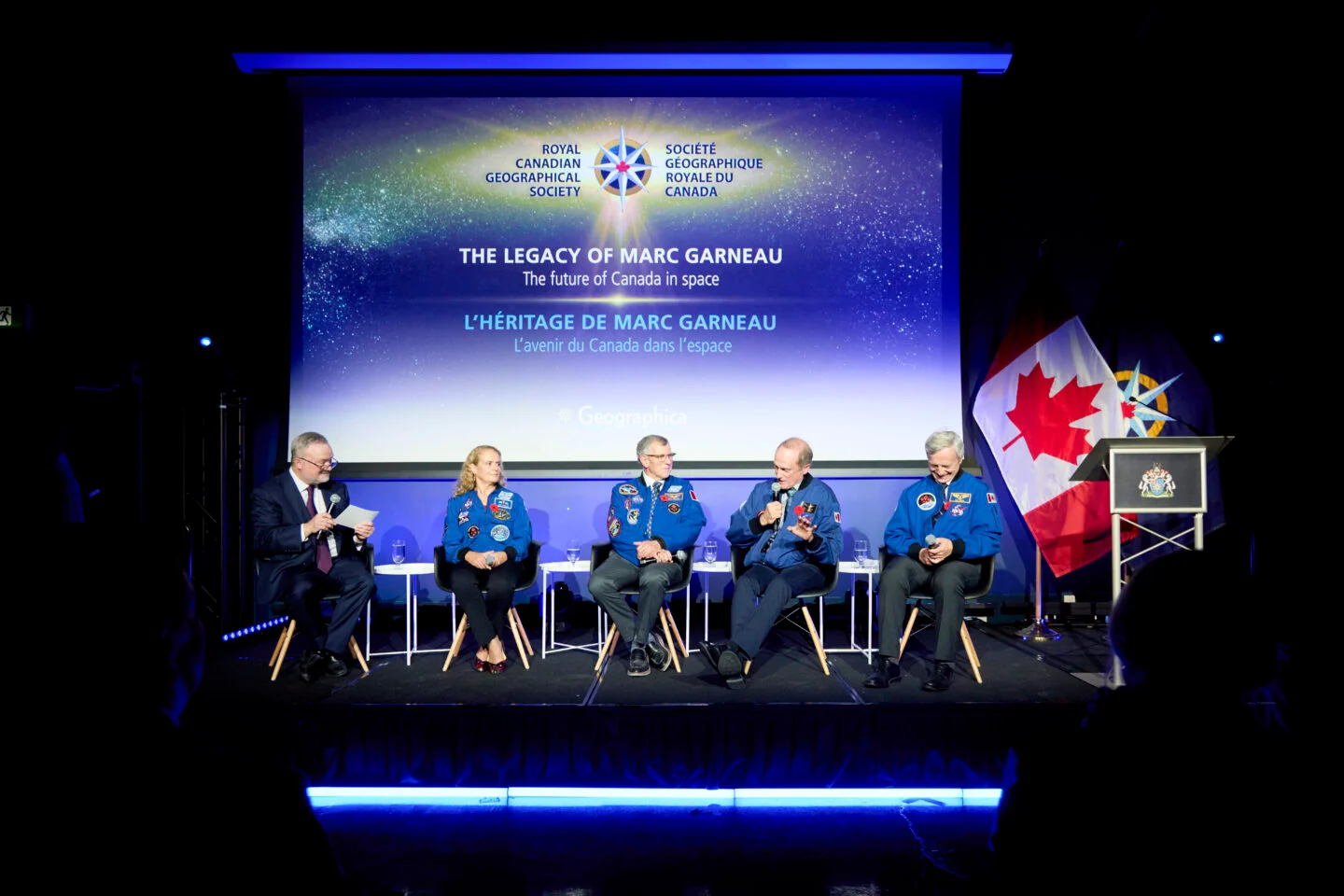
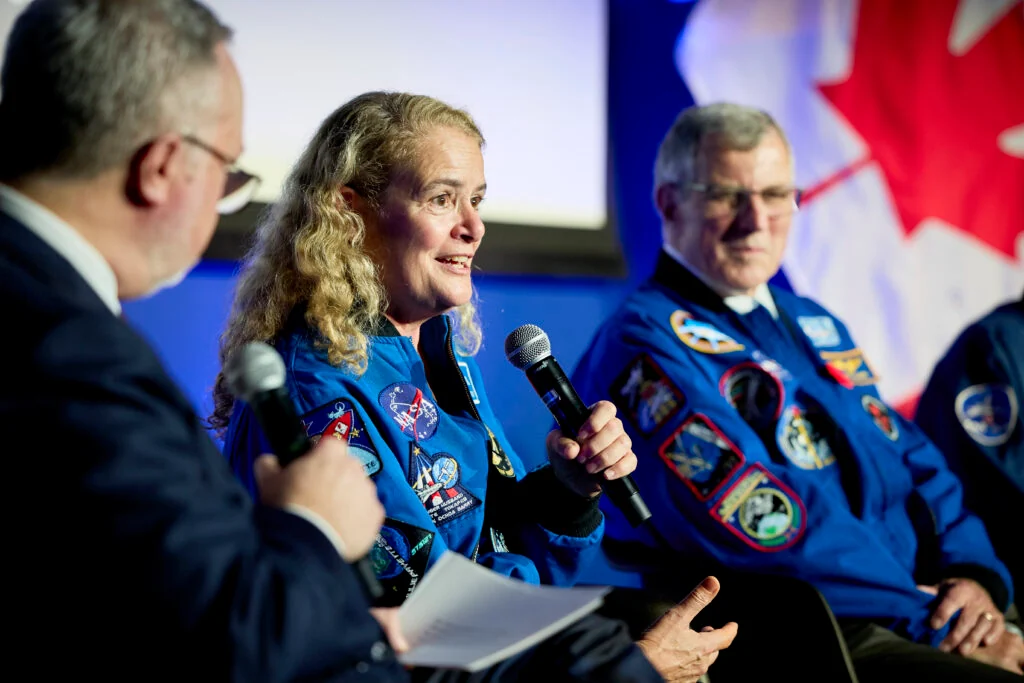
Retired CSA Astronauts Steve MacLean, Dave Williams, Julie Payette and Bob Thirsk then took the stage alongside journalist André Pratte to reflect on the early days of Canada’s involvement in space exploration and share their first impressions of Garneau. Garneau’s warmth and sense of humour were mentioned repeatedly, but it was his focus and leadership that made him stand out. 

“From that very first day, Marc had that aura of duty and service,” said MacLean. “I felt, that first time I met him, that he was going to be Canada’s John Glenn.”

André Pratte, left, interviews astronauts Julie Payette, Dave Williams, Steve MacLean and Bob Thirsk about their colleague, the late Marc Garneau. (Photo: Melody Maloney/Can Geo)
Expand Image

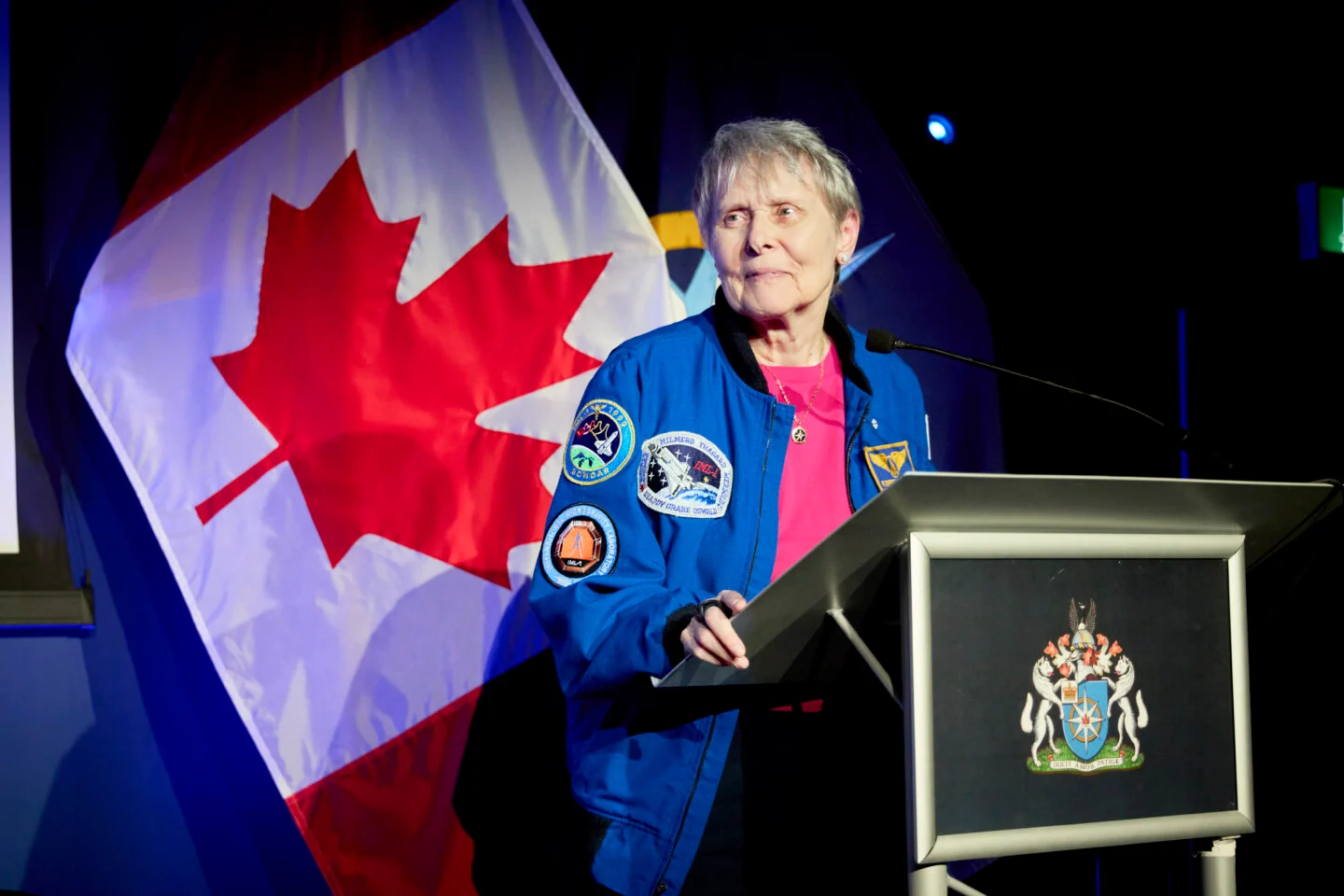
Roberta Bondar, the first Canadian woman to go to space, also shared her gratitude for and fond memories of Garneau, including his inability to stomach the drive back to Toronto after space motion sickness simulation training. “That’s where I learned that even heroes throw up,” Bondar quipped. Bondar, a talented photographer with a special interest in endangered birds, then introduced an exciting new addition to Canadian Geographic’s annual Canadian Wildlife Photography of the Year competition. 

“About 10,000 people submit photos every year to the wildlife photo competition, but there was never a separate prize for youth,” she said. “There will be now.”

The new Roberta Bondar Youth Photography Prize, funded by the R. Howard Webster Foundation, will be the Society’s first photography prize for youth, and will be awarded alongside the Canadian Wildlife Photographer of the Year competition as of fall 2027. 

From astronauts past to astronaut present, the celebration reached new heights when a message arrived from orbit: a heartfelt message from Joshua Kutryk, recorded on the International Space Station. Just days after he became the fifth Canadian to perform a spacewalk, Kutryk communicated his deep admiration for Garneau. “As a child, I wanted to be like Marc because he was a space explorer,” said Kutryk. “As an adult, I wanted to be like Marc for an even more important reason: he was the best example of human kindness, Canadian values and public service that I knew.”

Roberta Bondar announces the Roberta Bondar Youth Photography Prize. (Photo: Melody Maloney/Can Geo)
Expand Image
Julie Payette and Dave Williams during their Geographica panel. (Photo: Melody Maloney/Can Geo)
Expand Image
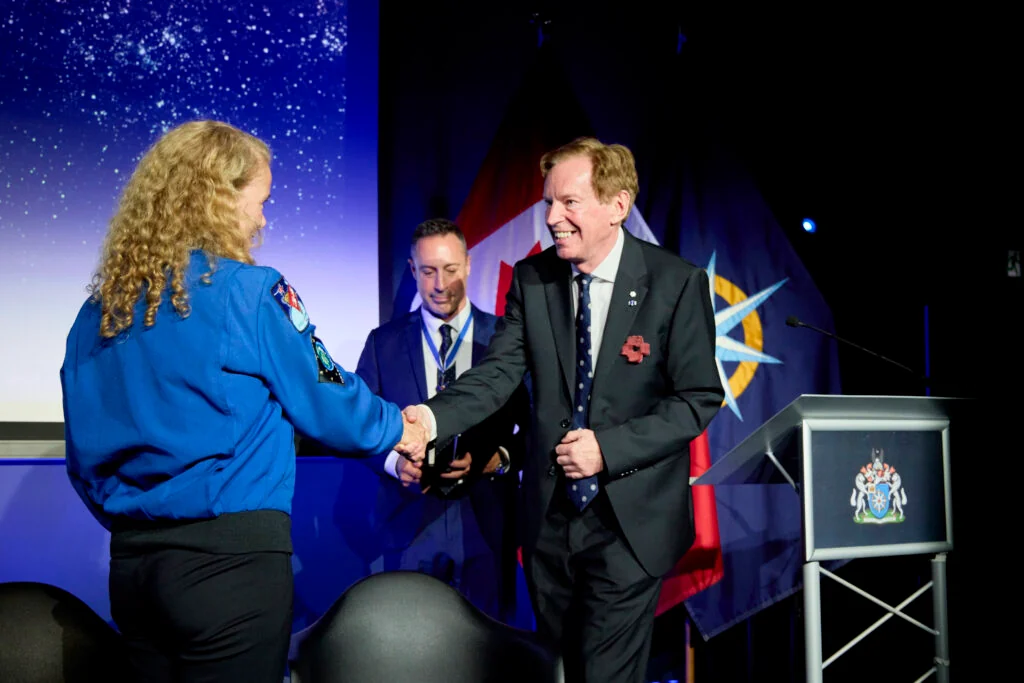
RCGS CEO John Geiger (right) and Honorary Vice-President Mark Pathy present Julie Payette with the Society‘s Gold Medal. (Photo: Melody Maloney/Can Geo)
Expand Image

John Geiger, CEO of the RCGS, noted the long history of collaboration between the Society and the Canadian Space Agency. To mark the agency’s 25th anniversary in 2014, the Society presented the entire astronaut corps with its Gold Medal — but one astronaut was absent. To finally recognize her achievements, including two missions to the International Space Station and her work with the iconic Canadarm, Geiger presented the Gold Medal to Julie Payette. 

Geiger then handed the mic over to Mark Pathy, chief mission specialist for the Society’s 2026 Heroic Age Expedition and himself an astronaut who spent 17 days onboard the ISS in 2022, to introduce the man everyone in attendance was waiting to hear from: Canadian astronaut Jeremy Hansen, who in April flew around the moon as part of NASA’s Artemis II mission.

Advertisement

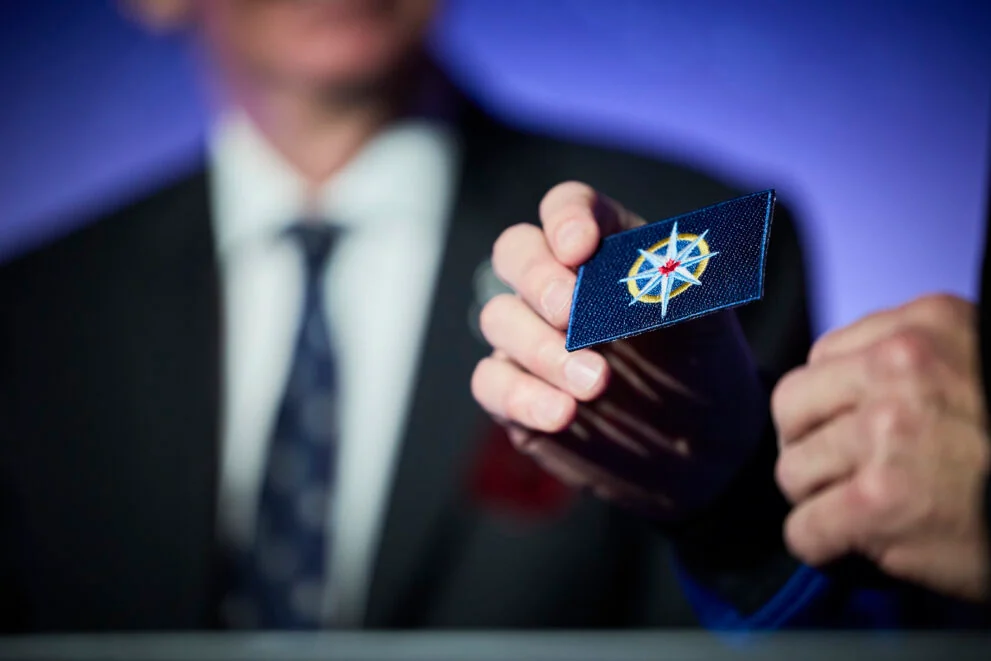
Joining Geiger and Pathy onstage, Hansen revealed a very special gift for the occasion: a patch embroidered with the Society’s flag that Hansen brought with him on Orion spacecraft Integrity as he and his crewmates flew 1,100,000 kilometres around the far side of the moon — farther from Earth than any humans in history.

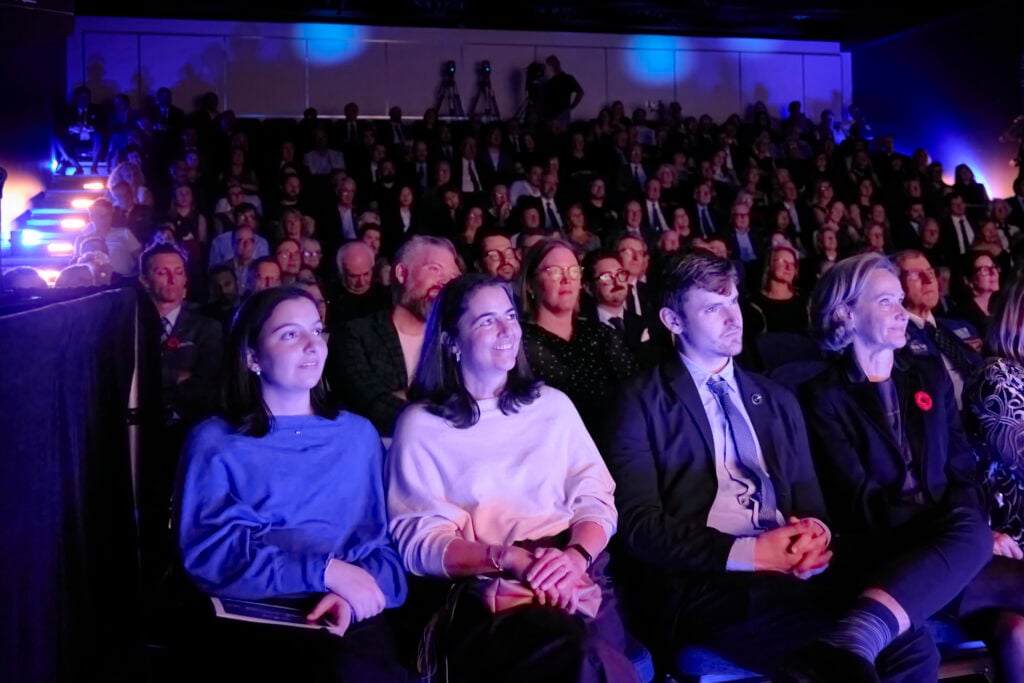
More than 400 guests attended the gala. (Photo: Melody Maloney/Can Geo)
Expand Image

Hansen regaled the audience with stories from his career as an astronaut, including getting stuck in quicksand during geology training in northern Labrador and what it was like to look back at the tiny Earth as Integrity approached the moon. “You start to look at home,” he said. “You don’t think about continents or countries, and you certainly question what the heck are we doing down there, that we could do anything other than use our energy to lift one another up.”

Hansen also paid tribute to the search and rescue efforts of the Royal Canadian Air Force squadron stationed in Winnipeg in response to the tragic accident at CFB Wainwright on Oct. 17. With little notice or details of what had happened, 11 search and rescue technicians made it onto the departing plane. 

“You don’t think about continents or countries, and you certainly question what the heck are we doing down there, that we could do anything other than use our energy to lift one another up.”

Jeremy Hansen on seeing Earth from space
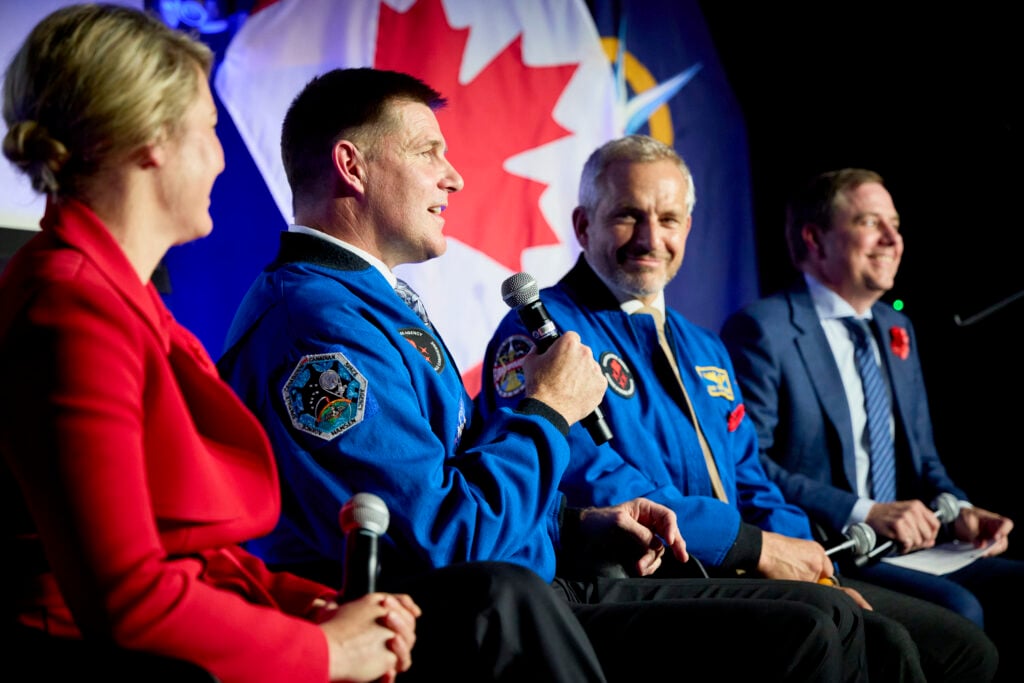
Left to right: Mélanie Joly, Jeremy Hansen, David Saint-Jacques and Ewan Reid discuss the future of space exploration and Canada‘s role in it. (Photo: Melody Maloney/Can Geo)
Expand Image

“They got on the plane, and on the way there they determined the best place for them to serve would be the hospital,” said Hansen. “They parachuted onto a football field beside the hospital and went to work in that hospital. Extraordinary.”

Hansen was later joined on stage by Joly, CSA astronaut David Saint-Jacques and incoming Space Canada board chair Ewan Reid, founder of Ottawa-based software company Mission Control, to talk about the future of Canada’s space program. Joly stressed the importance of Canada “putting more astronauts in space” and the need for “a culture of results.”

It was a stirring message that amplified the overarching feeling of the night: that Canada will approach space exploration with passion and ambition, and that the country’s achievements in this sector will continue to be something every Canadian can be proud of.

It’s a legacy that in many ways began with Garneau, whose uplifting spirit continues to inspire and motivate today’s cohort of astronauts. It was fitting, then, that the final speaker in the evening’s journey to the stars was Garneau’s brother, Philippe Garneau, who concluded with a reflection on his brother that perfectly encapsulated Marc’s humility and passion for discovery.

“I once asked Marc what his favourite thing was about being an astronaut,” Philippe recalled. “And he leaned in and said ‘Every day I wake up knowing that I get to work with the finest minds in the world. It’s absolutely intoxicating.’”

Celebrating the Heroic Age Expedition

From outer space to the ocean floor, the inspiring evening continued with a celebration of the 2026 Heroic Age Expedition, which saw the Society carry out the first comprehensive survey of the wrecks of Quest and Terra Nova in partnership with Woods Hole Oceanographic Institution. A number of expedition team members from WHOI travelled to Ottawa to attend the event, including co-chief scientist Dwight Coleman, Alvin pilots Bruce Strickrott and Benen ElShakhs and marine biologist Kirstin Meyer-Kaiser. 

Following a teaser trailer for The New Heroic Age of Exploration, a forthcoming documentary about the expedition, Kevin Chan, senior director, policy campaigns for Meta, spoke about how Meta technology such as Rayban smart glasses helped make this an expedition for the 21st century. Then, Strickrott presented a brief history of Alvin, the world’s most storied submersible.

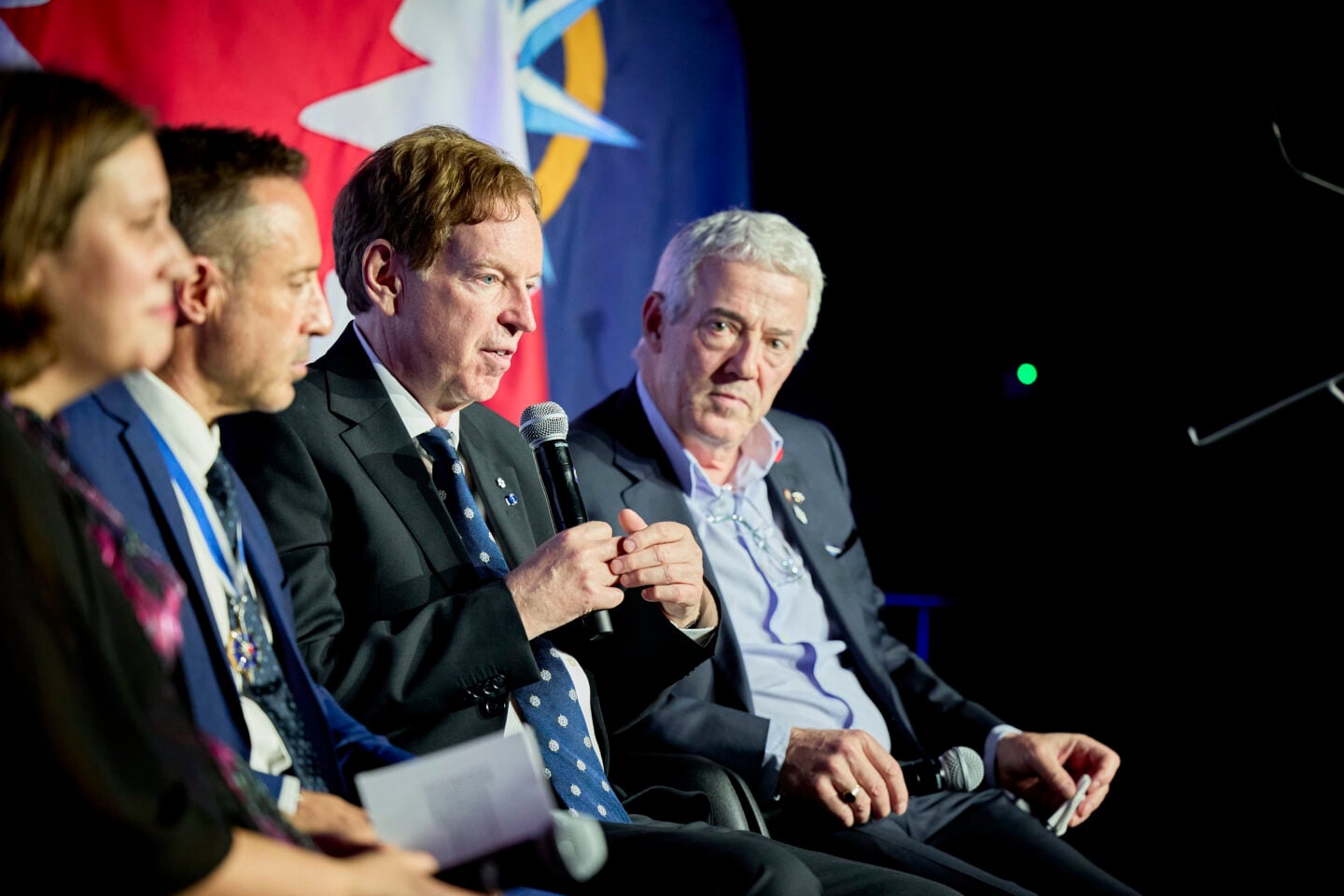
John Geiger, second from left, describes the moment he first saw Quest with his own eyes in the submersible Alvin during the 2026 Heroic Age Expedition, as David Mearns, Mark Pathy and Alexandra Pope look on. (Photo: Melody Maloney/Can Geo)
Expand Image

The event concluded with a panel discussion featuring expedition leader John Geiger, co-chief scientist David Mearns, chief mission specialist Mark Pathy, lead researcher Antoine Normandin, Voyis head of ocean science Brenden St. John, and Meyer-Kaiser and moderated by Canadian Geographic editor-in-chief Alexandra Pope. The panelists discussed what it is that pushes people, whether astronaut or shipwreck hunter, to explore.

“Rather than because of famine or warfare, great periods of human exploration historically have actually happened during periods of relative calm at home,” said Geiger. “People leave comfortable places and put themselves intentionally in risky situations. In our case, it was 40 atmospheres of pressure down to look at a shipwreck. It’s an instinct people have to push those boundaries.”

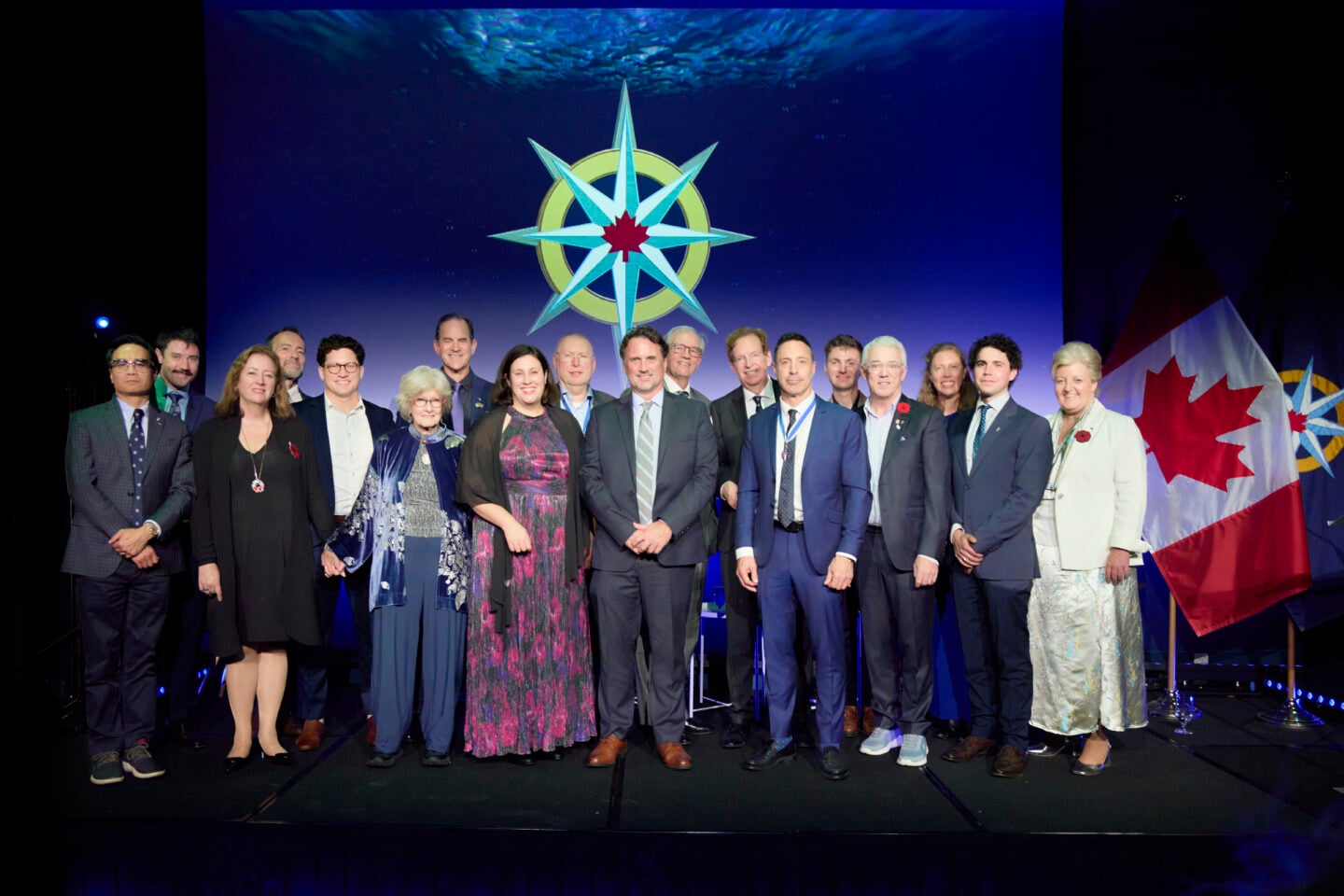
Members of the Heroic Age Expedition pose for a group photograph. (Photo: Melody Maloney/Can Geo)
Expand Image

It’s the same instinct that pushed Jeremy Hansen to complete a lunar flyby, with all the associated risks of space flight. But by following that instinct, people can achieve great things.

For Normandin, it was an instinct that changed his life. “I approached John and told him I was interested in using mathematics [to find a shipwreck]. And six, seven months later, we were finding a historical shipwreck in the middle of the Labrador Sea, and two years after that, you’re on the Alvin submarine. You never know where these things are going to lead you to. That’s the beauty of it.”

The Society gratefully acknowledges the support of our sponsors: Meta, BMO, MDA Space, Vale, ESRI Canada, Rio Tinto, Swan Hellenic, Mission Control, Air Canada, Nancy Love, Molson-Coors, Dunrobin Distilleries and many other individuals and companies that supported the silent auction and gift bags.

Advertisement

Help us tell Canada’s story

You can support Canadian Geographic in 3 ways:

Related Content

Science & Tech

Artemis II astronauts have returned safely to Earth following historic mission around the moon

Canadian Geographic is following this history-making mission, which saw Canadian Space Agency astronaut Jeremy Hansen become the first Canadian to fly around the moon

  • 5285 words
  • 22 minutes

Science & Tech

Who is Jeremy Hansen, the Canadian tapped by NASA to fly around the moon?

Canadian Space Agency astronaut Jeremy Hansen will soon be blasting off on NASA’s Artemis II mission. How did he get from an imaginary treehouse spaceship in rural Ontario to the real thing? 

  • 3607 words
  • 15 minutes
531A2816.NEF

Exploration

Canadian astronaut Joshua Kutryk steps out into “pitch black” for critical spacewalk

Kutryk became the fifth Canadian spacewalker on Oct. 29, installing an external power upgrade on the International Space Station

  • 1028 words
  • 5 minutes

Science & Tech

Canadian astronaut Joshua Kutryk launches on long-term mission to International Space Station

Months after Jeremy Hansen flew to the moon on the Artemis II mission, another Canadian astronaut has achieved his spaceflight dream

  • 841 words
  • 4 minutes
Advertisement
Advertisement