Science & Tech

Who is Jeremy Hansen, the Canadian tapped by NASA to fly around the moon?

Canadian Space Agency astronaut Jeremy Hansen will soon be blasting off on NASA’s Artemis II mission. How did he get from an imaginary treehouse spaceship in rural Ontario to the real thing? 

  • Feb 02, 2026
  • 3,607 words
  • 15 minutes
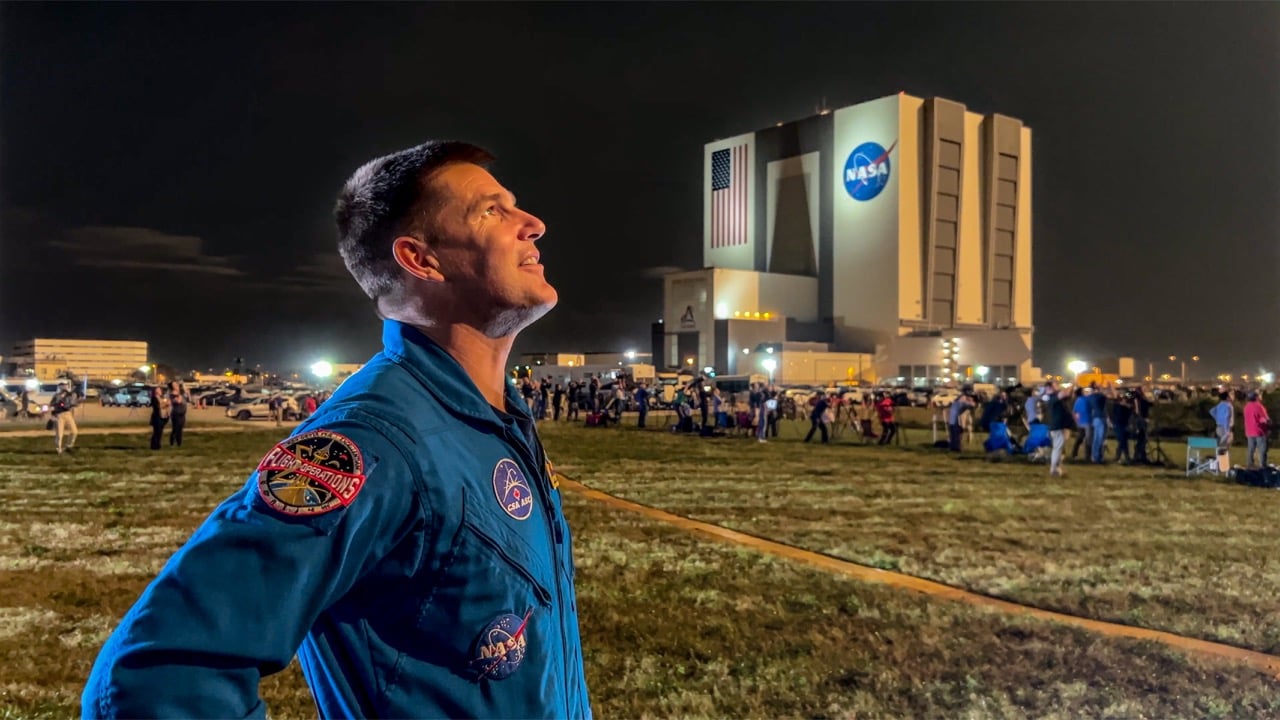
Canadian Space Agency astronaut Jeremy Hansen watches the launch of NASA’s Artemis I mission at Kennedy Space Center, Florida on Nov. 16, 2022. The following spring, Hansen was confirmed as crew for the Artemis II mission. (Photo: Sean Costello)
Expand Image
Advertisement
Advertisement

To be an astronaut is to be humanity’s highest symbol of daring, of curiosity, of longing. These sailors of the stars, as the translation from Greek has it, hold a unique place in the human imagination. Alone among the billions of people who have ever walked our planet, they have been chosen to journey to the celestial bodies that have fascinated and even ruled our species since we first looked to the sky. As a result, astronauts, as individuals, are inscrutable.

Instead, they share characteristics that are noble — even heroic — if eerily uniform: smart, capable, technically gifted, team-spirited, free of vice, clear of vision, uninterested in personal glory, replete with sangfroid, preternaturally patient, eager to take orders yet ready to make tough decisions, ferociously committed to advancing human knowledge, almost cartoonishly physically perfect.

How, then, to capture the uniqueness of Canadian astronaut Jeremy Hansen, who is slated to take part in NASA’s nine-day Artemis II mission to circle the moon this year? To point out that he will be the first Canadian to leave Earth’s orbit, as well as the only non-American to do so — or that by doing so he will accomplish what only 24 others in the history of human life have accomplished — is to sketch only the bare bones of his story.

As is to mention the fact that he’s taking part in a momentous project in the history of humanity. The Artemis missions are named after the twin sister of the Greek god Apollo, who gave his name to the NASA program that carried those other 24 into deep space more than half a century ago. But where the Apollo era was about a single country — the United States — proving its mettle by getting to the moon and back, the Artemis program is about humans collaboratively establishing a settlement there. And, eventually, Mars.

“It’s radically new in the human experience,” says Chris Hadfield, the retired astronaut. He knows what he’s talking about. Hadfield was the first Canadian to command a spaceship (the International Space Station), has spacewalked for 14 hours and 54 minutes and recorded a cover version of the David Bowie song “Space Oddity” while drifting weightlessly through the station’s cramped interior, among many other firsts. Hansen’s mission, he says, is “not only incredibly rare [and] enabled by the best of our technological creativity, but it’s also opening a door to a future that has been just imagined.”

The potential perils of Hansen’s mission are staggering. No human has ever been propelled by this particular rocket, known as the Space Launch System, or flown the tiny Orion spacecraft that sits on top of it. No crew has ever had to hurtle in that little capsule back into Earth’s atmosphere and shed, using friction from our planet’s atmosphere plus a partially proven heat shield, the massive amount of energy the vessel has gathered on the journey, before opening the parachutes that slow the capsule down enough to land safely in the Pacific Ocean near San Diego. It is, as Hadfield puts it, “a long catalogue of unproven risk.”

In other words, this is a huge technical, geopolitical and sociocultural moment. “And Jeremy’s right on the cutting edge of all that.”

The question is, why?

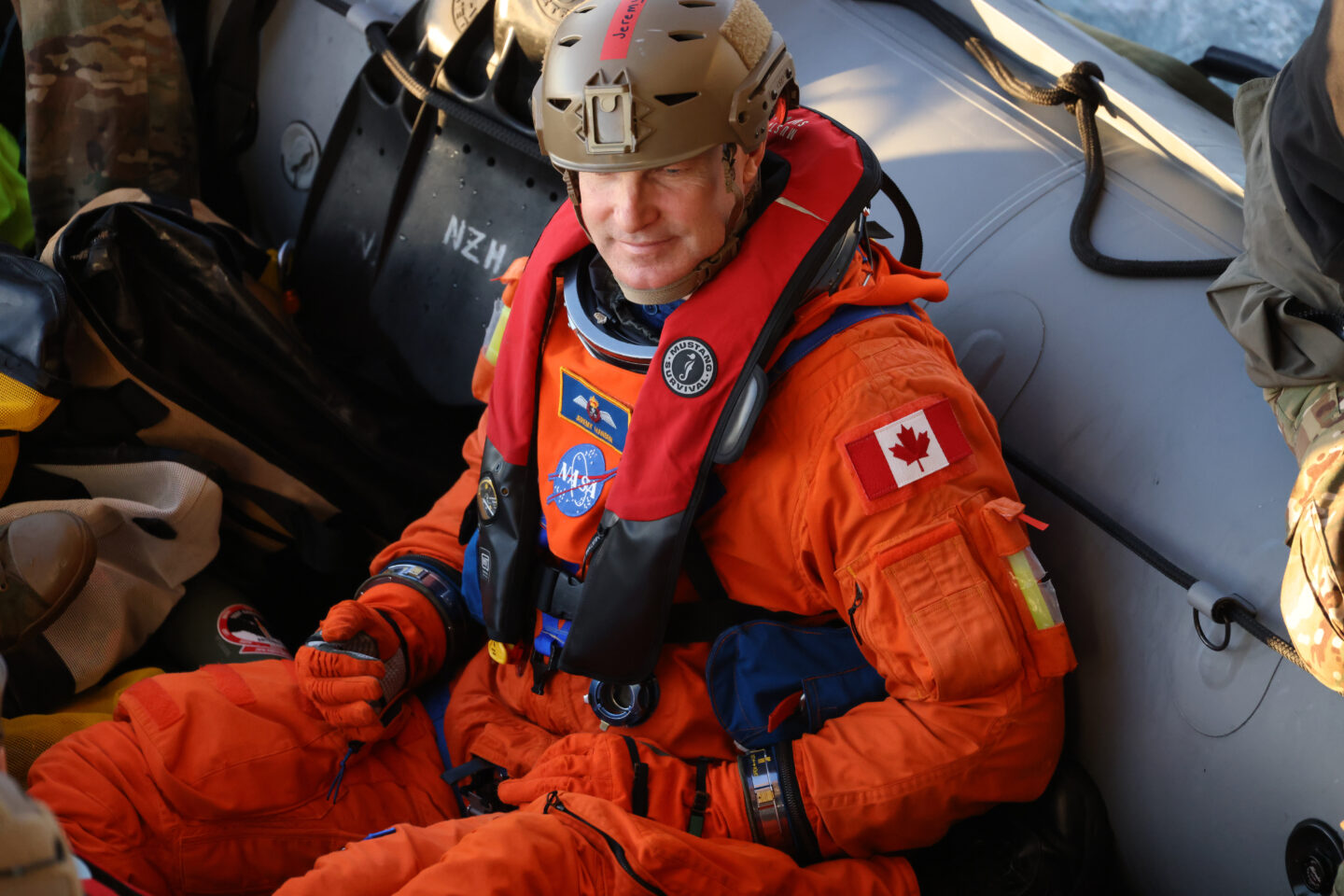
Hansen takes part in a rehearsal for splashdown and retrieval of the Orion crew capsule in the Pacific Ocean off San Diego, Calif. (Credit: NASA/Isaac Watson)
Expand Image
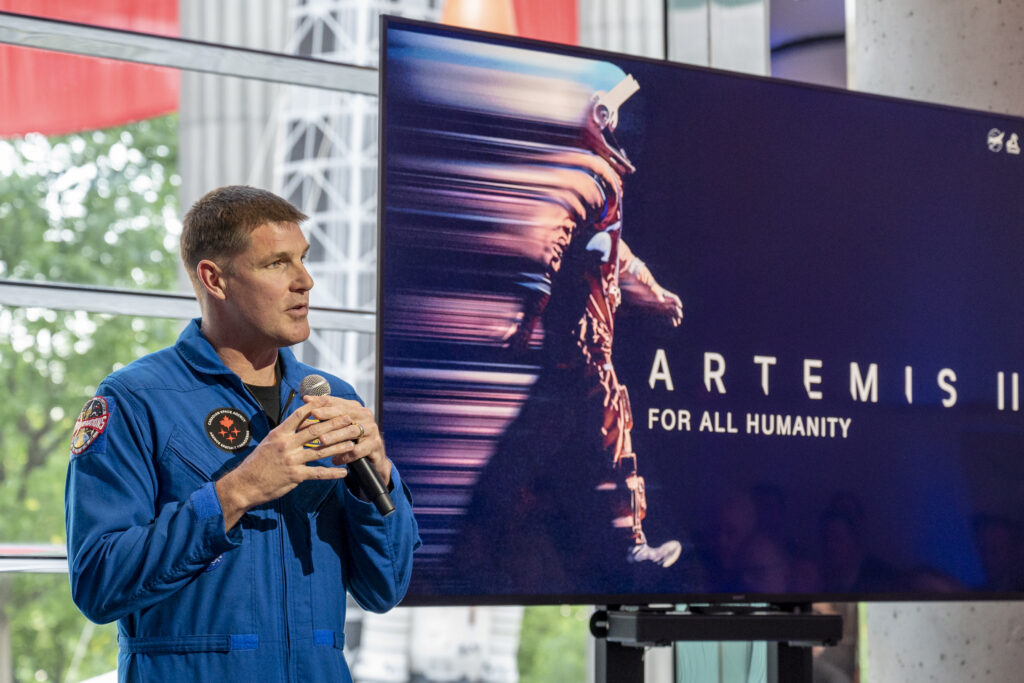
Hansen explains the Artemis II mission to members of U.S. Congress at the Canadian Embassy in Washington, D.C. (Photo: Keegan Barber/NASA)
Expand Image

Hansen — crewcut, impeccably shaven, wearing his trademark full-body blue space jumpsuit and black leather boots polished to a military sheen — is manoeuvring across a floor of exhibits at the Canada Aviation and Space Museum in Ottawa to do an early morning video interview, one of a torrent he’s undertaken to help Canadians understand his mission. His media handler at the Canadian Space Agency has warned him that he has precisely half an hour before the next item on his extremely packed agenda. But Hansen is unhurried. There’s no swagger. No hubris. Maybe a bit of quiet bemusement at all the attention. He is, above all, focused on the task at hand.

And he is massive. Not just tall, at well over six feet, but wide-shouldered and narrow-waisted, with the lithe musculature of a long-distance runner. He settles carefully back into a small, padded chair in front of a display about the International Space Station and spreads his feet wide, bracing himself, forearms resting on his thighs. He is not just an astronaut, but also a colonel in the Royal Canadian Air Force; this is the stance of someone who has spent countless hours in the cockpit of a fighter plane.

He smiles even before the camera turns on. Despite his girth and resumé, he strives to avoid being imposing. It strikes me that he must have had to practise this when he met new people, something like being a rescue worker trying to coax a scared kitten out of a tree. (“I remember being quite intimidated the first time I met him,” admits Gordon Osinski, the planetary geologist from Western University in London, Ont., who trains NASA and Canadian Space Agency astronauts and who has taken Hansen on several Arctic field trips. The two have become fast friends.)

One of the most famous origin stories about Hansen is that when he was a kid growing up on a farm near Ailsa Craig, Ont., he flipped open the first volume of an encyclopedia and, under the letter A, happened on a picture of the astronaut Neil Armstrong standing on the moon. Armstrong was part of NASA’s Apollo era, which ended before Hansen, who turned 50 in January, was born. But the image ignited a lifelong passion in Hansen, who shortly thereafter turned his treehouse into a spaceship.

Still, how do you get from an imaginary spaceship in rural Ontario to the moon? Hansen, still sitting calmly in front of the camera, is quick to credit others. “One day, I told my family. I told teachers, and people started to use that inspiration to push me,” he says.

The potential perils of Hansen’s mission are staggering. 

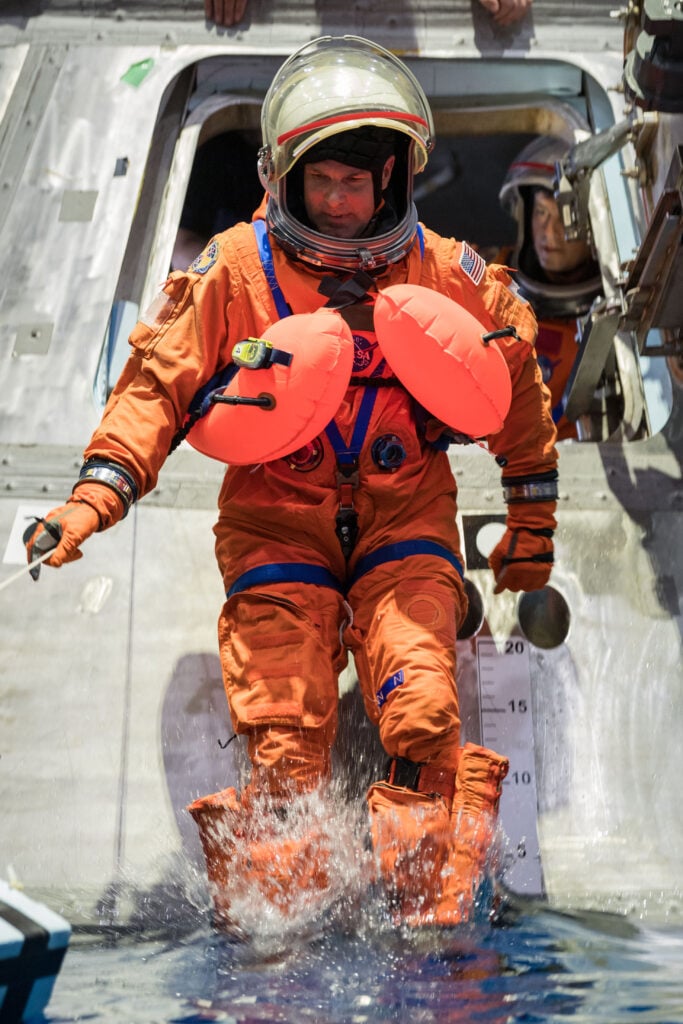
Hansen exits a mockup of the Orion spacecraft during a training exercise in the Neutral Buoyancy Lab at NASA’s Johnson Space Center in Houston, Texas. (Photo: Josh Valcarcel/NASA-JSC)
Expand Image

Even when he occasionally lost faith, these supporters kept him going. “I don’t think being able to set the goal and believe in it initially is unique, but to have the people around you who will enable you to hold the vision long enough to attain it, maybe that is, unfortunately, somewhat rare.”

The dream led to his joining the Royal Canadian Air Cadets, a national youth program that encourages teens to develop leadership skills while learning about aviation, which in turn led him to officer training in the Royal Canadian Air Force. Major-General Chris McKenna, who today is the operational commander of Canada’s air force, recalls how Hansen was assigned to greet him and the other new recruits at their swearing-in ceremony at a church in Saint-Jean-sur-Richelieu, Que. Hansen was literally the first person in uniform whose hand McKenna shook when he joined the military.

“He looked very perfect, you know. He had the high, tight haircut. He had the uniform to fit perfectly. He was an inspiring guy, just super kind,” McKenna says. The recruits asked him masses of questions about military college, and he patiently answered them all. “Just a really generous guy, which has not changed today.”

After Hansen finished his first degree in 1999 at the Royal Military College, specializing in space science, he did a master’s in physics, a mark of his exceptionality, even in that elite group. “That is offered to very few people,” says Lieutenant-General Eric Kenny, who recently retired as commander of the Royal Canadian Air Force and who managed Hansen’s career for many years. Only those who are academically inclined and recognized leaders take on that extra year of study, “because at the end of the day, you’re delaying your pilot training for a year.”

Hansen ultimately completed his flight training in Moose Jaw, Sask., in a group of about a dozen that included McKenna. While McKenna says it was a pressure-cooker for most — “You’re always a flight away from failing and just not being a pilot” — Hansen seemed to breeze through.

“Jeremy was annoyingly, extremely good at it,” says McKenna, now a close friend, calling him “exceptionally gifted as a hands-and-feet pilot.” In fact, while the other students were sweating to make the grade, Hansen was quietly mentoring those who needed extra help. “You’d pop by the simulators on a Friday night when everyone else was in the mess, and you’d see Jeremy with a student who was not doing well, making sure they could pass the next flight.”

When the Moose Jaw group needed to set up a community event as part of an officer development program, Hansen suggested opening the base for a sports day for local kids, adding that he’d been volunteering as a Big Brother throughout the whole gruelling course. “We’re all like, ‘What?’” McKenna says. “So, on his own, he had — because he’s a bit of a saint, right, he’s just one of these amazing people — he’d been working with at-risk youth.” Hansen went on to organize the whole event.

By the time he was chosen for astronaut training in 2009, Hansen had been flying CF-18s as a fighter pilot for six years. The astronaut selection process involved a year of fiendish tests that included being strapped into “the dunker,” a mock helicopter cockpit that crashed six metres down into a swimming pool in Dartmouth, N.S., collapsed and filled with water. Three times. Each time with increasingly more complex escape possibilities. Then there were fire rescues on a mock navy ship in Halifax, dousings with frigid water, encounters with toxic spills, induced extreme fatigue, plus psychological probes of the candidates’ deepest, most secret fears.

This was followed by two more years of study, a move to Houston and the Johnson Space Center with his physician wife Catherine and their three grade-school-aged children, multiple Earth-bound missions and a stint as the first Canadian to be put in charge of training NASA astronauts.

But zero trips to space. Finally, in April 2023, he got the nod for Artemis II. Kenny went with other Canadian luminaries to Texas for the announcement, which was a bit like a rip-the-envelope Oscar ceremony. He says he felt like a proud dad sitting in the front row of the hangar when Hansen’s name was called. “The energy was electrifying.”

Again, Hansen shifts the credit for this milestone. Sure, he’s worked hard, but so have thousands of people over decades who have had the vision to build Canada’s space program, catapulting it onto the world stage.

“I have gone through the gamut of emotions all the way from the fear and uncertainty to the joy and the excitement,” Hansen says. “But where I always land is gratitude and being very humbled by the opportunity. I’m very much aware that I just happened to be the person in the right place at the right time.”

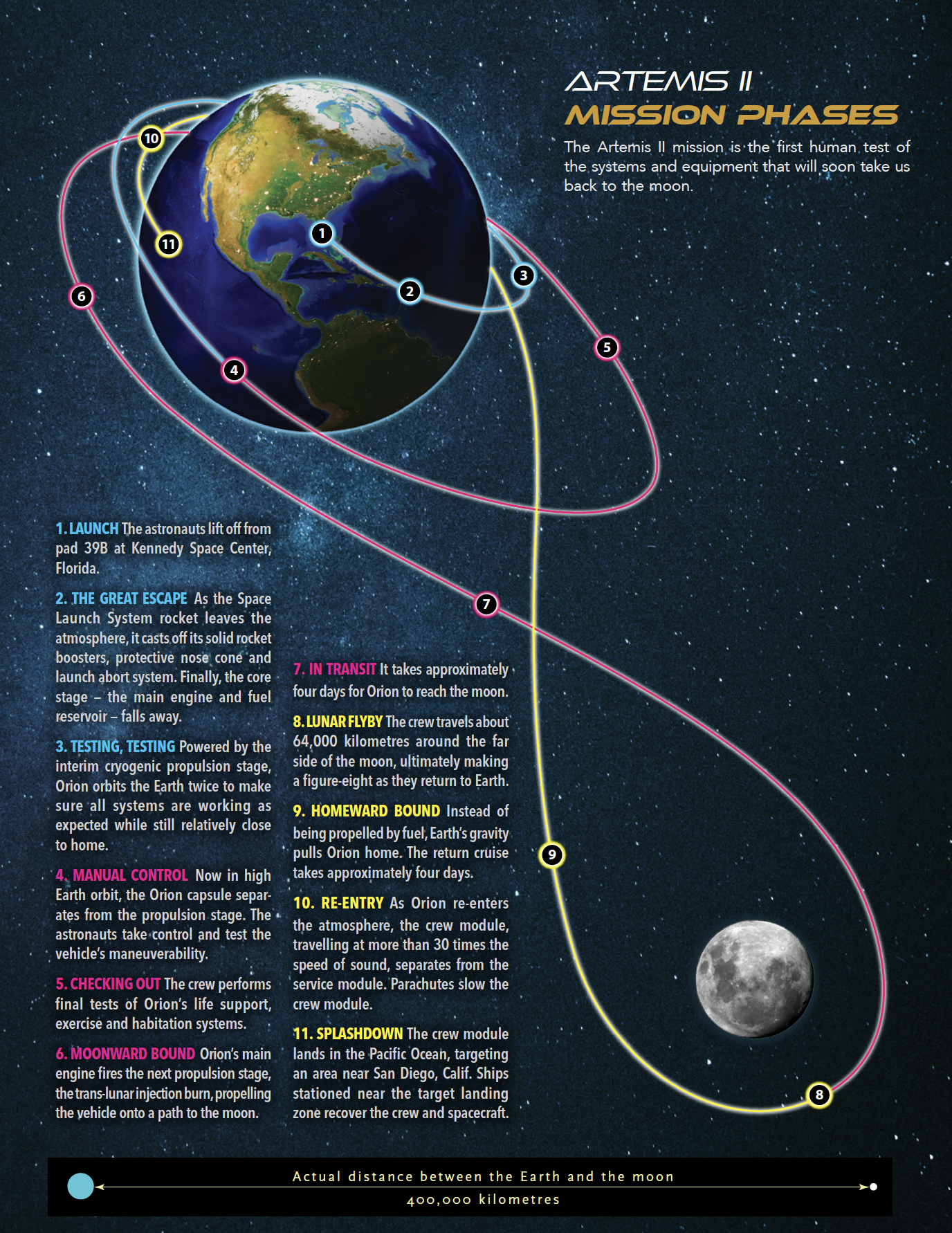
Map: Chris Brackley/Can Geo.
Expand Image

THE DAY AFTER his interview at the museum, Hansen is at an event in Ottawa to celebrate the centenary of the Royal Canadian Air Force. He is by far the biggest celebrity in this room full of military elite at the Royal Canadian Geographical Society’s headquarters. As usual, he is in his blue spacesuit, boots gleaming, sharply groomed. Part of the celebration is the unveiling of a portrait of Hansen by the visual artist Chris Cran for the Society’s collection. That means Hansen has to give a speech.

This should be an easy audience. Hansen knows most of these people, and it’s clear that he’s done the air force proud. But he’s self-conscious, so he resorts to joking that every day he and the other three Artemis II astronauts have to pass by enormous photographs of themselves posted at the NASA compound, and every day Reid Wiseman, the mission’s commander, stops to count the pores on Hansen’s nose. The crowd eats it up.

His self-deprecation aside, they, more than most people, appreciate just how rare a bird he is. Just 14 Canadians have ever qualified as astronauts, beginning with the first six in 1983. Ten have since retired or died. Hansen is one of the remaining four.

This crowd is also keenly aware of the enormity of what Hansen is about to undertake. On the day of the launch, he and the three others, sitting in the minivan-sized Orion capsule perched on top of the massive, fuel-laden rocket, are going to blast off from the Kennedy Space Center in Florida, briefly enter an elliptical-shaped orbit around Earth, then ignite an engine to propel themselves to a yet higher elliptical orbit for a day or so. For part of that time, they’ll be flying by hand — without outside control — checking to see whether everything is working properly while they’re still relatively close to Earth.

If all is well, they’ll do the so-called translunar injection burn, igniting an engine right underneath their feet that will take them to 39 times the speed of sound and give them the final push to the moon. This is the manoeuvre Hadfield, who will be closely monitoring the mission, is most focused on. He calls it symbolic. “That’s the one that takes them away from the Earth, and that’s when I’ll have my fingers and toes and eyes crossed the hardest.”

The journey to the moon will take about four days, and they’ll cruise to perhaps 15,000 kilometres beyond its far side — likely the farthest any humans have been from our planet — where they’ll lose contact with Earth altogether. Then they hitch into Earth’s gravity field and use that to pull the vessel back home, another four-day journey.

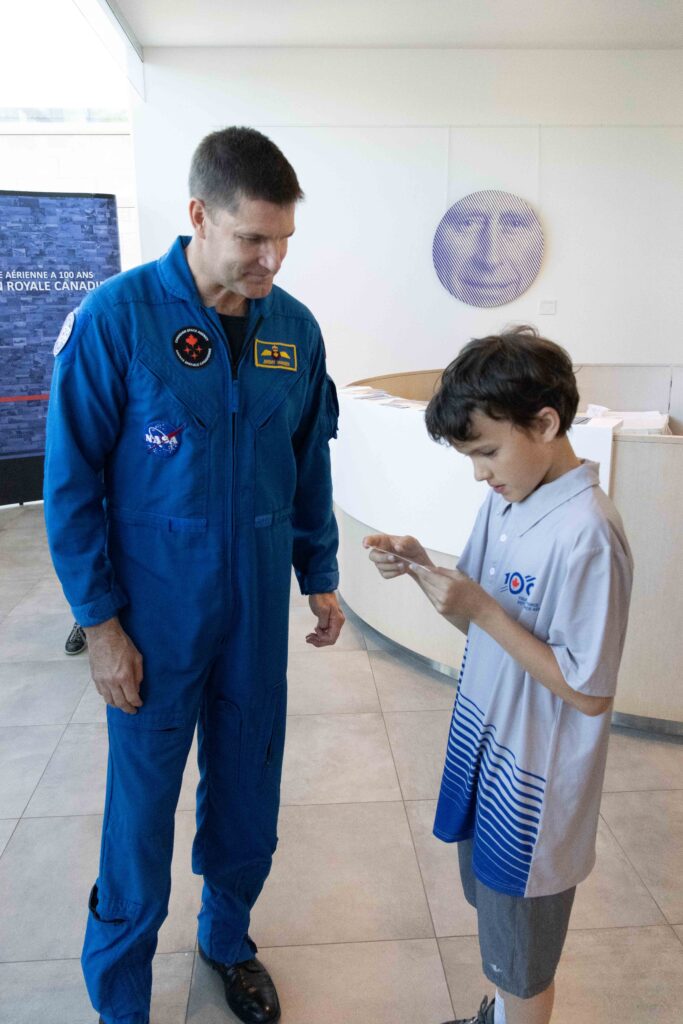
Hansen presents 10-year-old Greg Jacula with one of his personal Artemis II mission patches at an event commemorating 100 years of the Royal Canadian Air Force. (Photo: Sean Costello)
Expand Image

It’s akin to a proof-of-concept flight. Artemis I, which took place over 25 days in late 2022, took Orion around the moon without crew. But the heat shield, while it would have protected any crew from death, got charred in places on re-entry. NASA says it has fixed the problem. This voyage will test that assertion. As well, Hansen and the others will evaluate the other systems that keep humans alive on Orion and determine how well the vessel is likely to perform in future missions. NASA engineers want Orion to be a space workhorse, sort of like a trusty half-ton, that can deliver people and materials to a yet-to-be-assembled moon-orbiting space station provisionally known as Gateway.

The goal of Gateway is to support humans living on the lunar surface. It will also be a launch pad for future missions to Mars. Gateway is where Canadarm3, the third generation of Canada’s famous robotic arm, comes in. It’s being designed to somersault from one part of Gateway’s outer shell to another to do repairs and maintenance, set up science experiments and help with spacewalks and other functions. It’s Canada’s entry card to space exploration and critical to Gateway’s success.

The Artemis II mission carries other pressures and opportunities. The science that humanity will carry out in space will drive innovation on Earth, just as it did after the Apollo era and throughout nearly 25 years of continuous habitation of the International Space Station, Hansen tells me. “It’ll bring great minds together, and we will discover things that will have ripple effects on the planet for decades to come.”

As the sole Canadian to ever undertake a journey of this magnitude, Hansen bears the weight of national expectations in addition to all the global ones. “I see this as a tremendous reflection on the country and reminder of what we’re capable of, which is obviously great things,” he says. Canada wants to leverage the human presence on the moon to solve some of our own issues by applying what the astronauts learn on the moon down here. Examples: remote sensing of environments, adapting to climate change, delivering healthcare to remote communities, boosting food security. “You know,” Hansen tells me, “if we can fly a Canadian around the moon in 2026, imagine what we can do in the years after that.”

Back at the assembly of military grandees, Hansen notices a solitary child, the 10-year-old son of one of its organizers. Rather than working the room, Hansen seeks the boy out, gently drawing him into conversation. Then he leans down to a pocket on the side of one blue leg, unzips it and pulls out one of a stash of his personal mission patches to give to the delighted child. Anishinaabe artist Henry Guimond of Turtle Lodge, an educational centre in Sagkeeng First Nation in Manitoba, designed the cloth badge, filling it with symbols related to Indigenous teachings and Hansen’s own life journey (see sidebar below).

Then Hansen stops to have a few deep conversations with colleagues, occasionally leaning his head to one side to listen more carefully above the din, mouth closed, nodding. His back is pole straight, shoulders wide, hands clasped at his front. Unconsciously, he keeps worrying a hangnail on his thumb, his only sign of stress.

“If we can fly a Canadian around the moon in 2026, imagine what we can do in the years after that.”

Jeremy Hansen
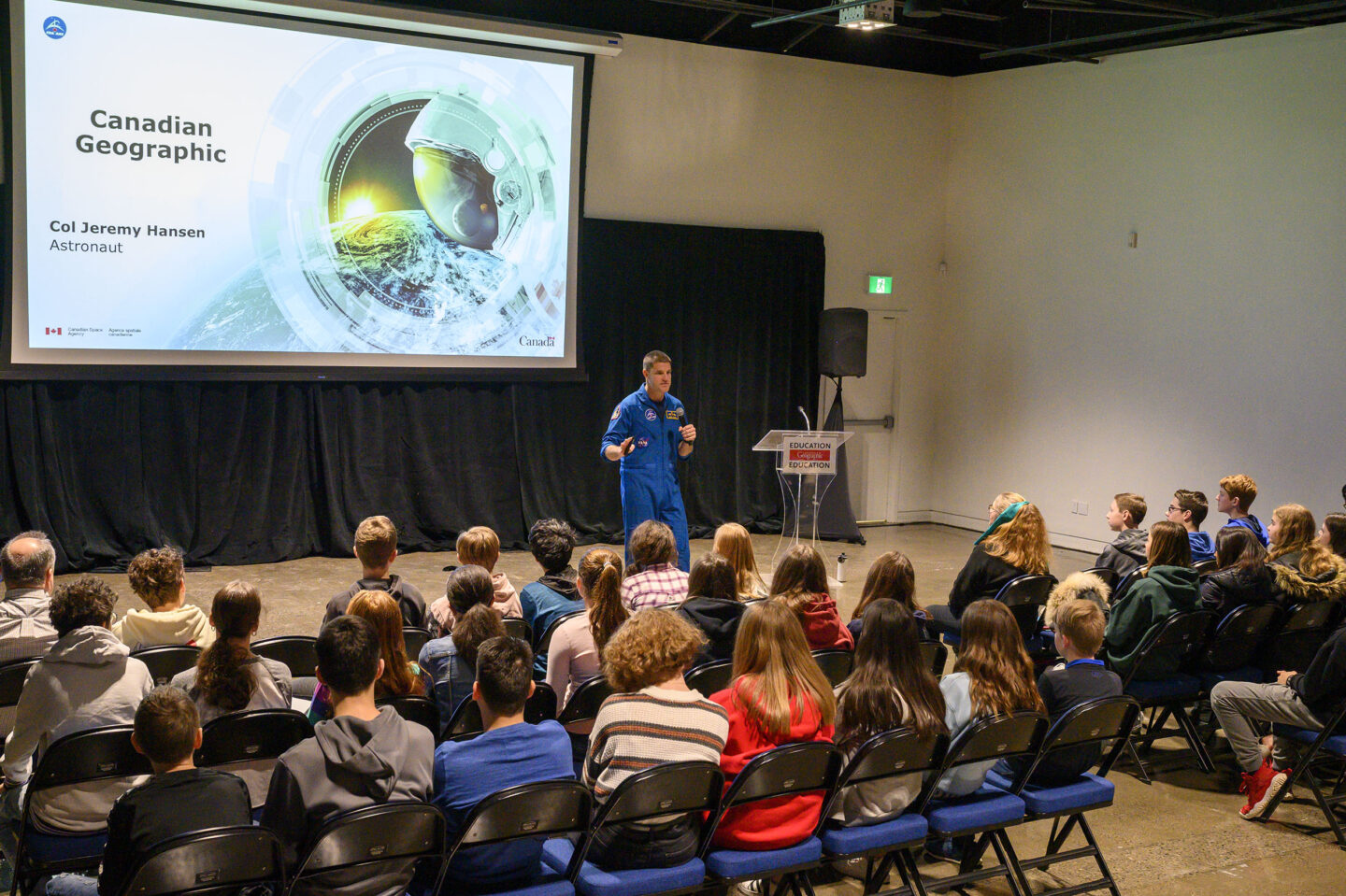
Hansen presents to a group of students at the headquarters of the Royal Canadian Geographical Society. (Photo: Javier Frutos/Can Geo)
Expand Image

THE HERO’S QUEST is perhaps humanity’s most ancient and satisfying literary form. The narrative goes through precise stages: you set an impossible task; you leave your familiar world; you endure fierce tests of courage; you overcome awful setbacks; you gain wisdom; finally, you return home. It takes courage and grit. You have to be in it for the long haul. And you have to prepare to be sacrificed if necessary in pursuit of the larger goal.

A few months before the launch date, I catch another few minutes to chat with Hansen over Zoom. He’s in Houston and unfathomably busy. The world has changed in the months since he and I last spoke. U.S. President Donald Trump has taken office. America’s wish for primacy in space travel is once again on its official agenda, even as Trump’s 2026 budget seeks to cut NASA science funding nearly in half. Domination, not collaboration, is the mandate.

Yet Hansen has not given up hope. He told me earlier that he passionately believes the ultimate goal of humanity should be to evolve into a state of total collaboration. In that state, humanity can thrive, coming together to solve whatever threats we face with more brain power, more ideas, more industry, more academia. Without it, we just can’t go as far.

“I do believe, still, with all my heart, that collaboration across the globe needs to be our stated goal,” he tells me now.

He is living out that belief. Much of his time right now is spent in an all-day simulator with the other Artemis II astronauts, hooked up to mission control, building up their capacity to respond to the different ways the mission can fail. Again, I’m struck by the fact that he and the others are consciously putting their lives on the line for the greater good. I know he has fear. He told me in an earlier conversation that his hardest moments are likely to be the day before the launch and the moment he hugs his wife and children, who are now university-aged, goodbye.

But that’s not what he focuses on. Hadfield has told me, rather crisply: “Astronauts don’t go into histrionics very often. We recognize that they’re non-productive, and we don’t need drama. That’s for grade school.” What Hansen focuses on is what the quest means. It is a symbol. As hard as it is, as long as it takes, as uncertain the outcome, the process of working together is what pushes us toward greatness.

Advertisement

Help us tell Canada’s story

You can support Canadian Geographic in 3 ways:

Related Content

Science & Tech

Artemis II astronauts have returned safely to Earth following historic mission around the moon

Canadian Geographic is following this history-making mission, which saw Canadian Space Agency astronaut Jeremy Hansen become the first Canadian to fly around the moon

  • 5285 words
  • 22 minutes

Exploration

From Labrador to Luna: Training future moon explorers

With the Artemis II mission set to blast off next spring, humanity is one step closer to returning to the moon. In the meantime, astronauts are honing their skills in a Labrador meteorite crater.

  • 2203 words
  • 9 minutes

Science & Tech

Canadian astronaut Jeremy Hansen will be among the next humans to fly to the moon

Hansen will be part of the NASA crew for Artemis II, which will see the astronauts spending up to three weeks on a flyby trip to the moon in 2024

  • 1231 words
  • 5 minutes

Science & Tech

Canada’s ‘moon joy’ will continue long past Artemis II. Here’s what’s next for our space program

While Jeremy Hansen’s mission is complete, Canadian scientists and astronauts will be involved in future space missions – including to the moon

  • 857 words
  • 4 minutes
Advertisement
Advertisement