
History
Polar Sea, on guard for thee — or not
Veteran journalist and governor-general spouse Whit Fraser recalls diplomatic row with U.S. over 1980s naval excursion into Canada’s High Arctic in excerpt from latest book
- 4041 words
- 17 minutes
Mapping
As international relations heat up, Canada is scrambling to secure its Arctic sovereignty
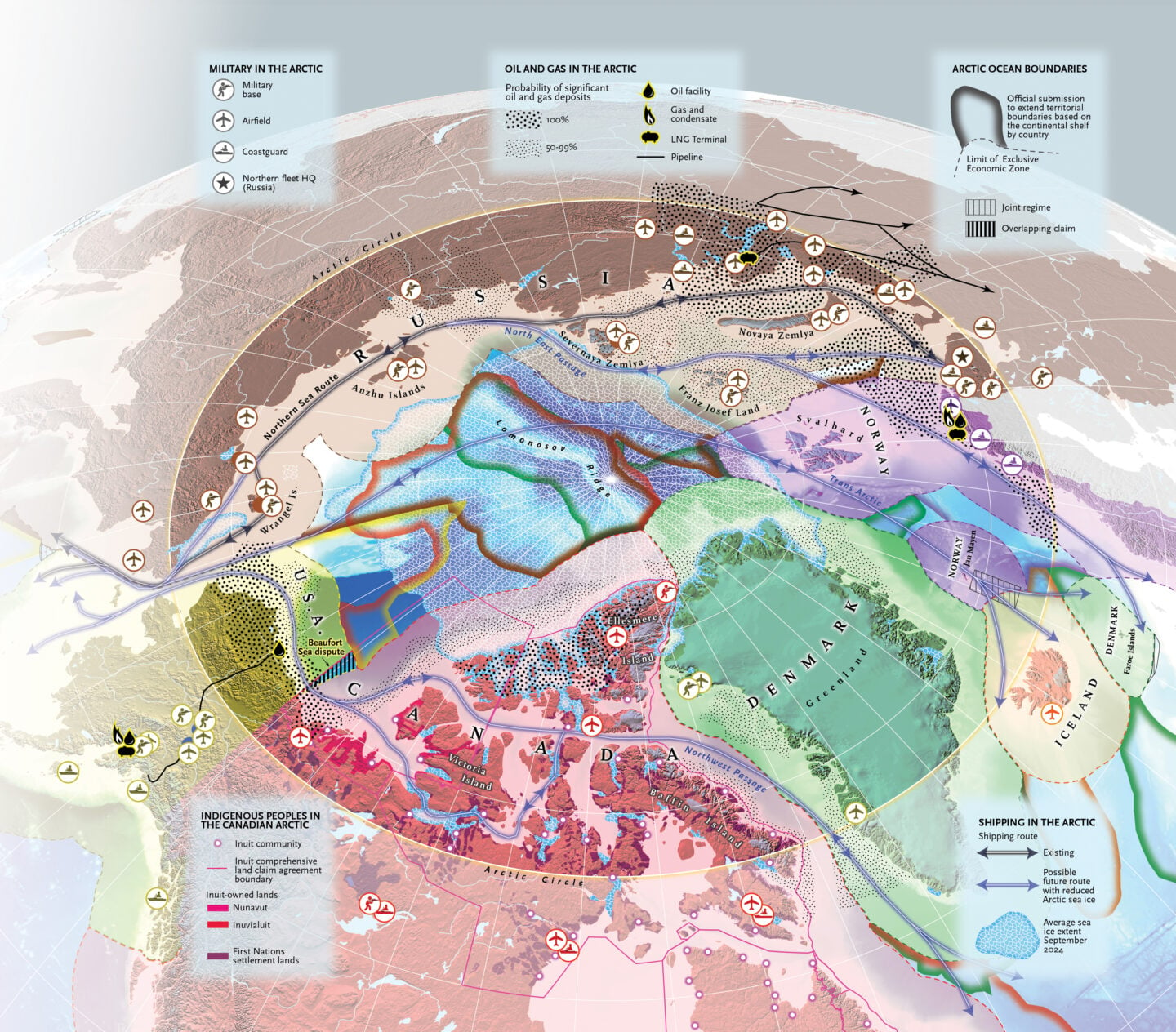
In the recent federal election, both the Liberal and Conservative parties identified threats to our Arctic sovereignty and security as a key issue facing Canada.
While these threats are not new, they’ve been intensified by Russia’s military actions and capabilities in the Arctic region and its war against Ukraine (both of which have been paid for in large part by its Arctic oil and gas production), as well as by China’s increased Arctic shipping and its launch of surveillance balloons over the North American Arctic and by the new political challenges of the American administration’s threats to annex Canada and Greenland.
This map shows the location of these threats, which also take place on Inuit Nunangat. It also shows the three key sovereignty challenges facing Canada. First, the maritime boundary that divides the Beaufort Sea is disputed between Canada and the United States. We also disagree with the U.S., and many of our European and Asian allies, over who can use the Northwest Passage for commercial and military traffic. Finally, our maritime claims over the outer limits of our extended continental shelf significantly overlap with those of Russia and Denmark.
In recent decades, Russia’s military build-up has driven significant remilitarization in the Arctic. During the Cold War, both sides deployed significant portions of nuclear weapons and their delivery systems in this region. The geography between the U.S. and the Soviet Union and the weapon technology of missiles and bombers meant that if the Soviets were to launch their weapons at North America, it would be over the Arctic. Canada and the United States needed to cooperate to defend against and deter bomber and missile attacks. When the Cold War ended, it was hoped that such capabilities would no longer be needed. But Russia has now modernized most of its Cold War bases to accommodate modern weapons systems, presumably for their possible use in a conflict with western nations.
As Canada rushes to catch up with the rest of the world, can we defend the true north before it’s too late?
This story is from the July/August 2025 Issue
History
Veteran journalist and governor-general spouse Whit Fraser recalls diplomatic row with U.S. over 1980s naval excursion into Canada’s High Arctic in excerpt from latest book
People & Culture
As the climate heats up, so do talks over land ownership in the Arctic. What does Canadian Arctic Sovereignty look like as the ice melts?

Mapping
Maps have long played a critical role in video games, whether as the main user interface, a reference guide, or both. As games become more sophisticated, so too does the cartography that underpins them.
Kids
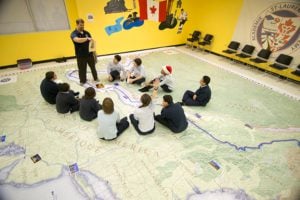
Canadian Geographic Education’s series of giant floor maps gives students a colossal dose of cartography and is a powerful teaching tool