Environment
Inside the fight to protect the Arctic’s “Water Heart”
How the Sahtuto’ine Dene of Délı̨nę created the Tsá Tué Biosphere Reserve, the world’s first such UNESCO site managed by an Indigenous community
- 1663 words
- 7 minutes
History
Veteran journalist and governor-general spouse Whit Fraser recalls diplomatic row with U.S. over 1980s naval excursion into Canada’s High Arctic in excerpt from latest book
Of all the stories I had done, or perhaps would ever do, none resonated more with Canadians than the 1985 voyage of the US Coast Guard icebreaker Polar Sea through the Northwest Passage. The CBC News managing editor said the audience for The National peaked at five million viewers that week.
Were Canadians reacting to American disregard toward Canada’s Arctic sovereignty, or was it Canada’s timid approach to asserting our ownership and control over Arctic waters that riled so many? Perhaps both, but either way, the huge ratings boost confirmed what I had learned long before from reporting in the far North: Most Canadians appear indifferent to the Great White North until somebody messes with it, and in 1985 the Americans were using their Coast Guard icebreaker to mess with us.
The big icebreaker, generating sixty-thousand horsepower from three turbine engines, had been doing ice trials and supporting research in international Arctic waters northeast of Greenland. Rather than taking it home via the Pacific Ocean and the Panama Canal, US political and bureaucratic brass decided to simply skip through the Northwest Passage. They expected Canada to object, but they had their own Arctic policy, which ran opposite to Canada’s. The United States considered the Northwest Passage an international waterway, plain and simple, and believed that viewing it any other way may set an important and detrimental strategic precedent in other parts of the world, particularly the Taiwan Strait.
Canada had three options: first, declare war and sink the Polar Sea off Ellesmere Island or Baffin Island, which would have made for even better ratings but would not have been wise. Second, go to the World Court, a notion that Foreign Affairs Minister Joe Clark initially threatened, but backed down from a month after the voyage was completed. Third, Canada’s alternative of least resistance set on a strangely worded diplomatic position: the two countries simply agreed to disagree. As added face-saving, at the last minute, August 1, the very day the Americans left Thule, Greenland, Canada granted permission for the voyage, even though the Americans hadn’t requested it.
To be clear, if the Americans wanted to test the Polar Sea’s superior ice capability, they couldn’t have picked a more tranquil Arctic summer than 1988. From Greenland and across the Davis Strait, the ship encountered little or no ice.
These waters have become familiar to me in recent years. For several summers I worked as an educator with Students on Ice, an educational foundation that takes more than a hundred students each year from the Canada and the world on a fourteen-day Arctic expedition that usually starts or ends on Greenland’s west coast. I later switched from students to Seniors on Ice, by signing up as a resource person with the Arctic cruise line Adventure Canada.
Polar Sea Captain John T. Howell and his crew would experience that same spectacular beauty we observed on every trip. As he entered the eastern Northwest Passage, on the starboard side, the huge mountain ranges of southern Ellesmere Island would come into breathtaking clarity in the clean, pollution-free Arctic air. On the port side would be Milne Inlet, leading toward the ancient Inuit community of Pond Inlet, and south, reaching skyward, more mountain grandeur. It’s likely several Inuit skipped past the icebreaker in wooden freighter canoes, doing a little sightseeing of their own as they fished, hunted, and sent their not-so-subtle message: somebody lives here; Inuit live here; Canadians live here.
Certainly, until the 1920s, few Canadians had shown any interest in the Far North. Most had heard the tales of the explorers, some going back four hundred years, like Martin Frobisher, or more recently seventy-five years, like John Franklin and his lost expedition in search of the Northwest Passage. Had Captain Howell heard of Canada’s best-known and remarkable nationalist and Arctic Sea captain, Joseph Bernier, who spent his life sailing Arctic waters? I wonder if the Polar Sea’s library has the memoirs of Captain Bernier or other historical accounts of Canada’s fascinating Arctic history.
Bernier overwintered in 1908 and ’09 at Melville Island, and during that year placed a marker claiming Canada’s ownership over all the Arctic Islands. The last plaque placed on Melville Island, on July 1, 1909, bears this inscription: “This memorial is erected today to commemorate the taking possession for the Dominion of Canada of the whole Arctic Archipelago.”
When Bernier wasn’t in the Far North or locked in ice, he was campaigning on the political circuit warning that if Canada didn’t take a strong and immediate stand on sovereignty, it would lose the eastern Arctic as quickly as it had lost the opportunity to bid for Alaska. Four prime ministers—Wilfrid Laurier, Robert Borden, Arthur Meighen, and William Lyon Mackenzie King—were very familiar with Bernier and his vision and passion for Canadian sovereignty. He declared that “the Yanks”—that is, the United States—were the greatest threat, based on applications for huge mineral leases on Baffin Island. He also cautioned that Admiral Richard Byrd’s plans to be the first to fly over the North Pole should be considered from a political and sovereignty perspective. History suggests that the prime ministers were listening.
In 1922, the Canadian government instituted an annual eastern Arctic patrol by CGSS Arctic, with Joseph Bernier as its unfailing captain. Scientists, surveyors, photographers, writers, and medical doctors were onboard. He visited every settlement and trading post on Baffin Island and southern Ellesmere Island. To assert sovereignty, RCMP detachments were established every year, even in places where no one lived.
The day after he left Greenland, Captain Howell would have been able to see and navigate the waters around the great islands Bernier had claimed—Baffin, Ellesmere, Bylot, and Devon—where physical and tragic evidence of those early sovereignty efforts remains.
In late August 1924, Bernier dropped anchor for about ten days and waited while crews built the Dundas Harbour RCMP detachment. Three Mounties were offloaded with a three-year sovereignty assignment. Today, on a little hill above the long-abandoned detachment, are claims markers of a different sort: white wooden grave markers, surrounded by a picket fence. They honour two Mounties who perished there in 1925 and ’26. A third remembers an Inuit child who died in the early 1930s, when the Hudson Bay Company ran a trading post at Dundas Harbour. In a sheltered cove only a couple of kilometres beyond the abandoned detachment are the remains of an ancient Inuit camp, a spot where people camped and hunted as far back as a thousand years ago.
Sailing westward for another half day, the Polar Sea would pass Beechey Island and more historic sovereignty graves, including those of some of John Franklin’s crew, who perished there in the winter of 1847. Needing a harbour to overwinter, Franklin sought refuge in a small harbour that is now named for one of his ships, Erebus. The shores of Beechey Island are lined with cairns and markers laid or erected by other explorers in the 170-year futile search for Franklin that only recently concluded.
In our national archives and museums are photos of remarkable Canadians, including A.Y. Jackson and Lawren Harris, members of the Group of Seven, who so beautifully staked a nation’s sovereignty on canvas. There is also a photo of Dr. Frederick Banting, the discoverer of insulin and a friend of both Jackson and Harris, walking the shores of Beechey Island in 1927 examining the ruins left behind by Franklin and his search parties.
Given how quickly Captain Howell got to Resolute Bay, it’s unlikely he took any time for sightseeing. He left Greenland on August 1 and had a rendezvous in Resolute Bay on August 3, about 900 nautical miles. His sailing was remarkably clear of ice, over deep blue or black waters sprinkled with the pure-white broken ice pans that would bob aside like rubber ducks in a big tub. The captain and duty watch on the bridge probably did a double-take as they approached the shores of Cornwallis Island and Resolute Bay and laid eyes on one more stake planted by Canada in the early 1950s in its continuing sovereignty claim. About two kilometres above the shoreline, the squat red former military buildings on a plateau asserted Canada’s presence before it allowed the United States to open military bases there and in Frobisher Bay as the Cold War began.
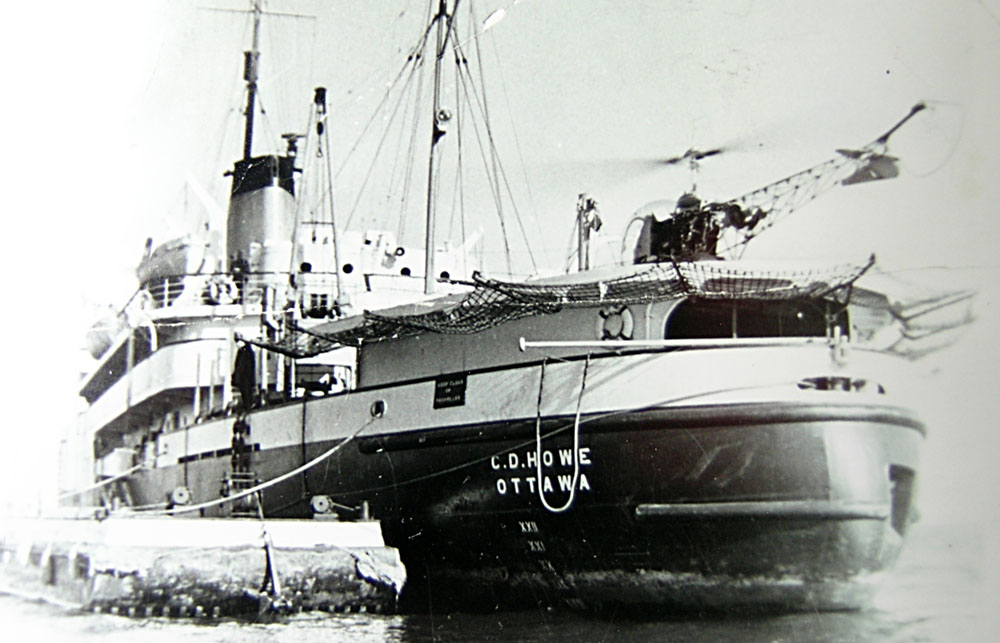
If the captain knew Canadian history, he would have recognized that the twenty or thirty much smaller houses close to the beach, belonging to the Inuit of Resolute Bay—or the High Arctic Exiles, as they called themselves—were also victims of a 1950s Canadian sovereignty assertion that had failed on every front. In 1953 and again in 1955, Canada had relocated a dozen families from northern Quebec to this desolate island that appears to be devoid of vegetation. As the crow flies, the straight-line distance from Port Harrison (inukjuak), northern Quebec to Resolute is about 1,900 km, but in 1953, in the old ship C.D. Howe, it felt like a trip across the Atlantic, seemingly thousands of kilometres and six agonizing weeks at sea. In that first winter, people lived in shacks and igloos and believed that if they didn’t freeze to death, they would starve instead.
What happened to the Inuit of Resolute Bay on Cornwallis Island and Grise Fiord on Ellesmere Island is a book in itself, not only because of the cruel way they were treated, but also because of the contradictions and the political paradox that followed. Consider: Inuit were relocated to assert sovereignty, but, in the opinion of one of their foremost leaders, then ignored.
John Amagoalik was a 10-year-old “exile” who used that experience to excel as an Inuit leader. He played key roles in the land-claims movement and is known by many today as the “Father of Nunavut.” Amagoalik believes that despite the painful relocation and hard-fought-for national apology that followed 60 years later, the Inuit are among the government’s strongest sovereignty assets: “It is we Inuit who are using the Northwest Passage as an inland waterway that is also surrounded by our settlements. It is a homeland!”
I couldn’t believe my good luck when I saw the Polar Sea anchored in the quiet waters of Resolute Bay. It was as though the American captain had been waiting for us. He hadn’t, but he was waiting for the 737 we were on, and two “Canadian observers” invited at the very last minute to be Canada’s human flagpoles for the remainder of the voyage. Also, at the very last minute, Canada had dispatched the Canadian icebreaker Sir John A. Macdonald to accompany the Polar Sea.
The US’ tardy diplomatic concession to Canada was designed to smooth damaged political egos and credibility, perhaps sending a message to Canadians, who were increasingly outraged at the whole diplomatic mess between “best friends” and closest allies. The Mulroney government was in full face-saving mode. I expect they were just as surprised at the level of nationalism and patriotic anger flooding the editorial pages of all major newspapers as our CBC managers were at the unexpected and very temporary boost in ratings.
I had been to Resolute Bay many times before and knew that the federal government maintained a support and logistics agency called the Polar Continental Shelf Project, which had its subtle sovereignty purpose. It provided comfortable accommodations, good food, and helicopters to a crop of scientific researchers who migrated north and south every year, as regularly as the geese. The logistics staff was most accommodating and generous when I asked, “Can we have the helicopter for an hour or two?”
Within 20 minutes after having landed, we were again in the air, this time hovering over the Polar Sea. At the moment cameraman Nick Haramis began to take the first pictures, a burst of exhaust emerged from one of the twin stacks and suddenly the ship was again moving westward in the Northwest Passage. We took some aerials, and I had the idea that we could land on Griffin Island, which sits in the middle of Lancaster Sound, and record some sequences as it went by. Our pilot had a better idea.
The passage was still almost ice-free and the Polar Sea would be tested in the days to come. But here and there were some magnificent ice pans, two or three hundred metres wide, and a half kilometre or more long: nature’s helipads, pure-white floating islands.
The pictures were spectacular, and Nick’s skill made the big ship appear more ominous and threatening. Close-ups of the big red hull would make people wonder if the monster ice-crushing bow might plow right into their living rooms. In TV news, this is what’s called “bullshit luck.” I did a quick piece to the camera, scribbled a script on the way back, recorded it on the tarmac, and walked it back to the small terminal. The two-hour PWA layover had just concluded, and, with a little persuasion, the pilot agreed to deliver it to a CBC courier who would meet him at the gate in Edmonton. It aired that night.
Our luck held for the next week; basically, we hitchhiked our way on airplanes over the western half of the passage, each day finding and photographing the Polar Sea. A couple of times we used an airplane’s radio connection to speak with Captain Howell on the bridge of the Polar Sea. Although very accommodating, he shied away from politics, but he did provide some short TV soundbites on the progress, including details on ice conditions, which became more severe as he moved westward.
On the second day, a Canadian Forces Tracker aircraft arrived. It is a rugged and vintage plane designed for navy patrols capable of landing and taking off from an aircraft carrier. The pilots were patriots, warning there wasn’t much room, but we would get our pictures. They wedged Nick between them in the engineer’s seat and stuffed me in the bomb bay. We flew for hours ever westward. That night back in Resolute, our producer, Nancy Sweetman, took all the tapes and boarded a jet bound for Edmonton, where she could cut and file future reports via telephone.
The next day, we got an “upgrade” with another Canadian Forces captain, this one with the long-range Argus aircraft that would fly over the Polar Sea, track it for a few hours, and then drop us in Inuvik. I was familiar with this plane; for six years as a supply guy in the Air Force, I had delivered parts, food, and fuel to a squadron of them in Summerside, P.E.I., and I knew the big four engines with the long sonar-detecting tail cone could stay aloft for more than 30 hours, and across the Atlantic and back. But I had never gotten to fly in one.
The real story and drama broke in Inuvik.
The story and nationalist fever, this affront to sovereignty, was boiling over. Liberal Leader John Turner made a pointed attack on Prime Minister Mulroney’s failure that “blatantly encouraged the United States.” Every nationalist in Canada and most of the editorial pages were up in arms. Nobody wore the Maple Leaf on their sleeve more proudly or loudly than Edmonton publisher Mel Hurtig, who headed a national citizens’ group called the Council of Canadians. It was a powerful lobby group and would become more so during the free-trade negotiations between Canada and the United States.
I met Hurtig in Inuvik and Edmonton. He had a plan and four very bright volunteers. If the country was to have one small feel-good moment in all this, Hurtig’s newly recruited courageous Canadian Commandos would give it to us. He promised Canadians one small victory and that savoured satisfactory last word that often seals a debate.
I had known Hurtig for about a decade; we had spent time together on one of Stuart Hodgson’s noted Arctic tours, two weeks visiting communities across the High Arctic. Mel had one of the country’s best-known authors with him, Mordecai Richler, and both were looking for ways to bring the North further into Canadian literature. Hurtig also had ten thousand dollars to spend on an airplane, not a modest amount in 1985, and they would give the 13,200-ton Polar Sea a Canadian farewell in the ice-choked Prince of Wales Strait, which runs between Victoria and Banks islands in the high Arctic, several hundred kilometres northeast of Inuvik.
Two of our newly described commandos were from the University of Alberta: 20-year-old Louanne Studer, a mountain of energy, and David Achtem, a 21-year-old science major. I have to admit being surprised, but delighted, to meet the other two, whom I knew. Roger Gruben had been a broadcaster at CBC Inuvik, and a good one. In his early 30s, Roger was big enough and athletic enough to be on any football team. Eddie Dillion was smaller, no less serious or determined, and had a great sense of humour. He always seemed to be smiling, even if he wasn’t. Both had been raised in Tuktoyaktuk and were now living in Inuvik.
Now, more than then, I am gripped by the delicious irony. Remember John Amagoalik’s dismay that a government would put Inuit families through decades of hell and hard times to assert sovereignty, and yet refuse to recognize their claims to land and rights as a way of actually and practically asserting sovereignty with a human face and heart?
“Fasten your seat belts,” said the pilot of the twin-engine Otter, who would soon demonstrate he was also a Canadian nationalist, and who paid a price for this patriotic flight. We flew for two or more hours across the eastern Beaufort Sea and northward perhaps 150 kilometres to the midpoint of the Prince of Wales Strait. It was mostly ice-filled, but not impassable, and no match for the power of the American icebreaker or, for that matter, the Canadian Sir John A. Macdonald.
Suddenly we were in a steep bank and approaching a low sweep of a barren gravel beach, the terrain the twin Otter had been built for. We endured a rough, short landing with big tires bouncing us up and down for a few pitches, and then that quick stop that draws the seat belt right into your gut.
Roger and Eddie pitched a tent to signify Inuit occupancy and Canadian ownership. Louanne and David built cairns and planted big Canadian flags that they waved as the Polar Sea passed. Beyond its bow, not 20 kilometres westward, was Banks Island.
I watched Roger and Eddie load the long cylinders, wrapped with Canada’s flag, with Nick capturing a few pictures of the process. Now, we were all back in the air, circling our 120-metre-long prey.
I am not sure who opened the back door, but I know Nick was on one side and a still photographer on the other. Hurtig had sacrificed his seat to get one more camera on board for the publicity. As it was, we were no more than eight people. Suddenly our altitude dropped, again this time to 40 metres. We came in on the practice run, stern to bow, right over the deck. When the nose and high wings above the fuselage caught the hot air updraft from the big turbines, the Otter jumped aloft. It was exhilarating and, I suspect, a good marker.
On the next pass, the very instant before he crossed the stacks, the co-pilot’s eyes were fixed on the captain, but his arm extended back into the cabin. The arm dropped—the bombs-away signal—and the flag-wrapped canisters went out the door, with one scoring a direct hit. It had a clear written message for Captain Howell:
“Your failure to request advance permission to sail the Northwest Passage is insulting and demeaning to our citizens and a threat to our sovereignty. It is not the action of a thoughtful, understanding neighbour.”
Roger and Eddie let out a cheer, and everybody in the plane—including me—joined in. It felt good, really good. If any of us had had a fear that somebody could get injured, they kept it to themselves. My view was that the icebreaker crew would be alert enough to get out of the way.
We flew back to Inuvik and got our tapes on the next flight south. I know by the time the item aired, the Polar Sea would have been well out of Canadian waters, having crossed the 141st meridian and into Alaskan waters. Within days, Transport Canada waved its own flag, charging the Otter pilot with endangering lives and suspending his licence for six months.
Two footnotes: In 1988, Canada and the United States signed an Arctic waters agreement, a kind of Northwest Passage treaty, agreeing that in the future the United States would ask for Canada’s permission; Canada, for its part, signed a similar pledge to grant it.
The remarkable thing about the Polar Sea voyage was the déjà vu. In 1969, the Americans had dispatched the supertanker Manhattan on a trip east to Prudhoe Bay, Alaska, and a return to the US eastern seaboard, testing the frozen waters and the politics for a new shipping route for the recently discovered Arctic oil riches there. Unlike sixteen summers later, the passage was choked with heavy ice the entire way. Repeatedly, two American icebreakers and the Sir John A. Macdonald had to plow, ram, crash, and collapse ice to clear leads. A couple of times all three American ships were ice-locked, freed only by the skill and experience of the Canadian skipper.
I have heard in several stories over the years that the Inuit of Resolute Bay made a sovereignty statement then as well, by driving their snowmobiles out on the ice and stopping the Manhattan until its captain wisely asked for permission to pass.
I’ll resist being facetious: I think for a very long time Inuit had views on sovereignty that were ignored or never sought. I am sure that will not be the case in the future.
Life’s unexpected rewards
In recent years, especially since Mary was appointed GG, I’ve come to realize the extent this very big world can seem so beautifully connected. I have lost count the number of times old orbits intersect with this one.
One of those was when fate put me side by side with the wonderfully respected and gifted print maker and artist, Shuvinai Ashoona, from Cape Dorset (Kinngait). She had just received the Governor General’s Award for visual arts. “Are you related to Kiugak Ashoona?” I asked, anticipating the answer. Kiugak was one of the world’s most celebrated Inuit artists, especially for his work in soapstone.
“He was my father,” she said. Without hesitation, I scurried upstairs for my most favourite carving, bought forty years ago almost to the day, while shooting a northern documentary with cameraman Dave Kellett, who still lives in Yellowknife.
We wanted to record the very best artists, and had to travel across the bay to visit Kiugak, who chose the peace and quiet of a big canvas tent over community life. We found him finishing off a masterpiece. It was a hunter, one foot planted, the other raised in motion as the archer pulled back the bow and pointed his arrow skyward. I think it was the veins in the hunter’s wrist that told me this stone has life.
“Can I buy it?” He nodded. I asked, “How much?” If Dave hadn’t had a pocket full of cash, I would have missed out. Shuvinai was thrilled when I came down with her father’s beautiful carving. She touched it so lovingly.
Make no mistake, she sees her dad’s work in nearly every major Canadian and international art museum, and in the master’s collection at home in Kinngait. I’m sure she didn’t expect to see one of his pieces in the possession of a very fortunate old reporter who got to see so much of this country and meet so many people, and then be blessed to relive so many treasured memories in real time.
Environment
How the Sahtuto’ine Dene of Délı̨nę created the Tsá Tué Biosphere Reserve, the world’s first such UNESCO site managed by an Indigenous community
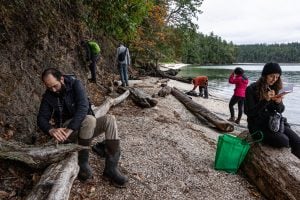
People & Culture
Naming leads to knowing, which leads to understanding. Residents of a small British Columbia island take to the forests and beaches to connect with their nonhuman neighbours
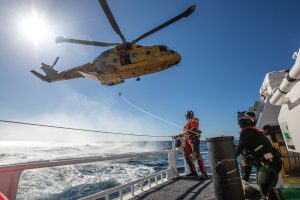
People & Culture
A celebration of the Canadian Coast Guard’s renowned search-and-rescue capabilities — and more — as the special operating agency turns 60
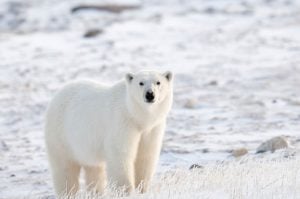
People & Culture
Depending on whom you ask, the North’s sentinel species is either on the edge of extinction or an environmental success story. An in-depth look at the complicated, contradictory and controversial science behind the sound bites