After reading about Sheldon Jackson’s reindeer project and initiating a correspondence with him in 1905, Grenfell met with Jackson, pleading for help in establishing a similar project in Newfoundland among the European settlers. Jackson turned to William Kjellmann, the Kven reindeer consultant who had worked with him in Alaska.
Grenfell complained to Jackson about the cost of hiring experienced herders from the Kvens, who had returned to Michigan. In response, Kjellmann expressed frustration with Grenfell’s penny-pinching, writing to Jackson: “I have to-day answered him asking to know for what purpose he intends to bring this herd of deer over to Newfoundland and also some other questions in regard to the probabilities of such a herd being cared for in the proper way and finding sufficient moss in Newfoundland to make the enterprise a success. You know that I will not and cannot afford to be identified with any failing enterprise.” Kjellman demanded that Grenfell produce proof that the reindeer could find the food they needed in Newfoundland and Labrador. Grenfell replied that he “believes there is sufficient moss,” and Kjellmann retorted that Grenfell “must not believe; he must know.”
Kjellmann reminded Jackson that, in Alaska, the two had made an unfortunate mistake: they had failed to personally inspect the tundra at one mission station before bringing reindeer there. Without hands-on experience on the ground and local knowledge, their herders were dismayed to discover that the promised lichens to support reindeer had been misidentified and reindeer starved. Kjellmann refused to make the same mistake twice. He told Jackson that before assisting Grenfell’s Newfoundland project, he needed to “inspect the field and look for moss.”
Grenfell instead sent a sample of moss to the Kew Gardens in Britain and appealed to the Canadian Department of Agriculture for funding. On December 19, 1907, Grenfell wrote triumphantly to Jackson: “You will rejoice to hear that the reindeer were successfully started on their voyage across the Atlantic.”
Kjellmann’s warnings about the importance of suitable lichen pasture would prove prophetic, but Grenfell pressed forward. In January 1908, with only a minimal ecological assessment completed, Grenfell’s hired ship approached the Canadian coast bearing three hundred Norwegian reindeer and several families of Sámi herders. What followed was a chaotic landing rescued by Sámi knowledge.
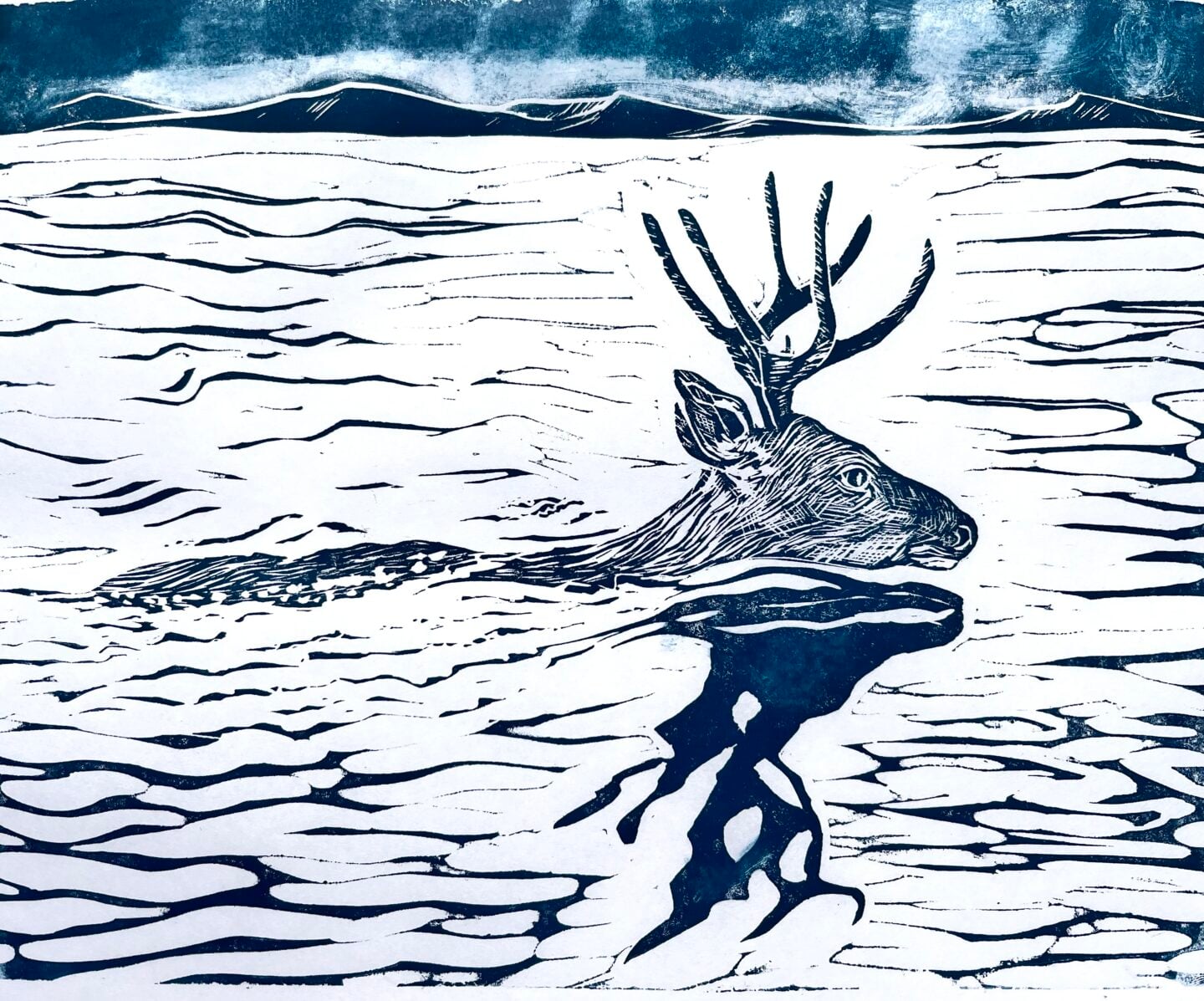
Grenfell had planned for the ship to land in Labrador in a location safe from village dogs. But, unable to push through the pack ice to Labrador, the ship dropped the reindeer instead near St. Anthony on the northern peninsula of Newfoundland, where dogs abounded. Luther wrote in her diary: “January 6th, 1908. This has been another day of excitement. Everyone who could possibly get off has been to Crémaillière to see the reindeer landing.” The reindeer bolted once they were lowered from the ship, plunging into the slob ice. Luther wrote: “Some swam off in all directions, some of them far out to sea, as though heading back home to Lapland. But miraculously none were lost.” Echoing his own mishap adrift upon an ice floe, Grenfell described the reindeer’s struggle to shore: “For a long time, the deer were seen floundering over the heaving ice. Suddenly, one disappeared, then the others vanished. We thought they had gone down between the chunks of ice. But in a minute, all four reappeared, scrambling onto another block.”
A few reindeer reached shore, but others swam to an island a mile and a half away. Grenfell despaired of rowing them to the mainland. The Sámi herders managed the situation by walking along shore with tethered reindeer wearing bells, drawing the lost animals back. “By the middle of the week,” Grenfell noted, “the Lapps located and assembled 285 deer, and the next day, reported the whole 300 safe and sound in one herd.” Despite the chaotic landing, rough handling, and freezing plunges beneath pack ice, not a single reindeer was lost.
At first, Grenfell’s experiment showed promise. Under Sámi care, the herd grew. In 1911, Grenfell sold fifty of the reindeer for an experimental introduction at Fort Smith, Northwest Territory. By 1913, the herd in Newfoundland had grown to approximately thirteen hundred. However, the Sámi families were frustrated by the low pay Grenfell offered and equally frustrated by racial antagonism among the livyer community. After being denied raises, they returned to Norway.
Without close Sámi herding, village dogs began attacking reindeer. After Grenfell shot some of the dogs, “hard feeling was aroused” against his project among locals. Grenfell suspected that the traders whose monopolies were being threatened by his cooperatives were stirring up tension. He wrote, “We know that some few of the traders raised the talk against the deer. It pleased their dealers, and one at least thought that the experiment threatened his winter hunting.”
Poaching presented an even greater threat. As Grenfell noted, hungry livyers saw no reason to “let tame reindeer wandering close to their villages alone, when they had long been able to hunt wild caribou.” Locals also believed that “reindeer have driven out their [wild] deer, eaten all the berries, and driven out the foxes.”
When World War I broke out, Grenfell’s attention shifted elsewhere. He enlisted with a Harvard medical regiment and served in France, leaving his reindeer experiment largely unattended. Without the Sámi herders, the knowledge necessary to maintain the herd vanished. Poaching and general indifference sealed the herd’s fate. As scholars Gregory Wood and Jose Lam write, “Shortly after the loss of Norwegian [Sámi] herders, the local people became very hostile towards the reindeer. They had experienced difficulties restraining their dogs, which attacked the reindeer. The Government of Newfoundland did not offer the herds any protection against being killed, for political reasons.”
By the time Grenfell returned from Europe, he was saddened to witness the collapse of his dreams for food security. In 1918, at Grenfell’s request, the surviving 126 reindeer were transferred by the Department of Indian Affairs to the vicinity of Saint-Augustin, on the north shore of the St. Lawrence River in northeastern Quebec. Without trained herders, most of those individuals soon died. A few years later, the survivors were moved to Anticosti Island in the Gulf of St. Lawrence. By 1940, only eleven remained.
Grenfell’s failure to heed Kjellmann’s ecological warnings, respect Sámi knowledge, or secure community support transformed a promising project into an ecological tragedy whose consequences persist a century later. The introduced reindeer brought to wild caribou in Newfoundland a lungworm parasite called Elaphostrongylus rangiferi, which causes paralysis in caribou and reindeer. Though the paralytic disease was known among Sámi herders in Sápmi, scientists learned in the 1960s that the parasite spreads when caribou or reindeer eat vegetation contaminated by slugs that had ingested larvae from feces left behind by other reindeer or caribou. Over time, it devastated native caribou herds, with one local population dropping from seven thousand to one thousand individuals. “We’ll never eradicate this worm,” notes Shane Mahoney, a Newfoundland caribou biologist.
This article has been excerpted from Reindeer by Nancy Langston, new from Yale University Press. Copyright © 2026 by Nancy Langston. Published by permission. All rights reserved.