Exploration

‘It is important for Canada to be here’

Canadian astronaut Joshua Kutryk touts Canadian contributions to space travel aboard International Space Station

  • Oct 19, 2026
  • 897 words
  • 4 minutes
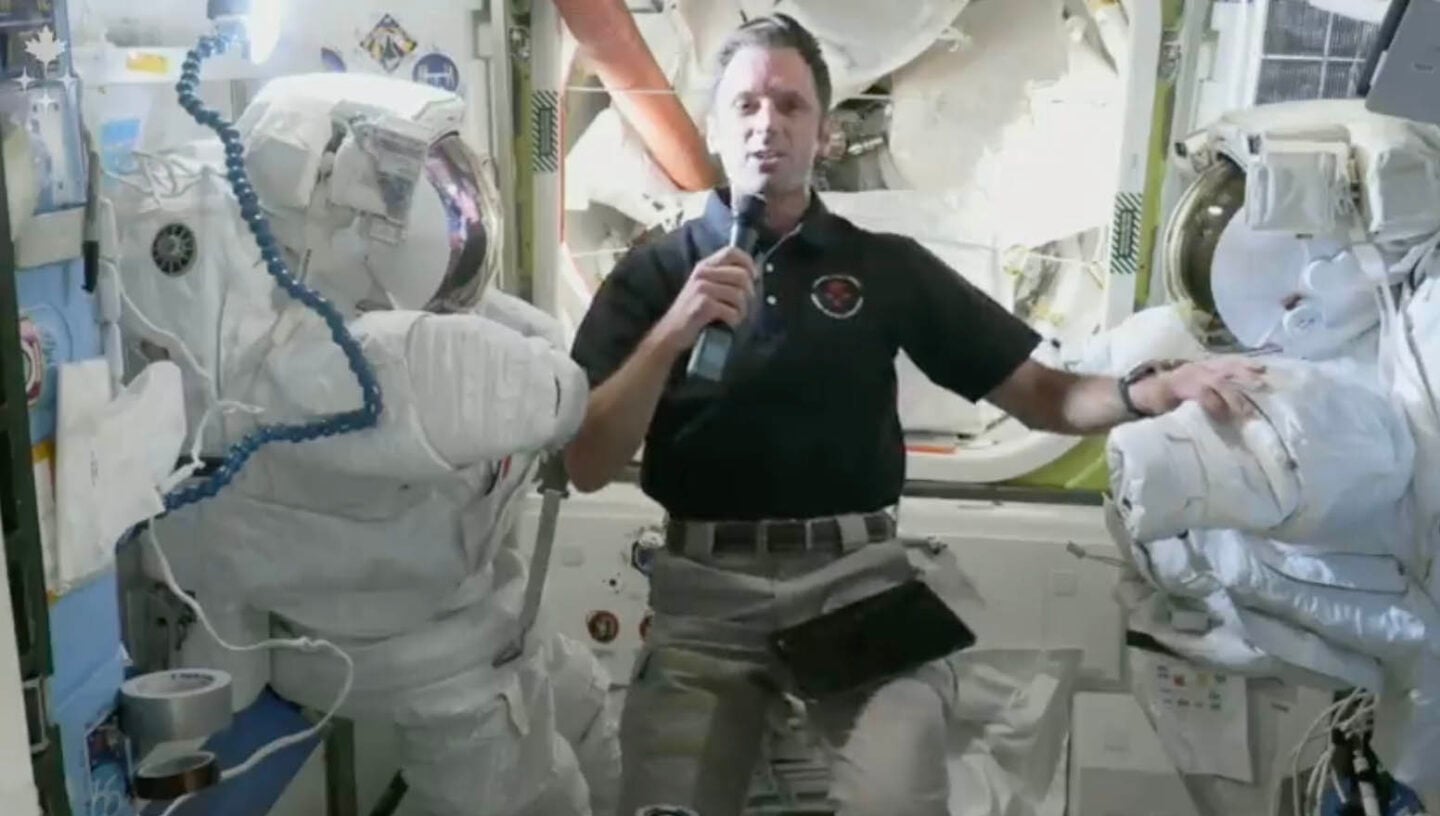
Canadian astronaut Joshua Kutryk during his first media interview aboard the International Space Station, Oct. 13, where he talked about viewing Canada from 400 km above Earth, the Canadian science joining the mission and the challenges of spending months in space. (image from NASA/CSA video).
Expand Image
Advertisement
Advertisement
Advertisement

Astronaut Joshua Kutryk often gazed at the northern lights while growing up in Beauvallon, Alta. Last week, he was looking at them from 400 kilometres above our planet.

The Canadian Space Agency (CSA) astronaut said the auroral view from space is even better than he expected. “It’s one of the most amazing things I’ve ever seen,” Kutryk said during his first press conference from the International Space Station on Oct. 13.

“To see the whole Earth, the curvature of the Earth, just embraced by this blanket of dancing fluorescent oranges and yellows and pinks — magical. You would think it was magic if you didn’t know what it was,” added Kutryk, speaking near a space station airlock and beside two spacesuits.

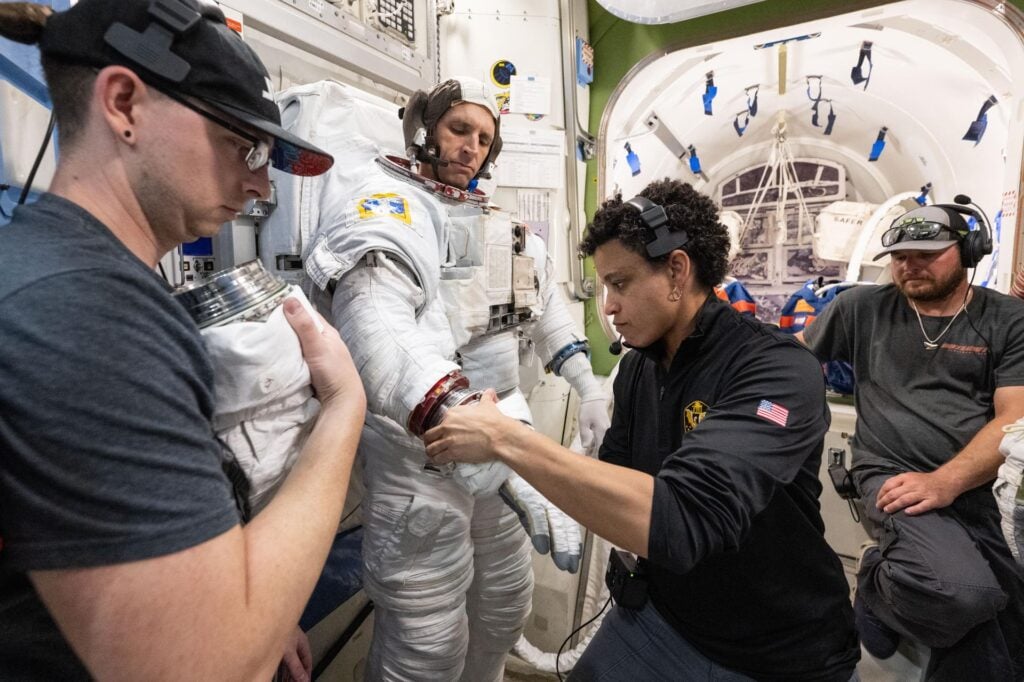
NASA astronaut Jessica Watkins (centre), surrounded by training specialists, assists Canadian astronaut Joshua Kutryk as he practices suiting up in a spacesuit in an International Space Station airlock simulator at NASA Johnson Space Center’s Space Vehicle Mockup Facility in Houston, Texas, prior to this month’s launch. (photo courtesy NASA).
Expand Image

Kutryk was launched to the space station on Oct. 1 from Florida for what is expected to be a half-year mission. By coincidence, he was flying over Canada while speaking with media who reached him from the CSA headquarters near Montreal. Kutryk crossed over Vancouver at the start of the 20-minute call, and then skimmed over the top of Quebec to the port of Sept-Îles — along the Gulf of St. Lawrence — as it concluded. .

Seeing the Earth from space, Kutryk said, made him feel lucky to be there and to have Canada on the space station. “It also makes you feel very, very small, and it makes you look at the world differently. As has been said before, it’s just one world. It’s one thing hanging in the blackness of space, and you don’t see all the countries and all the problems and all the challenges. You just see this little bit of perfection that we should really, really be trying to protect.”

Kutryk is letting Canadians share in this perspective with his social media posts, with recent offerings including shots of Vancouver and the Great Lakes, and a video of the northern lights glowing green behind the robotic Canadarm2 that helps keep the space station running. 

And there’s more of Canada launching to the space station to join him: a SpaceX cargo ship docked with the orbiting complex Oct. 15 with thousands of kilograms of supplies and experiments, including Canada’s ACTIS (Acute Care Testing In Space) device to help with assessing blood-clot risk in space. Kutryk also wore a Canadian-made “smart shirt” during the media event that measures astronauts’ vital signs in comfort, without cumbersome probes on it that could interfere with their tasks. The Bio-Monitor first went into space in 2018 with Canadian astronaut David Saint-Jacques. The shirt is paired with a headband that Kutryk had taken off for the interview.

“It’s all designed with the long-term view of trying to get humans deeper into space for longer periods of time, and of course returning to the moon,” Kutryk said, dangling electronics in front of the camera. “I took [the headband] off to do the interview, but normally this is wrapping around my head and I have a bunch of sensors on underneath.”

Kutryk highlighted other Canadian experiments devoted to astronaut health. C-STARS, which examines astronauts’ mental health during long space voyages, helps psychologists come up with strategies for managing the isolation of spaceflight. The SANSORI experiment looks at how microgravity negatively affects eyesight, as some astronauts experience degraded vision after months aboard the space station, while TBone looks at the weakening of bone structure in space.

These experiments are important not only for astronauts, but for seniors on Earth — dealing with effects of aging, such as bone and muscle loss, similar to what an astronaut experiences after a few months in space — or who have certain medical conditions. They’re also essential to extending human spaceflight. Kutryk said staying for long periods in space is “one of the biggest challenges we have with longer, more aggressive missions into deep space and to the surface of the moon. This is something we really have to work on.” 

Kutryk said the price of challenging his body will be worth it, as being in space is an opportunity not only for him, but for Canadian science and industry to work together on challenging space projects with earthbound applications. “I’m having a blast, but I hope people see the bigger picture,” he said. “It is important for Canada to be here. [We] benefit from these missions, and it’s something that we hope we can continue.”

Next up for Kutryk will be a pair of spacewalks alongside NASA astronaut Anil Menon and Canadarm2, which will happen no earlier than Oct. 29 and Nov. 5. The spacewalks are part of a series of procedures to upgrade power on the space station, by adding newer solar arrays to the decades-old space facility. 

Kutryk’s excursions in a spacesuit will be the fifth-ever for a CSA astronaut, and the first since David Saint-Jacques’ single spacewalk on April 8, 2019 during another mission aboard the space station. “To go do pretty much anything outside the space station, the explorer part of me … would love to,” Kutryk told Canadian Geographic in an interview this past June.

The January/February issue of Canadian Geographic will feature more about Kutryk’s journey and mission. Watch for it on newsstands starting Dec. 14, or better yet, subscribe and never miss an issue. 
David Saint-Jacques is the last Canadian Space Agency astronaut to have participated in a spacewalk on April 8, 2019, also while onboard the International Space Station. Joshua Kutryk is scheduled to take part in two spacewalks: the first no earlier than Oct. 29, the second on Nov. 5. (photo courtesy NASA).
Expand Image
Advertisement

Help us tell Canada’s story

You can support Canadian Geographic in 3 ways:

Related Content

Science & Tech

Artemis II astronauts have returned safely to Earth following historic mission around the moon

Canadian Geographic is following this history-making mission, which saw Canadian Space Agency astronaut Jeremy Hansen become the first Canadian to fly around the moon

  • 5285 words
  • 22 minutes
Roberta Bondar, Jenni Sidey-Gibbons, and David Saint-Jacques (appearing via video link from the International Space Station) talk to students at the Canada Museum of Science and Technology

Exploration

Canadian astronaut David Saint-Jacques launches a new educational initiative — from space

The Exploring Earth project also involves Canadian astronaut Roberta Bondar and aims to inspire students to learn about Earth’s landforms and natural processes from space

  • 694 words
  • 3 minutes
Canadian astronaut David Saint-Jacques in spacewalk training at NASA’s Neutral Buoyancy Laboratory in Houston, Texas.

Science & Tech

How to train your astronaut

From enduring extreme isolation and psychological strain to operating high-tech robotics and undergoing an intense physical fitness regimen, here’s a glimpse at what it takes to head to space

  • 1370 words
  • 6 minutes
Canadian Space Agency astronaut Robert Thirsk

Exploration

Timeline of the Canadian Space Agency

The significant CSA events since Alouette’s launch

  • 772 words
  • 4 minutes
Advertisement
Advertisement