Exploration
Updates from the 2026 Heroic Age Expedition
Follow along as an international team led by the Royal Canadian Geographical Society surveys the wrecks of Quest and Terra Nova in the Labrador Sea
- 5021 words
- 21 minutes
Exploration
How the Heroic Age Expedition digitally reconstructed the wrecks of Quest and Terra Nova
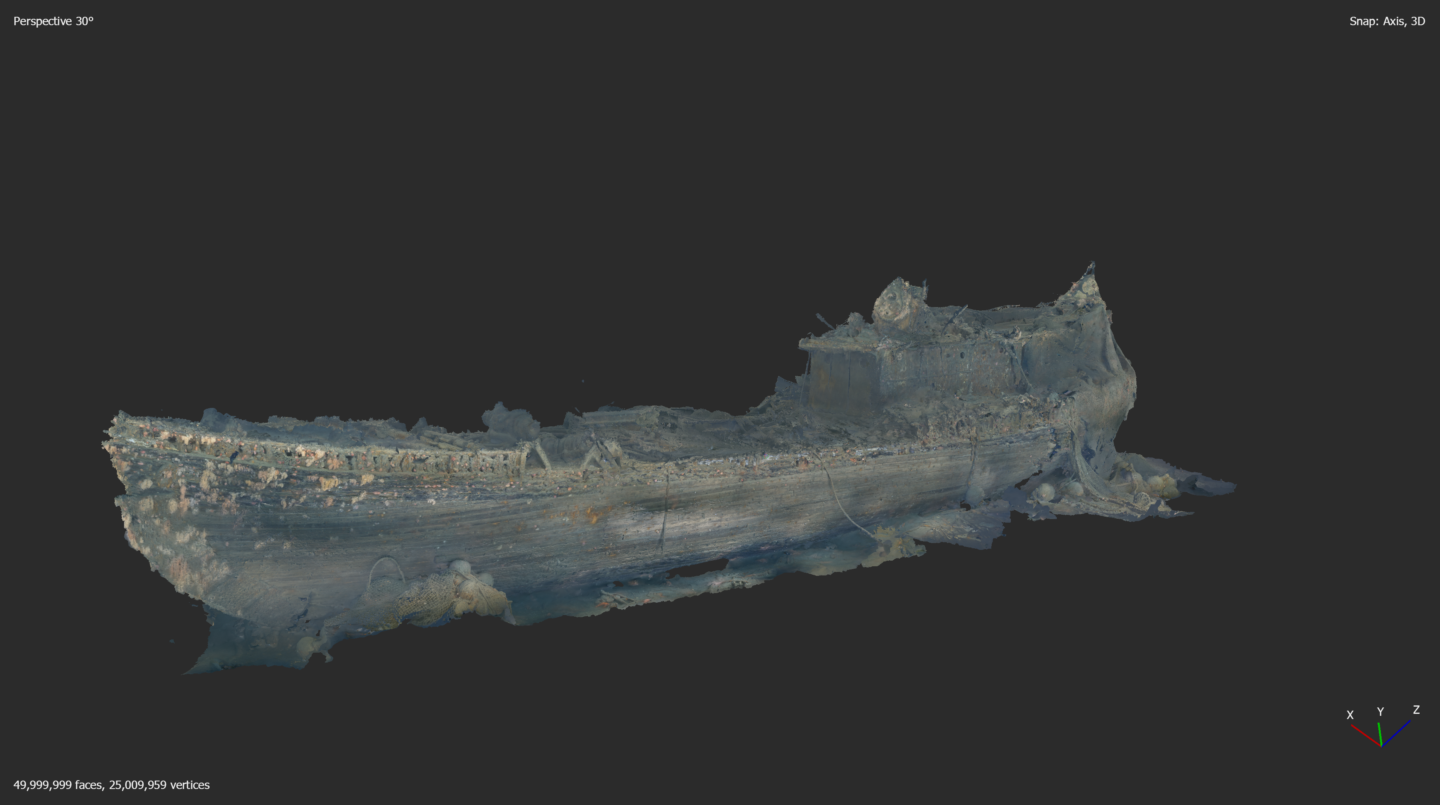
When you combine camera technology capable of employing photogrammetry with a state-of-the-art remotely operated vehicle, the result is what you see below: detailed reconstructions of the Quest and Terra Nova wrecks, created in real time on the Heroic Age Expedition.
Photogrammetry is the process of creating accurate 3D measurements from two-dimensional images – in this case, a series of overlapping photographs of the shipwrecks from where they sit on the ocean floor.
To make this possible, our team at Woods Hole Oceanographic Institution prepared for the expedition by integrating a specialized camera system — designed and made in Canada by Waterloo, Ont.-based company Voyis Imaging — into the Falcon remotely operated vehicle. It took both precision and skill to capture the required images. Two ultra-high-resolution colour cameras were carefully mounted in stereo configuration, similar to human eyes, and provided precise and measurable depth perception.
During Falcon’s dives on the shipwrecks, the pilots manoeuvred the remotely operated vehicle meticulously around the wrecks, maintaining a distance of one to two metres and a constant depth and altitude to collect the overlapping paired photographs, thanks in part to the position-maintaining capabilities of the research vessel Atlantis. By covering areas of the shipwrecks multiple times and from multiple angles, we were able to collect images with and without fish in the way.
Lighting was also key to the Falcon surveys. Our engineers mounted four specialized LED lights in perfect positions around the cameras to reduce shadows and glare as they strobed during photo capture. During the dives, we used specialized software called VSLAM, again provided by Voyis, to build 3D point clouds in real time. Because sea water absorbs different wavelengths of light at different rates, the image data was also colour-corrected in real time. As the dive progressed, we were able to see our coverage and model outline unfurl before our very eyes.
Falcon’s buoyancy had to be adjusted to compensate for the extra weight of the two cameras, and the cameras were mounted in positions that allowed them to look straight ahead or at a 45-degree down angle — important when imaging the horizontal features of the shipwrecks.
The data we collected from 24 hours of dive time on each shipwreck included hundreds of thousands of photographs in addition to high-definition video and other sensor data. The team used specialized software to process the image data and construct the 3D models, something that took hours to days for each shipwreck. The resulting high-resolution models are both visually stunning and extremely accurate, which will be key in letting researchers measure and examine the wrecks in detail.
Exploration
Follow along as an international team led by the Royal Canadian Geographical Society surveys the wrecks of Quest and Terra Nova in the Labrador Sea
Exploration
Inside the Royal Canadian Geographical Society’s expedition to survey the wrecks of Quest and Terra Nova

Exploration
Inside the expedition that found famed explorer Sir Ernest Shackleton’s last ship
Exploration
An international team led by the Royal Canadian Geographical Society in partnership with Woods Hole Oceanographic Institution is heading to the North Atlantic to examine iconic ships of the Heroic Age of Antarctic Exploration