Exploration
Updates from the 2026 Heroic Age Expedition
Follow along as an international team led by the Royal Canadian Geographical Society surveys the wrecks of Quest and Terra Nova in the Labrador Sea
- 5021 words
- 21 minutes
Exploration
Digital twins of Terra Nova, Quest will keep explorers’ stories alive
The Heroic Age Expedition is close to completing the most comprehensive visual and scientific survey ever undertaken on the wreck of Terra Nova, a Newfoundland-based sealer that was the last expedition ship of British Antarctic explorer Captain Robert Falcon Scott.
Through a combination of ultra-high-resolution video and cutting-edge underwater photogrammetry technology, the expedition, led by the Royal Canadian Geographical Society in partnership with Woods Hole Oceanographic Institution, is creating a permanent digital record of the historic wreck as it looks today, including a highly detailed three-dimensional digital twin.
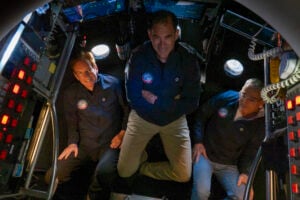
Travelling on WHOI’s research vessel Atlantis, the expedition arrived at the Terra Nova wreck site July 12, two days after completing a similarly thorough survey of the wreck of Quest, the last ship of rival Antarctic explorer Ernest Shackleton. The team is working around the clock, deploying deep submergence vehicle Alvin to explore and film the wreck during the day, and the Falcon ROV with an integrated Voyis imaging system at night to capture additional imagery and create the digital twin.
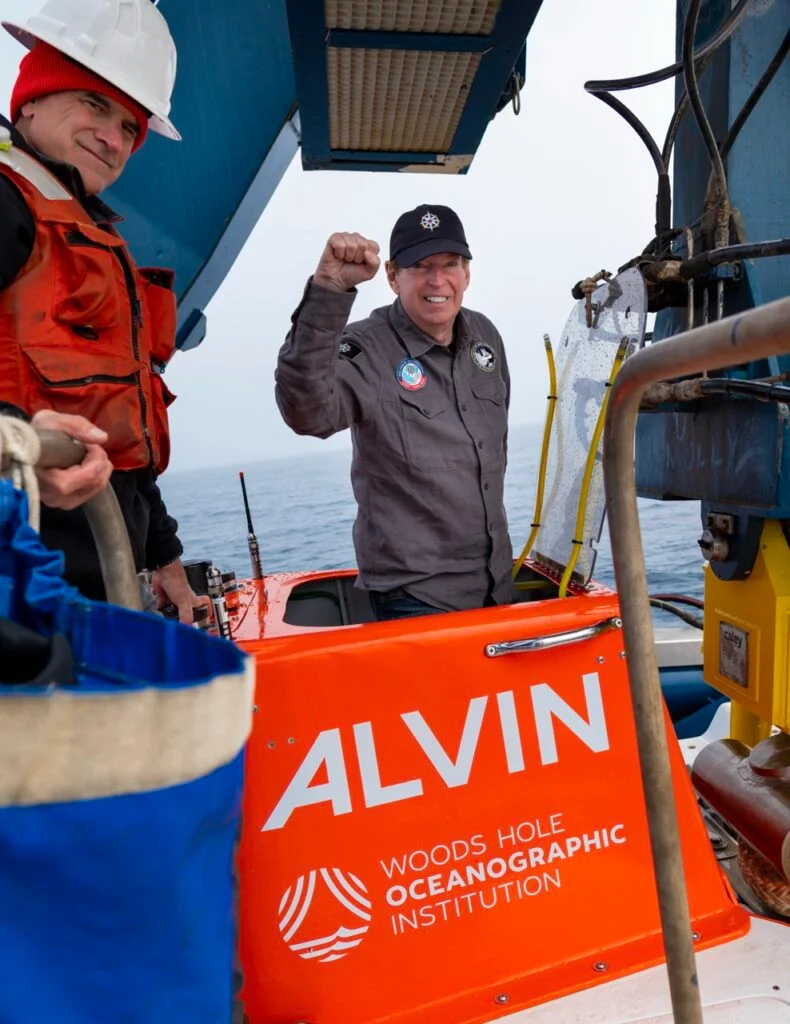
Expedition leader John Geiger, who was one of the first team members to visit Terra Nova in Alvin, says the experience was “epic.”
“The water is so clear, there’s an absence of fish, and the bow is split open so you could literally drive the submersible into the hold and see the inside of the ship. I almost felt like I could reach out and touch it.”
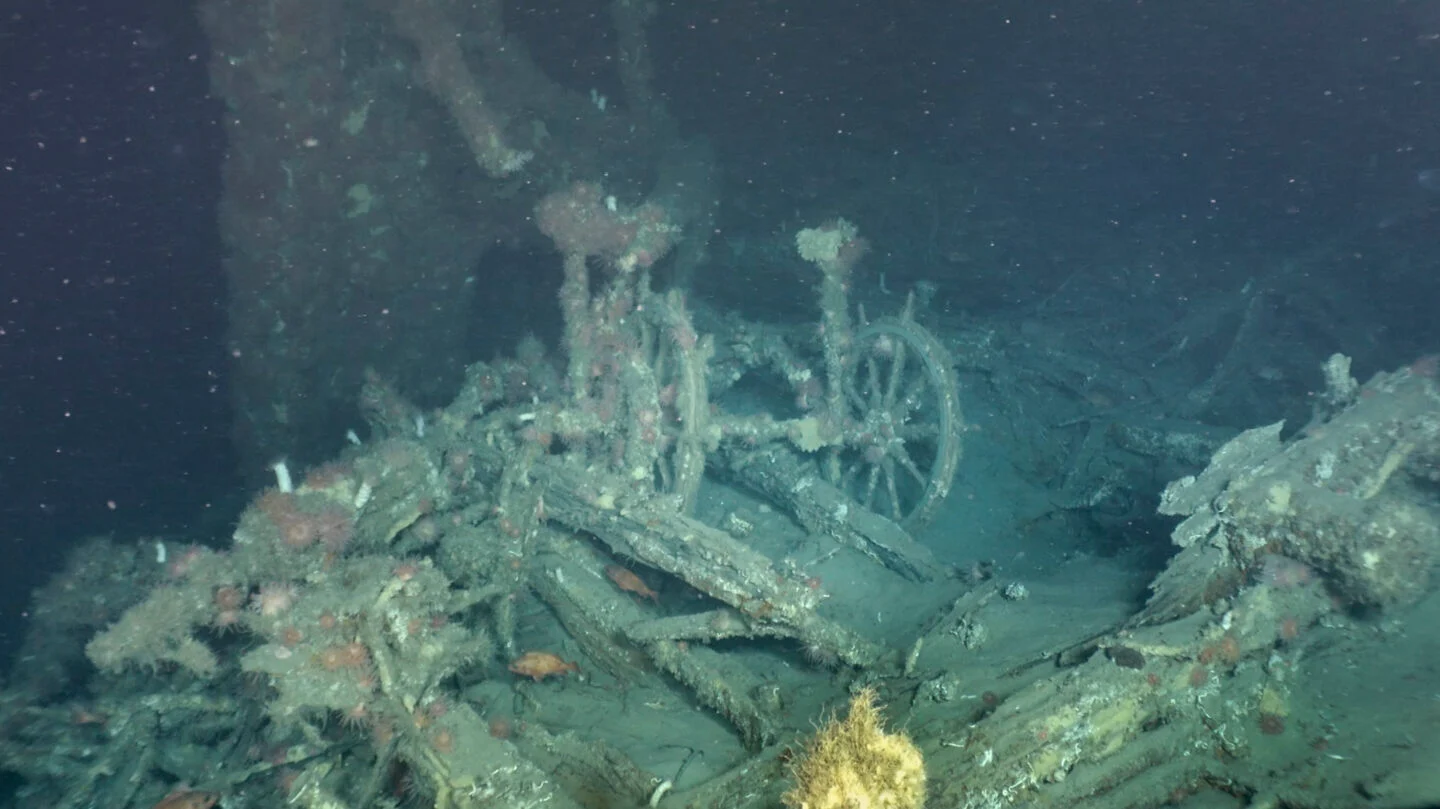
In contrast to Quest, which was in part hidden behind abandoned fishing nets and surrounded by Atlantic cod, Terra Nova’s wreck is completely unobstructed, though it has deteriorated significantly in the 83 years since the ship sank off the southern coast of Greenland. Her decks have completely collapsed and disintegrated and her hull, made of thick, reinforced wood meant to withstand polar sea ice, is split down the middle, revealing the ship’s inner workings, including the engine room, boiler, propeller and rudder. Compellingly, the wardroom is still intact and sitting on top of the engine room, and the ship’s distinctive double helm is clearly visible at the stern, which was otherwise destroyed in the sinking.
“Essentially [some of] the wood has rotted away, but every metallic structure remains,” says Antoine Normandin, the expedition’s research director. “It’s like an open book. She’s going to tell us a lot.”
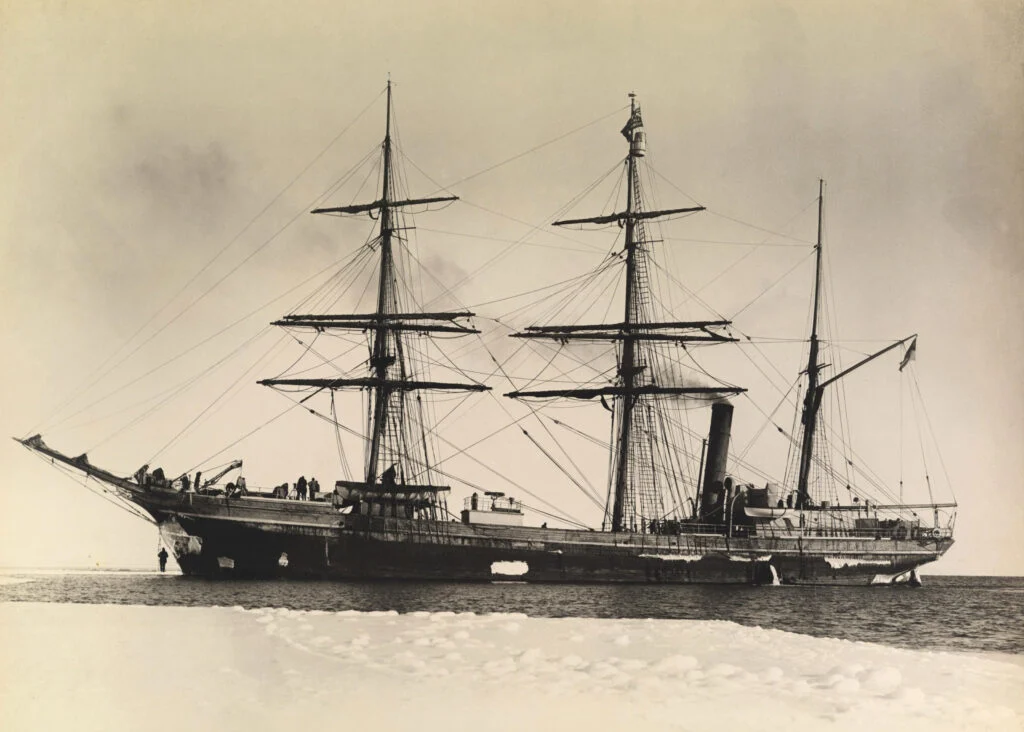
Built as a whaler in 1884 in Dundee, Scotland, the elegant, three-mast Terra Nova spent much of her life sealing in Canadian waters as part of a fleet owned by the St. John’s-based Bowring brothers. She was acquired by Britain’s Royal Navy in 1903 to serve as a relief ship, alongside SS Morning, for Scott’s first Antarctic expedition aboard Discovery, which had been beset by ice for two years.
In 1910, Scott once again set his sights on the South Pole, having come within 800 kilometres of it on the Discovery expedition. Terra Nova underwent a major refit, temporarily gaining a lab space, darkroom and sounding equipment to fulfill the expedition’s scientific objectives. This time, Scott had a serious challenger for the pole in Norwegian explorer Roald Amundsen, who arrived in Antarctica armed with knowledge of polar travel and equipment gleaned from two winters in the Arctic among the Inuit. Scott’s party reached the pole on January 17, 1912 — five weeks after Amundsen. All five members of the party succumbed to a combination of exhaustion, starvation and exposure on the return journey. Three of their bodies were recovered later that year along with geological samples they’d dragged with them from the pole, letters to their loved ones and Scott’s journal containing his last written words: “For God’s sake, look after our people.”
Terra Nova picked up the survivors of the expedition in 1913 and carried the news of Scott’s death to the world. Then, she went back to the Newfoundland seal fishery.
In 1943, during the Second World War, she was contracted to run supplies to U.S. naval bases in Greenland. On Sept. 12 that year, she was damaged by ice and sent a distress signal. The U.S. Coast Guard cutter Atak responded the following morning and rescued the crew; then, to prevent the disabled ship from becoming a navigational hazard, Atak and other vessels fired on her with three-inch guns until she finally sank on the afternoon of Sept. 13. Visible shell holes in the wreck seem to confirm official reports about Terra Nova’s final moments.
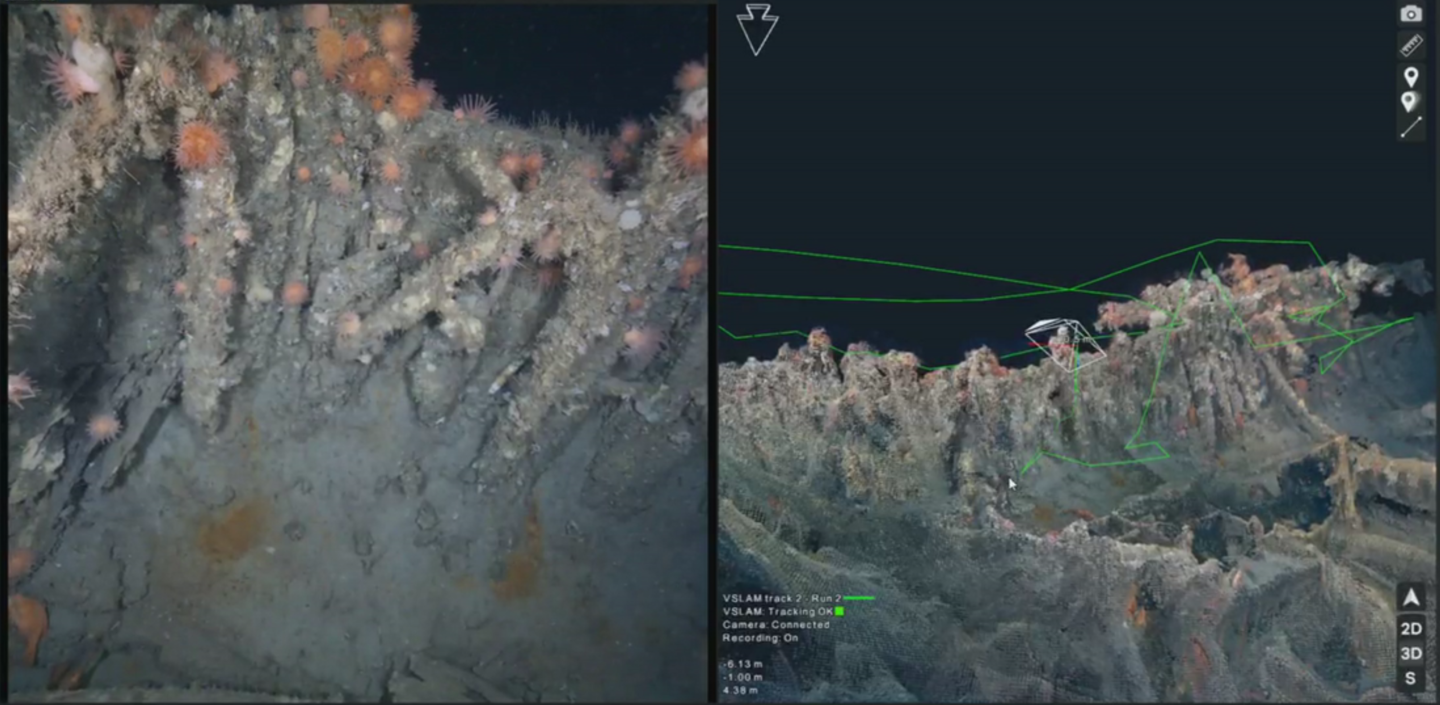
The expedition team has one more day and night of operations planned to complete the survey of Terra Nova, after which Atlantis will return to Woods Hole, Mass. The approximately weeklong transit will give the WHOI imaging team time to finish processing the three-dimensional digital twins, which will preserve the wrecks in incredibly fine detail.
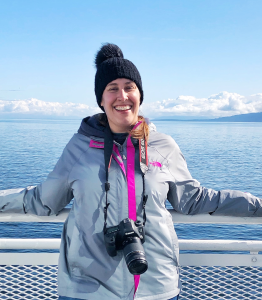
The Voyis system uses a stereo camera to capture thousands of overlapping images that can then be stitched together to create a three-dimensional model. WHOI software engineer Zoë Daheron says the system generates some 500,000 images over a couple of days of diving. Sophisticated software also tracks the movements of the ROV and creates a realtime “point cloud” that the pilot can see to ensure there are no gaps in the final model.
“This is a really cool, advanced tool,” says Daheron, adding her biggest challenge will be carefully filtering out the cod that are blocking features of interest on Quest.
The Society will use all the imagery captured on the expedition to continue telling the stories of Scott, Shackleton and their ships through articles, exhibits, books and educational programming. There is a symmetry to their respective histories that remains incredibly compelling more than a century after the explorers’ deaths, says Geiger.
“To see Quest, to me, was half the story. [Seeing Terra Nova], I feel like we have a complete picture of one of the most remarkable periods in exploration history.”
Exploration
Follow along as an international team led by the Royal Canadian Geographical Society surveys the wrecks of Quest and Terra Nova in the Labrador Sea
Exploration
An international team led by the Royal Canadian Geographical Society in partnership with Woods Hole Oceanographic Institution is heading to the North Atlantic to examine iconic ships of the Heroic Age of Antarctic Exploration
Exploration
An expedition led by the Royal Canadian Geographical Society found the vessel intact and upright at a depth of 390 metres

Exploration
Inside the expedition that found famed explorer Sir Ernest Shackleton’s last ship