Environment
Inside the fight to protect the Arctic’s “Water Heart”
How the Sahtuto’ine Dene of Délı̨nę created the Tsá Tué Biosphere Reserve, the world’s first such UNESCO site managed by an Indigenous community
- 1663 words
- 7 minutes
Travel
In Nibiischii, the land of water, you’re sure to find a warm welcome, even when the water turns to ice

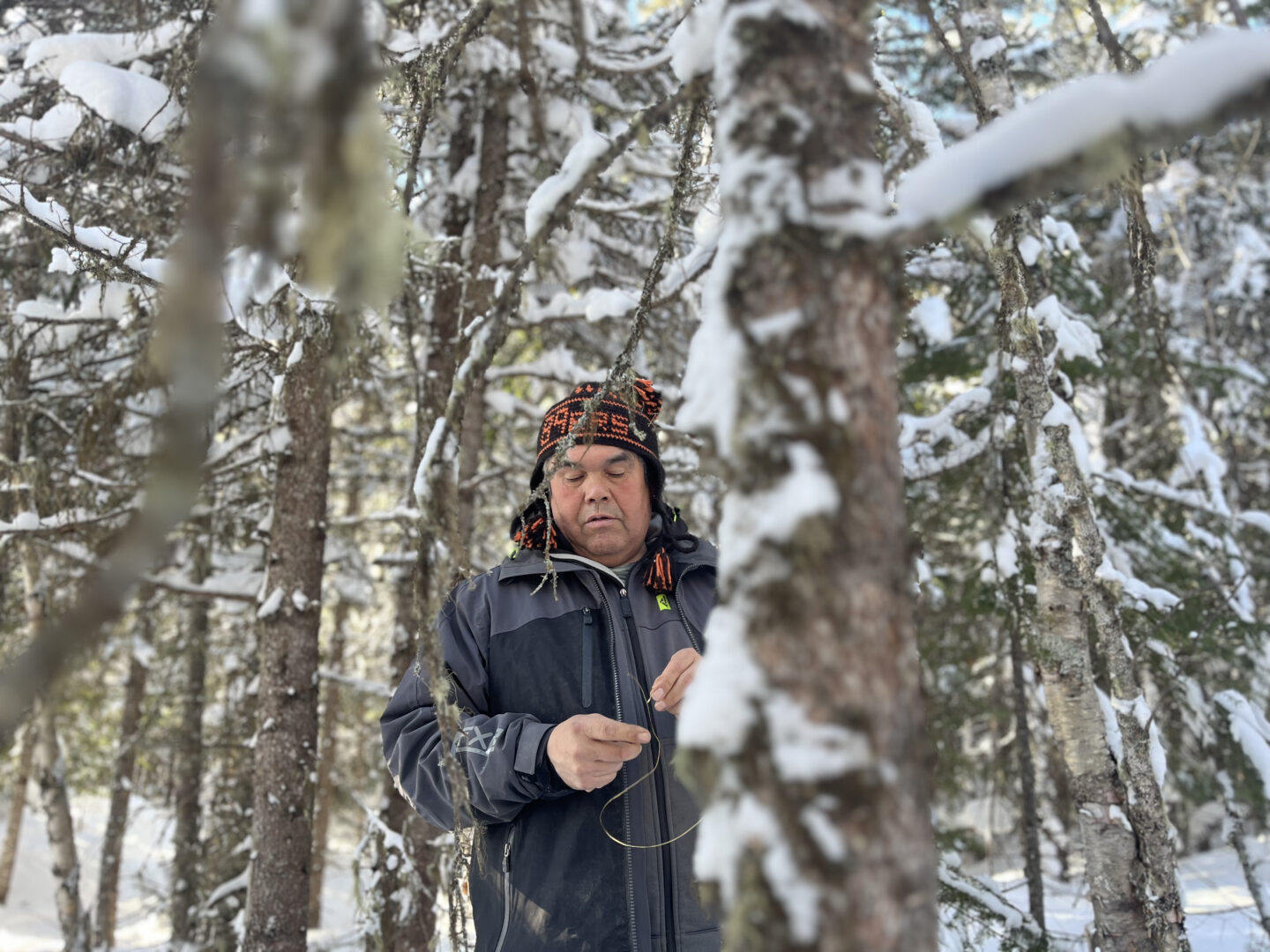
On the shores of Waconichi Lake ᐧᐋᐦᑯᓇᒌᐤ ᓵᑲᐦᐃᑲᓐ (lichen mountain lake), sun dapples softly down through snow-covered trees. Snowshoe-clad, our small group is paused next to an old shelter leaning against a tree, the icy air of Eeyou Istchee James Bay filling our lungs. The snow keeps the forest floor a secret. It’s bringing back memories for Clifford Neeposh, a Cree trapper and entrepreneur from Mistissini ᒥᔅᑎᓯᓃ.
“In wintertime, this is how they used to make the shelters,” he says, explaining how his grandfather would layer boughs and branches to protect against the freezing elements. “They would build a fire here, and they would find rocks, heat the rocks up and put them right here. The shelter would keep you warm.”
Neeposh notices a scattering of rabbit tracks in the snow. “Even animals have used the shelter,” he says with a grin, traps jangling in hand.
Once the memories start, they flow. “This used to be the old trail; we used to live not far from here,” he says, pointing to a clearing in the trees. Each morning at 5 a.m., his grandfather and the other adults who worked at Waconichi Lodge, which was then a fishing lodge, would walk along this trail to get to work. “When I was a kid, we would stay at the camp just like little puppies or wolves or foxes in their beds.”
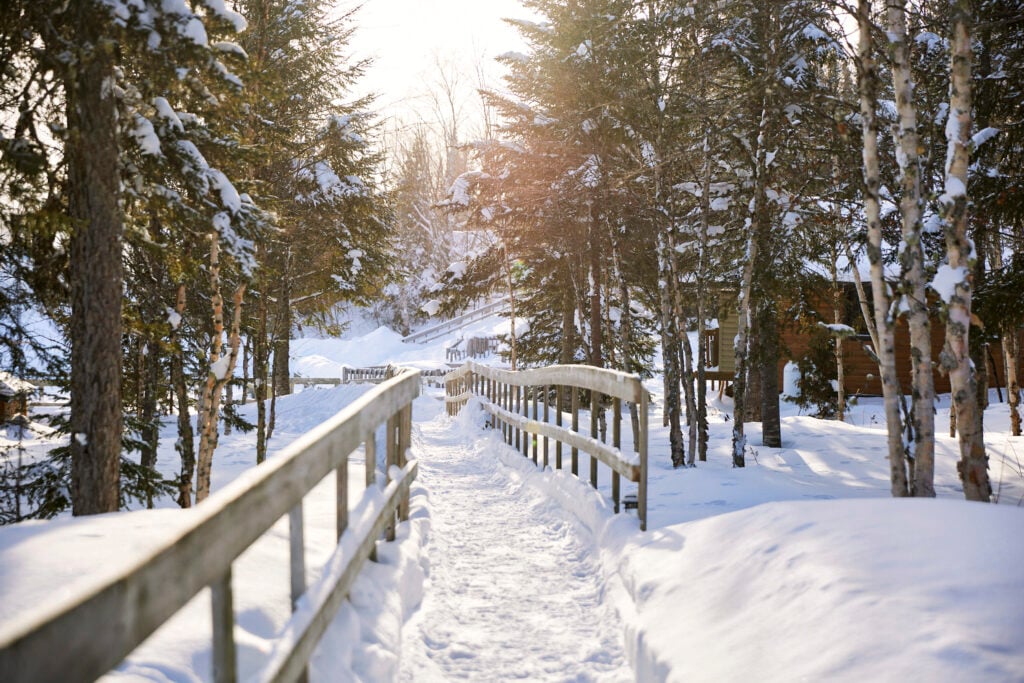
There’s a warm, welcoming shelter back along the trail at Waconichi Lodge, which is now run by the Nibiischii Corporation, created by the Cree Nation of Mistissini. With 11 self-catered atihkw ᐊᑎᑊᑊᒄ (caribou) cabins, connected by boardwalks, and even the option of mwakw ᐧᒫᒄ (loon) on-ice cabins, which can be reached by snowshoe or snowmobile, it’s a cosy place to stay on the edge of the boreal forest.
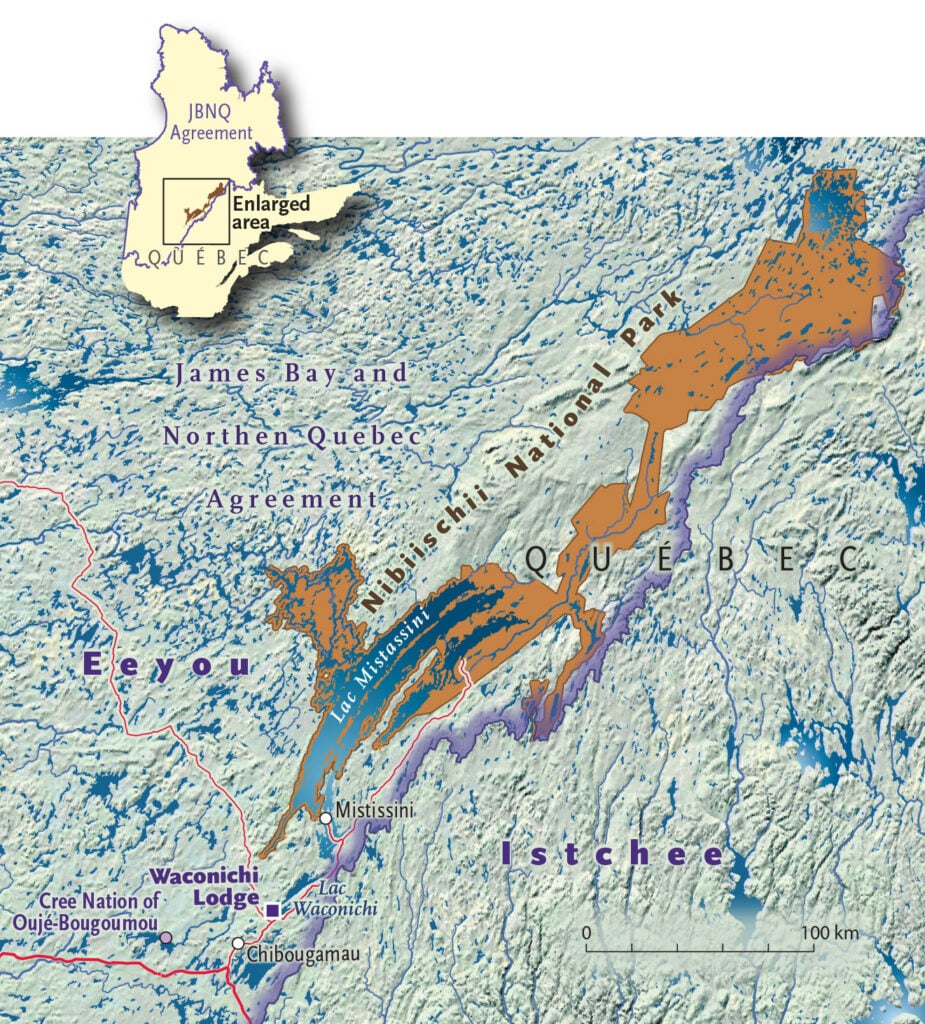
The accommodations at Waconichi Lake are just part of the puzzle: Nibiischii not only offers a whole host of places and ways to explore this “land of water” — it also protects it through the management of the Albanel-Mistassini-and-Waconichi Wildlife Reserve.
And at the end of last year, after more than two decades of careful negotiations, the Cree Nation of Mistissini and Quebec governments announced the creation of a new national park — the first national park in the province to be operated by a Cree community. Nibiischii Park will work with Cree hunters, trappers and tallymen — the Cree people who supervise harvesting on the trapline — so they can continue to live in relation with the land and waters the way their ancestors did.
“We’re very excited,” says Deputy Chief John Matoush of Mistissini on reaching this achievement and collaborating on eco-tourism. “And it also goes in line with what we bring as Crees — the culture, the land, how connected we are. Really goes in line with protecting an area. But at the same time, we’re able to hunt, we’re able to harvest, we’re able to maintain our rights when it comes to living the way of life on the land.”
Tourism like this doesn’t just bring economic opportunities to Cree communities; it allows people to be who they are in the place they’re from. “The passion that people have out on the land, getting to spend time on the land, the two go together,” says Matoush. “You’re working, but at the same time you’re going where you’re able to hunt, where your family traplines are.”
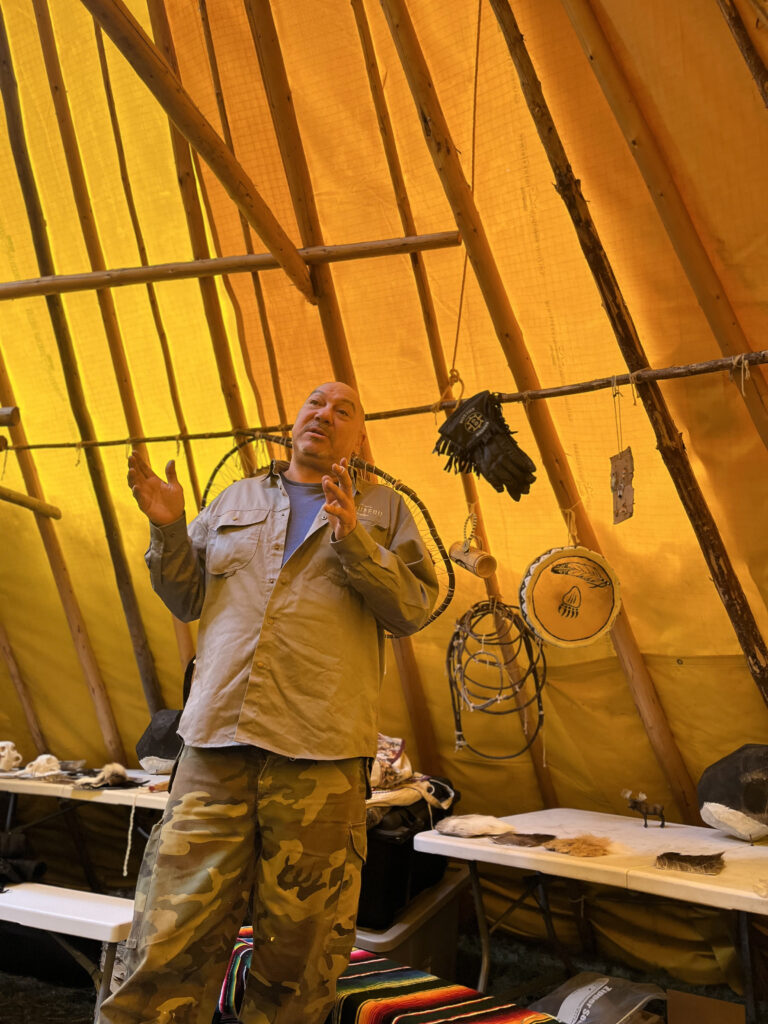
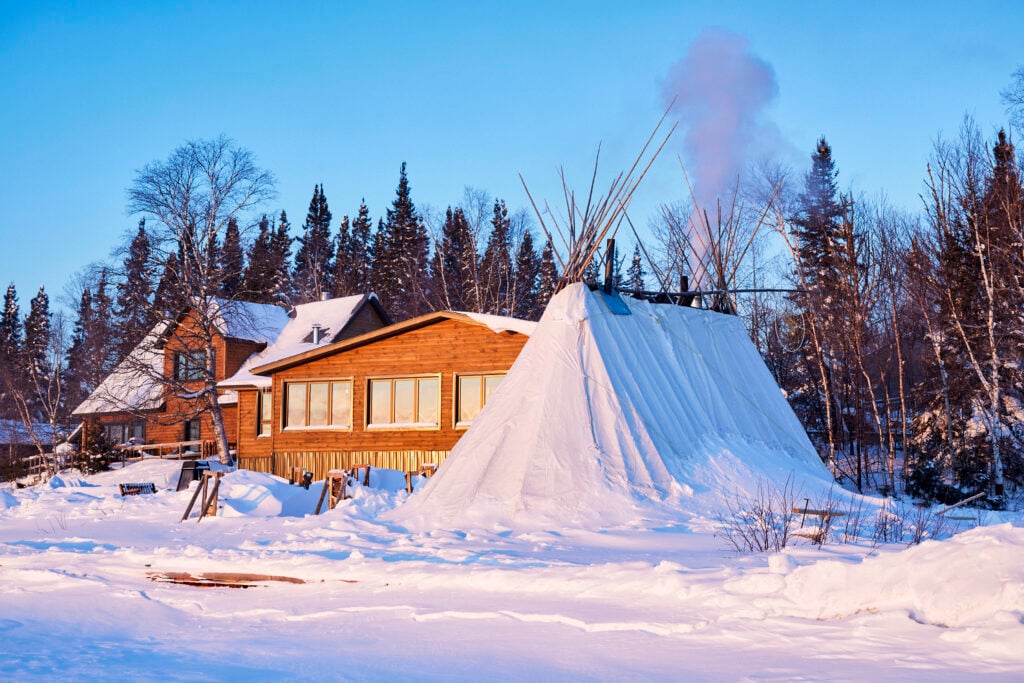
The beating heart of Waconichi is the Sabtuan, a traditional Cree shelter built with care by Mario Lord, a tallyman and Nibiischii’s cultural development officer. The first thing you’ll learn about Lord is that he’s a Boston Bruins fan. The second thing you’ll come to know is that Lord can make practically anything.
Behind where he stands in the Sabtuan, wooden posts sloping to the sky, there’s a handcrafted wooden tanker with the Bruins logo, a beaded bracelet in yellow and black, a hand drum painted with a bear print with yellow and black around the edge, a turtle rattle from down south with yellow and black beads. There are stretched hides, a happily crackling fire and a ptarmigan on a stick being roasted by the heat of a metal drum.
The type of tarp he used for the Sabtuan, Lord tells us, he’d first seen in his 15 years working in the mines, where they were used for pushing air underground. “They don’t burn. They don’t rot. Can’t even try to tear it — you won’t be able to. When I see that, I said, I got to get some,” he says, and points up. “After 15 years, there’s one! And I had to glue everything, cut it, measure, you know. I didn’t need an engineer to make this. I had the plans all in my head.”
The knowledge Lord has, he shares. In our short time on Waconichi Lake, he teaches us how to weave tamarack into niskihkan ᓂᐢᑭᐦᑲᐣ (goose decoys), used by Cree hunters to encourage nisk ᓂᔅᒃ (geese) to land when they return in the spring. He teaches us to make a fire, to cook a goose, to bake bannock and to sew together a pouch from moose-hide to gather kaachichepakw ᑳᒋᒉᐸᒄ (labrador tea).
“The best way to learn it is to live it — like this. You see somebody do something, you learn,” he says.
Lord was brought up by his grandparents in the bush when he was unable to attend school after getting sick from tuberculosis. He doesn’t know who he would be today if he hadn’t been raised in nature. (“Maybe a lawyer. A chief, maybe!”) He knows the hunting ground, south to Senneterre, and north up to Chisasibi. He knows the creeks and the lakes in this land of water. “I kind of feel lost when I go into the city. If you throw me anywhere in the middle of the forest, I’ll come back…” Lord trails off, emotional.
The fire crackles. The aroma of pine needles wafts up from a layer that carpets the floor. “So, that’s a little history of my life,” Lord chuckles. It’s a history we’re honoured to hear. Then it’s time for lunch.
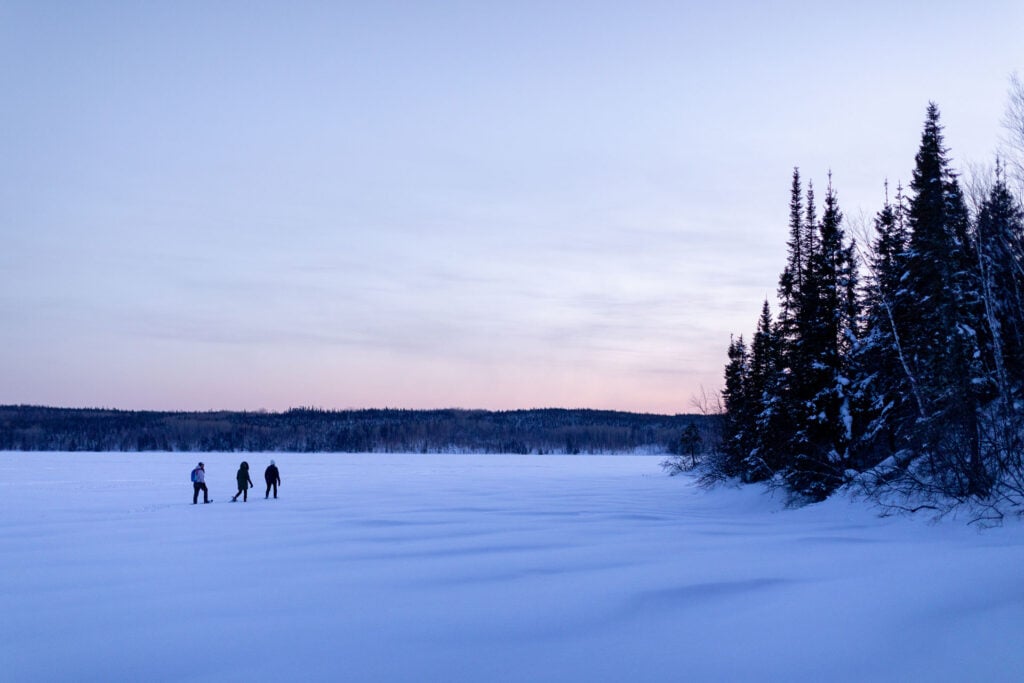
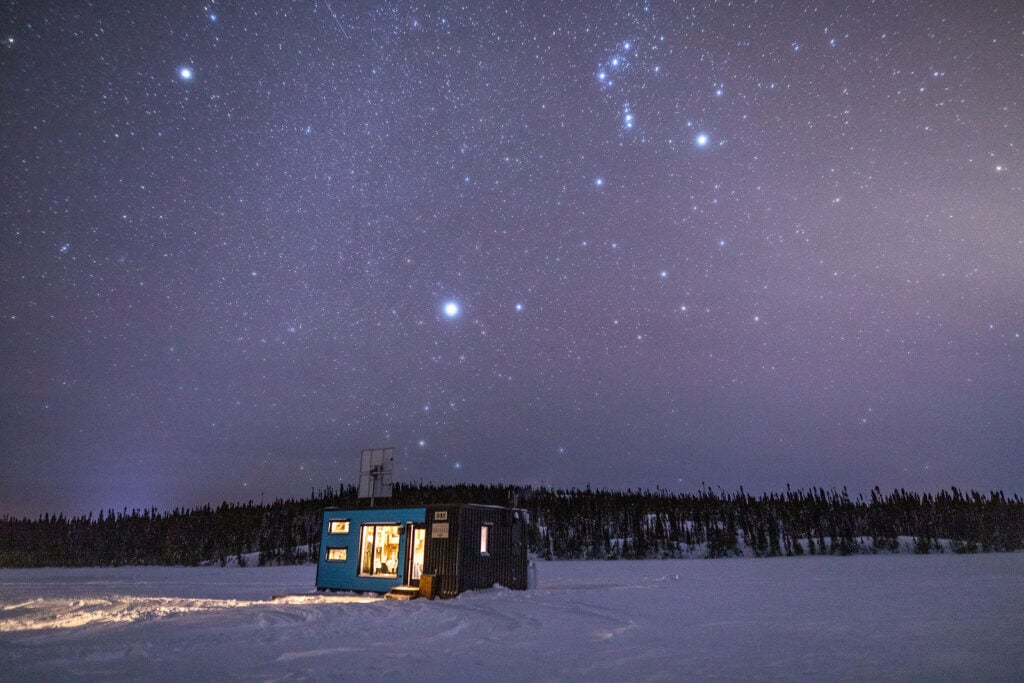
After an afternoon of learning how to weave the goose decoy (after a few hours, my goose is tiny and still not finished), our hands a bit sticky and smelling like tamarack, it’s time to head out on the frozen lake. It’s a bumpy ride in a slick black carriage drawn by snowmobile around the peninsula the lodge sits on to where the mwakw ᐧᒫᒄ on-ice cabins flank an on-ice studio. The light is leaving the sky, which has turned a slate grey, heavy with the promise of more snow. Warm light spills out from the beckoning shelter.
As darkness closes around the cabin, we’re warm inside, tucking in to a dinner of locally prepared ready-made meals, which guests can purchase at reception. There’s falling-off-the bone smoked beef ribs and slow-simmered beef bourguignon and bannock: perfect hearty food to fend off the cold outside. The menu also includes corn soup infused with boreal notes, woodland phō flavoured with locally foraged mushrooms and roast duck inspired by traditional goose cooked on an open fire.
Feeling warm and fuzzy, we stomp back out onto the lake ice. If it was a clear night, the stars would be out in their millions, and it could be a good evening to check out the Uchekatahkw ᐅᒉᑲᑕᐦᒄ (Big Dipper) astronomical observatory, a short walk or snowshoe from the lodge. As it is, the sky is filled with fluffily billowing snow. No matter. We head across the ice to Waconichi’s ice cinema for a screening of the 1974 documentary film Cree Hunters of Mistassini. The light of the projector becomes a glowing column of flurrying snowflakes as, from a heated geodome, we watch the rhythms of a previous generation of Cree harvesters build their winter camp. It is at once ancient and futurist.
On the very first night, we were joined by Elder Irene Otter of Waswanipi. Otter’s Cree name means “Laughing Woman,” and she’ll be the first to tell you she loves to laugh. She sat in an armchair by the fireplace, wrapped in a shawl, her long white hair in braids. She told us about a time long ago when there was a scarcity of food. No moose, no bear. The people were starving. So now it’s part of being Cree to share food, and welcome other people. Even now, when someone hunts a moose, they give some to the Elders first.
“That’s the way we are: we share,” says Otter. “I’ve always grown up seeing how my family is. We learned that when we were young. When you are in your cabin or your tent or wherever you’re at, you always have something ready for a visitor.”
Her great-grandmother used to have a feeling when a visitor was about to arrive. “Osihowin we call it. You feel somebody coming. A premonition, I guess, and you would fix something — bannock, soup, whatever we have — and we’re ready for someone to come and feel welcomed. That’s the way I see my people.… We are very welcoming people, and I hope you feel that now.”

This story is from the November/December 2025 Issue
Environment
How the Sahtuto’ine Dene of Délı̨nę created the Tsá Tué Biosphere Reserve, the world’s first such UNESCO site managed by an Indigenous community
Travel
The new movement building flourishing tourism hubs across Canada – one sustainable example at a time
People & Culture
Uprooted repeatedly by development projects, the Oujé-Bougoumou Cree wandered boreal Quebec for 70 years before finding a permanent home. For some, the journey continues.
Travel
Un nouveau mouvement créateur de pôles touristiques florissants dans tout le Canada – la durabilité, un exemple à la fois