People & Culture
Excerpt from Manomin: Caring for Ecosystems and Each Other
Grounded in Indigenous methodologies, Manomin examines our interconnectedness with the natural world
- 2324 words
- 10 minutes
History
How Kìwekì Point on the Kichi Zìbì (Ottawa River) was reimagined, not just as a lookout, but for visitors and Ottawans alike to learn the context for this special place

This story has been fact checked
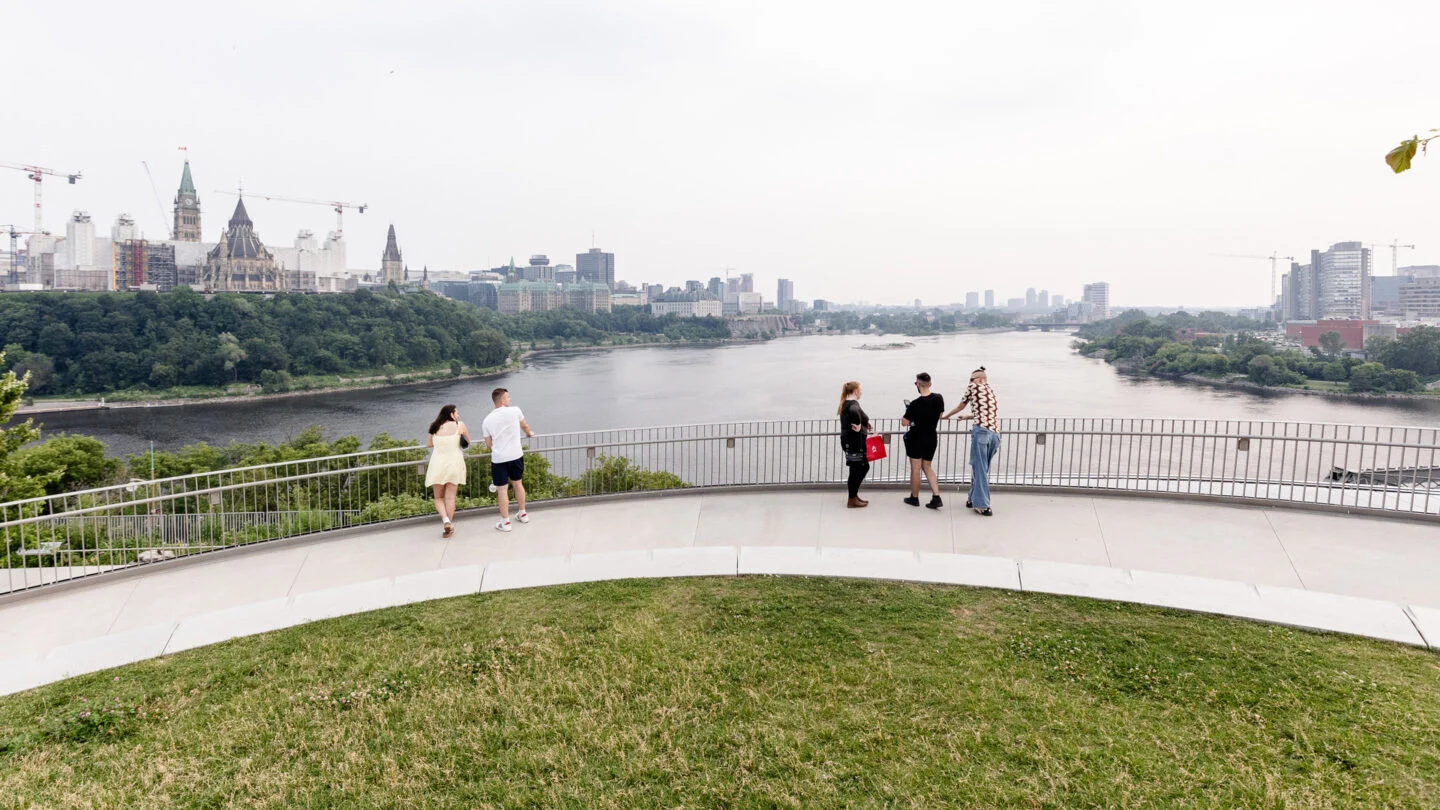
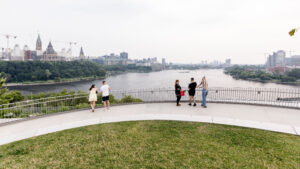
Above the Kichi Zìbì (Ottawa River), unceded Algonquin Anishinàbeg territory, a lookout rises beside Parliament Hill. It provides a stunning panoramic view of both the capital city and Gatineau’s sprawling skylines, separated by the junction of the Kichi Zìbì, Pasàpikahìganì Zìbì (Rideau River) and Tenàgàdìno Zìbì (Gatineau River) and connected by the aging Alexandra Bridge. In the spirit of land-based reconciliation, the prominent lookout, previously known as Nepean Point, was renamed Kìwekì Point in 2022. Kìwekì, in Anishinaabemowin, means “returning to one’s homeland.”
Parliament Hill and its surrounding areas are deeply rooted in the tapestry of Ottawa’s colonial history. This is especially true for the lookout.
The banks and waterways of the Kichi Zìbì have been used by First Nations since time immemorial, serving as seasonal camps, ceremonial lands and portage routes. Kìwekì Point itself was marked on settlers’ maps as early as the 1820s, originally named Bluff Point by Philemon Wright, an American colonialist from Massachusetts who founded the timber trade in the Ottawa Valley in the early 1800s. The lookout was renamed Nepean Point in 1876, for its location in Nepean Township, which was named after Evan Nepean, a British politician and colonial administrator.
In more recent history, the point has taken many shapes and forms, offering differing aspects of tourist attraction and commemoration. Historian and Heritage Ottawa board member David Jeanes shared photos of when the lookout housed decorative canons, a Japanese fountain titled “Elephant and Python” commissioned in 1907 (part of this fountain now stands in a park in nearby Aylmer), an old pedestrian bridge that was eventually demolished and an overhead shot of the scenic driving road that used to run through the park before being closed for the National Art Gallery’s construction in the 1980s.
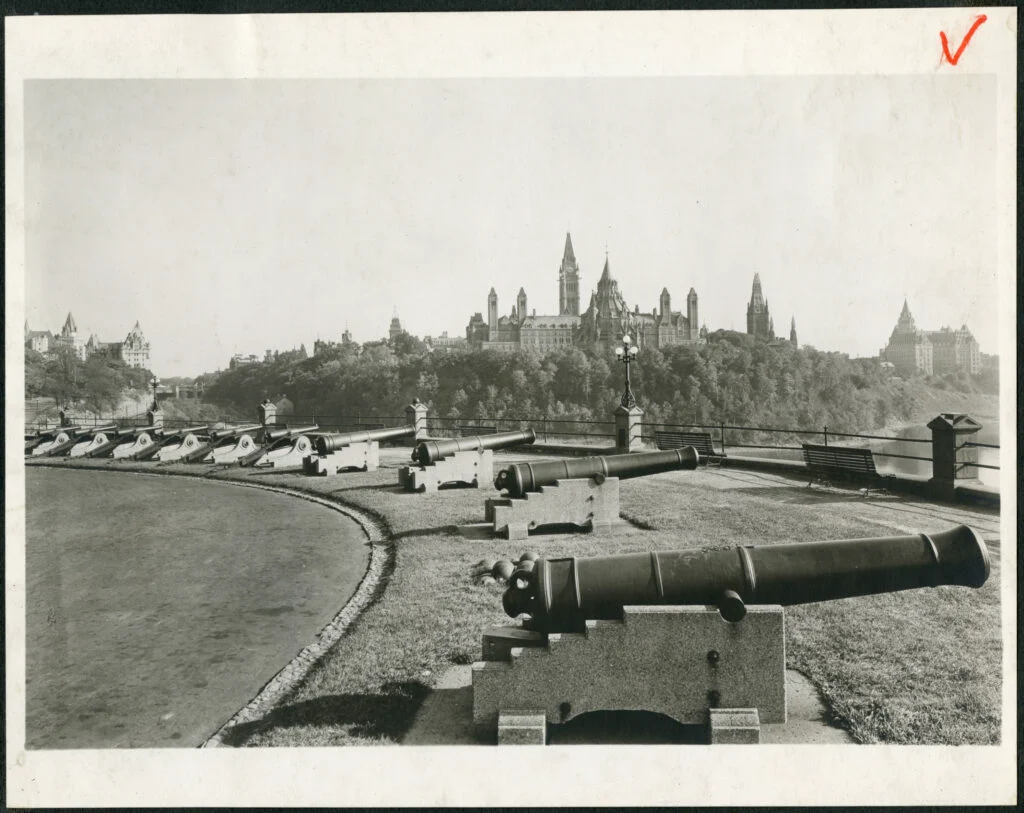
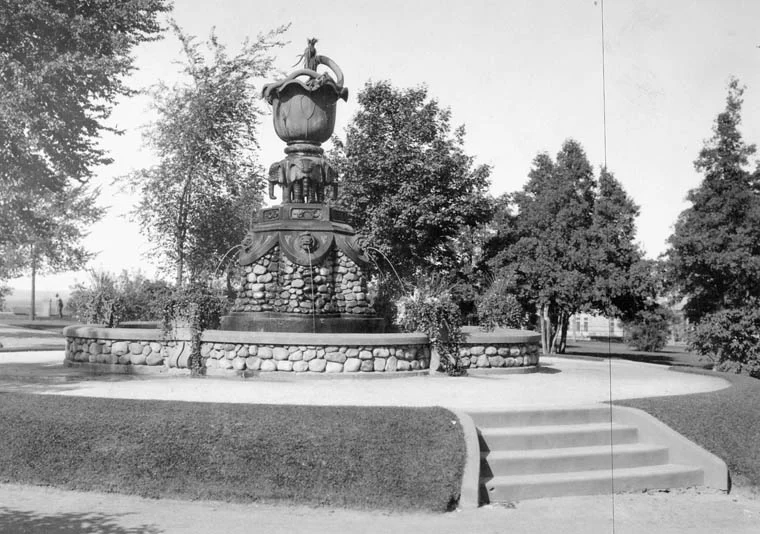
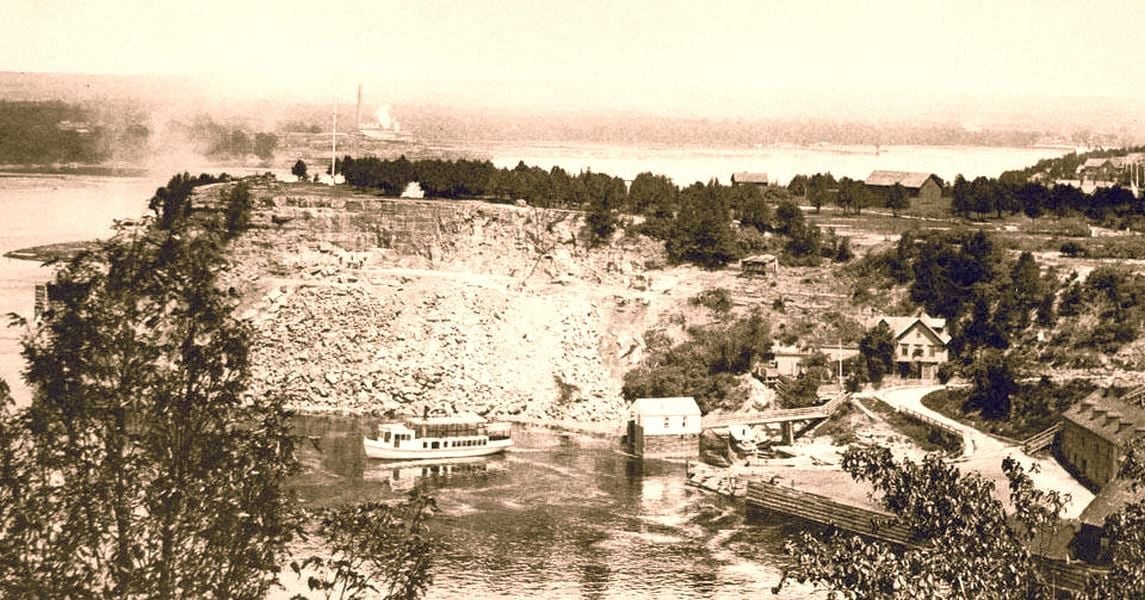
Jeanes recalls how the lookout had been an important part of his childhood. “My father used to have many visitors, particularly from overseas, and in the ’60s to ’80s, he would always take them on scenic drives around Ottawa,” Jeanes says. “When he could do it in the ’60s and ’70s, driving around Nepean Point was an important part of that driving tour of the National Capital.”
Since 1915, the lookout has featured a statue of French explorer Samuel de Champlain. The sculpture was created by Hamilton MacCarthy to commemorate the 300th anniversary of Champlain’s arrival. Three years after the Champlain statue was erected, MacCarthy created a kneeling Indigenous man to be placed underneath the explorer’s raised platform. The statue’s name was informally changed in 2013 from Anishinabe Scout to Kitchi Zìbì Omàmìwininì or “great river people” by advocates pushing for Algonquin recognition in Champlain’s travels. The statue was then officially renamed Kichi Zìbì Innini, meaning “great river man,” in 2023 by the National Capital Commission, which manages the site.
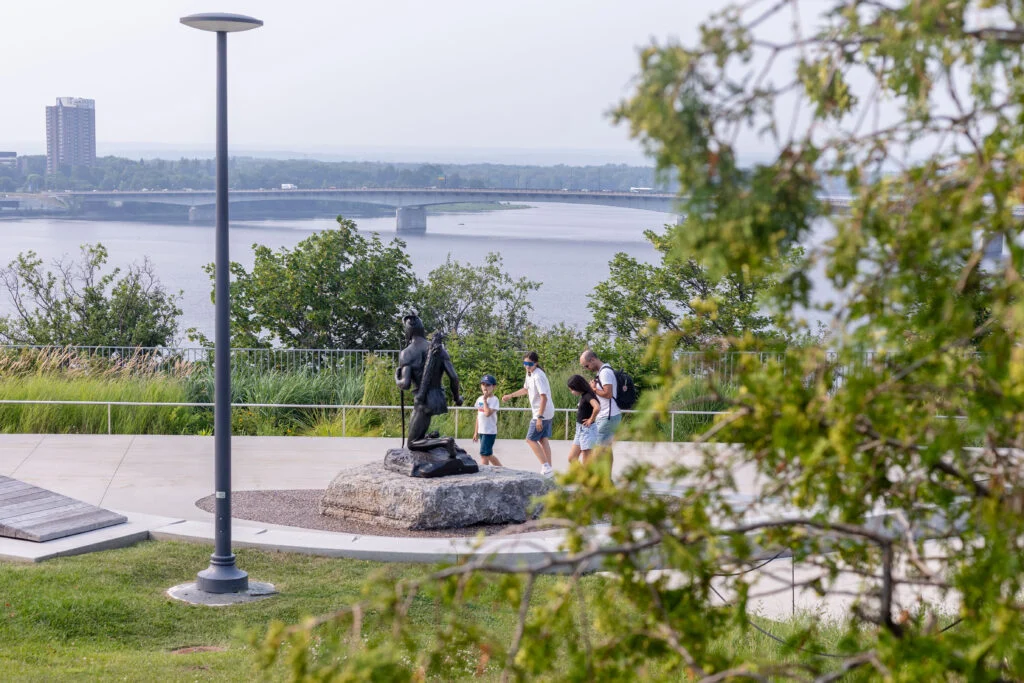
Both statues have been a source of contention for local Indigenous groups since their creation because of their controversial depiction of Indigenous history and culture. “Imagine that there’s this tall, elegant statue of an Algonquin, and Champlain is kneeling near him. I don’t think it would go over very well with very many people,” says Kitigan Zìbì Elder and traditional teacher Albert Dumont.
The posture of the statue is not all that caused issue; Kichi Zìbì Innini was not created in the likeness of any real Indigenous person that assisted in Champlain’s travels, but instead was based on stereotypes. In 1996, Assembly of First Nations’ Chief Ovid Mercredi launched a movement that led to the statue’s 1999 relocation to Major’s Hill Park.
In 2014, the National Capital Commission kicked off an international design competition, with architects and firms pitching how they would redesign the lookout to turn it into a main attraction of the city. The “big river landscape” proposed by Janet Rosenberg Studios, a Toronto-based firm in landscape urban architecture, won the job and also a 2026 Ontario Association of Architects Design Excellence and Service Award.
The design team created a layout offering an accessible clifftop view of the city’s skyline, with the river as the focal point. They also established an advisory and design committee of local Indigenous community members, including Kirby Whiteduck and Anita Tenasco, to assist with the park’s design and interpretation.
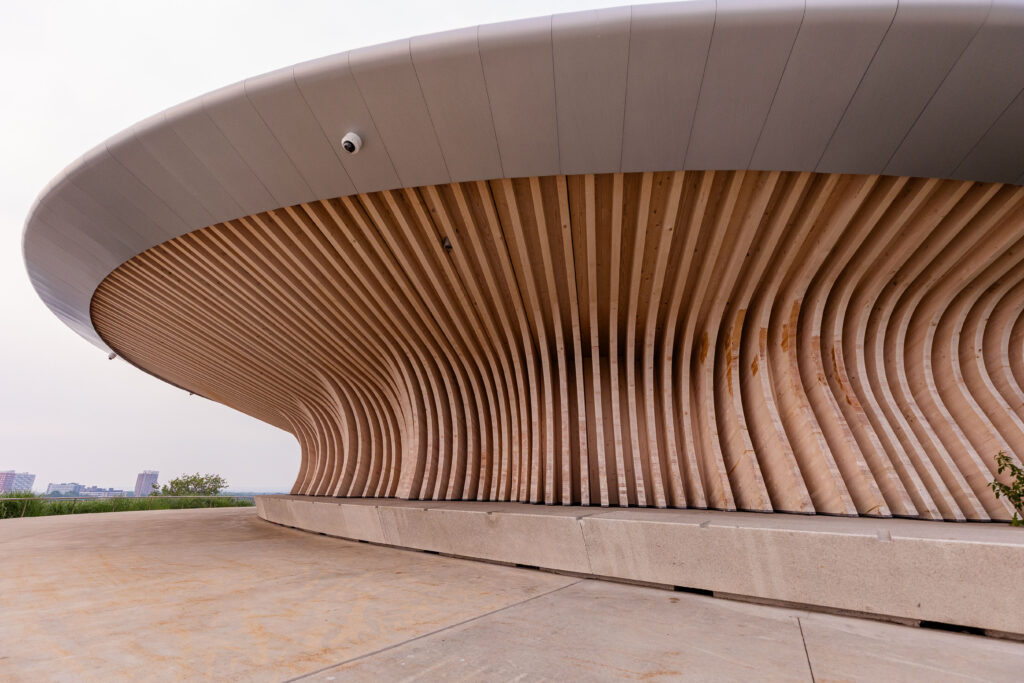
After years of planning and construction, the lookout officially reopened to the public in May 2025 with a completely new look. A new pedestrian footbridge connects the point to Major’s Hill Park, and layered metal sculptures of Ottawa area animals and native plants appear in the point’s lowered outer edge, which is called a ha-ha in landscape design. A two-level structure called “the whispering point” resembles a wooden white-capped wave crashing over the edge of the lookout. The top of the whispering point provides an elevated platform for a better view, and the sheltered lower section’s nooks direct attention toward the river. (The whispering point was damaged seven months after opening when a school bus driver illegally drove the path, scraping the top of the vehicle along the wooden panels. The structure is in the process of being repaired.)
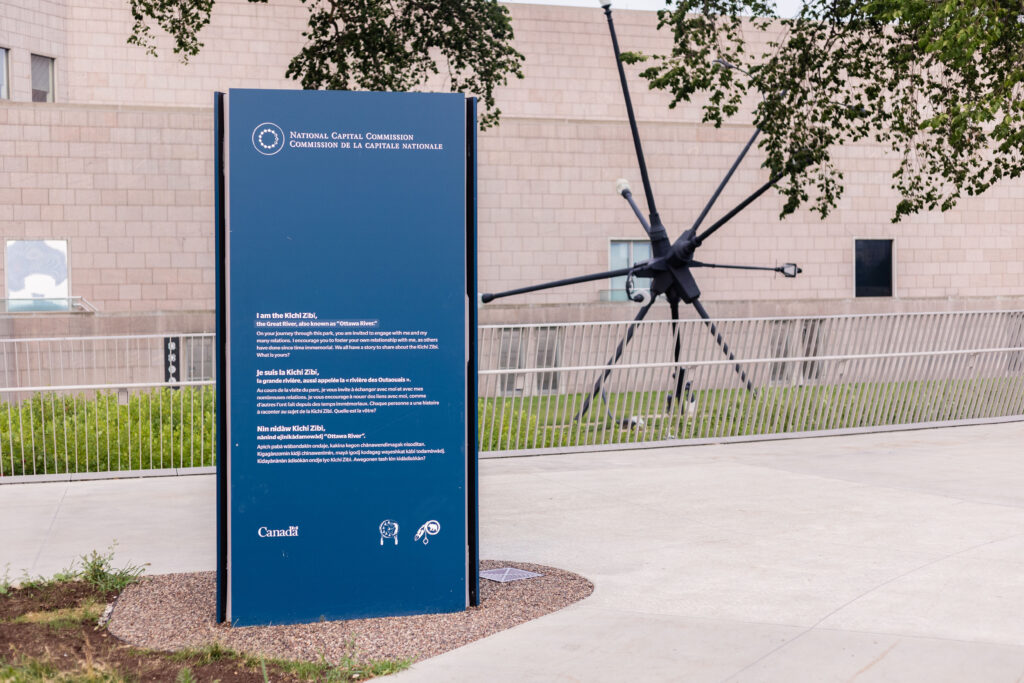
“The main aspect is that the Ottawa River has always been the focal point,” says Garry Meus, a landscape architect with the National Capital Commission. “Through the design and how it moved from the schematic phase to the implementation, it was always to make [the river] the main figure that enhances the visitor experience.”
Included in these changes was the relocation of both the statue of Samuel de Champlain and Kichi Zìbì Innini. In the case of Champlain, the statue’s base was disassembled, restructured and moved, bringing the explorer closer to the ground and pointing him toward Parliament Hill. Kichi Zìbì Innini was moved from Major’s Hill Park back to the point in a prominent location facing the Kichi Zìbì.
Today, Kìwekì Point stands not just as a scenic lookout but as a reimagined space that ties its history to its present. A weaving of art, memory and meaning into a physical space, it showcases how natural landmarks like this move forward even while reckoning with the controversies and stories that shape them.
People & Culture
Grounded in Indigenous methodologies, Manomin examines our interconnectedness with the natural world
History
Comment la pointe Kìwekì, située sur la Kichi Zìbì (rivière des Outaouais), a été repensée, non seulement pour servir de belvédère, mais aussi pour permettre aux visiteurs et aux habitants d’Ottawa de mieux comprendre l’histoire de ce lieu exceptionnel.
People & Culture
Throughout the Great Lakes, Anishinaabeg communities work together to sow the seeds of success for wild rice

People & Culture
In the seventh part of the “Languages of the Land” digital series, the Anishinaabekwe cultural programs manager of the Georgian Bay Mnidoo Gamii Biosphere sits down with Canadian Geographic to talk about practicing language and thinking in Anishinaabemowin