People & Culture
Excerpt from Manomin: Caring for Ecosystems and Each Other
Grounded in Indigenous methodologies, Manomin examines our interconnectedness with the natural world
- 2324 words
- 10 minutes
People & Culture
Throughout the Great Lakes, Anishinaabeg communities work together to sow the seeds of success for wild rice
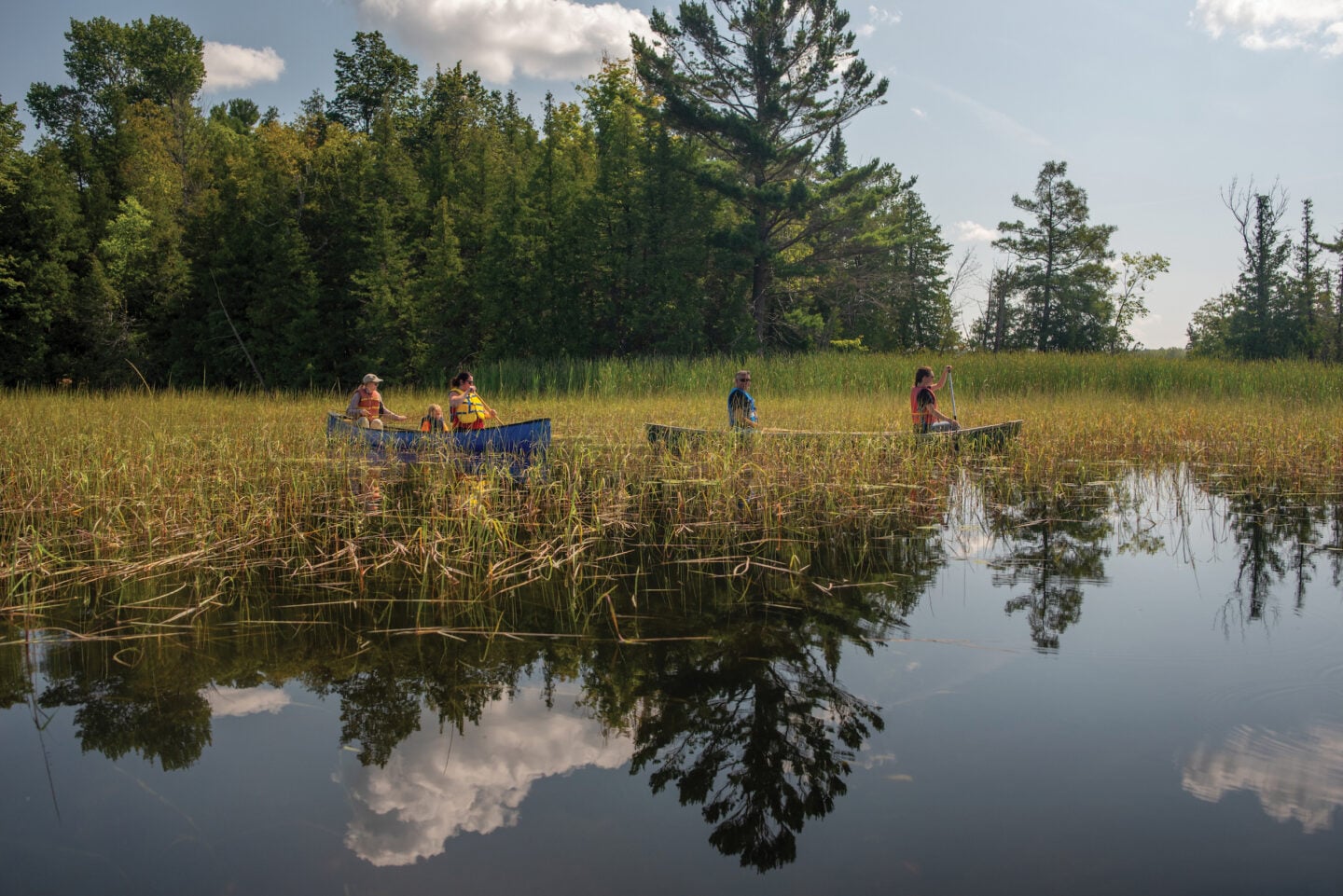
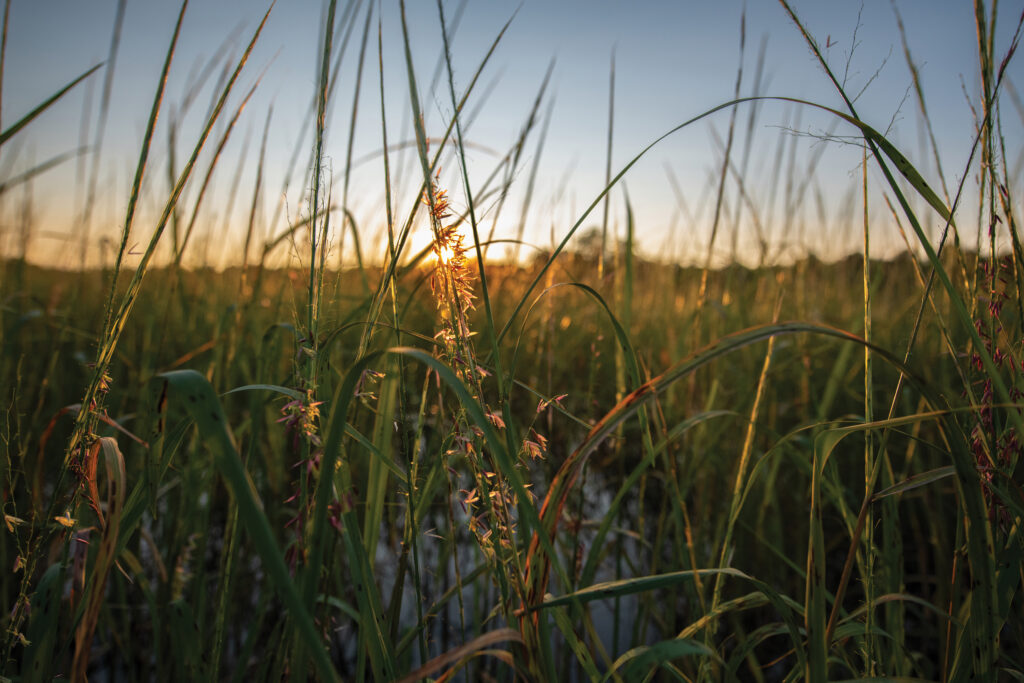
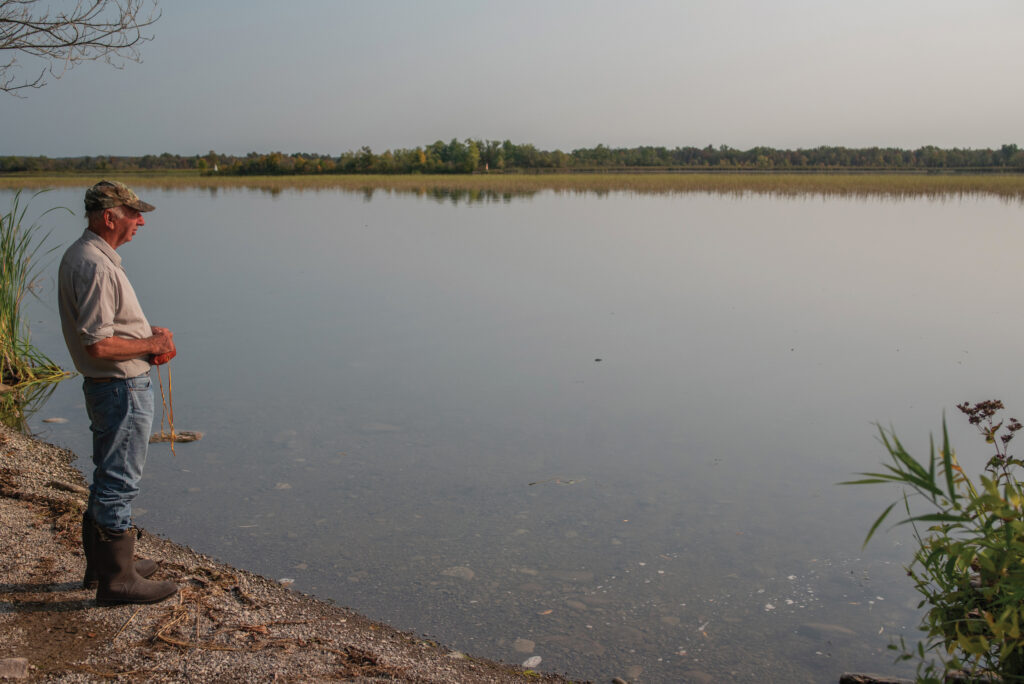
Even with a ball cap on, Ryerson Whetung still squints looking out over Chemong Lake in the intensity of the early-September evening sun. “Our waterways have never been surrendered,” he says, as he makes himself comfortable in the back of his uncle Billy’s canoe. Through the tall grass-like plants behind him peek glimpses of cottages on the shore across from Curve Lake First Nation.
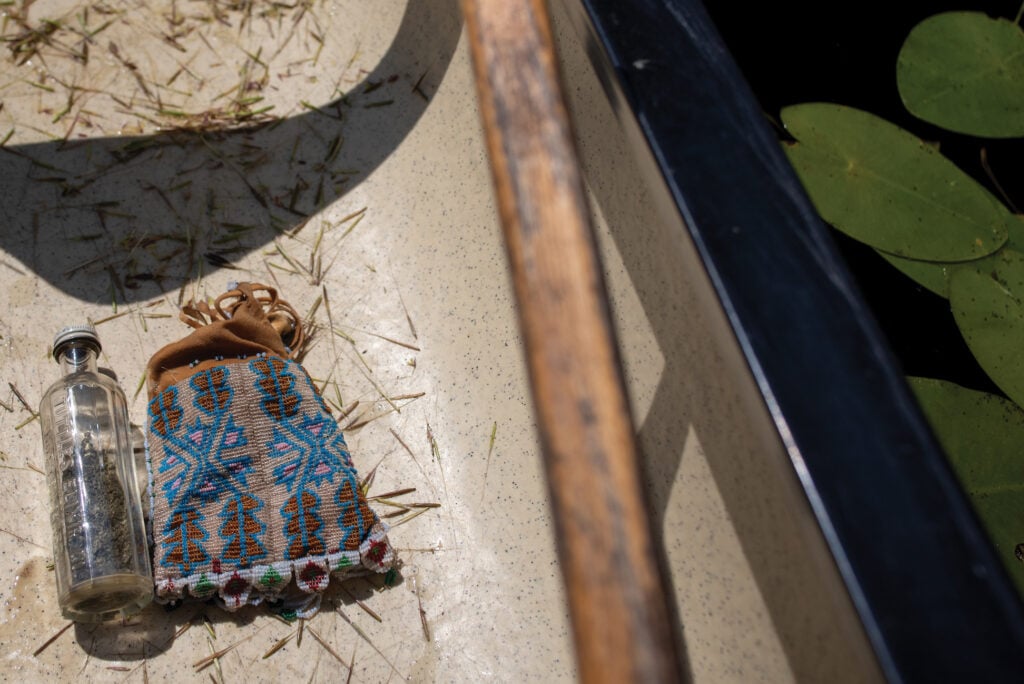
As Ryerson waits for his uncle to join him, he quietly opens a leather pouch decorated with intricate beadwork. Removing a pinch of medicine and reaching down, he opens his hand to release an offering of asemaa (tobacco) atop the shimmering ripples, as small bugs dance along the surface of the water. “Our Ojibwe bands down here, we put [into our treaties] that we did not want a dwelling within 20 metres of the waterway, and that was to be able to protect the water,” he says, referencing Treaty 20, also known as the Rice Lake Purchase, signed in 1818. “Those treaties have been violated, because you can go to any lake in the Kawartha Lakes region and you can find a cottage, you can find a dock, you can find a boat house. You can find restaurants, nuclear plants and dams. You can find all this within 20 metres of the waterway. We are being stolen from by all of these entities that think that they have some rights in the waters.”
He looks down the see the asemaa slowly sinking as sunlight glints through the clear lake, a beam illuminating the water to the aquatic plants below. This clear, shallow water is vital for the growth and survival of one of the community’s most cherished plant relatives: Manoomin. “Without the land, without the water, without the animals and without the Manoomin, we’re not Ojibwe people,” says Ryerson. “Every time we go and harvest Manoomin, we are acting in resistance, we are acting in resilience, and we’re thriving as a people.”
“Every time we go and harvest Manoomin, we are acting in resistance, we are acting in resilience, and we’re thriving as people.”
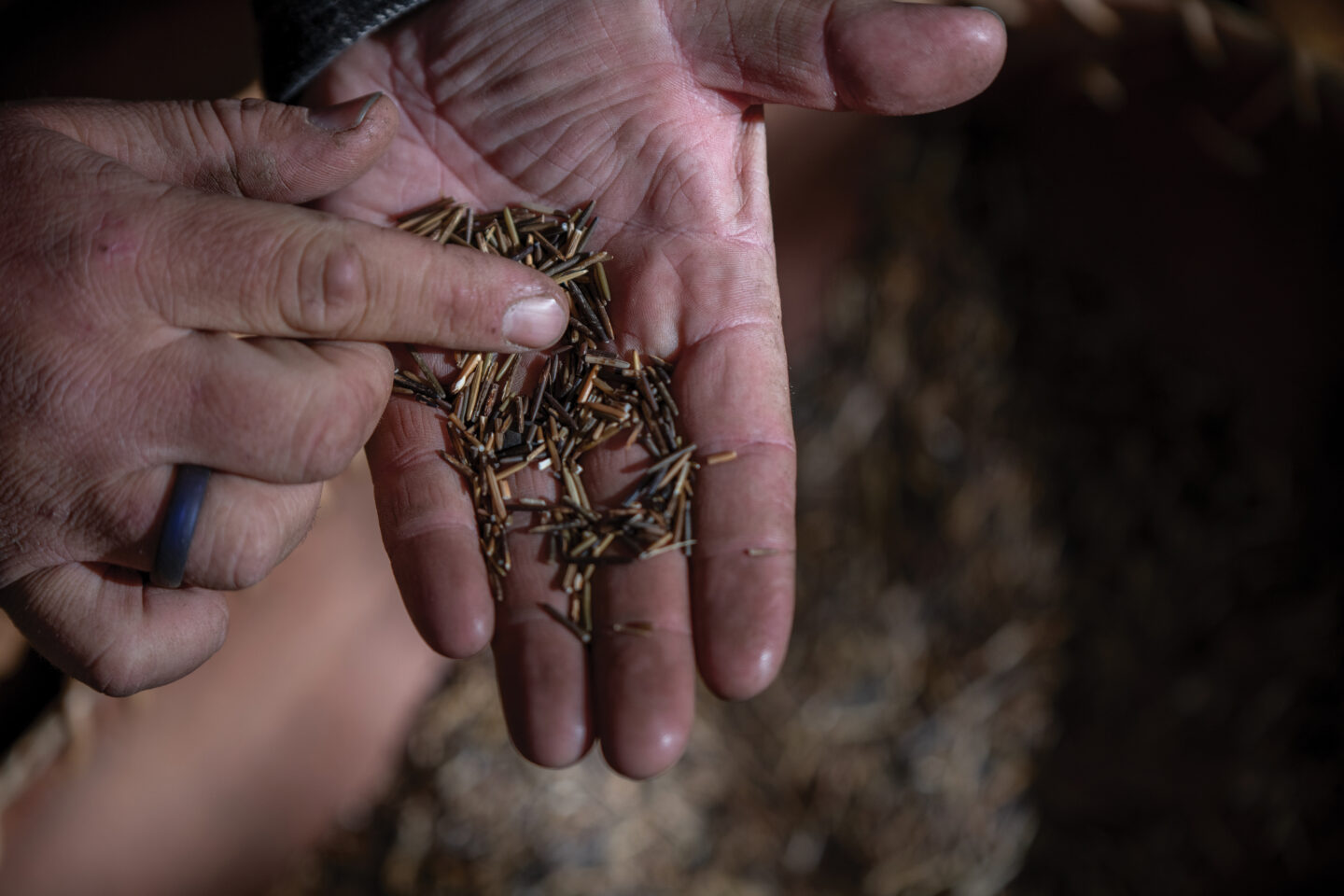
Manoomin, also known as Zizania aquatica or Zizania palustris to scientists and as “wild rice” in English (although it is not a rice but actually North America’s only native cereal grain), thrives in the shallow and slow-moving fresh waters of the Great Lakes. Because Manoomin needs to be reseeded every year, it does best when it lives in relationship with human and non-human relatives that help to move the seeds around.
While communities have variations on the spelling of Manoomin (Manomin, Mnomin, Mnoomin), they all carry a similar translation. To the Anishinaabeg, Manoomin is “the good berry” or “the good seed” and is an important grain that they have cared for, relied on for sustenance and honoured in ceremony since their migration to the region thousands of years ago, when they came in search of the prophesied “food that grows on the water.” Manoomin continues to offer a path for the Anishinaabeg today — now to a sense of belonging, cultural connection and fulfillment of their original instructions from the Creator to be caretakers of the land and waters. When they translate Manoomin as “the good berry,” the “goodness” that the name refers to is the beneficial relationship to the Anishinaabeg and all their relations. They truly mean that this seed represents only goodness: for your body, for the animals and for the environment.
Billy Whetung points towards the Manoomin growing in the middle of the water, a patch he estimates to be about 180 metres wide, remarking that his Elders say there was a time when Chemong Lake used to be so full of Manoomin that there were only a few small paths through the plants, just wide enough for canoes to move through. “My Elder told me, from the beach, as far as you could look down this lake was rice.” But the Manoomin was flooded and nearly decimated by the rising water levels that accompanied the addition of the lock and dam systems along the Trent-Severn Waterway. “My Uncle James [Whetung] travelled to Ardoch and got rice seed and reintroduced it to Curve Lake waterways about 40 years ago,” says Billy, “and it’s just now come back to the point where we can have a community harvest each year.”
Adds Ryerson, “One of the big reasons why they [flooded], specifically these lakes, was a tactic by the government to get rid of the Indians. Because that was our main food source, and if we didn’t have that, why would we want to live here?” If the water levels are raised before the Manoomin shoots poke out of the water, the plant doesn’t have enough energy to grow through the water and reach the air. But once it passes the water’s surface, in the “floating leaf” stage, around June, it needs air to continue growing, and if the levels are raised at this point, the plants will drown. Conversely, if the water gets lowered later in the summer, when the plants are standing tall, the stalks will fall over and possibly break.
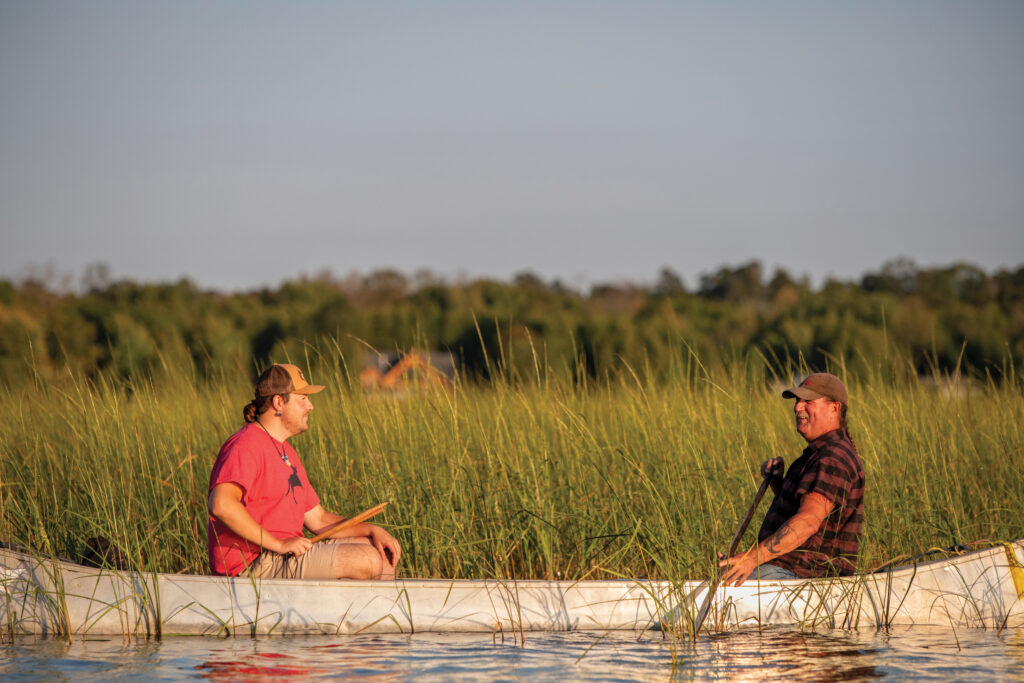
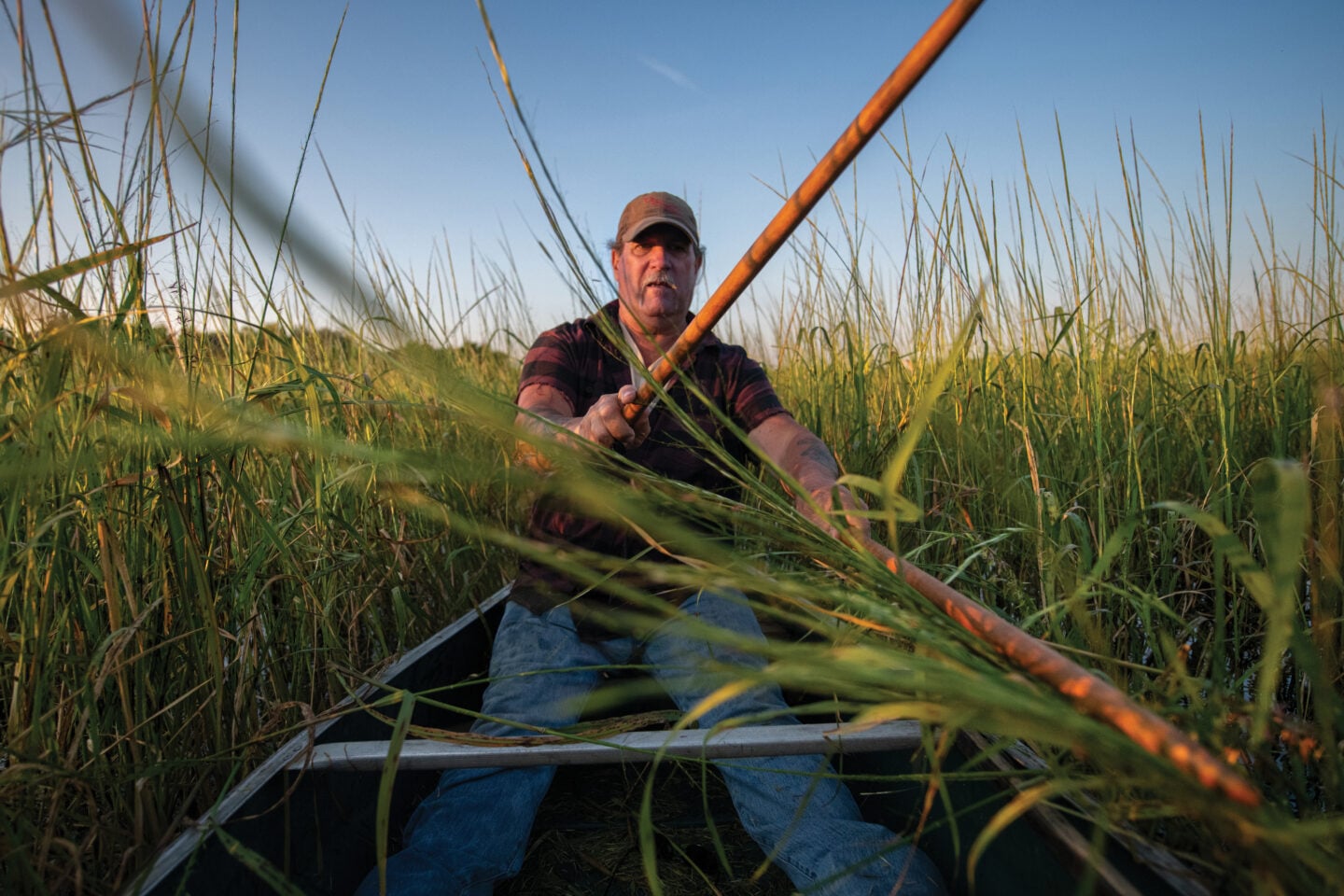
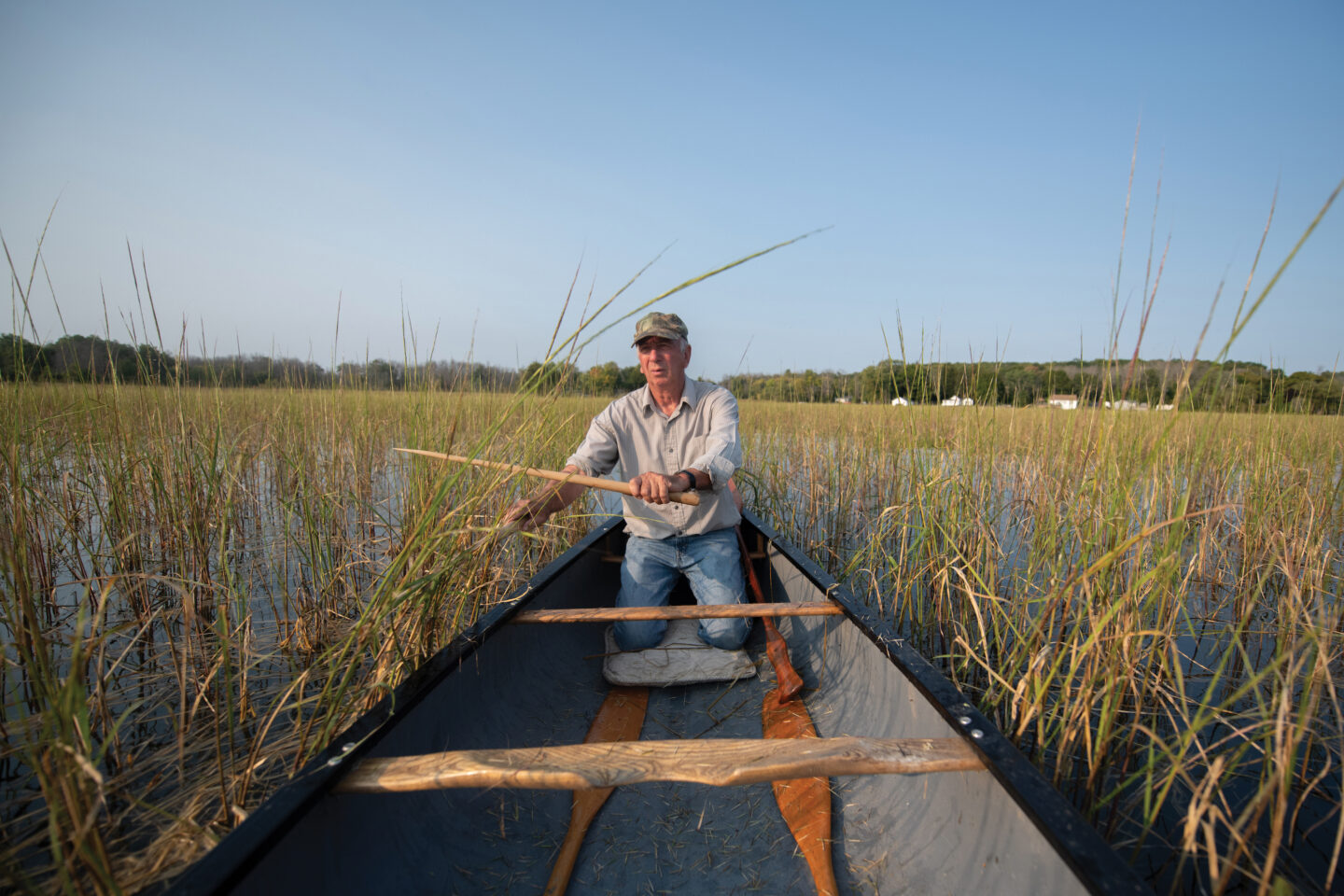
A speedboat zooms past the men, rocking their canoe, but the relatives pay no attention as they talk and joke back and forth. Billy joins his nephew in the boat with the ease of an experienced canoer and takes up his position paddling, while Ryerson holds two cedar “rice knockers” or “thrashing sticks” at the ready. “Gathering,” “ricing” and “knocking” are all terms used by “ricers.” In Anishinaabemowin, “our word is bawaam,” says Ryerson, explaining that it means he or she knocks rice. “You’ve got your ricing sticks, you’re hitting that rice, and what’s that sound you’re hearing? BA-WAAM!”
As they glide through the Manoomin, Ryerson reaches behind with one arm, pulling a small bundle of the plant over their canoe with one wooden stick, using the other to tap, carefully knocking down twice — bawaam! bawaam! — on the bent stalk, scattering the ripened seeds around his feet in the bottom of the canoe. A few land back into the water for the animals to eat or to reseed the plant for future years.
Billy picks his canoe paddle up high out of the water, over the tops of the Manoomin stalks, taking care to disturb them as little as possible as he pulls the canoe slowly through the aquatic garden. The two men move back and forth, back and forth, until only the tops of their heads are visible, and then they disappear into the Manoomin entirely. Back at the shore, they bag up every last grain of Manoomin from the bottom of their canoe as the sun ducks behind the treeline, leaving traces of light pink just above the horizon and a nip in the air.
The harvest season begins as the Manoomin seeds turn from green and milky to a reddish-brown colour in the late days of August and early September. The plant ripens slowly from the top of the seed head to the bottom, over several days or a couple of weeks, so this patch can be revisited in a few days to gather again. But the window for collecting Manoomin is short, typically only about two weeks long, and can be difficult for families to accommodate around the start of the school year.
The transmission of knowledge and seasonal access to the Manoomin harvest was greatly disrupted when Anishinaabe children started being forced to participate in the colonial school system. “Residential schools made it exceptionally difficult for families to pass down their plant knowledge and their plant teachings on the land and in season,” says Brittany Luby, professor of history at the University of Guelph and a descendant of Niisaachewan Anishinaabe Nation in Treaty 3.
Settler colonialism brought the suppression of Indigenous hunting and gathering rights, along with growing human interference along waterways. These impacts, as well as climate change and invasive species, threaten the plant and have even caused it to disappear from certain lakes and rivers. Even still, every year in late summer, families in Anishinaabe-Aki get into their canoes to gather, honour and feast on Manoomin. And bringing in a canoe full of Manoomin is only the start of the work to prepare to eat, sell, share, trade and reseed the plant for future generations.
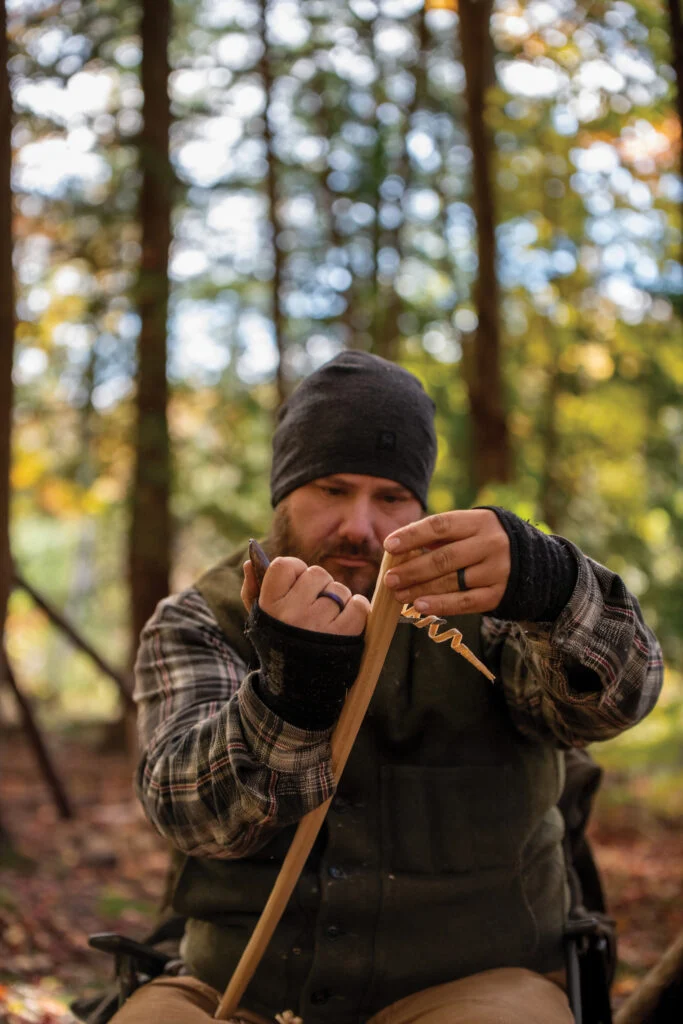
Through a clearing of trees off a dirt road in Hiawatha First Nation, Caleb Musgrave sits by a fire carving a cedar rice knocker, a basket full of Manoomin at his feet and a large kettle warming in the fire.
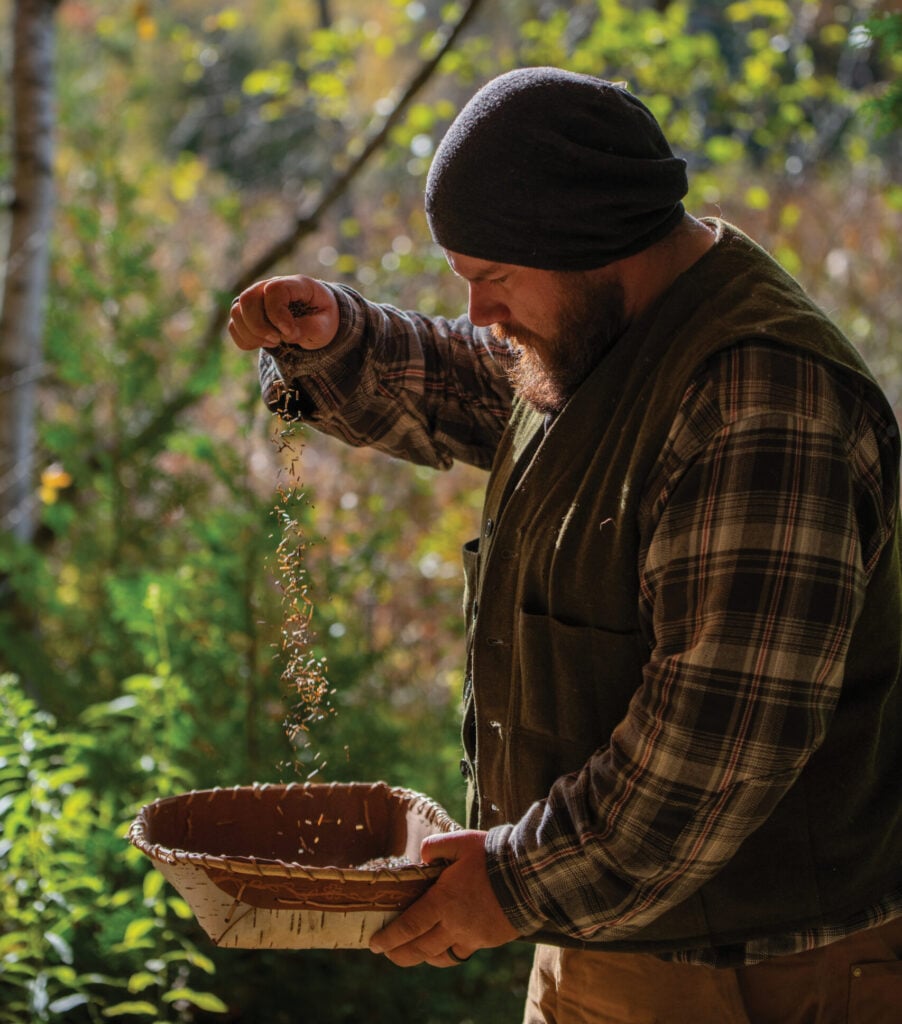
As part of his complex network of land-based knowledge, Musgrave has spent more than 15 years honing his skills in Manoomin parching, which he says is the most delicate step in processing Manoomin. “This batch that I have in the basket was gathered four years ago,” says Musgrave. Dry Manoomin “can keep for a long time until you’re ready to process it.” After gathering, he submerged the bags of rice in water for a couple of days to kill off the rice worm moth that will eat away at it, and then laid the wet seed on a tarp, exposing it to sun and wind until it hardened and became tough enough to withstand the force of processing.
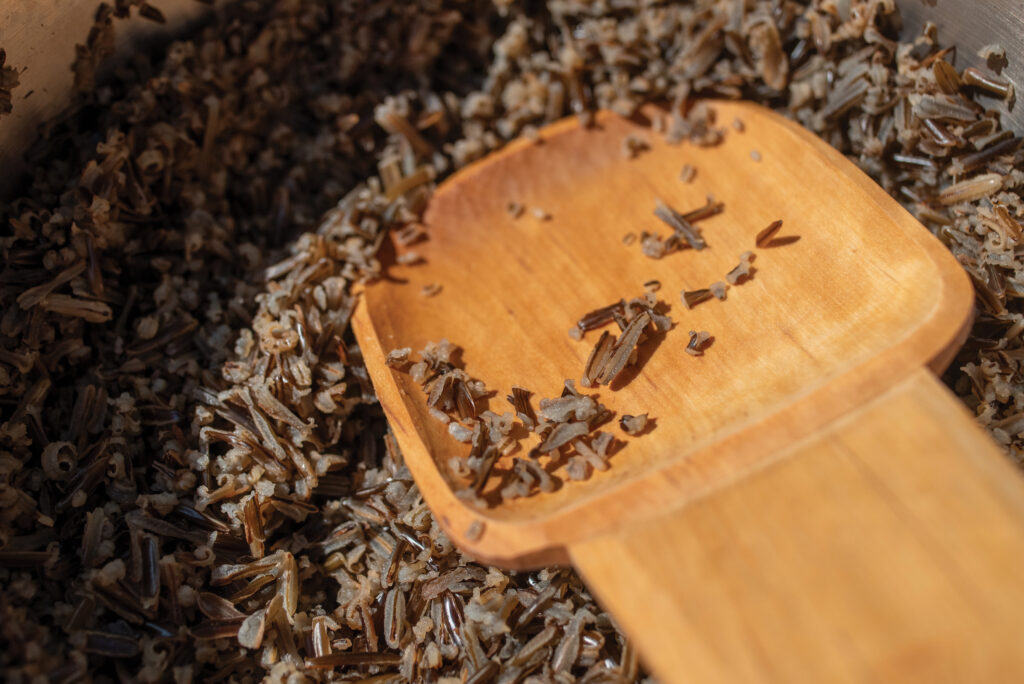
As Musgrave throws the seeds into the kettle, they have the colour and smell of a handful of straw or dried grass. He watches closely to see how the Manoomin moves, never looking away as he stirs it gently with a wooden paddle. As the tails start to get charred off and break down and oils are expelled from the seed, the Manoomin takes on a more fluid motion in the large cauldron and releases a rich nutty, oily smell. A good parcher must engage all their senses, observing how the seeds look, smell and move and continuously adjusting the temperature of the fire. Even the sound changes.
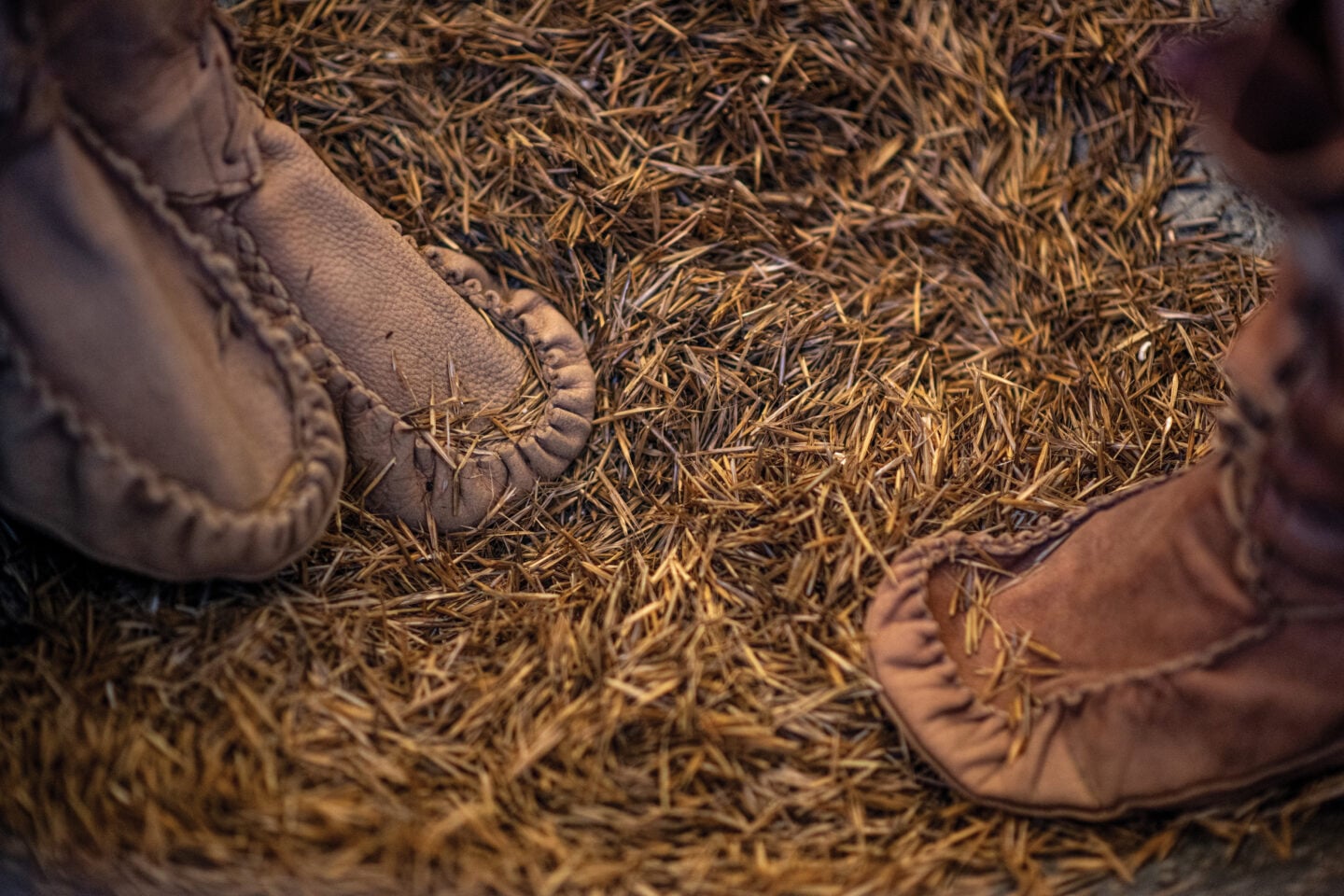
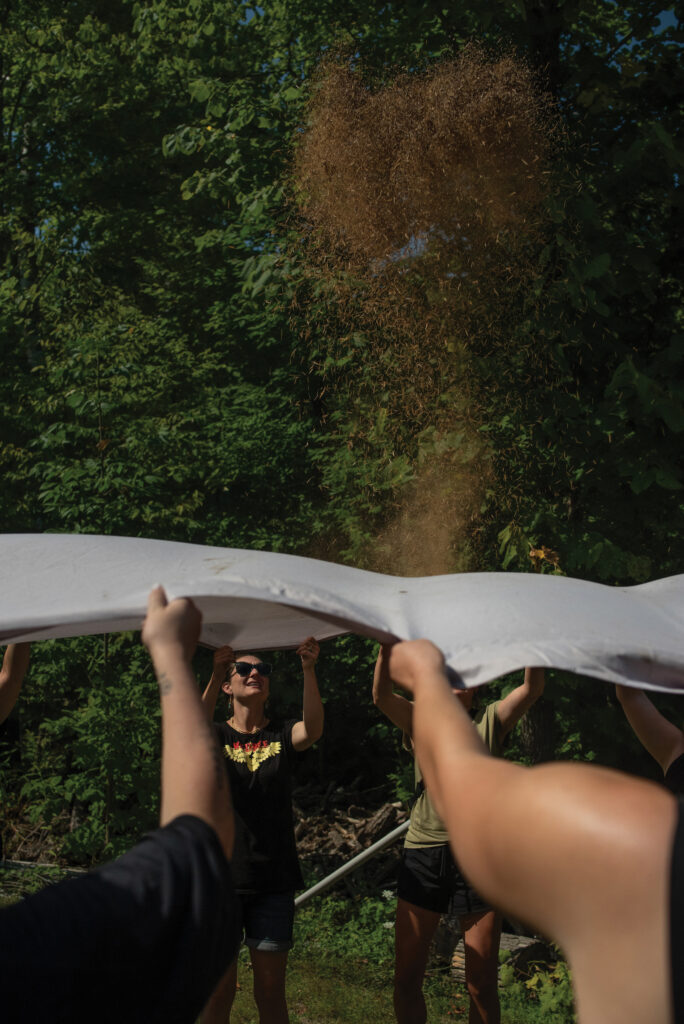
After the parching, children would often be the ones to lace on their moccasins and dance or jig on the Manoomin — stepping on the parched seeds to thresh them. The grains are placed in a shallow pit or hole in the ground lined with hide or a tarp and then stepped on until the friction loosens the inedible seed coat from the kernel inside. Then they are gathered up to be winnowed, and on a day with a nice breeze, the loosened husks and chaff will blow away, leaving just the edible seed, ready to cook and enjoy.
Luby emphasizes that in Manoomin camps, each community member has a place, and children learn about their roles and responsibilities within the community and the ecosystem, in caring for the waters, plants, animals and future generations. Even something as simple as children’s joy is seen as integral to their operations, as the sound of their laughter and play scares away larger animals like bears and keeps the community safe.
The intergenerational space also instills a sense of belonging; as children carry the knowledge that their ancestors have seeded and cared for the Manoomin, they see that they, too, will do so for future generations. “You can see people at different life stages contributing to their community, and you know you will always belong and have a role,” says Luby. “How you participate may change over time, but for as long as you are in your earth body, you know you have something that you can give to your community.”
Within that sense of community are also the non-human relatives that benefit from sharing their environment with healthy Manoomin patches, including many species of birds that feast on and help to spread Manoomin in their beaks and feathers as they travel to different waterways. In return, the plant provides protection, habitat, breeding areas and nesting materials. “Thousands of species are partially or tangentially dependent on Manoomin,” says Musgrave. It also filters phosphates, nitrogen, potassium and other nutrients that flow from farmlands down into our rivers and waterways. Manoomin, says Musgrave, is “the kidneys and the liver of our waterways.”
When settlers arrived, they were threatened and taken aback by the independence and sustainable lives of the Anishinaabeg, fearing that there was nothing they could offer the people to motivate them to act in accordance with their religion, law and desires. Luby and her father, Allan Luby, who joined our conversation over the phone, have spent hours listening to stories about Manoomin from Elders in Niisaachewan. Allan recounts instances where a treaty commissioner said it was difficult to negotiate with Treaty 3 because of their abundant food supply. Harming the environment to starve Indigenous Peoples became a significant tactic of colonialism and land acquisition.
“We were, for a period of time, able to feed and to raise warriors to defend the territory. And when you jeopardize somebody’s food supply, you jeopardize their ability to raise healthy families,” says Brittany Luby. In 1873, when the community was negotiating Treaty 3 with the newly federated Canadian government, the leaders of Niisaachewan Anishinaabe Nation communicated their worry that food was becoming more scarce where it was once plentiful in the rivers and their wish that the rivers should be left as they were.
In the Trent-Severn Waterway, there has also been great cultural and economic loss to surrounding Anishinaabe communities. “Up until the completion of the Trent-Severn lock system, we had an average annual harvest of 10,000 bushels per year from Rice Lake alone. That’s over half a million kilograms harvested annually, all done with canoes and ricing sticks,” says Musgrave. “The financial independence and economic sovereignty of this community was stolen to build a lock system that was immediately obsolete when it was completed.”
To the Anishinaabeg, Manoomin is “the good seed” and is an important grain that they have cared for, relied on for sustenance.
Despite Manoomin being such a delicate plant, Anishinaabe communities successfully maintained its ecosystem until settlers started to manipulate the waterways. “The oldest [Manoomin] fossil that I’ve heard of was located in northeastern Minnesota, and it dated back 10,000 years. So, it fits with our migration story,” says Jeff Beaver, an avid ricer from Alderville First Nation who has been working on community Manoomin research for over 30 years. Archeologists have found evidence that people have been processing and cooking Manoomin for at least 2,500 years and that communities are still using many of the same methods to harvest, process and cook Manoomin today.
“Jeff Beaver is, for the Mississaugas of Rice Lake, the closest person we have to a ricing chief,” says Musgrave. “When it comes down to Manoomin in this territory, I defer to Jeff for everything. If he says, ‘don’t pick in this area,’ I don’t pick in that area. If he says, ‘go and gather over here next week; it’ll be ripe by then,’ guaranteed it’s going to be ripe by then.”
After moving around the country and working as a Parks Canada warden for 14 years, Beaver returned to Alderville in 1988 and became involved with Manoomin research before moving into full-time monitoring and management of the rice beds around 2008. He maps and restores the beds in the surrounding lakes and works with nearby schools to educate and offer students and community members hands-on experiences with Manoomin.
“We go around with a GPS unit, so as you paddle it’s tracking you,” says Beaver. He’ll paddle around the perimeter of a rice bed so they can track which way it’s spreading from year to year and reseed the beds in that direction. He also monitors the Manoomin beds to inform the community when it’s ready to harvest. His restoration and monitoring work is funded within the community, something Beaver says is better than relying on provincial or federal government funding that might fluctuate or disappear from year to year, leaving them with missing data.
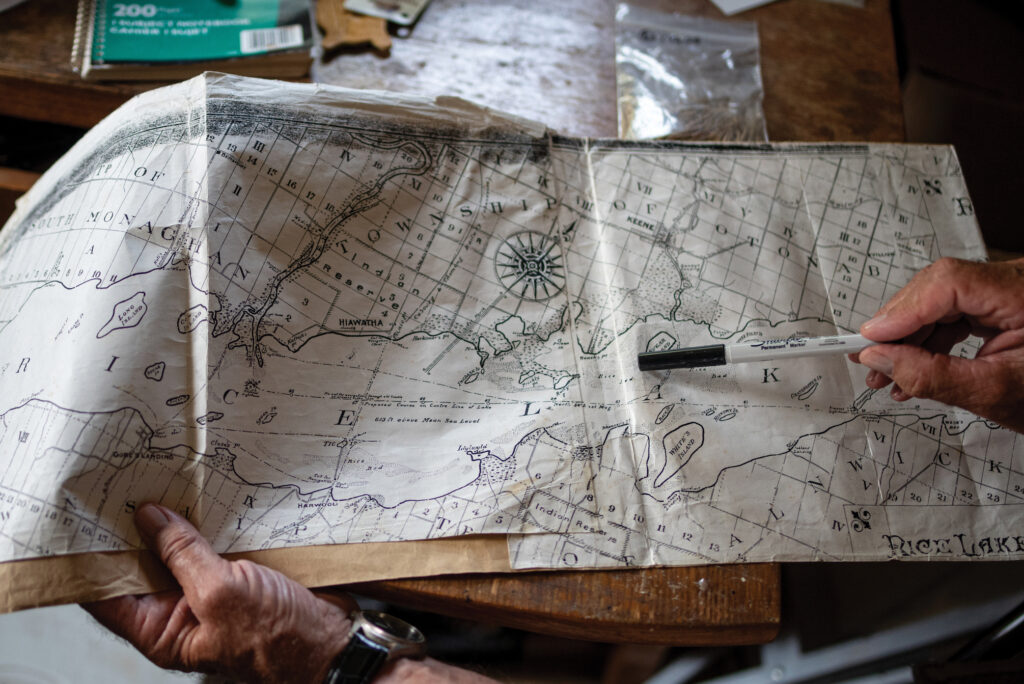
From the back room of his family’s craft store in Alderville, Beaver pulls out old photos, newspaper clippings and maps from the archive he has compiled of community knowledge on Manoomin. On an old wooden desk, he unfolds a large map of Rice Lake, named for the Manoomin that used to be plentiful in the 28-kilometre-long waterway between Hiawatha and Alderville First Nations. Someone has written 1938 on the map, but Beaver believes it could be older. “The shaded areas — that’s where the rice was on Rice Lake,” says Beaver, circling the large, dotted areas labeled “rice bed” with the end of a pen, “There were still 2,500 acres [1,011 hectares] left when this map was made. It wasn’t long after that that it was all gone.”
“If you can educate people about it and the value of it, maybe they won’t
Before the Manoomin was decimated, people used to travel by canoe from all over to gather in Rice Lake. Beaver hopes to restore the rice beds to a state where that will be possible again. His other hope is to educate people about Manoomin and its importance to the Anishinaabeg but also to the greater ecosystem. “If you can educate people about it and the value of it, maybe they won’t be so anxious to destroy it,” he says, referring to its mis-identification as a weed by cottagers who pull it out of the waterfronts. Beaver has worked with willing cottagers to make channels through the Manoomin so they can move across the lake in their boats with the least amount of disruption to rice beds as possible.
With his canoe loaded up in the back, Beaver gets into his truck, headed towards the water for another day of work. “Hopefully it hangs on,” he says, looking up to the cloudy sky. “If we get a big thunderstorm now, a lot of wind, it will probably blow it all off. It’s pretty delicate.” He doesn’t do much harvesting himself these days. The rice he gets from Rice Lake, he throws back in to increase the size of the patch. His goal is for there to be enough Manoomin in Rice Lake that all of the surrounding communities will be able to harvest there once again. “It’s going to be nice if we get a full bed there. That might be about half a square kilometre in one spot, maybe a quarter in another. If we had that much rice, that’d be enough.”
The effects of his work might not be seen right away, but it’s a labour of love and care for the future generations in his community. “We get only 10 per cent of what’s actually there, doing the two-stick method, so the rest of it just goes back into the water. That’s your seed for the future,” he says. “Not every seed comes up right away. They can lie dormant down there for a while, until the right conditions come along. Even if you don’t see any rice this year or next year, you’ll know it’s all down there. Just wait for the right conditions to come along, and it’ll come back.”
Biinaagami is a Can Geo collaboration connecting people with the Great Lakes-St. Lawrence watershed. Learn more at biinaagami.org
This story is from the Biinaagami Special Issue 2025 Issue
People & Culture
Grounded in Indigenous methodologies, Manomin examines our interconnectedness with the natural world

People & Culture
Announcing a new initiative to connect to and protect the Great Lakes-St. Lawrence watershed

People & Culture
How three organizations have come together to promote urban swimmability and change our relationship with water — one plaque at a time
Wildlife
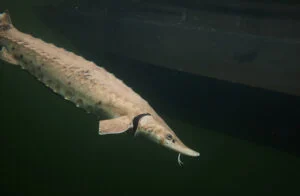
Lake sturgeon populations have plummeted in the Great Lakes watershed. Here’s how First Nations are collaborating with scientists to save an ancient relative.