
People & Culture
How Gander’s airport brought Newfoundland into the 20th century
A writer follows his relatives' path across "The Rock", 80 years after they helped put it on the map
- 671 words
- 3 minutes
People & Culture
Originally published in the July/August 2016 issue of Canadian Geographic, this story dives into a city that was built on aviation, and was made famous for its role in the wake of the September 11 attacks. But after 80 years, what does the future hold for Gander and its famed airport?

You should fly, if you’re going to Gander, in keeping with the town’s rich aviation history and maybe out of respect for its famous airport, which turns 80 this year. I drove. My reasons were (a) scheduling and (b) ancestral, which is to say that (a) I couldn’t find a flight to fit my week and (b) I felt a duty to follow my great-uncle’s trail.
Today, it’s a town of 11,000 and Newfoundland’s seventhlargest municipality, but there was no Gander when Maurice Banks came to pre-Confederation Newfoundland in August 1935, for the good reason that he was one of the British aviation officials sent to summon it up out of the weather and wilderness. Four years later, it was home to the world’s largest airfield. Another decade had almost passed before there was a town. From the start, this was a place like no other in Newfoundland. “The rest of the province was essentially founded on fish,” says Reg Wright, the Gander-born CEO and president of the airport. “But we were founded on the air.”
Historian Frank Tibbo may know more than anyone about Gander. He still marvels at the unlikelihood of the place that’s been his home for 60 years. “People were just amazed to come upon this place called Gander,” he says of the town’s earliest days. “Where the hell did it come from?”

Start with mathematics. You don’t need to know words like orthodromic or geodesics on an ellipsoid to understand how Gander fits into what’s known as the Great Circle Route. Moored out where it is in the Atlantic Ocean, Newfoundland is 1,500 kilometres closer to Europe than Montreal or New York is, which made it the most convenient place to land and refuel for transatlantic flights.
That’s why Newfoundland’s skies started filling up soon after the First World War. The first men to fly non-stop to Ireland, John Alcock and Arthur Brown, took off from St. John’s in 1919. In the 1920s, local newspapers teemed with news of pilots overhead in contraptions often preceded with the less-than-reassuring adjectival formulation heavier-than-air. In 1932, Amelia Earhart launched her historic solo flight across the Atlantic at Harbour Grace. A year later, Charles Lindbergh stopped by, scouting for likely airfields on behalf of Pan American World Airways.
As the 1930s progressed and aircraft technology developed, questions of influence and strategic advantage moved to the fore. Britain had commercial designs of its own, and the government was soon partnering with the private Imperial Airways to establish a worldwide aviation network. Newfoundland was at this time its own sovereign dominion and there are those who’ve argued that when Britain took back economic control the year of Lindbergh’s visit, air routes and landing fields played a large part in their calculations. Passenger service was a piece of the eventual plan, but more immediately there was mail to deliver, and cargo. The fact that officials weren’t talking openly about future military uses doesn’t mean that they weren’t top of mind, too.
Linked to the world beyond like no other place in Newfoundland, Gander had a different spirit to go with its outlook.

This is where my grandfather, Donald Banks, enters the frame. In the First World War, he survived the trenches of the Somme. In the Second, he was the man in charge of lighting the English Channel on fire if the Germans tried to invade. That was a plan, post-Dunkirk: flood the coastline with oil and gasoline and spark it up. Between the wars, he headed Britain’s Post Office. It was in this capacity that he got involved with the Empire Air Mail Scheme. “A three-cent Empire air mail is the ultimate aim of the British Government,” he told reporters on a visit to Ottawa in 1935. Within the year, he’d move over to run the Air Ministry as its senior civil servant.
While he was fighting in France, his younger brother, Maurice, became a pilot in the First World War. When the war ended, Maurice stayed aloft, flying commercially
across Canada in the 1920s before joining Donald at the Air Ministry in 1935. As an operations officer, Maurice was a kind of roving airport prospector, tasked with putting bureaucratic plans into practice across Britain’s far-flung realm. Newfoundland was his first stop. “We gathered it to be a land of ‘Fogs, Ponds, Bogs and Dogs,’ ” he wrote later in an account of his explorations there, “and this proved to be the case.”
Like Maurice, I would have taken the train to Gander, but Newfoundland abandoned its railway in 1988. Highway fog tunnelled ahead as I drove the three hours west from St. John’s on the Trans-Canada. Completed in 1965, it helped put the train out of business. Past the turn for Heart’s Desire, past St. Jones Within. Ferocious is a word you sometimes see associated with the fog here, but this was more of a gauzy smother. It began to. disperse as I reached Clarenville, restoring trees and tuckamore to view, along with gleaming bight and bare landwash.
There’s a spirit in Newfoundland legend, the fog man, who’s supposed to orchestrate island weather. I’m not certain that he has any real folkloric standing other than with tourists, but Maurice does write about an actual living local that he and an Air Ministry companion were told they needed to talk to about where best to site an airport, a savant of the atmosphere known as Fog-Free Thomson.
They never did track him down. The Newfoundlander who did guide them was the engineer T.A. Hall. Lacking detailed maps, and without reliable long-term meteorological data, they set out.

A seaplane base was a priority: flying boats were the more reliable long-range aircraft at the time. Lindbergh had been to the Bay of Exploits, and the British scouts went there too. After studying the harbourmaster’s logs to learn the historical patterns of winter ice, they selected Botwood. For the main aerodrome, they divined about 100 kilometres to the east, near Gander Lake, bushwhacking in at a place known as Hattie’s Camp, Milepost 213 on the railway line, cutting trails through spruce, pine, birch and bakeapple as they tried to discern whether the plateau beneath the forest was suitable for runways.
Eventually a famous Newfoundland pilot, Captain Douglas Fraser, flew them over the site. He later told Frank Tibbo that he was the one to pick the site, but the selection seems to have been more of a communal effort, with a Newfoundland surveyor, Allan Vatcher, doing much of the decisive work of plotting elevations and clearances after the others had moved on.
Vatcher’s measurements went into a report Hall submitted to the Newfoundland government, along with some preliminary costing, including wages for the men who’d be arriving in the spring of 1936 to clear and excavate the site. A labourer might expect to earn 30 cents an hour, a blaster 34. A teamster could pocket as much 45 cents, though 20 of that was earmarked for his horse. In January 1938, Douglas Fraser’s Fox Moth was the first aircraft to land at Gander. By November, Newfoundland Airport was open for business.
Today, it’s not hard to drive right by Gander — the strip of hotels and Irvings and Ultramars fronting the highway is brief — but if you turn in, you’re soon in the thriving centre of town. Not far from the Fraser Mall, the drive-thru at the Tim Hortons abuts the Bank of Montreal, across from the Canadian Tire. Hockey nets lie next to pickup trucks in the driveways of the houses that line the streets named after famous international aviators. One of Gander’s prominent nicknames is Crossroads of the World, but at actual intersections in Gander — where Lindbergh meets Bishop, say — you could be anywhere in Canada. It was a different story in the early days. The war that broke out a year after the airport opened transformed the remote, new facility. By 1942, Gander was a hive of military activity, with as many as 10,000 personnel — Canadian, British, American — stationed there, along with fleets of bombers and transports, convoy escorts and U-boat hunters.
‘The rest of the province was essentially founded on fish,’ says the airport’s CEO. ‘But Gander was founded on the air.’
There was still no town when Frank Tibbo first passed through here in 1950: everybody who worked at the airport lived there, in barracks. The new town site was just starting to fill out in 1956, the year he came back to stay. That also happened to be the busiest year in the airport’s history, as Tibbo points out: even as Gander proper was ramping up to its heyday, the airport that put it there was already on the wane.
Tibbo was the one who showed me on the map how the original town plan traces the outline of a goose’s head — no one knows exactly whose idea that was — and it’s from his comprehensive local history that I know what they almost named Gander before they didn’t: Beaverwood, Airlandia.
It’s easy to immerse yourself in the rich lore of Gander’s milestones. First air crash: December 1940. First wedding: November 1941. First bomb scare: August 1957. Trespassers to have strayed into airport precincts: moose, a cat newly landed from Iraq, a polar bear. Not so easy to distil is a sense of what it’s like to live in Gander. Jamie Fitzpatrick is a St. John’s writer and broadcaster who grew up there through the 1970s and into the ’80s. “It was understood that the airport’s golden age had passed, but it still defined the town and its purpose,” he says. “It wasn’t quite a one-industry town, but close to it.”
Linked to the world beyond like no other place in Newfoundland, the town had a different spirit to go with its outlook. “Gander prided itself on being sophisticated and young, full of young families living large on the snazzy new industry of air travel,” Fitzpatrick says. “The town is older now, of course. But I think the idea that it’s a modern, youthful place still lingers.”
Part of this, Fitzpatrick says, involved a certain separation from the mainstream of Newfoundland history. “Someone’s granddad might take him out cod jigging when the family went out around the bay for a summer visit. But I never heard anyone express an interest in living on the ocean and eking a living from the fishery. Most of our parents would have viewed such a move as defeat.”

The airport business isn’t what it once was. It was in 1958, Frank Tibbo points out, that commercial jets began to dominate the skies. They didn’t need to refuel, and they weren’t diverting to Gander for the scenery. “The amount of landing traffic gradually decreased until there was practically none,” Tibbo says. “They were all flying over.” Pegging Gander’s existential worries that far back may be a little gloomy, but it does put its more recent struggles in perspective. In 2006, for instance, facing the burdens of a new federal airport act, the then-airport CEO mused about closing the whole show down. “If it has no worth to anyone,” he said, “then why are we beating a dead horse? Let it go.”
The Canadian government got out of running airports in the 1990s, which means that Gander is community-managed, on Ottawa’s behalf, under a long-term lease. “We’re essentially sink-orswim,” Reg Wright says. “So if we don’t make money at year-end, then we have to take remedial action to address that.” Airports are capital-intensive: an upgrade of one of Gander’s two runways can run to $10 million.

Commercial carriers still serve Newfoundland and Maritime destinations, and there are winter charters aiming for the sun in the south. Gander is home to a Canadian Forces Base, as well as to air ambulances and a fleet of water bombers. It remains a vital centre for air traffic. “Gander’s long been known as the lifeboat of the North Atlantic,” Wright says. “A quarter-of-a-million flights every year will red-circle Gander as their emergency alternate, in the event something develops.”
Meanwhile, the town has diversified. Claude Elliott, Gander’s mayor since 1996, says it still depends on aviation, but that’s just one sector of an economy in which the regional healthcare centre is now the biggest employer in town. “The challenges will be different than in the past,” he says. “It’ll be a challenge to keep the airport going. It’ll be a challenge to maintain our military base. To maintain your health-care facility. Your education. But right now? Gander is growing in leaps and bounds. Right now, we have the biggest elementary school east of Montreal: 1,000 kids.”
I’d had to wait to hear this. On his way to meet me, Elliott had found himself stuck in Friday-afternoon traffic. He wasn’t complaining. “We’re a service centre for 80,000 people,” he explained as we shook hands.
The fog man had settled a storm over Gander the day I last talked to Reg Wright. We were discussing the plan, first announced in 2014, to replace the airport’s large terminal building with a new “right-sized” facility. “The challenge in Gander is that we’ve inherited a building and a footprint that was built for a totally bygone era,” he said. “It’s almost like, you want to start a hot dog stand, and instead of buying a little cart, you’re operating out the back of a transport truck.”
Wright doesn’t deny that details have to be worked out, not to mention money raised. But he remains focused on making it happen. “A new terminal building guarantees Gander Airport’s future for as long as airplanes need airports,” he was telling me when he was interrupted.
He was back after a moment: his director of operations had just handed him a note to say that an Emirates fl ight, New Yorkbound, was heading in with dual medical and mechanical issues. He sounded as eager as you’re allowed to in a serious situation: this would be the fi rst Airbus A380 ever to visit Gander.
Wright quickly found his focus again: this new terminal is the key to Gander’s ongoing viability. “If we can get this thing taken care of,” he said, “I think we can start writing that next chapter.”
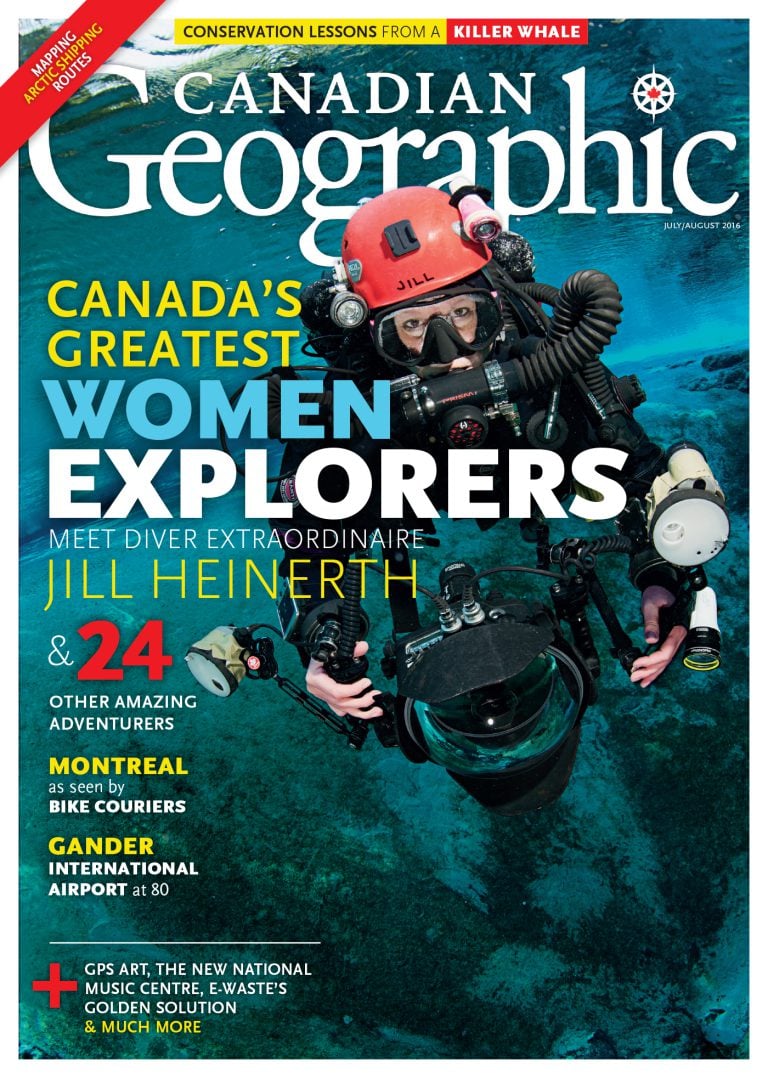
This story is from the July/August 2016 Issue
People & Culture
A writer follows his relatives' path across "The Rock", 80 years after they helped put it on the map

History
A new children’s book from the RCAF Foundation hopes to inspire the next generation of aviators

Exploration
The aircraft was discovered by an international dive team on a steep ledge nearly 50 metres below the surface of the lake in central Newfoundland

Travel
Immerse yourself in Viking archaeology and Basque whaling history while taking in Newfoundland’s scenic coastline and incredible geology