Environment
Inside the fight to protect the Arctic’s “Water Heart”
How the Sahtuto’ine Dene of Délı̨nę created the Tsá Tué Biosphere Reserve, the world’s first such UNESCO site managed by an Indigenous community
- 1663 words
- 7 minutes
People & Culture
As climate change dramatically reshapes their community, residents of Tuktoyaktuk, N.W.T. face difficult choices
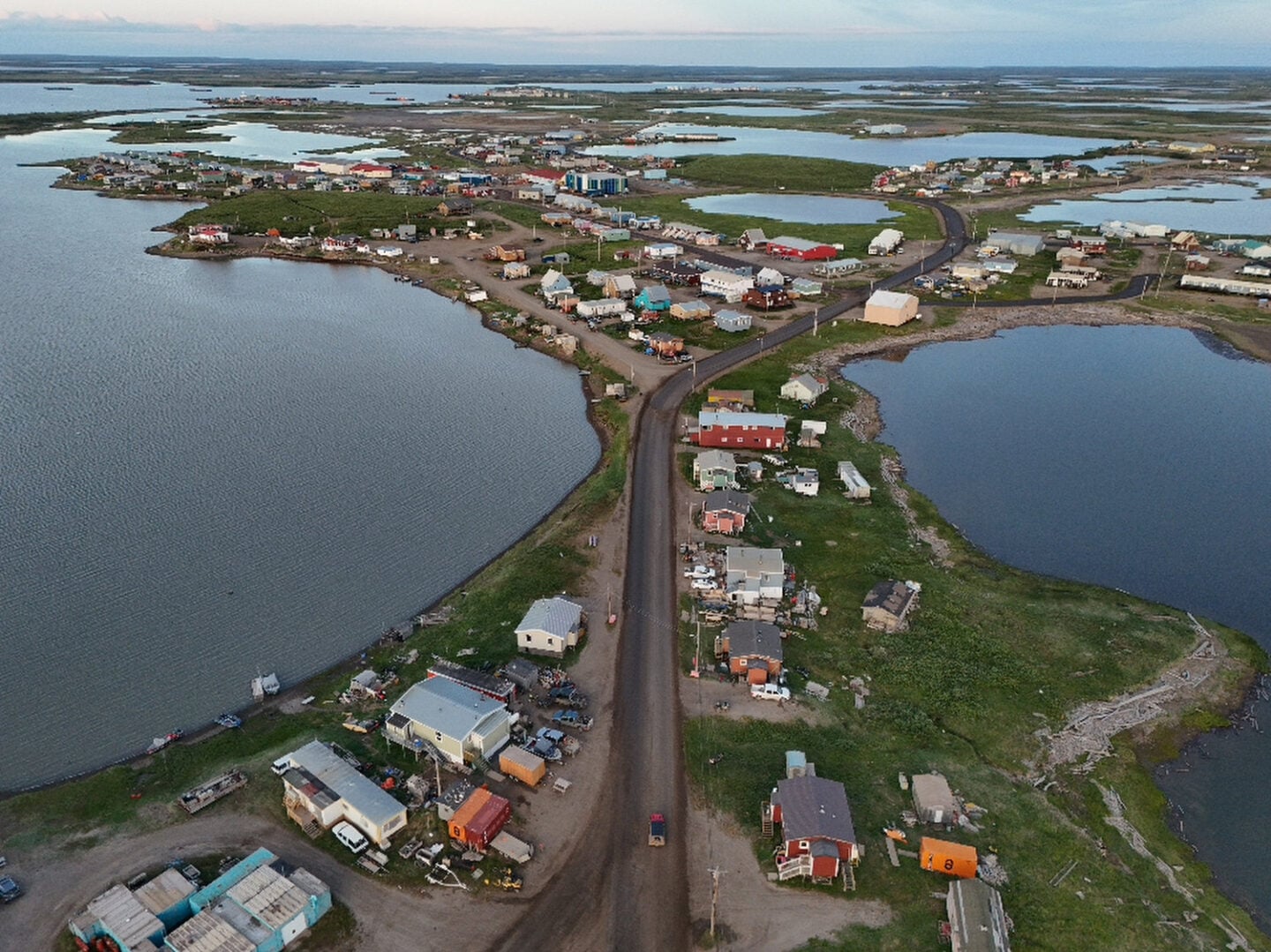
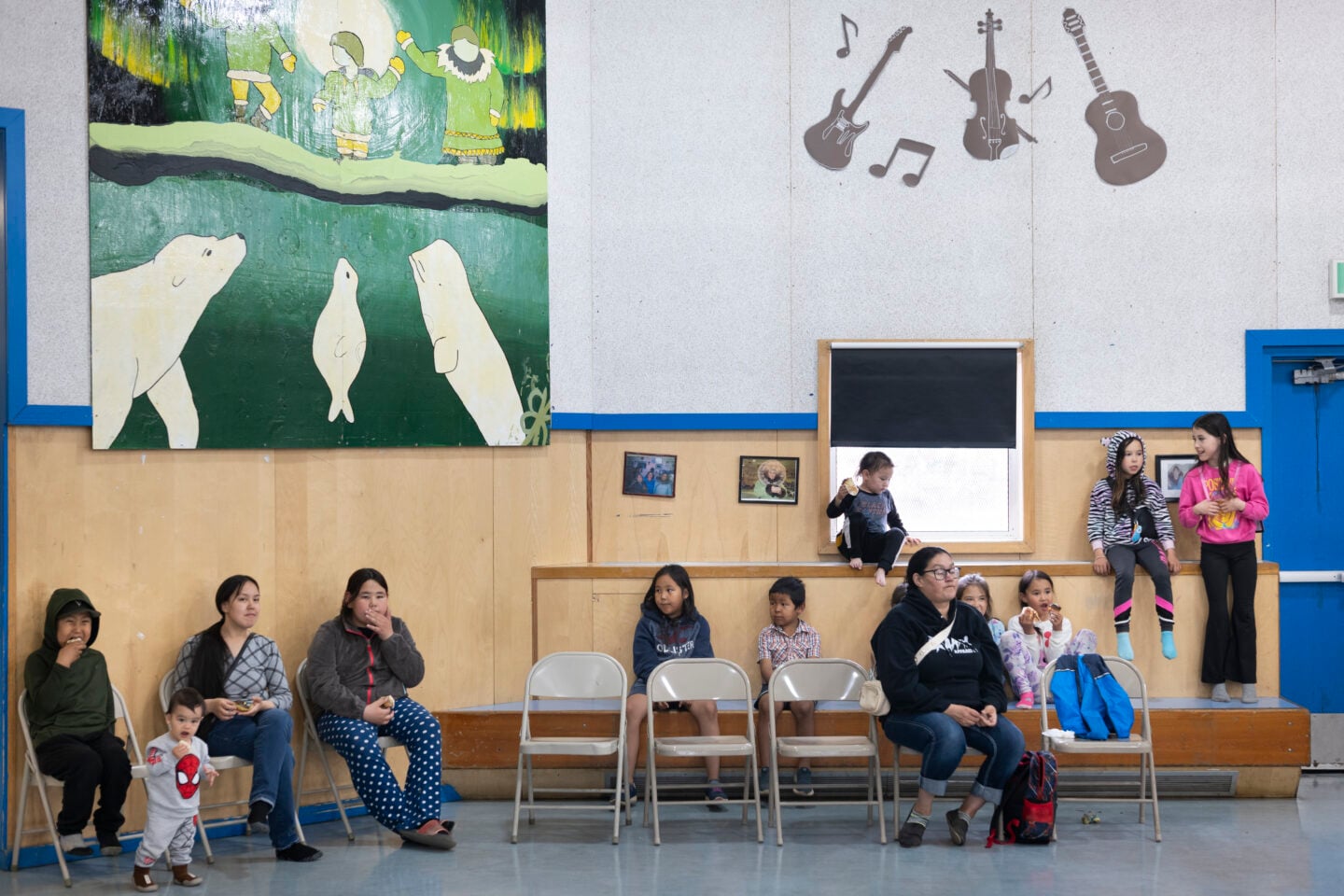
CHILDREN’S LAUGHTER ECHOES across the hamlet of Tuktoyaktuk while dogs that carry the wild genetics of wolves howl from their yards. It’s July, when the midnight sun refuses to set, and the air carries the rich, oceanic scent of freshly caught fish and harvested beluga whale. Families work together cutting massive slabs of meat into strips for drying and rendering the precious grease that will sustain them through the harsh Arctic winter ahead.
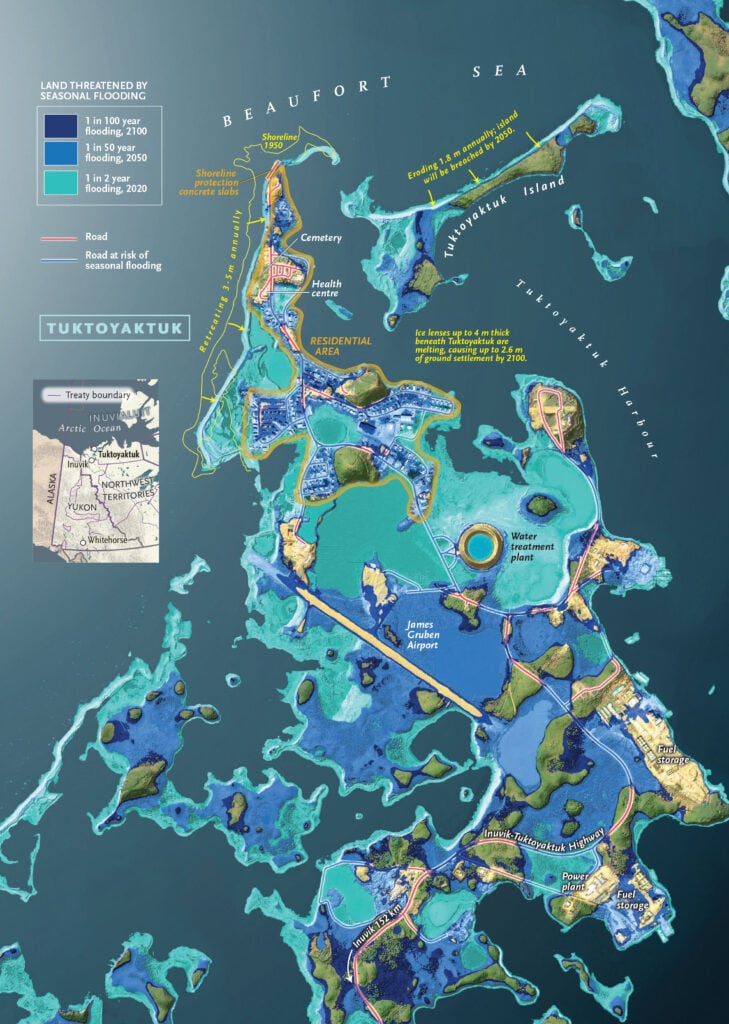
Built on stilts above the permafrost, the colourful houses of “Tuk” rise like defiant flags against the endless tundra, their foundations carefully engineered to dance with the frozen ground beneath without breaking it. The Beaufort Sea laps at Tuktoyaktuk’s shore with increasing urgency, each wave a reminder that time is running out for this small Inuvialuit community perched on the edge of the world. Storm surges roll in without warning, flooding streets and threatening homes, each one a preview of what scientists predict could be the permanent submersion of this community by 2050 — or sooner.
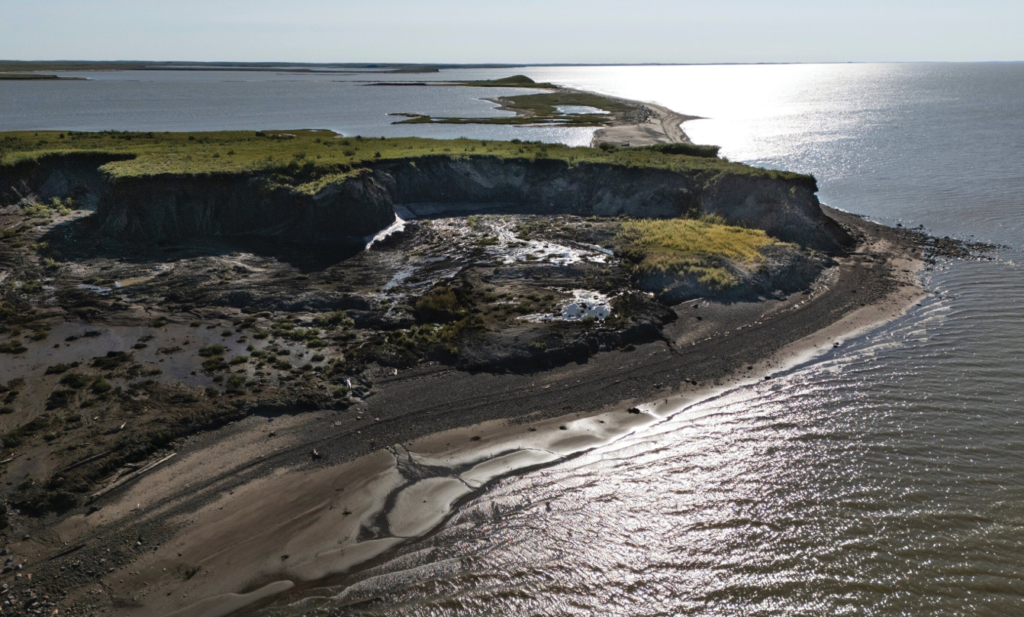
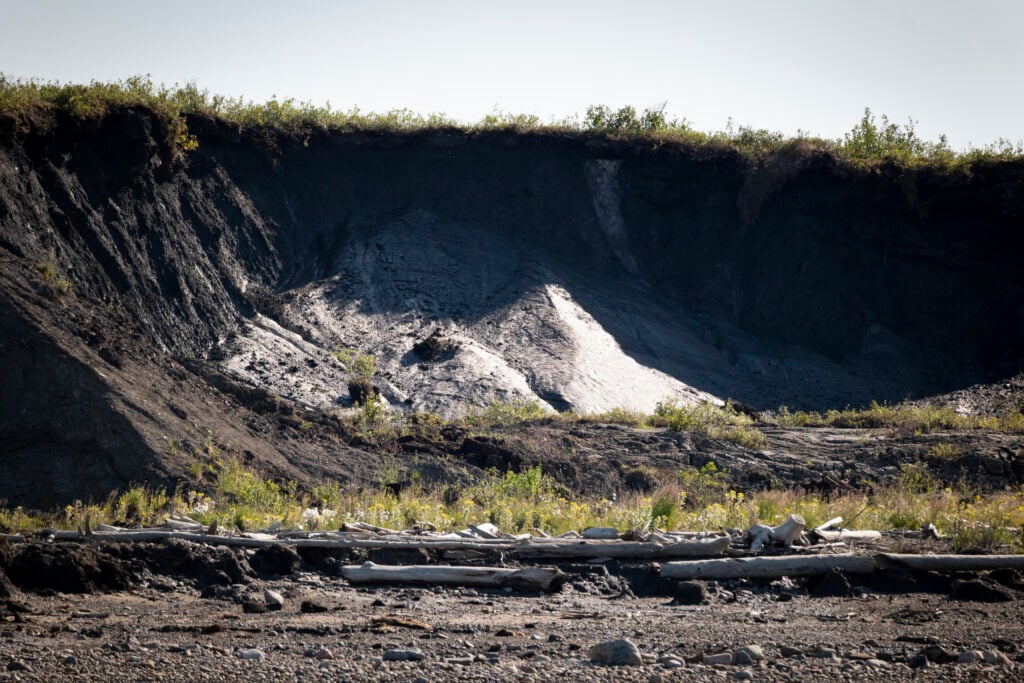
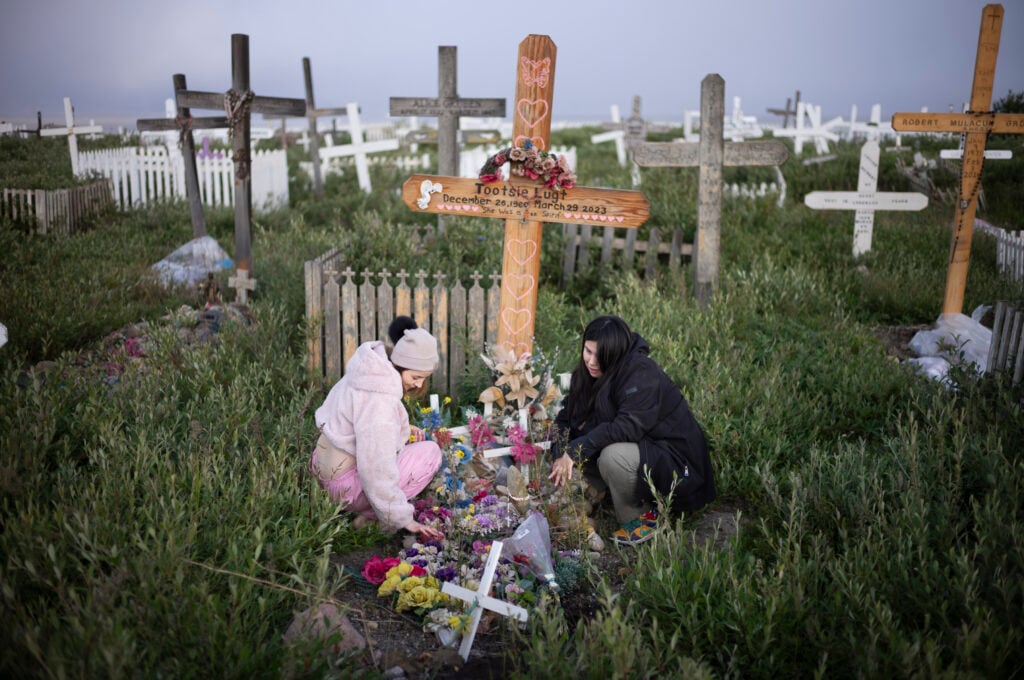
But the threat is more complex than rising seas alone. According to the Future Tuktoyaktuk project, the community faces an unprecedented convergence of climate threats. The west shore retreats by up to three metres annually, accelerating to five metres during major storms. Tuktoyaktuk Island — the natural breakwater protecting the harbour — erodes at 1.8 metres per year and will be breached by 2050. Meanwhile, permafrost up to four metres thick beneath the community is thawing as ground temperatures increase — up 2 C since the 1970s, potentially causing 2.6 metres of ground settlement by 2100. The Arctic Ocean itself is transforming, with shrinking ice coverage making way for waves of unprecedented height. This perfect storm of threats means critical infrastructure faces systemic destruction within decades. Scientists project the health-care centre and half of the cemetery will disappear within 50 years — forcing the community to confront not just relocation but the possibility of moving graves, something foreign to Inuvialuit culture.
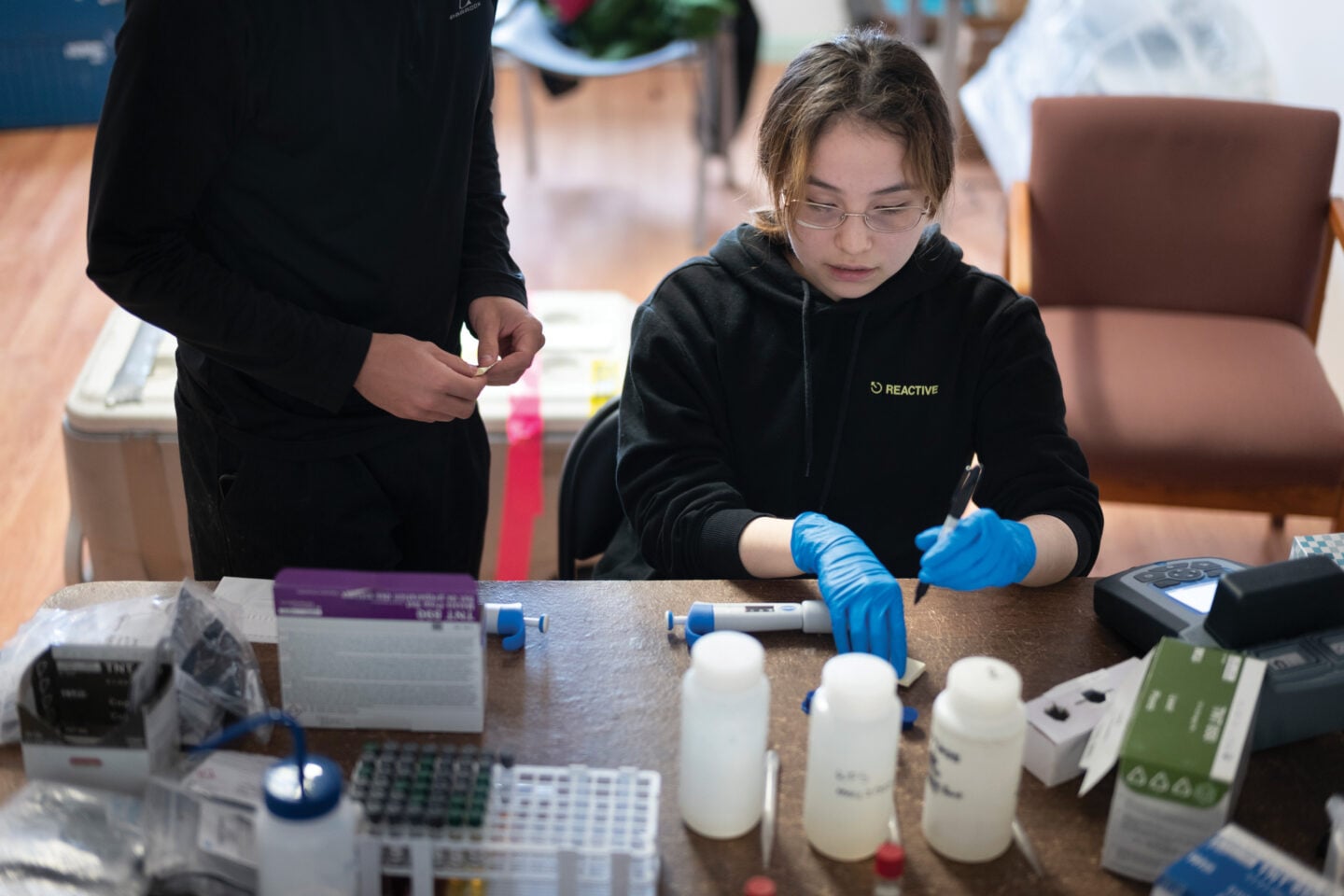
In her cramped, attic laboratory above the hunters and trappers committee office, Deva-Lynn Pokiak sits surrounded by water testing equipment and research papers, planning for the day her community might have to abandon everything and start over somewhere else. At 33, she carries the weight of an impossible job: she is Tuktoyaktuk’s relocation coordinator, tasked with preparing for a future no one wants to imagine.
“It’s stressful sometimes,” Pokiak admits, her voice steady despite the magnitude of her responsibility. “That’s why we need youth and people from the community involved — we need the Elders for their wisdom, youth for them to learn. And me in the middle.”
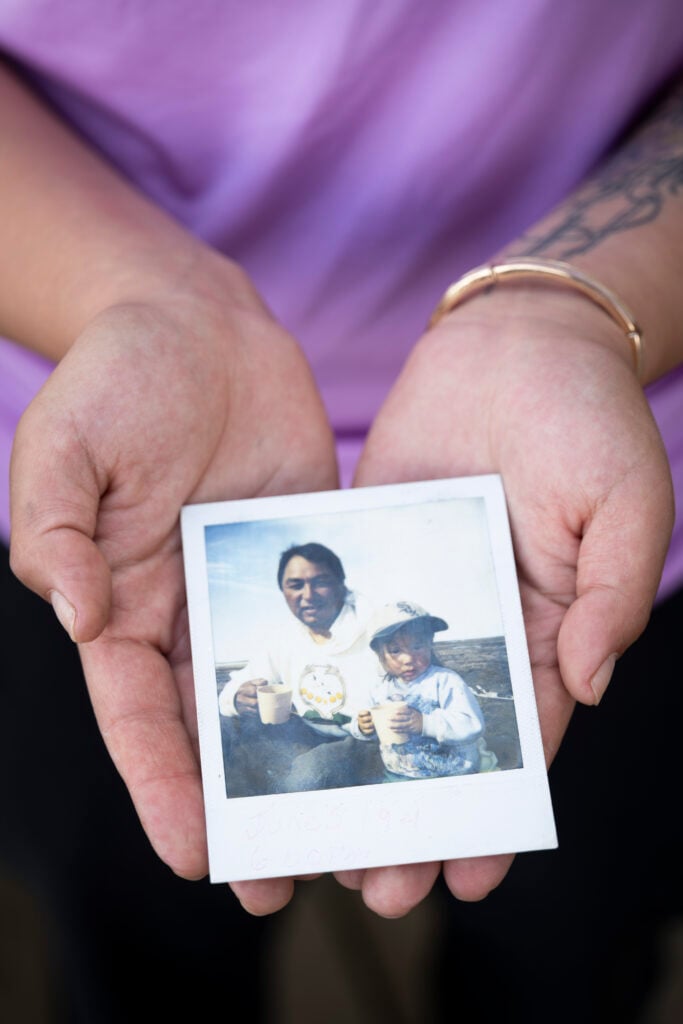
Pokiak learned to read the land from her father, Randal Boogie Pokiak, a well-known historian and community leader who passed away in 2020. Growing up, she followed him and her brothers across the tundra and ice, absorbing traditional knowledge that had been handed down for generations.
“In the past I was able to listen to my dad and his predictions were right, bang-on correct, like about the weather and the ice conditions,” she recalls. But climate change has scrambled those ancient patterns, making traditional knowledge less accurate than it used to be.
“Now that my dad has passed, I’ve seen these changes. My dad used to be the leader and I used to follow him all the time, along with my brothers. My dad would be out on his sled trying to follow the same trails he always had, but they were changing, and my brothers would go and find a new path.”
These changes are everywhere. Herring appear in July when they shouldn’t arrive until August. Geese hunting seasons are shorter. Navigation routes that worked for generations are now more precarious. The sea is angrier now. Where ice once held the waves back for months, open water stretches further every year, and the storms that move across it are growing in power and frequency.
“Everything has changed now due to the changing environment,” Pokiak says. “So, everything is adapting. What my dad told me was that when these changing things happen, the animals adapt, and then when the animals adapt, we adapt to animals because we hunt and harvest them.”
The urgency of Pokiak’s water monitoring work becomes clear as she explains what climate change is unleashing beneath Tuktoyaktuk. Erosion is happening on three fronts: waves physically tear sediment from the shore during storms, longshore currents carry that material away, and warming temperatures thaw the ground ice locked within the permafrost cliffs, causing them to collapse into the sea. The result is a coastline that looks visibly different from one year to the next, entire sections of land dissolving into the Beaufort Sea like sugar in warm water. And, as the permafrost thaws and erosion accelerates, mercury locked in the soil for millennia is being released into the water supply.
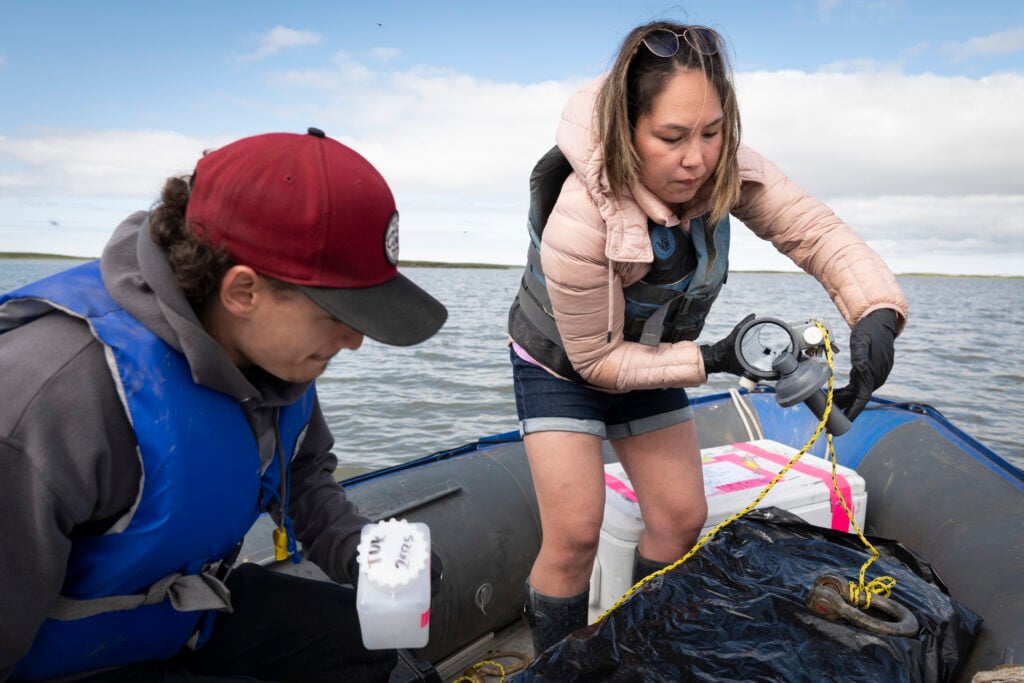
Pokiak’s attic space doubles as a laboratory for the Northern Contaminants Program, where Pokiak monitors mercury in the surrounding waters. Two young assistants work alongside her: Miley Wolki, who dreams of studying anthropology, and Gabriel Côté, a research student from Montreal. The makeshift lab reflects the community-led approach that has become Tuktoyaktuk’s new strategy for dealing with outside researchers.
“Research isn’t coming in here telling us what they need to research anymore,” says Pokiak. “They’re coming, asking us: what are our priorities and what are our needs and what do we want? What do you want us to research and monitor?”
This shift is the result of years of advocacy from the community’s leadership against extractive research practices. “We have strong leadership because they pushed back and said, you know, ‘no more research until we get what we need back from you,’” she says.
“The reason why we decided to study the water is because people are concerned about their waterways and is it affecting the marine ecosystems,” she explains. “A lot of the mercury is coming from the [Mackenzie] river and also mostly from erosion. Mercury is in the soil, deep in there.”
Pokiak’s work fills a crucial gap in understanding Arctic contamination. While researchers have been monitoring mercury in beluga whales for years, “the beluga travels all over, so you don’t really know where the source is coming from.” By testing water at specific locations — river mouths, erosion sites, areas with no erosion and places with industrial legacy waste — Pokiak’s team can pinpoint contamination sources.
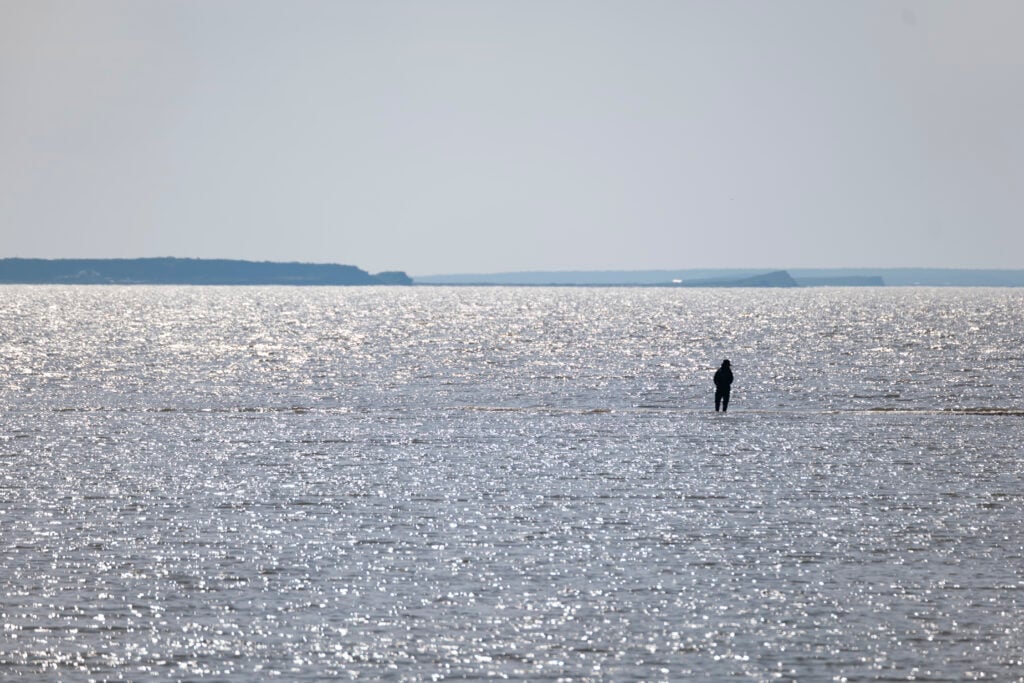
The water samples collected in boats on choppy Arctic waters get shipped south to Environment and Climate Change Canada labs in Ontario for analysis. Pokiak is also planning to test for microplastics, adding another layer to the monitoring of her community’s changing environment.
POKIAK’S ROLE as relocation coordinator has taken her to Alaska, where she’s met with communities that have already faced the choice Tuktoyaktuk may soon confront. Pokiak has visited Newtok, a Yup’ik village of about 300 people in western Alaska, which became one of the first communities in North America to fully relocate due to climate change — a process that took decades and cost an estimated $160 million to move 14 kilometres inland to a new village called Mertarvik.
Shishmaref, an Iñupiat community of 600 people on a narrow barrier island in the Chukchi Sea inhabited for over 4,000 years, has been fighting erosion since the 1990s and has yet to secure the funding needed to move.
Pokiak has learned the difference between “retreating” — moving structures back from immediate threats — and full “relocation,” which means abandoning a site entirely and starting over.
The views of community members about relocation are mixed. The hamlet has invested in shoreline protection measures, buying time while longer-term plans develop, but Pokiak knows these are temporary fixes. “People are saying, why spend all this money on the beach instead of relocating us now?”
The Hamlet of Tuktoyaktuk has identified potential relocation sites along the inland highway to Inuvik, where Pokiak’s team is taking permafrost core samples and to ensure any new location will remain stable as the Arctic continues to warm.
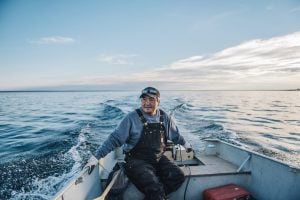
The afternoon light — though in July it could be any hour given the endless Arctic day — catches the determination in Pokiak’s eyes as she prepares for another water sampling expedition. Balancing her role as a single mother to a five-year-old daughter, community liaison, researcher, and relocation coordinator, she embodies the resourcefulness that has allowed Inuvialuit communities to thrive for thousands of years in one of Earth’s most challenging environments.
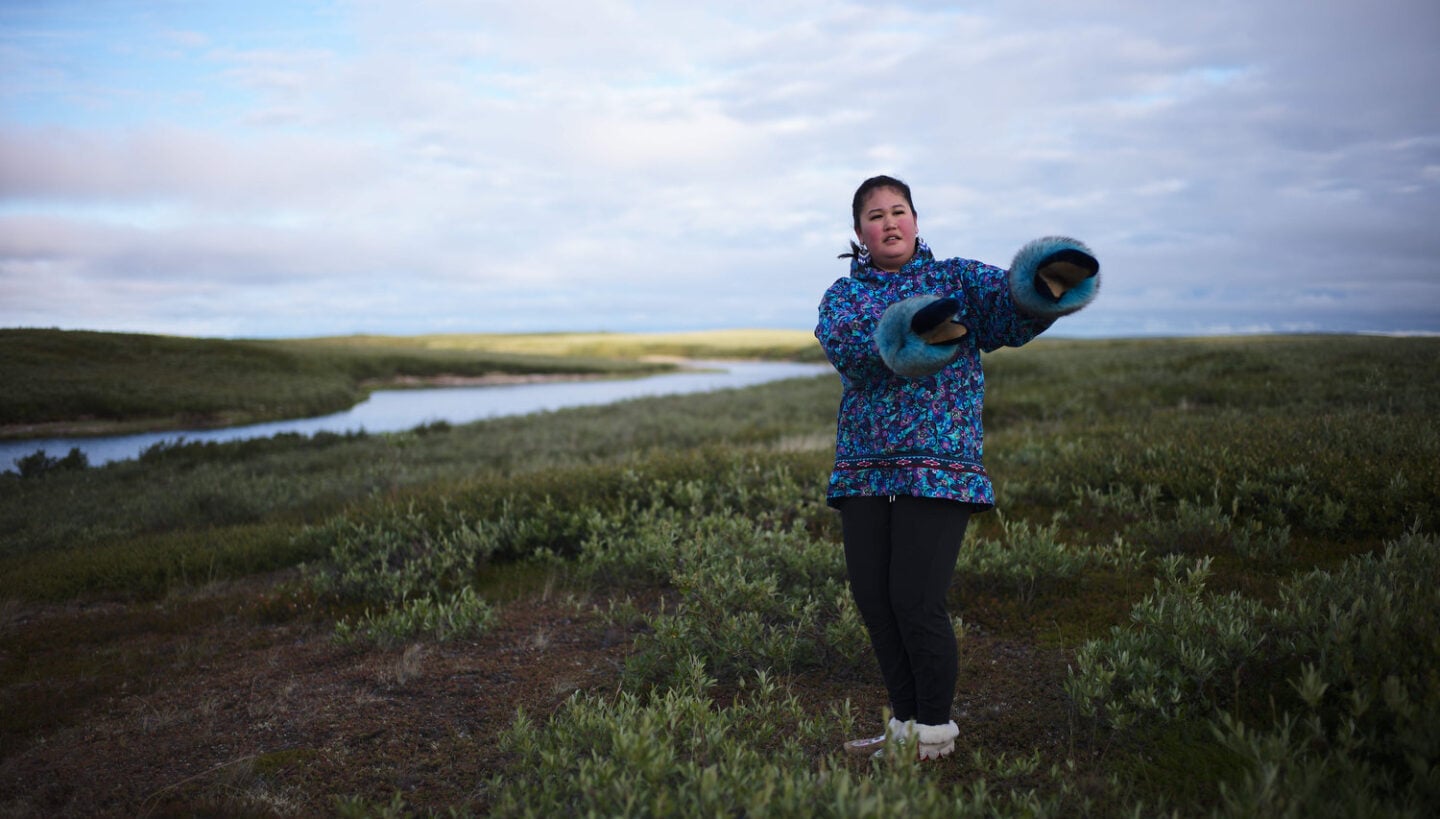
“We’ve always been relocating,” she notes, putting the current crisis into historical context. “Our Elders did it before, so we’ve got to keep moving forward. You can’t just be sad all the time and worried — worrying is going to do nothing. It’s better to be proactive and try to figure out solutions to these changes than worrying about them.”
Yet the weight of preparing an entire community for an uncertain future while trying to preserve traditional ways of life in a rapidly changing landscape is immense. As Pokiak gathers her water sampling equipment and heads toward the harbour, where a boat waits to take her team out onto the increasingly unpredictable waters of the Arctic Ocean, the magnitude of what Tuktoyaktuk faces becomes clear.
This is more than climate adaptation — it’s about maintaining cultural identity and community bonds while everything familiar transforms or disappears. In Pokiak’s words and work, the resilience of the Inuvialuit people shines through but so does the urgency of their situation. Time and tide wait for no one, not even those who have called this land home since time immemorial.
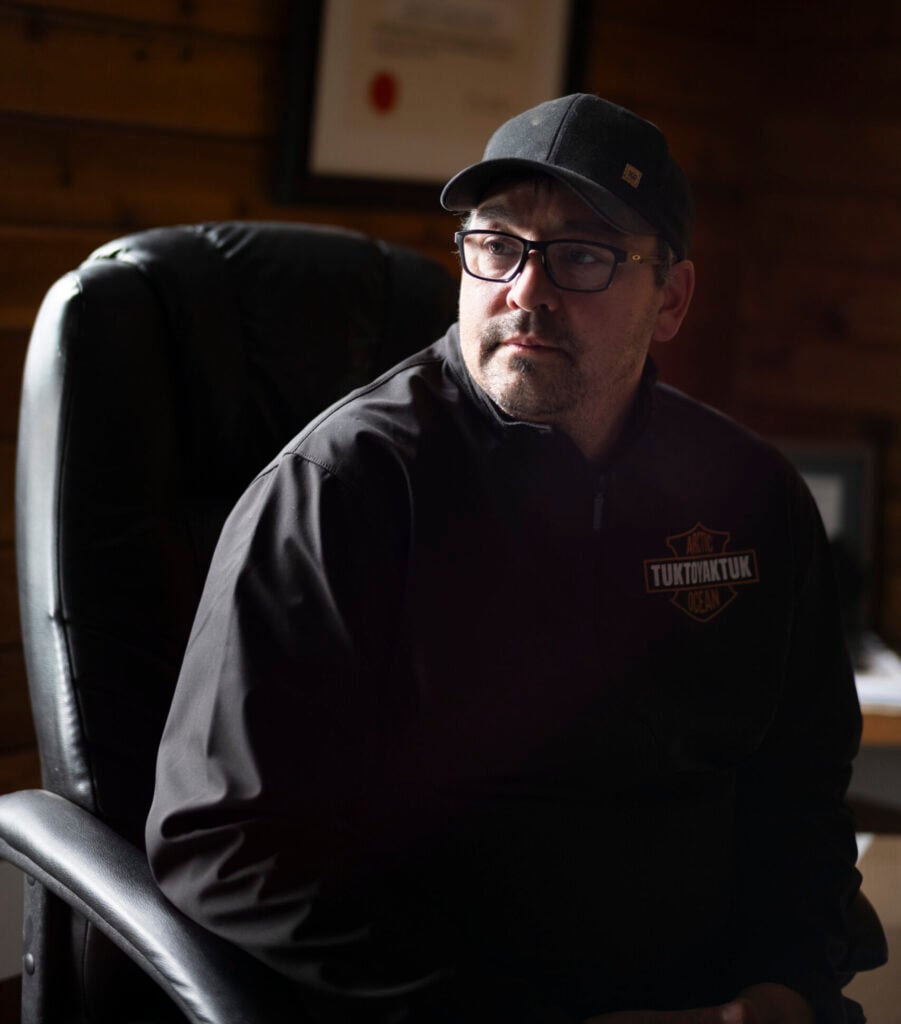
IN THE HAMLET’S COUNCIL chambers, Erwin Elias spreads a map of Tuktoyaktuk across his desk, his finger tracing the vulnerable coastline that defines his community’s precarious existence. Elias, who completed his third term as mayor earlier this year and is now chair of the Inuvialuit Regional Corporation, names his community’s situation without hesitation.
“We are in a state of emergency,” Elias emphasizes, his voice carrying the frustration of years spent navigating bureaucratic indifference. The urgency in his words reflects a hard-won understanding: traditional political timelines don’t match the pace of climate destruction.
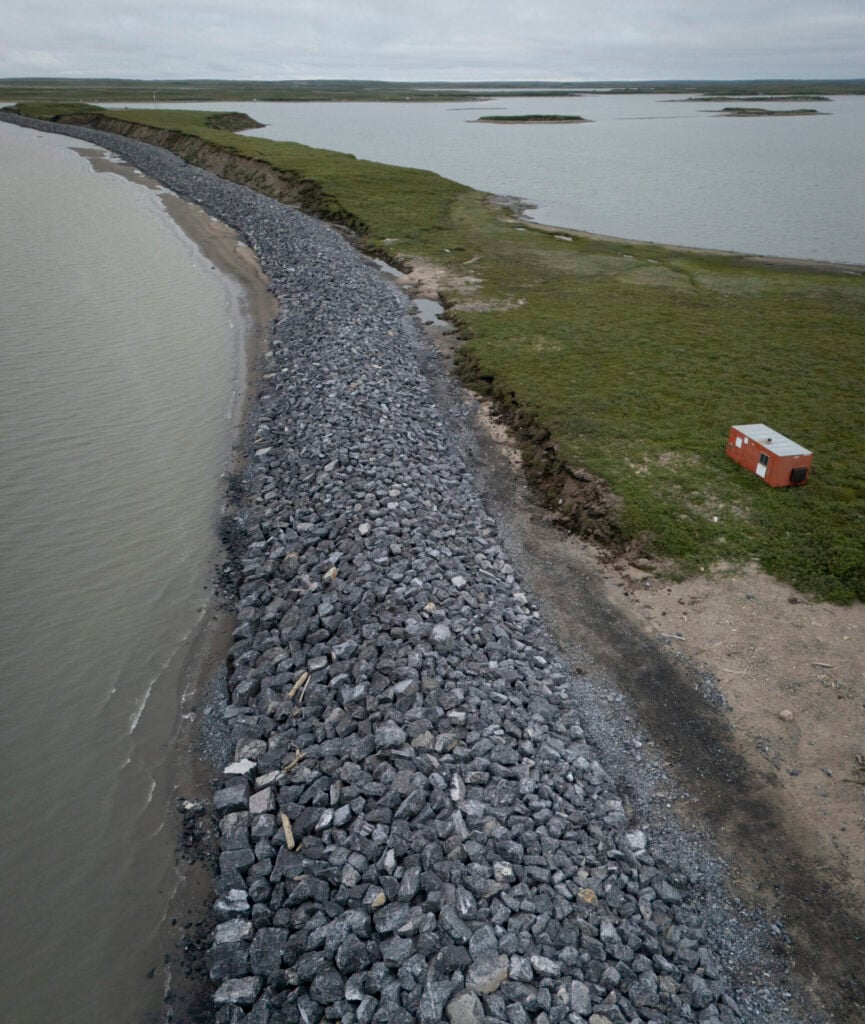
Tuktoyaktuk submitted a proposal about four years ago that resulted in $53.7 million in federal funding for shoreline protection. The project was completed at the end of April of last year — a massive undertaking involving precisely engineered rock armour designed to buy the community time. The total cost of the project ended up being just under $60 million.
Elias is clear about what this expensive engineering represents — it’s disaster mitigation and adaptation, not disaster prevention, buying perhaps 20 to 30 years while the community prepares for relocation.
The timeline haunts Elias’ calculations. Scientists warned five years ago that Tuktoyaktuk would be covered in water within 30 years. But the bureaucratic process of securing relocation funding and executing such a massive project could easily consume those remaining years.
“What I’m afraid of is that if nobody’s listening to us, you almost have to wait for a catastrophe to happen before they say, ‘okay, let’s evacuate this community,’” Elias explains. “We don’t want that. We’re trying to be proactive.”
Elias’ frustration becomes palpable when discussing the federal government’s mixed messaging. Just as the rock armour project was being celebrated, Prime Minister Mark Carney was in Inuvik promoting Bill C-5, legislation aimed at opening Arctic resources for development — the same extractive industries driving the climate crisis threatening Tuktoyaktuk.
“Why didn’t the prime minister come here?” Elias asks, noting Carney was just a three-hour drive south in Inuvik meeting with Indigenous leaders.
Despite the challenges, Elias sees Tuktoyaktuk’s unique position as both a burden and an opportunity. The community has become a focal point for Arctic climate research, potentially serving as a model for other threatened coastal communities. Everything researchers and scientists learn here about permafrost, slumping and erosion provides “a design that the other communities can fall back on.”
Elias’ approach balances pragmatism with deep roots in the land. Born and raised in Tuktoyaktuk, he speaks of the community’s incredible natural wealth — not just the oil and gas deposits that make them “resource rich and cash poor,” but the organic abundance of the traditional economy. “All I need is sustenance,” he reflects. “We could have our life, we’re so rich. The community is super rich with everything and it’s all organic. Everything’s from the land.”
Yet even this traditional knowledge base is being challenged by climate change. The driftwood scattered far inland serves as a reminder that massive storm surges have hit this coast before, though likely not in recent memory. “At some point, something brought that driftwood there. And it must have been a pretty big storm,” Elias ponders.
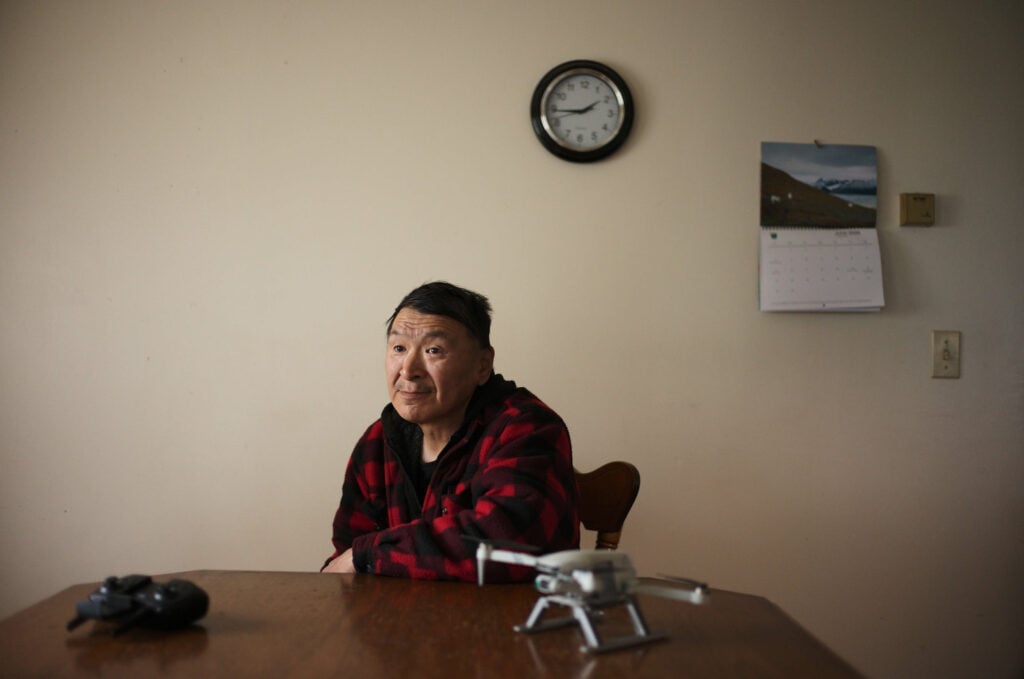
In a modest mobile home he ents for just under $2,000 a month, Obie David James Anikina sits at his kitchen table, black coffee in hand, his black hair emerging from beneath a baseball cap. At 55, his soft-spoken manner carries the essence of someone who has spent years watching the land change in ways his ancestors never imagined.
For nearly six years, starting in-late 2018, Anikina worked as a climate monitor, part of a team that began with a dozen community members interested in documenting the changes happening around Tuktoyaktuk. Over time, the group winnowed down to a core of dedicated observers, including Anikina and another colleague, along with a few younger community members who remained consistently available.
Using penetrating probes to measure how deep the permanently frozen ground extends, Anikina and his team documented the gradual thaw that threatens not just Tuktoyaktuk’s foundations but the entire ecosystem of the region. “It’s been melting,” he says simply.
“We know it is melting. It changes all the time and every day we need to adapt.”
The biological changes are equally dramatic. During summer plant and berry monitoring walks, Anikina documented plant life growing “at least two weeks earlier” than in the past. “That’s a big deal because people are thinking, you know, what the regular berry time is, and they go out and they find they’re already dropped off or they missed out.”
The permafrost thaw creates unexpected effects. Methane released from thawing permafrost acts as a fertilizer, creating unnaturally lush vegetation. “Within the last five years we’ve had a spurt, really spurted growth. It’s getting like the southern communities.”
This accelerated growth serves as a visible reminder of invisible changes happening beneath the surface. The environment around Tuktoyaktuk is becoming more temperate while the community struggles to maintain its northern identity.
The possibility of Tuktoyaktuk’s submersion weighs on Anikina’s mind, though he tries to compartmentalize the anxiety. “It’s the fact that never really leaves your mind, I guess. But we kind of block it out because we need to get through our daily lives,” he says.
The speed of change particularly concerns him. “The change is so fast. We’d be just flat-out hit and all of a sudden, we’d have to go. It could happen that fast.”
When asked where he would go if forced to relocate, Anikina’s answer reflects both practical and cultural considerations: “We [would] probably choose high ground, where it’s high enough that we wouldn’t have to leave for quite some time again, and we’d have to choose a spot where it’s sheltered from wind, big winds east and west, and somewhere close to food like wildlife.”
His perspective on climate change blends scientific observation with spiritual reflection. “I do believe in … the spiritual world, you know, the Bible,” he says, connecting contemporary environmental crises to longer cycles of change. “A lot of people believe… further north was like a tropical climate long ago before the ice age. It’s a cycle. We might not survive that cycle. But Earth will.”
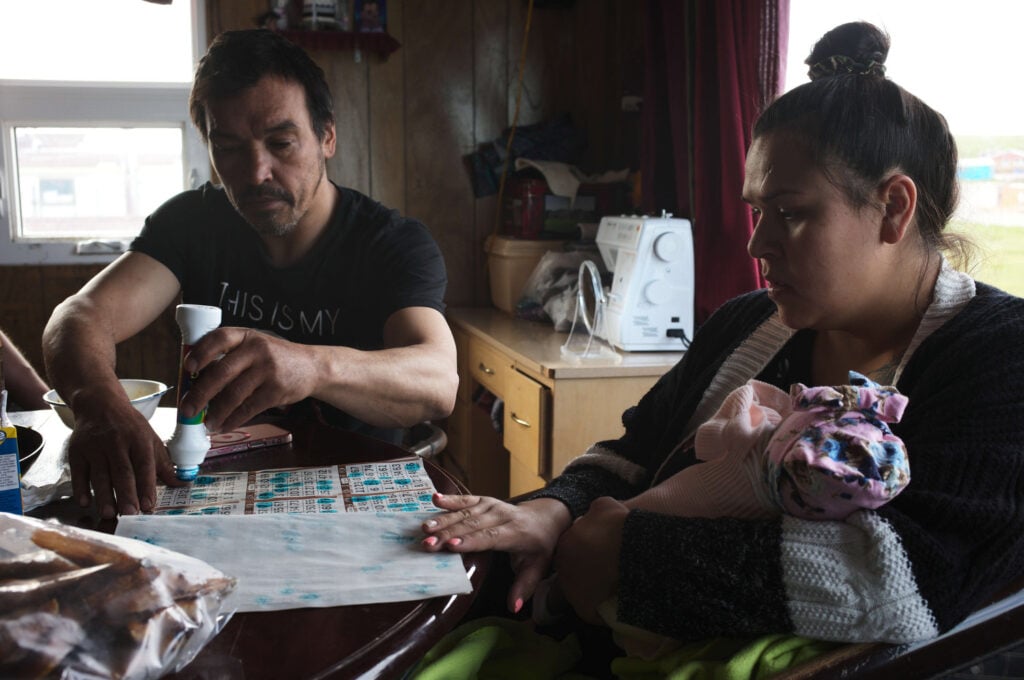
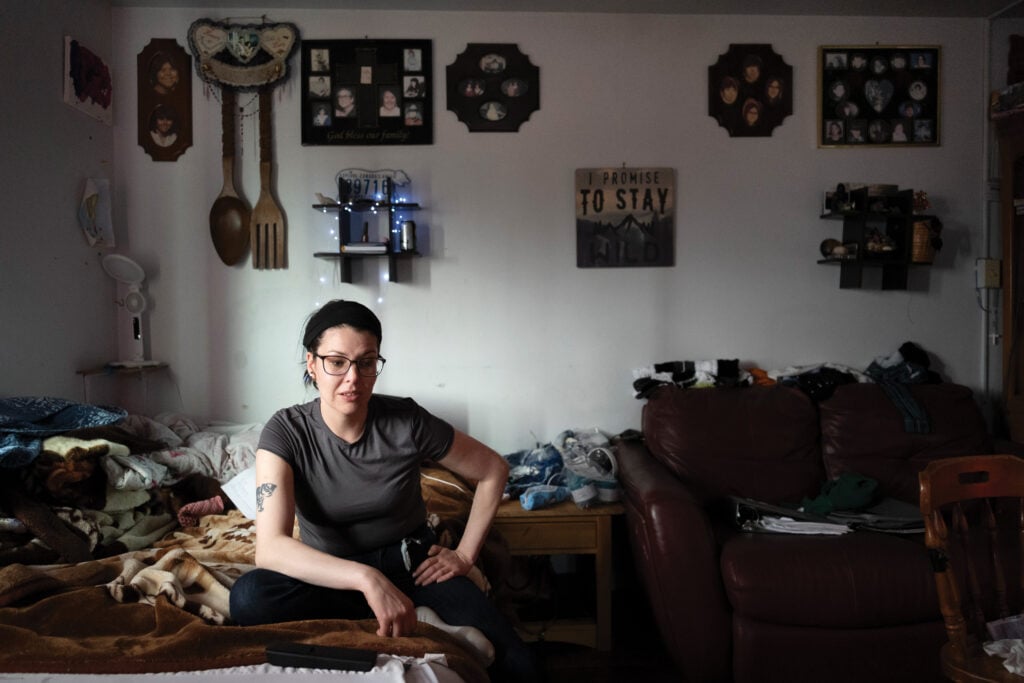
SHAYNE COCKNEY sits in the living room of a house that holds four generations of family history — but is no longer in the place where it was built. Her dark hair is tied back and her piercing blue-grey eyes, inherited from her father’s side, glint as she tells the story of a home in constant motion — first moved to save it from the advancing sea, now shifting and settling on unstable ground that threatens its very structure.
Cockney is 34. She and her sister Jenny grew up in this house, which belonged to their grandparents. By 2020, coastal erosion had reached the doorstep.
“This was their home and back in 2020, they moved it over here,” Cockney explains, gesturing toward the area now claimed by the sea.
Storms had grown so fierce that she recalls timing the waves just to get out her front door without getting wet, terrified she might wake up one morning to find her porch gone. That spring, local contractors moved four houses threatened by erosion — including Cockney’s grandparents’ home, her mother Noella’s next door, and two neighbours — seven to eight kilometres inland to Reindeer Point, a subdivision created specifically for relocated homes. Each house was assessed by an engineer to determine if it could withstand the physical move, then hauled intact across an ice road and set down on freshly laid gravel pads.
The timing couldn’t have been worse. Cockney was in Whitehorse, where COVID-19 restrictions had shut everything down. She managed to make her way back to help with the move and support her 83-year-old grandmother through the trauma of moving the family homestead.
“How long after did she pass?” Cockney asks herself, the pain evident on her face. “Months. Really. Yeah. That, uh, August.”
Now, four years later, the house faces a different kind of destruction. The relocated homes at Reindeer Point were placed on gravel pads that hadn’t been given enough time to settle. “The year they actually did move it, you could walk out here and the ground would sink,” Cockney says. With each seasonal freeze-thaw cycle, her erratic home shifts.
The instability is viscerally apparent. Cockney asks her 15-year-old son Isaac to flop down on the bed in his room upstairs and the entire house shakes from the movement.
“That’s the unevenness of it. If we move too much, the place shakes because of the unevenness of the ground.” Each spring when the snow melts, the ground grows soft and the house sinks further. The foundation problems have spread throughout the home, affecting not just the base but the walls and framework. When the wind picks up, the walls flex. “I don’t expect it to last for a whole lots of years,” admits Cockney. Her son completed a school project on erosion, but Cockney hopes her children can focus on school and their future rather than dwelling on the housing crisis surrounding them.
The bureaucratic response has been as unstable as the ground itself. While federal funds paid for the massive coastal protection project, relocated homeowners like Cockney find themselves caught in administrative gaps.
She doesn’t qualify for Elder housing subsidies because she is too young, and attempts to discuss the ongoing structural problems with hamlet officials have gone poorly. In fact, one conversation about the condition of her house went so badly that she not only got no help but ended up quitting her job at the hamlet office.
“It wasn’t our fault that the house had to be moved,” she reflects with frustration. “If Tuk is in a state of emergency, as the [former] mayor described it, because of erosion, because of climate impacts, the feds should be stepping up to help.”
There is nothing more profound than losing the place you’ve called home, especially if you’re an Indigenous community.
The broader context of Tuktoyaktuk’s crisis reflects what human rights lawyer and climate researcher Robin Bronen calls “the greatest human rights challenge of our time.” Bronen, who has worked with communities displaced by the climate crisis since 2005 and co-founded the Alaska Institute for Justice, points to a fundamental gap in the governmental response: “We in the United States have no governance institutions that have the mandate or funding to facilitate a community-wide relocation,” she explains. The same institutional vacuum exists in Canada.
Bronen’s research with Alaska Native communities has documented how Arctic warming — now occurring four times faster than global averages — creates what Yup’ik communities call “usteq,” meaning “catastrophic land collapse” from the combination of thawing permafrost, erosion and flooding.
This term has been officially incorporated into Alaska’s state hazard mitigation plan as recognition of an environmental threat that Western science struggled to define because researchers worked in silos — studying each phenomenon separately rather than understanding their interconnected effects.
The fundamental principle Bronen emphasizes applies directly to Tuktoyaktuk: “The right to self-determination is the most important human right to protect in this process because communities have to make all of the decisions regarding whether, when and how they relocate.”
That’s why Pokiak’s work is so important. Without community control over relocation decisions, Bronen argues, other human rights — housing, water access, subsistence — will be very difficult to protect.
The injustice Bronen identifies resonates powerfully with Tuktoyaktuk’s situation: “There is nothing more profound than losing the place you’ve called home, especially if you’re an Indigenous community.” While a recent International Court of Justice ruling found that national governments have legal obligations to address climate change, enforcement mechanisms are limited, she added.
Communities like Tuktoyaktuk will face continued displacement caused by global emissions they did not create, while not being given the resources they need to adapt.
Despite the uncertainty surrounding her housing situation, Cockney maintains a determined optimism about her role in the community. She works at Tuktoyaktuk’s visitor center, welcoming thousands of tourists who travel to experience “the end of the world.” The international attention both fascinates and unsettles her — The New York Times interviewed her about the relocation, making her briefly famous for living through climate displacement.
Whether she’ll stay in Tuktoyaktuk permanently remains an open question: “Let’s see how much we can accomplish while I’m here. Who knows what the future holds? We’ll cross that bridge when we come to it.”

This story is from the September/October 2026 Issue
Environment
How the Sahtuto’ine Dene of Délı̨nę created the Tsá Tué Biosphere Reserve, the world’s first such UNESCO site managed by an Indigenous community
Environment
Permafrost thaw is widespread, accelerating and irreversible. With it comes visible effects on the ecology, hydrology and landscapes, and communities of the North.
Environment
The planned highway is meant to connect a vast stretch of the Northwest Territories. But the challenges are real and the promised benefits may not be guaranteed.
Environment
Another reckoning is coming with climate change. How do we deal with our mental health — and ultimately find hope?