Travel

Kluane colours: Trekking off-trail in the Yukon

A multi-day hike through the magically surreal landscapes of Kluane National Park and Reserve is a lesson in leaving behind your pride, reconnecting with nature and engaging your glutes

  • Jun 12, 2026
  • 2,991 words
  • 12 minutes
Advertisement
Advertisement

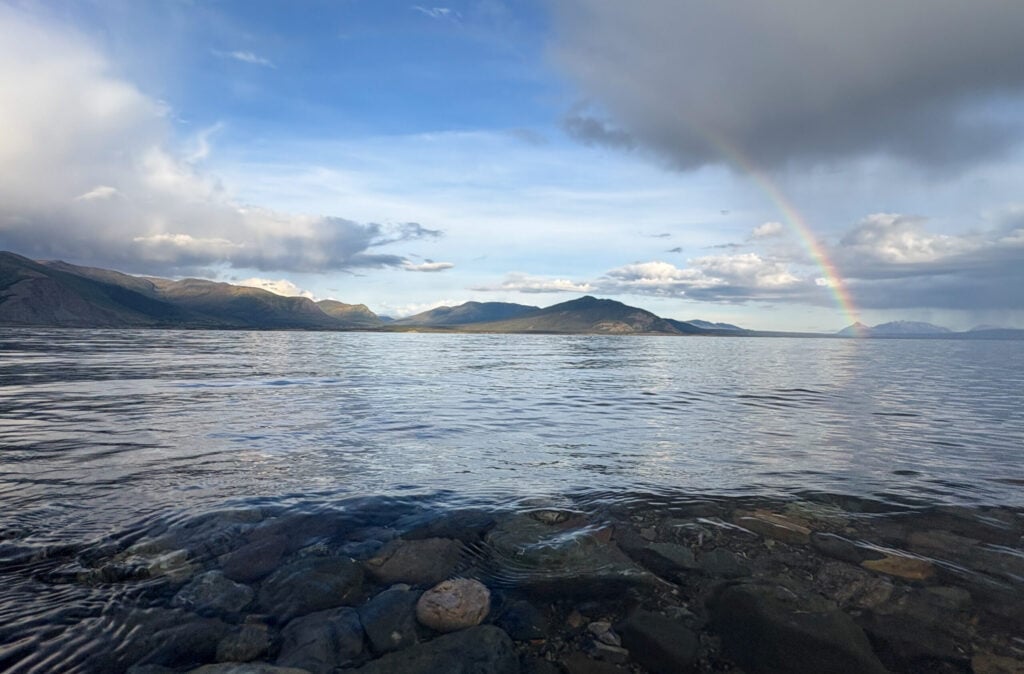
ŁÙ’ÀN MÄN (“big whitefish lake” in Southern Tutchone), or Kluane Lake, stretches out bluely, gently lapping until it meets green hills dappled with cloud. The sun shines down through rain and cloud in gentle beams. As it sinks, raindrops turn golden. Rainbows unwrap themselves like gifts. One arcs across the whole sky, its spectrum rippling into the glistening lake. How lucky we are to be here, I think. There could not be a more perfect beginning to a trek named “Kluane Colours.”

I am embarking on this seven-day backcountry hike with Terre Boréale, a family-run company offering sustainable trekking and canoeing expeditions in lesser-known areas of the Yukon. We’d met our trekking group the day before at the hotel in Whitehorse. There’s Jiachen (a.k.a. J) from London, Ont., Kelsey from Calgary and a couple, Cindy and Blake, from Ottawa. Plus, our two amazing guides, Anne and Amélie, both from Quebec.

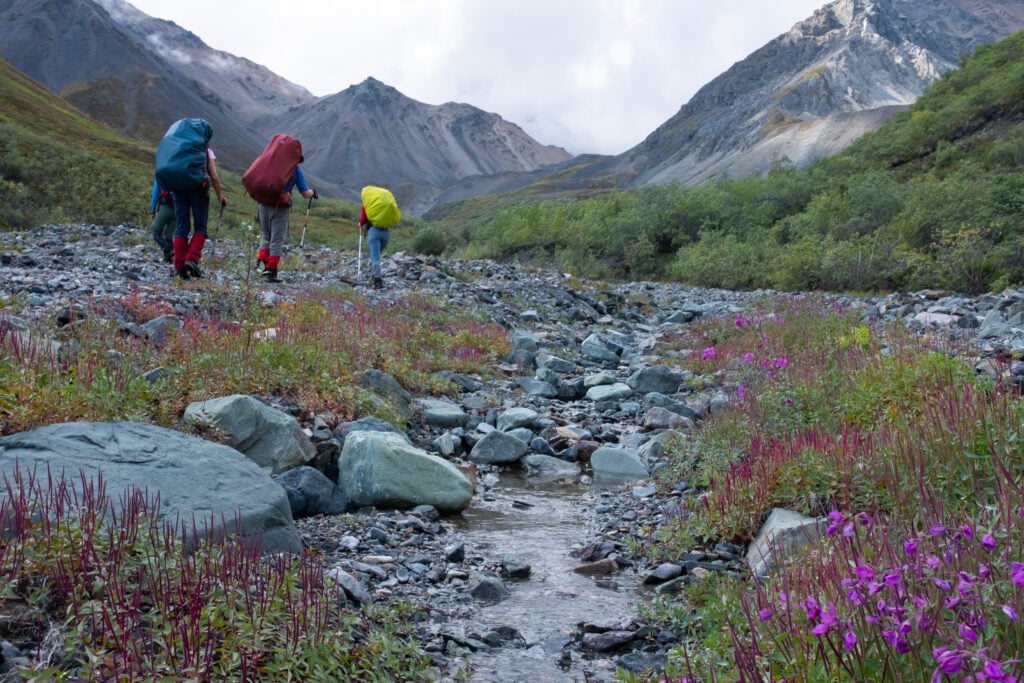
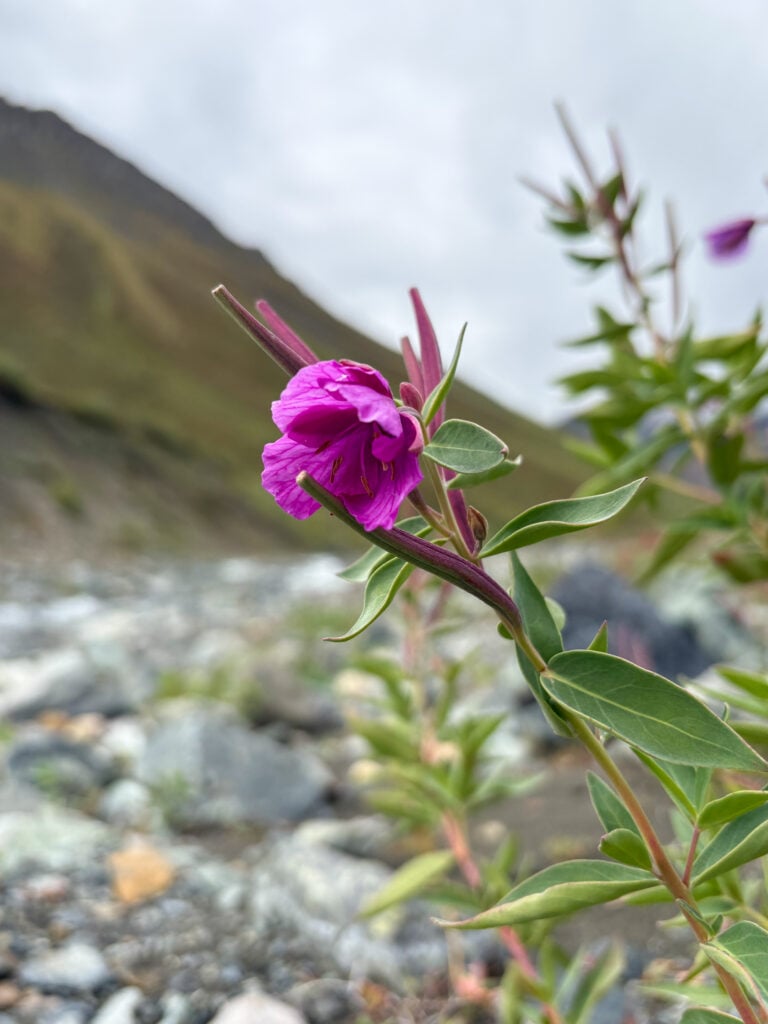
River beauty pops up, bright against the grey stones of the riverbed.
Expand Image

Together, after travelling west from Whitehorse, we’ll be traversing about 60 kilometres, off-trail, through Kluane National Park and Reserve — over rocky slopes, alpine ridges, verdant valleys. One kilometre walking off-trail, Terre Boréale co-founder Miléna Georgeault tells me later, is the equivalent to hiking two kilometres on the trail. We are about to learn this for ourselves.

On the shores of the lake, at Congdon Creek Campground, where we’ll spend the night, we unpack our trekking backpacks under the watchful eyes of Anne and Amélie. As I pull things out of dry bags, I feel like I’m getting undressed. If an item is unnecessary, Anne shakes her head and I make a “no” and a “maybe” pile. My “luxurious” items I decide to bring consist of a blow-up pillow, an extra pair of socks and a packet of caramelized nuts. 

Terre Boréale also provides us each with bear spray, a tent, a bowl, a sitting pad and a “TP kit” (toilet paper, hand sanitizer, paper bags and a cloth bag to put our waste into, as we’ll pack anything that isn’t… organic, let’s say, out with us). Along with our individual gear, group gear is distributed: fuel to cook with and dehydrated meals in a bear-safe bag. The food is the heaviest thing we will carry, though our loads will lighten as the days go by. Anne helps me wrestle everything into my bag in an efficient manner, and miraculously everything fits. The bag weighs 23 kilograms. This is fine.
Łù’àn Män, or Kluane Lake, ripples softly as a rainbow arcs across the sky.
Expand Image
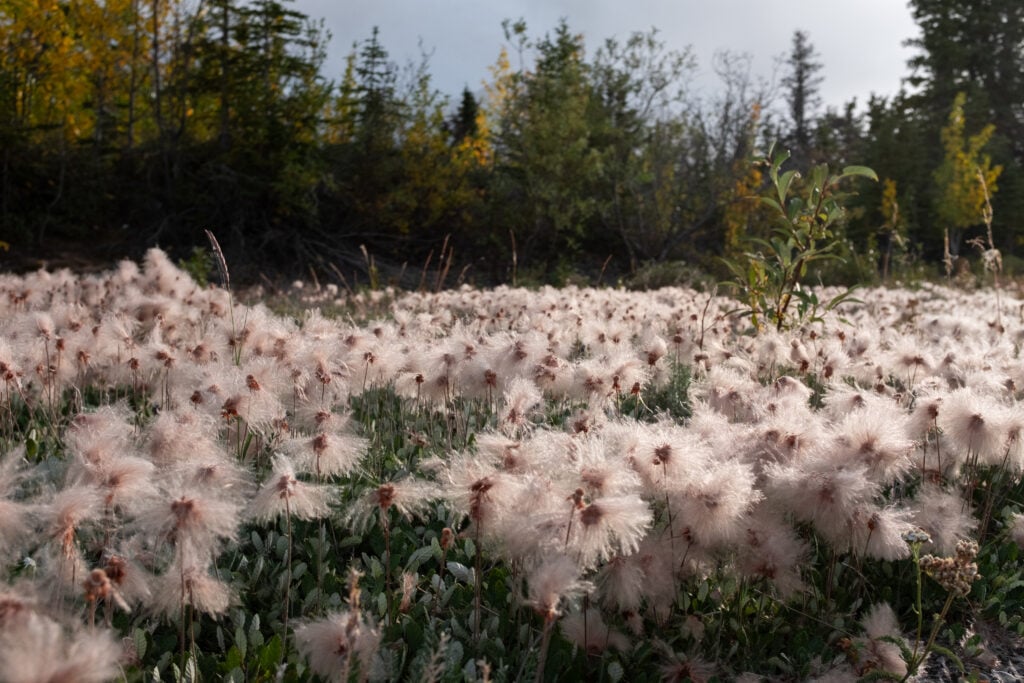
The seed heads of mountain avens tremble in the breeze as the evening light casts a rosé glow.
Expand Image

WE’VE BEEN WARNED the first day is the hardest day, and it is. We start our trek walking up a rocky riverbed, after shedding all sense of embarrassment with some warm-up exercises. As Anne says, “Leave your pride in the van and find it when you’ve finished the trek.”

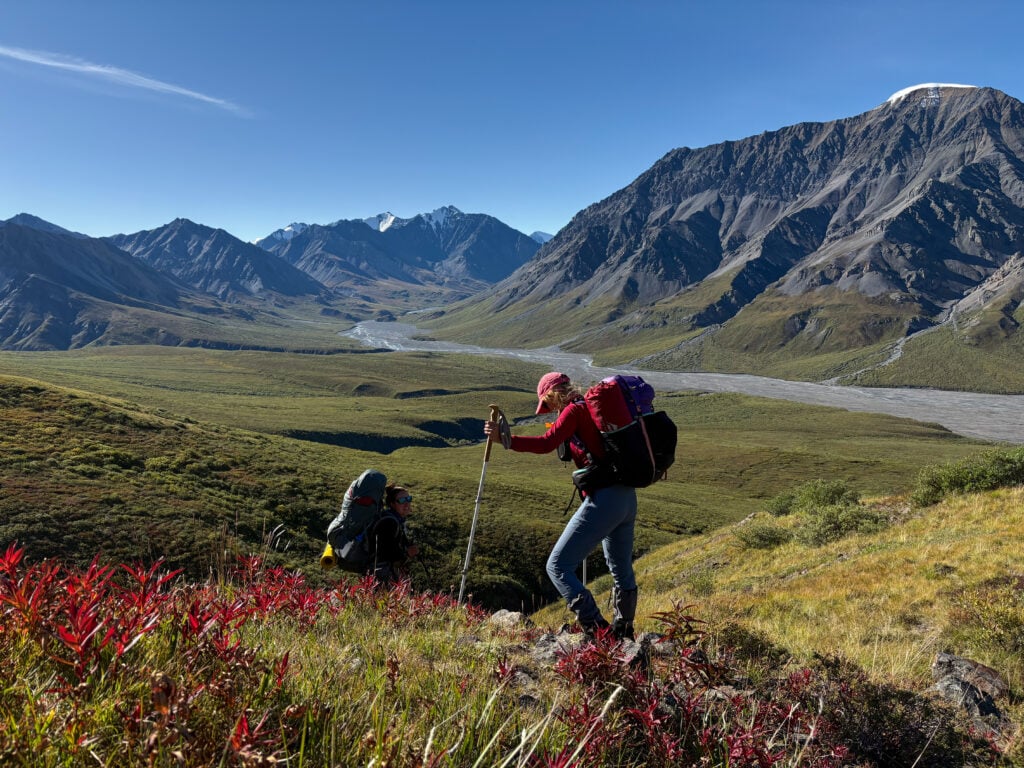
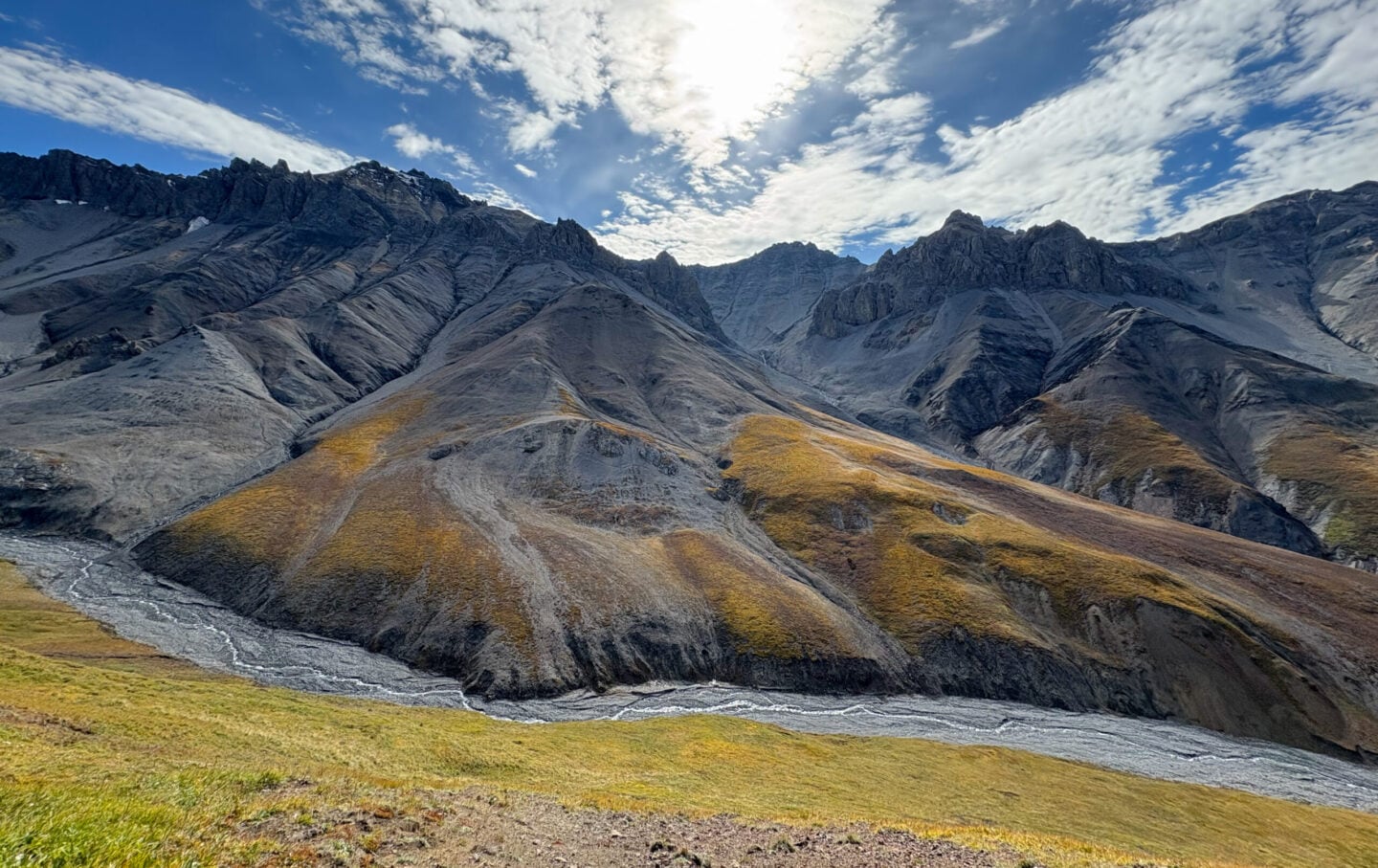
Before too long, the river narrows to a swiftly flowing stream. A violet-pink flower called river beauty, or dwarf fireweed, pops up from out between the rocks. Its hot pink glow is shocking amid the grey rocks. Beside it, willows, aspens, fluffy mountain avens. As we slowly make our way uphill, the trees start to turn yellow, the mountains shades of orange and brown when the sun comes out.

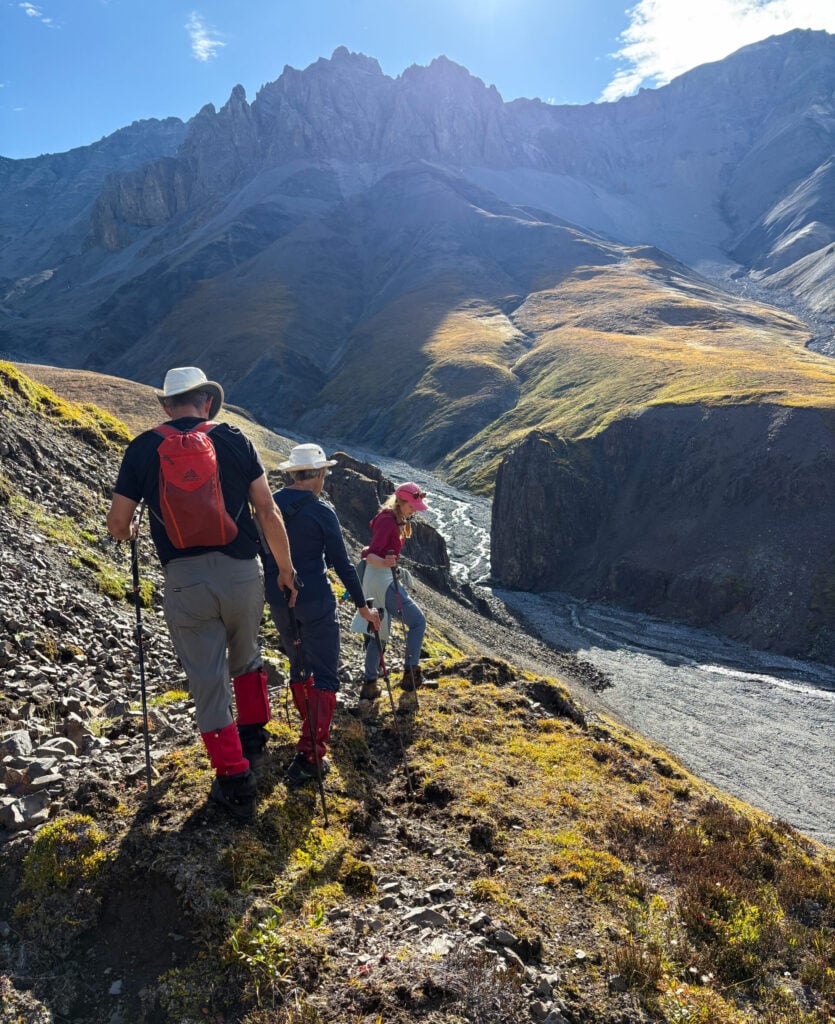
Heading into the alpine up Bock's Creek on day one.
Expand Image

We stop a couple of times along the river for snacks to fuel up. When we were at the campsite the day before, our guides had laid out Tupperware filled with snacks (homemade by Georgeault), both sweet and savoury options, that we packed in reusable cloth bags. My favourite are protein balls made with mango, apricot, cashew, coconut and ginger.

After lunch (feta and mint wraps with cookies for dessert), we fork off to the right and bushwack up a gully, then up a steep scree slope, sending small rocks tumbling down as the ground slips beneath us. As we climb, the slope becomes less rocky and more spongy, covered with myriad mosses, lichens, mushrooms and wildflowers. It starts to rain, but it’s sunny too, so the raindrops are like jewels. 

The terrain changes again, as we balance on bigger rocks, slick with rain, sometimes wobbly underfoot. We try to keep our weight low, step low. Our trekking poles skitter on the rock. It starts randomly hailing. At one point, a particularly treacherous rock rolls beneath me, and I have to throw myself towards the hill so the weight of my backpack doesn’t topple me the wrong way down the mountain.

LEAVE your pride in the van and
find it when you’ve
FINISHED the trek.”

It rains heavily all night. But my tent (alas, not pitched particularly flat) keeps me dry, and I am not cold, as I feared I might be up in the alpine. From time to time I hear the deep, unnerving rumble of rockfalls in the surrounding valleys.

It’s not raining by the time I wake up in the morning, and after a breakfast of hot oatmeal, we set off for a day hike. It’s much easier going without the weight in the backpack, even as we hike up steep rocky terrain. We reach a ridge with incredible views of a glacier, striking white against the grey-marmite mountains. Looking the way we’d come, streams braid into a verdant olive green toward the vibrant turquoise lake. Then onwards into the beyond across Łù’àn Män and the indigo-hued mountains stretching out of sight. 

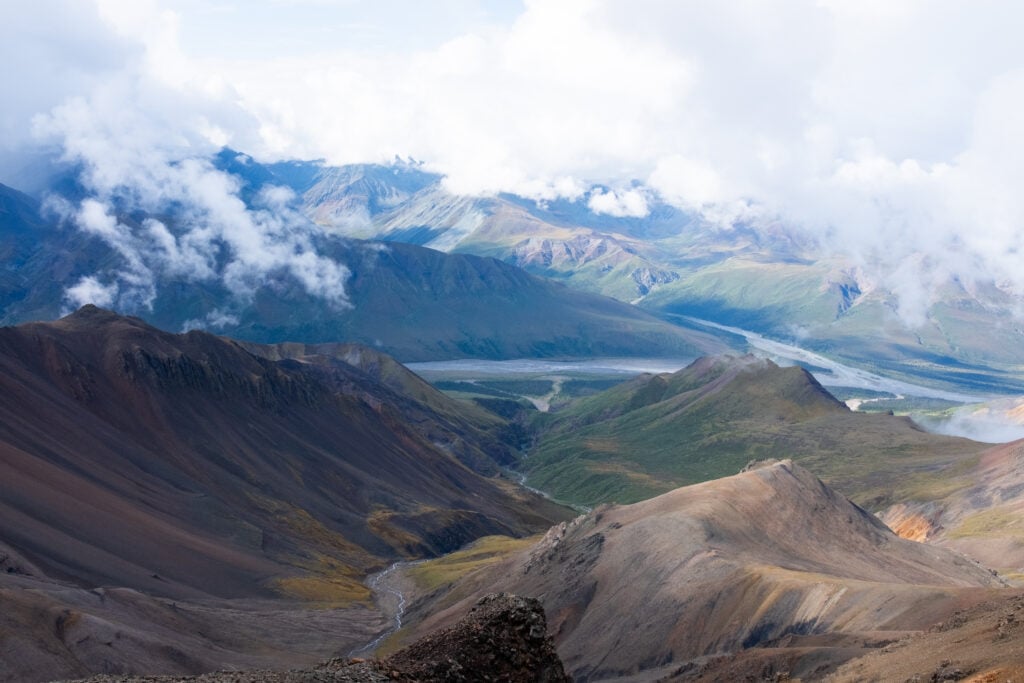
Looking down from the pass towards Shä́r Ndü Chù, or Duke River, as the Saint Elias Range disappears into the clouds.
Expand Image

We have a choice: to keep hiking up to a pass or to drop back down. Most of us continue upwards, scrambling up the rocky slopes, to be gifted with the epitome of “Kluane Colours.” A sloping pyrimidine mountain streaked with rust red and grey, an emerald river valley filled with the teal waters of Shäŕ Ndü Chù (“long bear river” in Southern Tutchone), or Duke River. The Saint Elias Range slopes into snow into cloud. On a clear day, one can see Mount Logan, the tallest mountain in Canada (we’re not so lucky today, but “we feel it in our hearts!” someone says). 

On the way down, we stop to eat lunch, even though it’s now raining and flirting with snow and hail. But lunch is delicious: a rehydrated veggie lasagna with zucchini and eggplant. We scarf it down, as we are getting pretty soggy, and hustle back down to camp.

That afternoon, I lie in my tent and write, drying my socks and gloves with my own body heat. I crack open the zip so I can watch the rain falling heavy with the sun’s golden glow.

After dinner, as we’re packing away our things for the evening, a thunderous CRACK resounds through the sunset-purple valley. Boulders bigger than cars split into two as they tumble through the air. Dust cascades into the sky as the storm of stones slowly rolls to a halt. “Mon dieu,” mutters Anne under her breath. It’s more polite than my own exclamation.

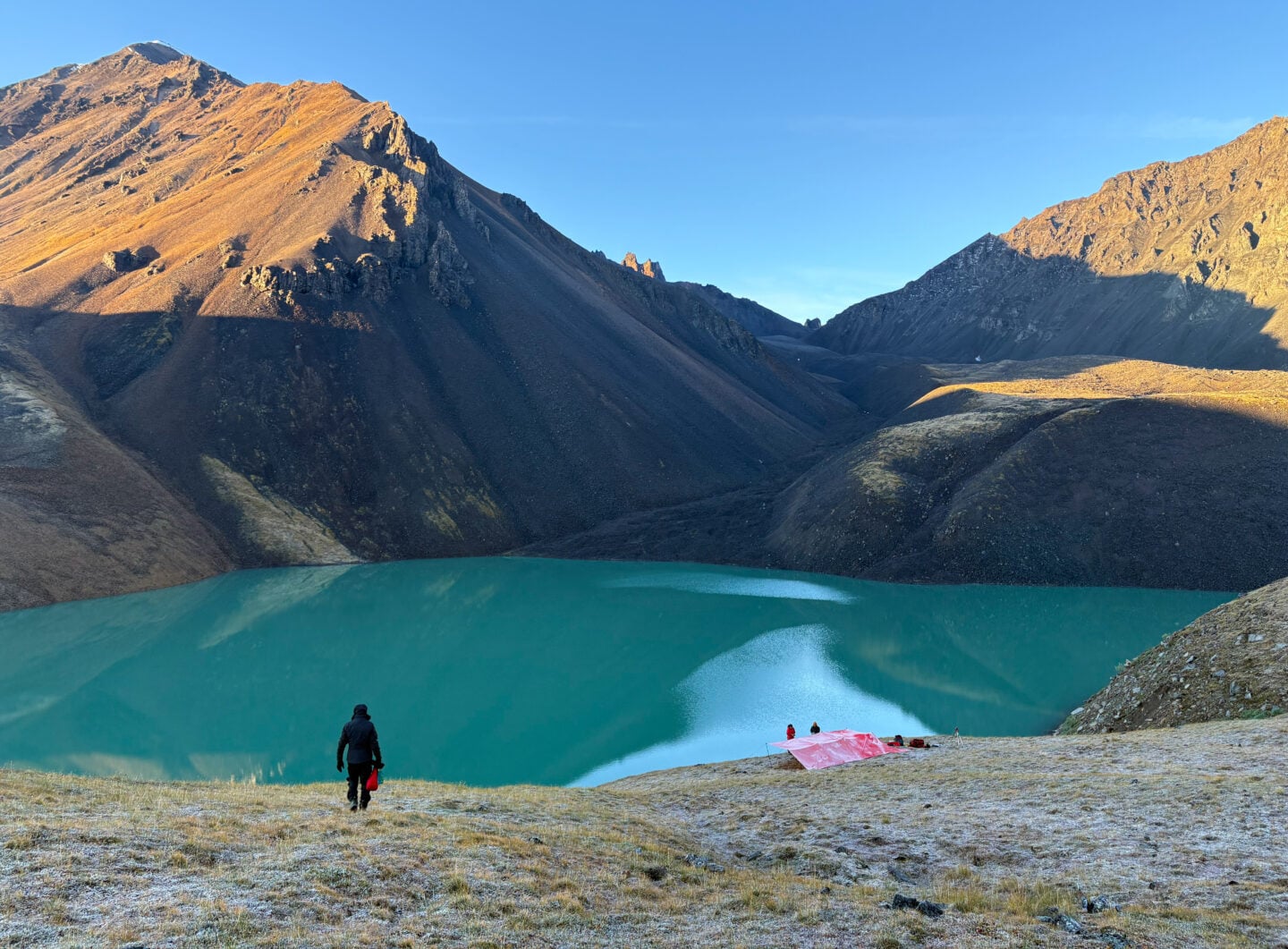
A frosty morning camped beside the turquoise waters of Bock's Lake, where we spend the first two nights.
Expand Image

AT SOME POINT after midnight, I get up to pee, and the sky is full of sparkling stars, the Milky Way surging up behind the mountains and arcing upwards. It is freezing, literally, the ground shimmering with frost in the light of my headlamp.

When I wake in the morning, my tent is frozen solid. The sky is a cloudless blue, and the mountains are perfectly reflected in the azure waters of the lake. I hike out to use the latrine, and as I squat down, a pika suddenly peeks out of a hole, scurries forward, and hangs out as the sun paints the vegetation gold. I’ve never felt so connected with nature.

As we head down into the Duke River valley, the landscape is giving Rohan from Lord of the Rings.
Expand Image

We set off for the day, shouldering our heavy backpacks once again, climbing up a mossy rise, before hitting rocky slopes. It’s unnerving after seeing the rockfalls over the past couple days. We take it slow and safely make our way up over the boulders to a pass with incredible views of the valley and Saint Elias Range beyond. We scuttle down a steep scree slope to some cool rocks at the bottom, embedded with ice-blue crystalline geodes. 

Just before lunch, J remarks, “I don’t just feel at one with nature; I feel at one with myself — and my glutes!” Our glutes are a frequent topic of conversation on the trek. Amélie, who is also studying kinesiology, teaches us that consciously activating our glutes with each step will lessen the strain on our knee joints, especially on the downhill. While I’ve been climbing mountains since I could walk, nobody has really taught me hiking techniques before. It’s particularly helpful for J, who took up hiking only a few months ago — everyone is impressed at his bravery for committing to this challenging trek in the backcountry.

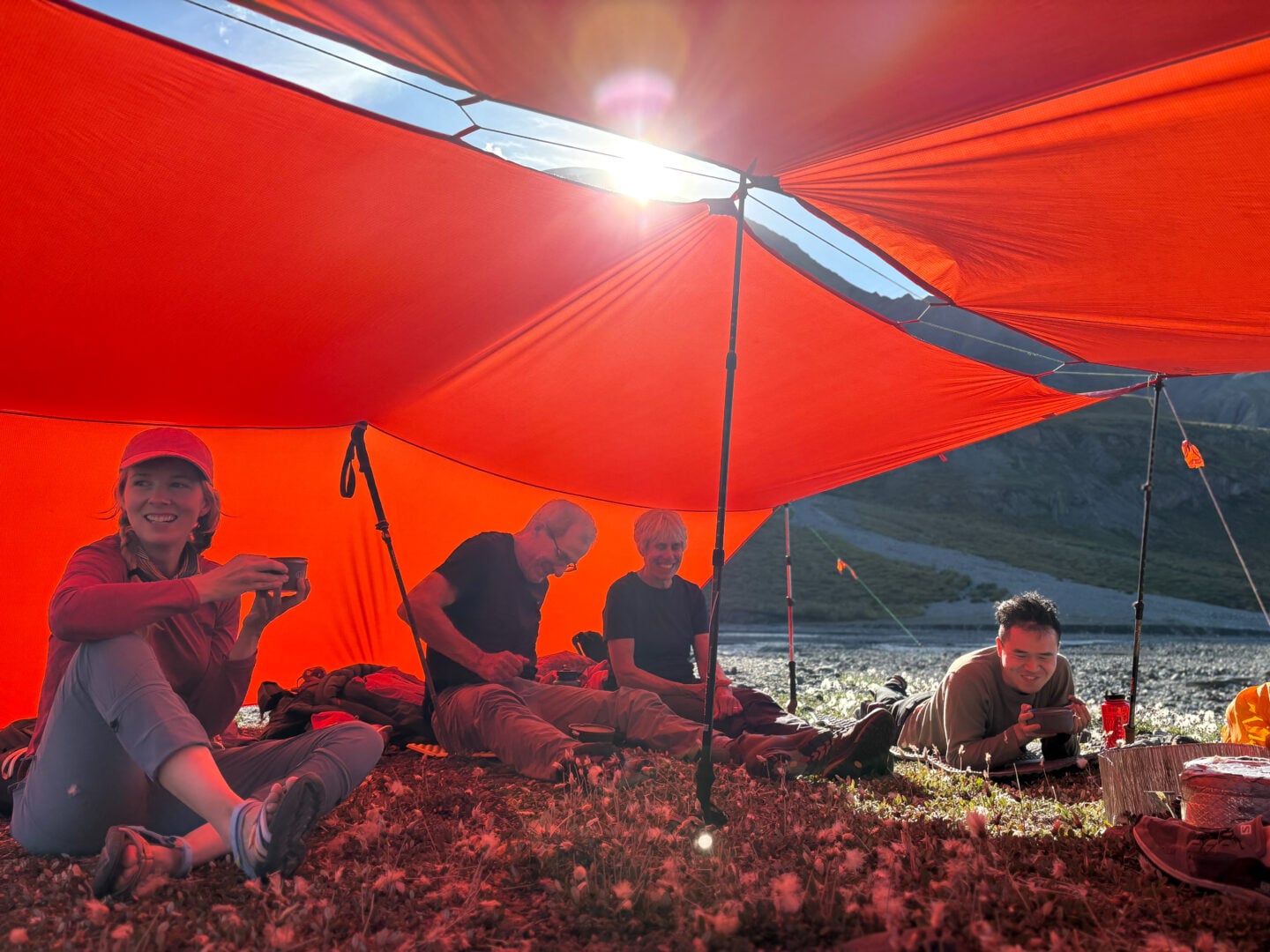
The sun dries my tent as we eat lunch (rice with tomato, feta and pesto) under the group tarp. We drop down a canyon to where it is flatter and greener. Volcanic-looking stones jut out from the tussocky grass, reminiscent of standing stones in the Scottish Highlands. Another hour of walking or so later, Amélie and Anne make the executive decision to make camp. I’m relieved, and exhausted, feeling the weight of my backpack and the blisters in my hiking boots, which have finally betrayed me after a decade of wear (I confess to Anne, as she lends me blister bandages, that I actually betrayed myself by doing a Korean foot peel mask, shedding all my calluses, a few weeks before the trek. “Why would you do that?” she asks incredulously. I don’t have a good answer for her). 

The sky is a cloudless BLUE, and the mountains are perfectly reflected in the AZURE WATERS of the lake.

Tent pitched on refreshingly flat ground, I soak my feet in the bracingly cold river. I fall asleep easily that night, lulled by the rushing water.

The next morning, the rising sun casts a peachy hue on distant peaks. As it touches our valley, it paints it golden green. We start our day on mossy, tufted ground, hiking up a steep section to a saddle where we see 12 mountain goats, ghostly white against a cerulean sky. A kid pauses to drink from its mother. Later, as we crest the pass, we see them galloping down the hill.

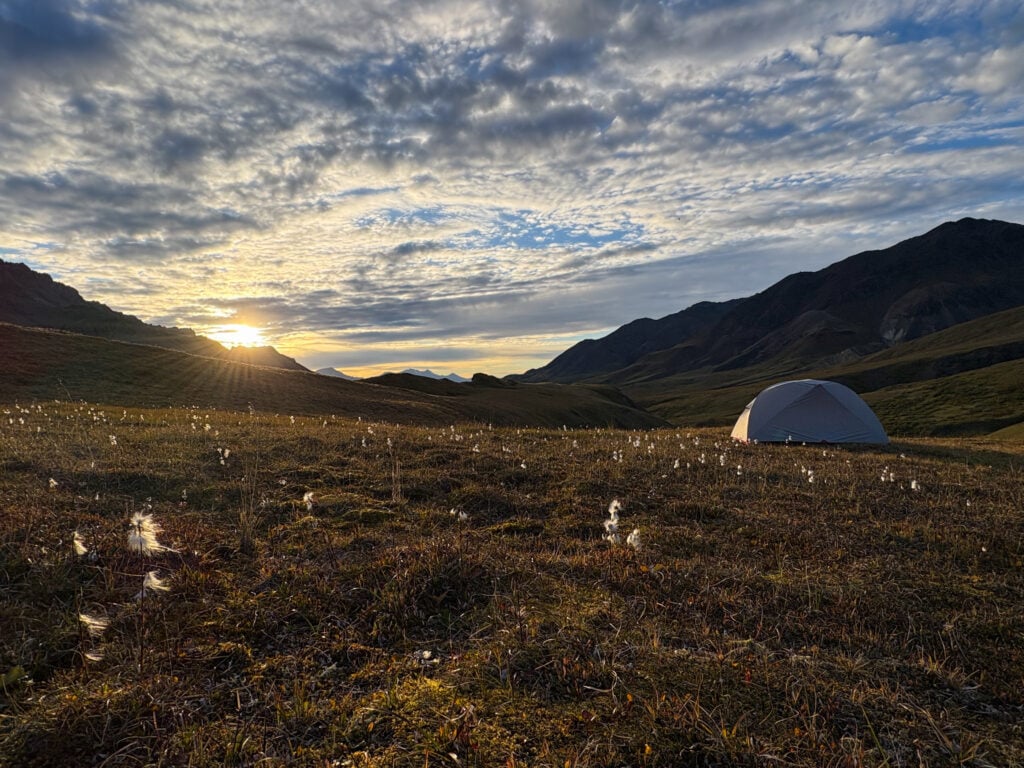
A perfect sunset shot from my tent on day five as the light fades from a burnished blue-silver sky.
Expand Image

We head down the other side of the pass as the sun gets hotter, and find ourselves on an epic ridge that’s reminiscent of The Lord of the Rings when Aragorn, Legolas and Gimli are tracking the hobbits across Rohan.

As we drop in altitude, we find ourselves surrounded by short trees, and we have to bushwhack through. It’s a full body workout as we try not to roll an ankle, trip over roots and branches, get our poles stuck, or wet our feet in boggy sections. We see lots of traces of wildlife via their scat: sheep, bear, moose and something felid, perhaps lynx. There’re also copious amounts of blueberries, which we cram into our mouths.

Eventually, we emerge into a grove of trees with heart-shaped leaves that’s less tightly packed. Then we come to a swiftly flowing river that will soon meet the Duke (Shä́r Ndü Chù). We’ll soon meet it too. But first, lunch. I lean against my bag like it’s an armchair, close my eyes and bathe in the sun’s heat.

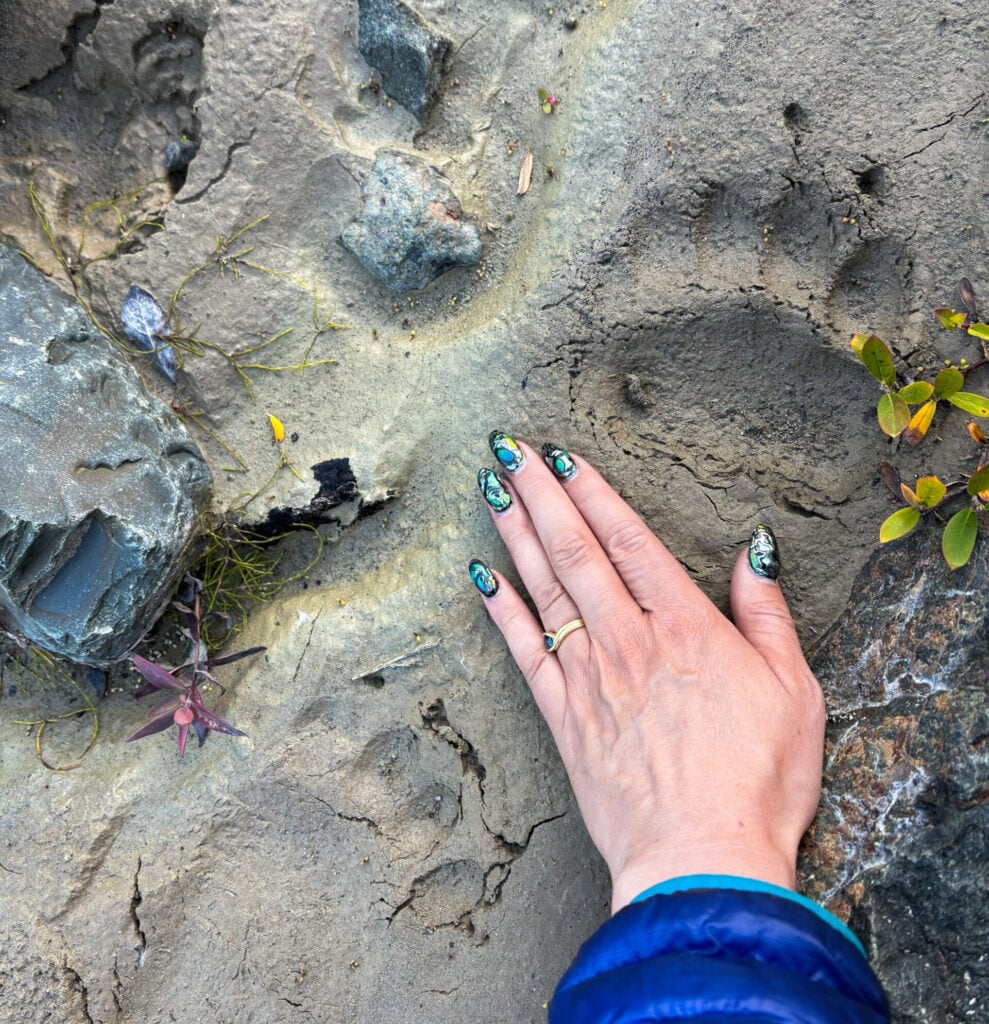
A grizzly print in the soft silt of a riverbed, as seen on the final day of the trek. The author's hand for size comparison.
Expand Image

It’s not long before we find ourselves in the bottom of the valley, leaving fresh footprints in soft silt. We hop over narrow creeks and fiord wider streams, our gaiters keeping out most of the water. I love this river-walking.

We reach an island in the braided river where we’ll make camp for the night amid fluffy mountain avens. I pitch my tent. It’s blessedly flat, but rocky, so I tie the tent’s guy lines to trees and larger rocks. Once I’m all set up, I head down the jade river to wash. The water is frigid, but the cold soothes my aching limbs and washes away the sweat from the past few days. The sun dries my body and makes the river sparkle. I feel sparkly too. 

That evening, while we’re eating dinner, a couple of red foxes trot boldly into camp, big, healthy and bushy tailed. One of them strolls in our direction
through the avens, entirely unbothered by us. It pounces on some kind of rodent, chews it up, poops and scuttles back into the bushes.

The sun leaves this verdant valley, ray by ray, lingering, glinting off a layer of snow on the highest peak.

Our trekking group shares a laugh under the group tarp at our river camp on day four.
Expand Image

DAY FIVE IS RIVER CROSSING DAY, and we’re almost at the halfway mark. We leave our gorgeous island camp at the meeting of Duke River and Dickson Creek behind, cross the Duke and head up into one of its tributaries. Anne and Amélie show us the correct technique to cross the river, facing upstream, not crossing over our feet, planting our poles for support.

We’re trudging slowly uphill, leaving the riverbed behind, up muddy, stony cliffs. I spot some excellent-looking mushrooms with elegantly rippling gills amid the yellowing grass. Not too long after the mushrooms, we emerge onto a breathtaking plateau which is to be our camp for the night. A couple days ago, J had asked our group for English words to describe our surroundings and how they made us feel. I’d taught him the word “awestruck” yesterday. Today’s word is “gobsmacked.” Both apply here. We feel so tiny in this vast mountain valley, surrounded by vegetation, peaks and sky. 

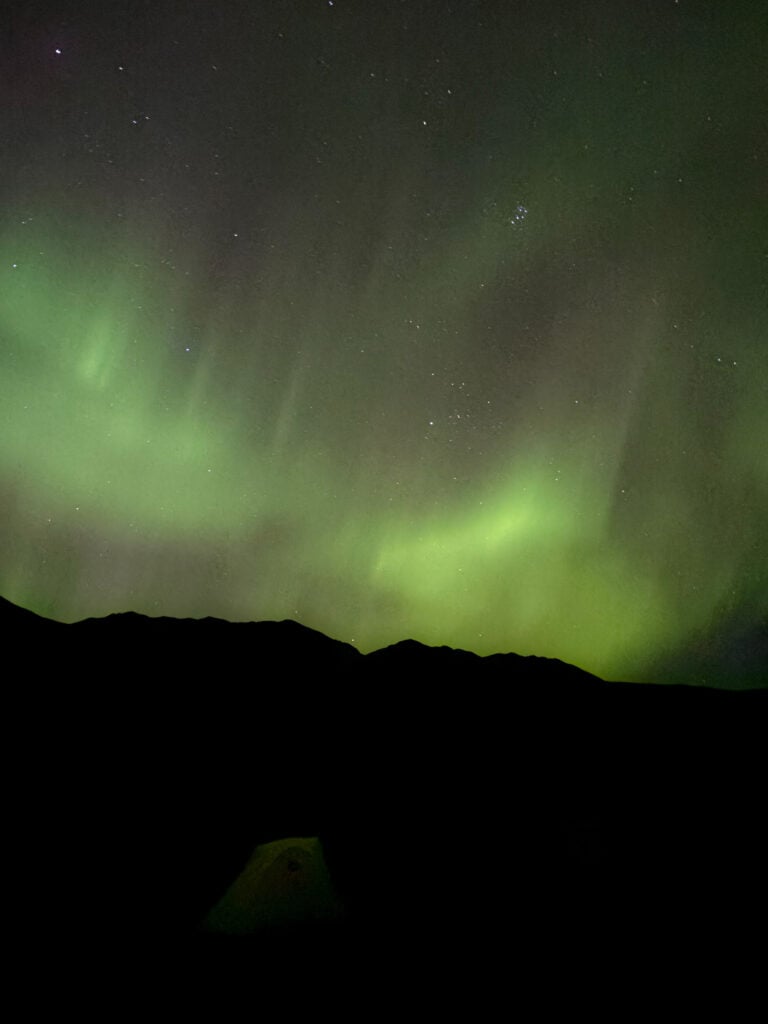
The northern lights ripples, alien and sacred, above us — a final gift for our final night on trek.
Expand Image

I pitch my tent barefoot, the ground soft and mossy under my soles. It’s damp, cool and pleasantly spongy against my skin after a morning in boots. I am one with the moss.

Today’s lunch is the best yet: pasta with zucchini, feta, pesto and mint. Everyone has seconds. Some of us have thirds. We have the option of an afternoon hike, bagless, to explore the area. My body is tired, but I opt in. As a group, we’ve collectively fixated on something from the first night when our guides were showing us the route that Georgeault and her partner and co-founder had scouted for the Kluane Colours trek. Someone had drawn an arrow along the contours and left a handwritten note “canyon (very cool!)” This is the time to find this very cool canyon once and for all. Anne puts her mind to it, and we hike up and down for a bit, trying to find a safe way down to the river we’d been criss-crossing earlier that day. 

Eventually we see it: a very cool canyon! Water flowing through a steep-sided gorge, the rocks painted in dramatic shades of orange, red and umber. The geological formation the canyon cuts through looks like a bird spreading its wings.

The sun is setting into the mountains, slowly, slowly. The light is golden, illuminating alpine avens swaying gently in a soft breeze. I simply don’t want this trek to end. I feel so blessed to be in these special, ancient landscapes we’ve been so thoughtfully guided in. Also, my hands are sunburned.

GOLD gives way to black, then COLOUR RETURNS to the sky once more

Gold gives way to black, then colour returns to the sky once more, and it’s the penultimate day of walking. To get over the next pass, we have to go up a steep rocky section, splitting into two groups in case of falling rocks. It’s gnarly, but our tired bodies make it up. At the top of the pass, the rocks get rounder, softly streaked with amber. When they break, there are spiralling patterns inside.

Getting down into the next valley is tricky. Amélie and Anne try a few different ways before they find a route that’s safe. I’m amazed at how they see ways through the landscape where we just see rock.

We make our way down through a steep-sided gully, eventually emerging onto a rocky ridge with views of a waterfall spilling through russet cathedral-like spires. We keep on going, slowly dropping in altitude until the guides finally let us stop to eat lunch. We sprawl on the ground amid the orangey foliage.

Later that afternoon, we see a black bear print in the dirt, a reminder we are not alone in the landscape.

Vegetation painted onto slate-grey slopes, as seen from the plateau on the penultimate night.
Expand Image

IT’S 3:20 A.M., and I’ve lost a game of “mind over bladder.”

I unzip my tent. The temperature has dropped again and it’s frosty underfoot. There are lights dancing, ghostly and beautiful in a star-pinpricked sky. The aurora ripples, snaps and folds in on itself in loops, columns of pink and green climbing into the heavens. I wake the others. It’s as if the very universe knew it was our last night in the mountains and had put on one last performance. A spectrum for us spectators.

An expedition to the "very cool" canyon, as written intriguingly on our guides' map! Very cool by name; very cool by nature.
Expand Image

The tent is frozen again when I wake, the red fly sheet stiff with frost. We pack our bags as the sky lightens in shades of apricot, the mountains in the distance turning blue-mauve as night falls away.

In all this time off-trail, we haven’t seen a single person. There’s another bear print in the riverbed, this time a grizzly.

We only have about four kilometres to walk before we meet the trail. Ptarmigans flutter in our wake. We see one on the path in front of us that has been decapitated, its spinal cord stretching out redly onto the grass. We also see increasingly fresher piles of bear scat, stained violet with blueberries.

Kelsey’s eagle eyes spot the grizzly. She’s beautiful, quite a ways from us, down in the valley. We shout, and she takes off at a gallop, galumphing toward the treeline, her butt fluffy and golden in the morning. A farewell. She disappears from sight and, soon, so will we from this landscape, grateful for our brief time in the embrace of its chromatic wilds.

Advertisement

Help us tell Canada’s story

You can support Canadian Geographic in 3 ways:

This story is from the May/June 2026 Issue

Related Content

Wildlife

Born for this: unravelling the disappearance of Dall sheep 

When scientists started documenting alarming declines in the Thechàl Dhâl herd of Dall sheep, it sparked a vital conversation between biologists and First Nations communities. What was causing the drop in numbers — and how could they work together to find a path forward?

  • 3618 words
  • 15 minutes

Wildlife

Into the wintry kingdom of the Canada lynx

In the boreal forest, where secretive lynx depend on the snowshoe hare to survive, climate change threatens to upset this longstanding predator-prey relationship

  • 1160 words
  • 5 minutes

Travel

The spell of the Yukon 

An insider’s account of the modern-day gold rush

  • 4210 words
  • 17 minutes

Travel

Trans Canada Trail celebrates 30 years of connecting Canadians

The trail started with a vision to link Canada coast to coast to coast. Now fully connected, it’s charting an ambitious course for the future.

  • 1730 words
  • 7 minutes
Advertisement
Advertisement