Travel
The spell of the Yukon
An insider’s account of the modern-day gold rush
- 4210 words
- 17 minutes
People & Culture
Now featuring a journey through the North, Toronto’s Little Canada scales the country’s vast landscapes down to tabletop size

Fitting the world’s second-largest country into a space about the size of 2½ hockey rinks is no easy task. But in Little Canada, Toronto’s “biggest little attraction,” the nation unfolds in intricate detail.
When Dutch-Canadian Jean-Louis Brenninkmeijer moved to Ontario in 1999, he arrived with more curiosity than knowledge about Canada. Inspired by Europe’s great miniature worlds, in 2011 Brenninkmeijer began sketching what would become Little Canada. “The majority of us will never have the means or the opportunity to go and see everything ourselves in our lifetime,” says Brenninkmeijer. “This was a way of celebrating the country that we now call home.”
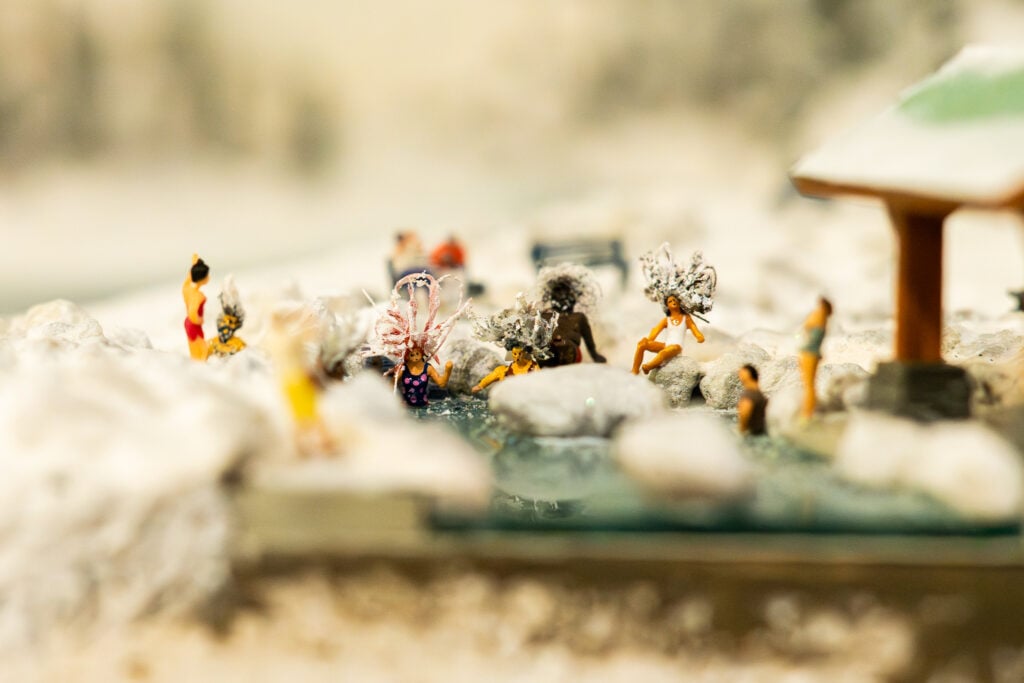
Opened in 2021, Little Canada now features more than 40,000 tiny residents and eight places across an almost 4,200-square-metre exhibit: Niagara, Toronto, the Golden Horseshoe, Ottawa, Quebec, East and West coasts — and now, the North.
From east to west, Little North curves through Yukon, Northwest Territories and finally Nunavut. Each section is further divided into a series of elaborate scenes: hair-freezing contests, coastal erosion in Tuktoyaktuk and Iqaluit’s road to nowhere — where a sign pointing north is stolen so often it’s become legend. In Yukon, Dawson City tells the tale of the infamous Sourtoe Cocktail, while, metres away, a sunken ship rendered in clear styrene acrylic pays tribute to the lost Franklin Expedition.
“This work wasn’t just simply about northern communities but … was done with those communities,” says Hunter Cardinal, co-founder of Indigenous consulting group Naheyawin, which Little Canada brought on in 2021 to help them get it right. Naheyawin helped Little Canada to identify and connect with communities and points of interest.
For the physical foundation, the team of engineers, designers and makers started with the “benchwork,” or base, fastening together plywood with screws, bolts and connectors, as well as traditional wood joinery. On top of this base, the middle layer uses thinner plywood. Then the models themselves are either 3D printed or assembled from an assortment of wood, card stocks, printed graphics and foam. Hundreds of little LEDs, magnets and miniaturized motors bring the scene to life — along with 2,500 figurines that live within these tiny northern lands and waters.
“Little Canada knows it’s important to create something that reflects who we are,” says Cardinal. “But they also care about something that I think is more rare and powerful, which is that feeling of belonging, regardless of who or where you are from.”
This story is from the January/February 2026 Issue
Travel
An insider’s account of the modern-day gold rush
Environment
To many, the Yukon appears to be the vanguard of a growing Indigenous land power movement in Canada centred mostly in the North
Environment
Yukon-based ecologists uncover four main patterns influencing changes in Yukon and address how outcomes can be improved
Science & Tech
Celebrating Canadian Innovation Week 2023 by spotlighting the people and organizations designing a better future