People & Culture

The Rideau Canal Skateway’s climate change challenge

Science, engineering and consistent cold are all factors in ensuring the world’s largest rink opens to skaters each winter

  • Jan 06, 2026
  • 869 words
  • 4 minutes
[ Disponible en français ]
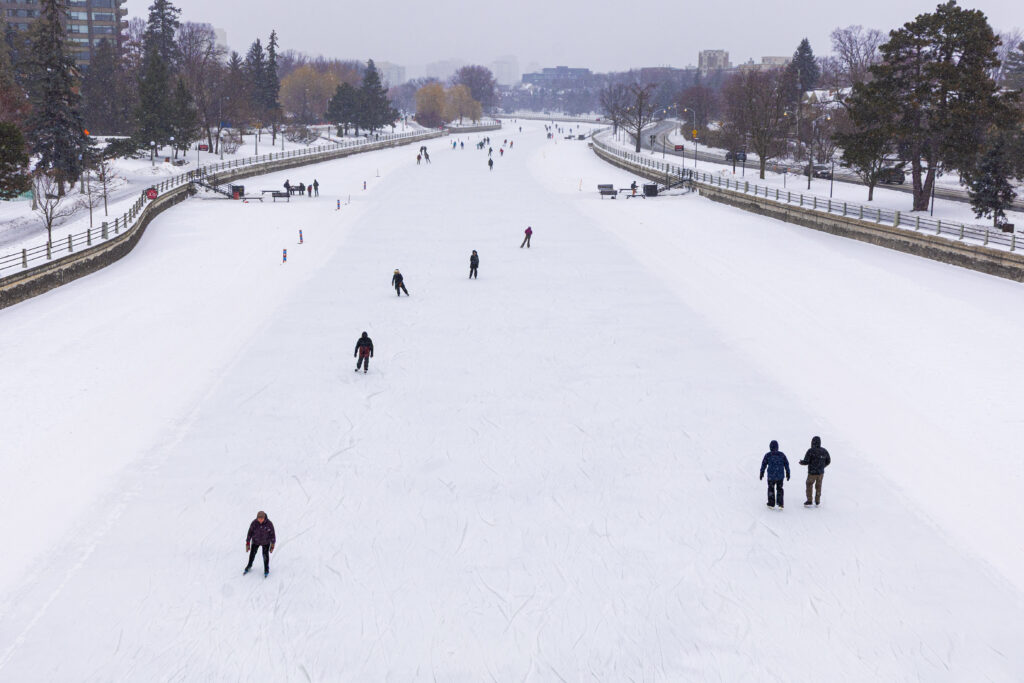
Avec ses 7,8 kilomètres de long, la patinoire du canal Rideau est la plus grande patinoire au monde, selon la Commission de la capitale nationale. (Photo: Ben Nguyen)
Expand Image
Advertisement
Advertisement
Live Net Zero Email Service

On Feb. 24, 2023, a social media post by the National Capital Commission brought the realities of climate change home to Ottawans.

“We won’t be able to open the #RideauCanal Skateway this winter,” read the X post. Unusually mild temperatures and heavy snowfall meant the canal’s water never froze to the solid 30-centimetre depth needed to support maintenance equipment and crowds of skaters. “Despite our best efforts,” the post continued, “the weather got the best of us for the first time in our history.”

The NCC — a Crown corporation that looks after many of Ottawa-Gatineau’s significant public sites — had been dealing with the capital’s fickle winter moods for half a century by that point. The commission first opened a groomed section of the canal to skaters in January 1971.

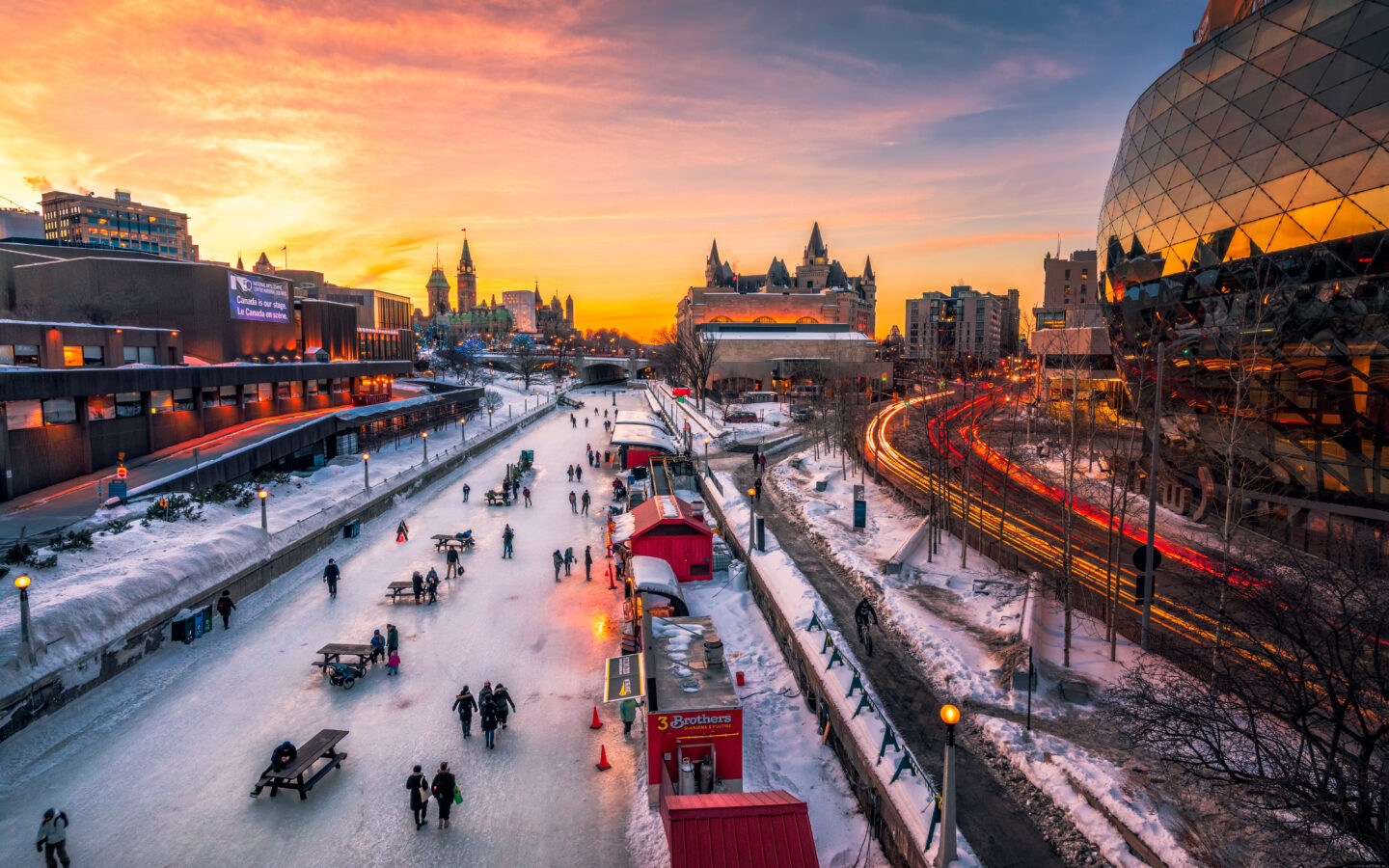
A view of the Rideau Canal Skateway from the Flora Footbridge in Ottawa. (Photo: Charlie Woolf/Can Geo)
Expand Image

Today, the Skateway — the world’s largest skating rink, according to the NCC — extends 7.8 kilometres through central Ottawa, from the National Arts Centre to Carleton University. Equivalent in area to 90 Olympic-sized hockey rinks, it draws hundreds of thousands of people annually between its typical opening day in mid-January to its close in early March.

So, when the Skateway didn’t open at all in 2023, it was a big deal. Media outlets around the world, from CNN to Agence France-Presse, picked up the story. But no one felt the loss as keenly as Ottawans.

“You’re disappointed. We’re disappointed. Bruce is disappointed,” concluded the NCC’s X post.

“Bruce” would be Bruce Devine, the NCC’s senior manager of facilities and programs. “I never thought that I would be the first manager to go through that experience,” he says today with a rueful chuckle.

We’re chatting on the bank of the muddy canal on a grey November day. Each fall, the canal’s water level is lowered to permit maintenance, then the Skateway section is partly refilled in preparation for skating.

With us is Shawn Kenny, an engineering professor at Carleton University. The ice mechanics expert is the co-lead on a four-year, $409,000 research project designed to help the NCC maintain the Skateway in the face of climate change. Conditions are evolving rapidly — between 2005 and 2021, the average length of the canal’s skating season dropped from about 61 to 46 days.

Kenny and his colleagues began the project in 2022 by collecting baseline data on precipitation, wind speed and direction, temperature and solar radiation. Using that information, they are developing models to predict ice growth.

In addition to probing the relationship between water quality and ice formation, Carleton researchers will be testing various approaches to snow management. Using snow cannons early in the season could accelerate the ice formation process, for example, while removing the insulating snow cover once the ice has reached a certain thickness would allow cold temperatures to penetrate more effectively.

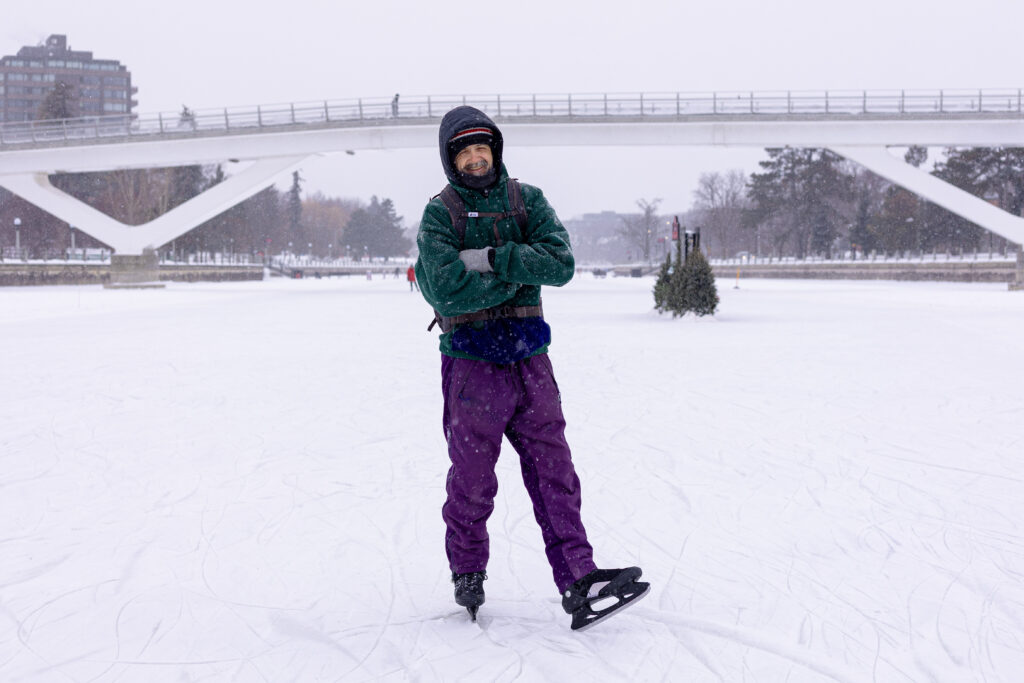
Keith Etsell enjoys a snowy skate along the Rideau Canal Skateway near the Flora Footbridge in downtown Ottawa. (Photo: Charlie Woolf/Can Geo)
Expand Image

The team has also prototyped lightweight robots (“snow bots”) to clear snow from thin ice. Snow inhibits ice growth, because air pockets in lightly compacted snow act as an insulator. In the disastrous 2023 season, alternating periods of rain and snow created layers of insulated water below the Skateway’s ice. “You had the thickness, but it was so soft that we couldn’t put any weight on it,” Devine explains.

Other aspects of the research project involve mapping ice depth along the entire Skateway, and assessing the effects of storm drains near the canal, as stormwater is usually warmer than canal water and laced with dissolved road salt — both factors that slow down ice growth.

Although the research project is slated to end this year, Kenny hopes to have his students collecting canal data long into the future. As he points out, the proximity of the Carleton campus to the canal makes it a perfect spot for students to gain practical experience.

Climate change isn’t a strictly linear process, so conditions along the Skateway continue to fluctuate. In the winter of 2024–25, just two years after the Skateway couldn’t open, frosty temperatures and scant snowfalls led to a 52-day skating season. That winter, more than 1.1 million people took to a canal blessed with what Kenny recalls as “perfect ice.”

One of them was Imee Plurad, who first visited Ottawa in 2019 and was captivated by the unusual sight of skaters gliding along the frozen waterway. “I said to myself, ‘Oh, one day, I will skate the whole stretch.’”

The following year, she moved to the capital. Since she hadn’t learned to skate growing up in the Philippines, she taught herself the basics on community rinks, taking a few spills. “I hurt myself too many times!” she says now, laughing. “But it didn’t stop me.”

In 2025, she finally skated the entire length of the canal and back. It took her three hours on a frigid, blustery day. “But I enjoyed the experience, and I’m so proud of myself,” the 42-year-old caregiver says. At the end of her trip, she spotted the Canadian flag flying from the Peace Tower on Parliament Hill and burst into happy tears.

This season, as the full Skateway opens early and Ottawans take to the ice, the NCC hopes to make memories like Plurad’s for decades to come.

Advertisement

Help us tell Canada’s story

You can support Canadian Geographic in 3 ways:

Live Net Zero Email Service

Related Content

Travel

Exploring Ontario’s historic Rideau Canal by houseboat: A scenic journey through Canadian history

Cruise through Canada’s past on a multi-generational houseboat adventure along the UNESCO-listed Rideau Canal, where history, charming towns and slow travel collide

  • 1655 words
  • 7 minutes

People & Culture

Canadians debate best place to skate

Twitter users engage in a friendly battle to determine Canada's best outdoor skating rink.

  • 784 words
  • 4 minutes
Lachine Canal, Quebec

Travel

Five Canadian canals worth visiting

These waterways offer more than just transportation from A to B

  • 681 words
  • 3 minutes

Places

Le défi du changement climatique pour la patinoire du canal Rideau

La science, l’ingénierie et un froid constant sont autant de facteurs qui permettent à la plus grande patinoire du monde d’accueillir les patineurs chaque hiver

  • 1027 words
  • 5 minutes
Advertisement
Advertisement