Environment
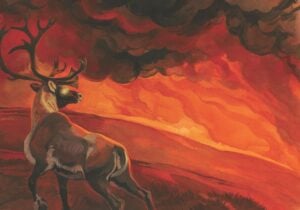
The great turning
Another reckoning is coming with climate change. How do we deal with our mental health — and ultimately find hope?
- 3646 words
- 15 minutes
Places
Despite its isolation, tiny Sable Island is a microcosm of the broader environmental forces reshaping our world

AS THE SMALL PLANE’S fixed wheels descend the last few metres to the sands of Sable Island, I hold my breath. To call this packed strip — with dunes on one side and the Atlantic Ocean on the other — a runway seems generous. But pilot Debbie Brekelmans takes us down smoothly for her 999th landing on this enigmatic island: a remote home to wildlife, rife with tales of stranded prisoners and violent shipwrecks.
This 42-kilometre-long crescent, a speck in the ocean 290 kilometres southeast of Halifax, is famous for its wild horses. But there are lessons here, too, of transformations that presage our planet’s resilience and fragility.

“It’s beautiful, it’s wild. It’s warm, it’s cold. It’s frustrating, it’s happy. It’s so many things all at the same time,” says Fred Stillman, owner of Kattuk Expeditions, one of the island’s three contracted tourism providers. He’s been visiting Sable since it opened to tourists in 2017. “It’s real life functioning as it’s meant to, without any rose-coloured glasses.”
Lacy clouds span a Dutch-blue sky as the sun sparkles off a shallow, brackish pond on the island’s edge. Within it swims a filefish, about the length of a human hand with mottled white, brown and olive skin. It’s gorgeous but worrying: as our climate warms, pulses of warm subtropical ocean carry rarely seen fish, including filefish, butterfly-fish and triggerfish, towards the chilly North Atlantic.
limate change may also be affecting the island’s population of Ipswich sparrows, which nest exclusively on Sable in summer. “Normally they migrate from the island back to New England,” says Sarah Medill, operations coordinator for Sable Island National Park Reserve. But increasingly, on wintertime walks, she’s finding little populations of the sparrows hiding in high vegetation, the birds opting to brave milder winters instead of migrating south.
No one is more intimately familiar with these subtle changes than Zoe Lucas, a naturalist and researcher who has worked on the island for 40 years. When I first meet her, Lucas is in her shed, surrounded by the detritus of one of her many projects: a multi-year study on the wide array of plastic that washes ashore. A bucket brims with mismatched Crocs below a clear garbage bag full of discarded curling ribbons. Lucas passes around an aggressively pink box of Gucci Rush perfume — when she first discovered it, she accidentally pumped its nozzle, spraying perfume on herself — along with a basketball from China, likely lost overboard by sailors shooting hoops and blown here by the whipping winds.
“Sable needs protection from the garbage and the pollution that get into the environment. Sable is as vulnerable as anywhere,” she says. Parks Canada enforces strict visitor limits and bio-security measures on the island, but even the best plans and intentions can’t prevent garbage, disease and warmer waters from arriving here.
Hiking around midday, I feel a twinge on my upper arm and look down to watch a mosquito sucking my blood. Strange, given I’ve been told there are no established populations of ticks, blackflies or mosquitoes on the island. Not anymore, it seems. Oblivious to the scientific implications, I smack it flat against my skin, Wile E. Coyote-style.
“There were more [mosquitoes] last year than I had ever seen before, and there’s more this year,” Lucas tells me, although it’s unknown whether mosqui- toes arrived here accidentally by ship or if there was always a small population that’s now growing due to milder seasons.
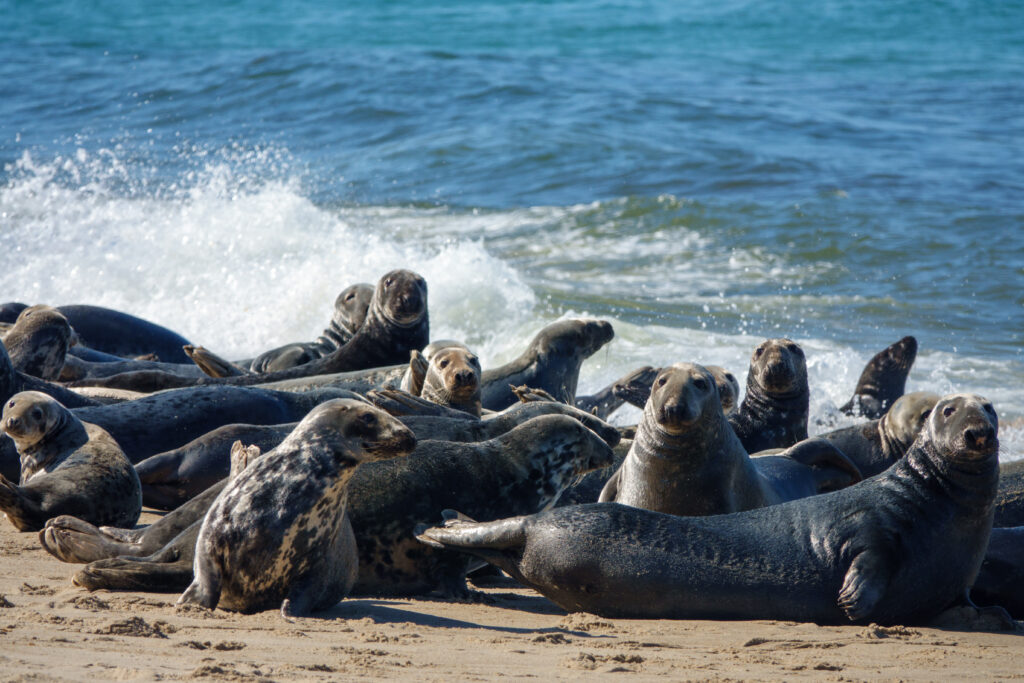
Heading north from the main station, we trudge, sand-weary, past hundreds of grey seals sunning themselves on the beach. Sable Island shelters the world’s largest breeding colony of grey seals, numbering around 320,000 during the January breeding season.
While scientists have long found influenza A in Sable Island’s grey seal population, says Medill, their understanding has been that, like humans, seals can largely survive the infection. However, in 2022, when a team tested a spate of dead grey seals in Quebec, they discovered that H5N1, a sub-strain of influenza A with a high frequency of outbreaks in wild and domestic birds, was behind the deaths. While they concluded the outbreak was limited, scientists on Sable are keeping a careful eye out for evidence otherwise.
When my 10-year-old son finds and holds aloft a bleached-white seal skull nearly as big as his own, I wonder what it died from. If a globally spreading disease, a designer perfume and mosquitoes can find their way to this remote “breezy sandbar,” as Lucas calls it, perhaps no place can be truly disconnected from the realities of our modern world.
This story is from the March/April 2026 Issue
Environment
Another reckoning is coming with climate change. How do we deal with our mental health — and ultimately find hope?
Places
This small rocky island was designated a national wildlife area in 2025 in recognition of its importance for a wide range of birds, including the graceful roseate tern, which is endangered in Canada
Travel
A pilgrimage to Kejimkujik reveals centuries-old connections between descendants of Nova Scotia’s first Scottish settlers and the Mi’kmaq who saved them

Wildlife
As white sharks make their presence known off the coast of Atlantic Canada, researchers and locals want to know: should people be worried?