
Wildlife
The race to save B.C.’s bats
As a deadly disease threatens the species’ existence, bat conservationists rush to find an antidote before it’s too late
- 4078 words
- 17 minutes
Places
In abandoned railroad passages in Georgian Bay, First Nation scientists find a refuge for Ontario’s endangered bats
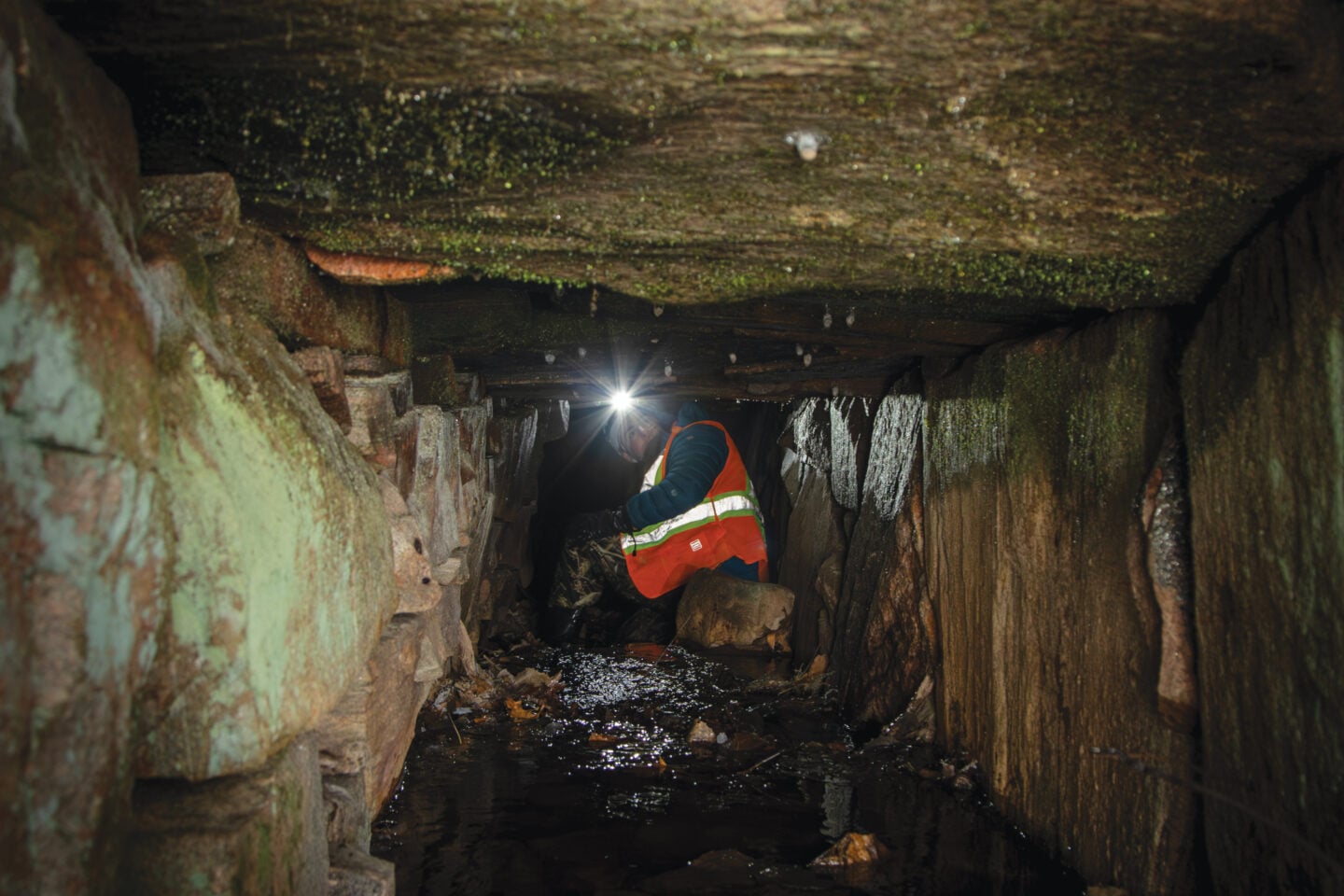
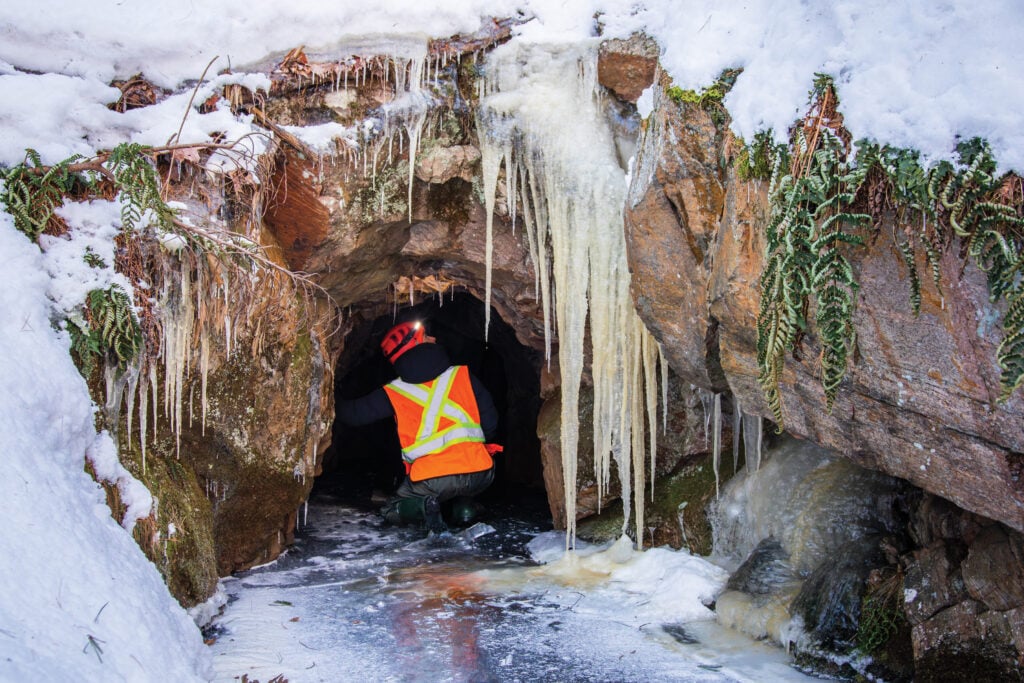
It’s -18 C and sunny in Ontario’s eastern Georgian Bay, and four scientists from Shawanaga First Nation’s species-at-risk program are striding through a patch of forest. Cold penetrates their layers as they march clad in chest-high waders, snowshoes and helmets with head lamps. After a two-kilometre hike through thigh-deep snow, they find what they’re looking for: a rare hibernation site for endangered bats.
It’s much warmer in these tunnels. The team crouches and crawls through several claustrophobic paths in the bedrock. The air smells of sulphur and is so damp that moisture clings to skin and protective face masks.
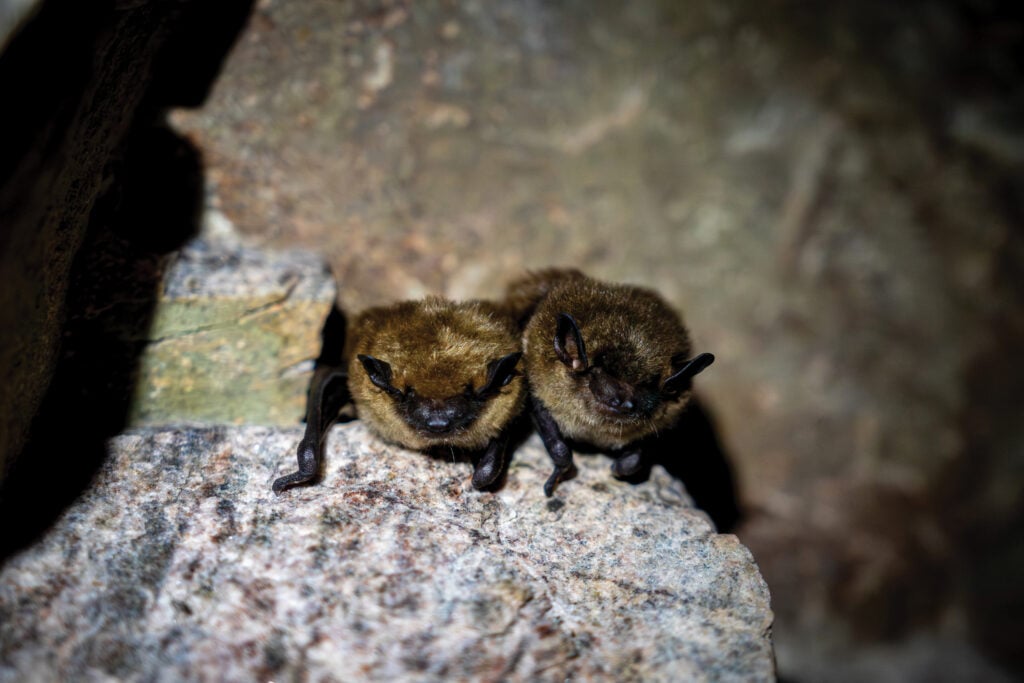
When the team finds the bats, the tiny animals, their bodies measuring 10 centimetres or less, are curled peacefully in the nooks and crannies of the tunnels, undisturbed by the scientists’ headlamps. To the researchers, the bats are cute, fuzzy and beloved.
These field days are part of the Tunnels Project, led by Shawanaga’s head biologist Steven Kell. The team has monitored these sites for seven years as an increasing number of bats use the tunnels under the Canadian National and Canadian Pacific rail-road, which were drilled and blasted with pickaxes and dynamite over a century ago. Their work is revealing how human-made structures can support threatened bats and help protect them from the sharp declines in bat populations across Canada.
Kell stumbled on these tunnels on his way to a traditional walleye spearing in the Shawanaga River in late April 2019. He was surprised to discover what he first thought was a cave and soon realized there was more than met the eye. With the help of Elder knowledge, he’s been able to find about a dozen tunnels — which originally functioned as water culverts under the railway line — with bats hibernating in more than half of them. “We rode the entire railway section, basically from Shawanaga’s northern land parcel to the southern land parcel, and we found a whole bunch of them,” says Kell.
This year, the team found more than ever before, visiting one tunnel with as many as 40 bats hibernating inside, including endangered eastern small-footed and little brown bats, along with the more common big brown bats. Previously, they had only ever found 17 to 20 bats in a single tunnel. “Before this project, there’s never been any confirmed hibernation sites for basically all of eastern Georgian Bay,” Kell says of the tunnels. Kell’s team installed acoustics to collect data on the bats entering the tunnels in the fall and leaving them in the spring.
For some of the species, like eastern small-footed bats, only a dozen hibernation sites were known in all of Ontario before the discoveries, and none were near Shawanaga’s territory. The jagged crevices in the tunnels’ rock create a cosy, well-ventilated hibernation spot for bats. That’s much needed, since seven of Ontario’s eight bat species, all found within the Georgian Bay area, are listed as endangered, partly due to habitat loss as a result of deforestation and urban development.
More pressing, though, is white-nose syndrome, a fungal disease causing bats to wake early from hibernation and then starve. It has killed 90 to 95 per cent of bat populations in some areas, and experts estimate that 52 per cent of bat species in North America are at risk of severe population decline in the next 15 years.
Kell says there is no way to know how many bats would have been using these tunnels in the years before the syndrome began to spread. But he is optimistic these recent increases may reflect a positive trend: emerging studies are finding that bats that survive the fungus may develop resistance to it, with some populations stabilizing after years of decline.
Provincial and federal funding over the last few years has helped Shawanaga First Nation, a small community of about 180 people living on reserve, sustain this project. The team also hosts community bat-netting nights to raise awareness, where folks help net and tag bats living in community buildings, including an abandoned church that’s become a maternity roost for many bat generations. They built a bat condo to accommodate more individuals and have other conservation projects on species from sturgeon to snakes. Now, with their project funding coming to an end, Kell is compiling a report to document their findings and encourage the railroad to protect these spaces. One of the biggest threats, Kell says, is beaver dams causing flooding and railroad staff blasting through the dams with explosives to keep water flowing.
And, while bats have a spooky reputation associated with carrying disease, they’re critical to Ontario ecosystems. A single bat eats thousands of insects per night, including those that are invasive or transmit disease. Ontario Parks’ website notes: “Unfortunately, because bats still elicit fear from the public, they may be perceived as ‘less deserving’ of conservation.”
But Kell is hopeful for this population’s future and the solutions it presents. “It’s just going to be a slow recovery,” Kell says. “One particular thing [about] these tunnels that I think will be significant for the future … if people wanted to build an artificial hibernation site, it [could] be a good structure to model off that.”
This story is from the November/December 2026 Issue
Wildlife
As a deadly disease threatens the species’ existence, bat conservationists rush to find an antidote before it’s too late

Wildlife
From contributing to the production of chocolate to regulating mosquito populations, bats are important animals that play a significant role in the world’s ecosystems

Wildlife
Disease has appeared for the first time in Manitoba, Minnesota and Wyoming

People & Culture
Indigenous ingenuity shines through in this century-old mode of winter transportation, a marvel of design perfectly suited to the challenges of snowy landscapes, ice, and open water. Behold the scoot.