People & Culture
How Indigenous culture shapes the Arctic Winter Games
Arctic sports and Dene games test pain resistance, agility and strength
- 1443 words
- 6 minutes
People & Culture
For the first time in Canadian Olympic history, more women will be competing than men — see where our athletes hail from
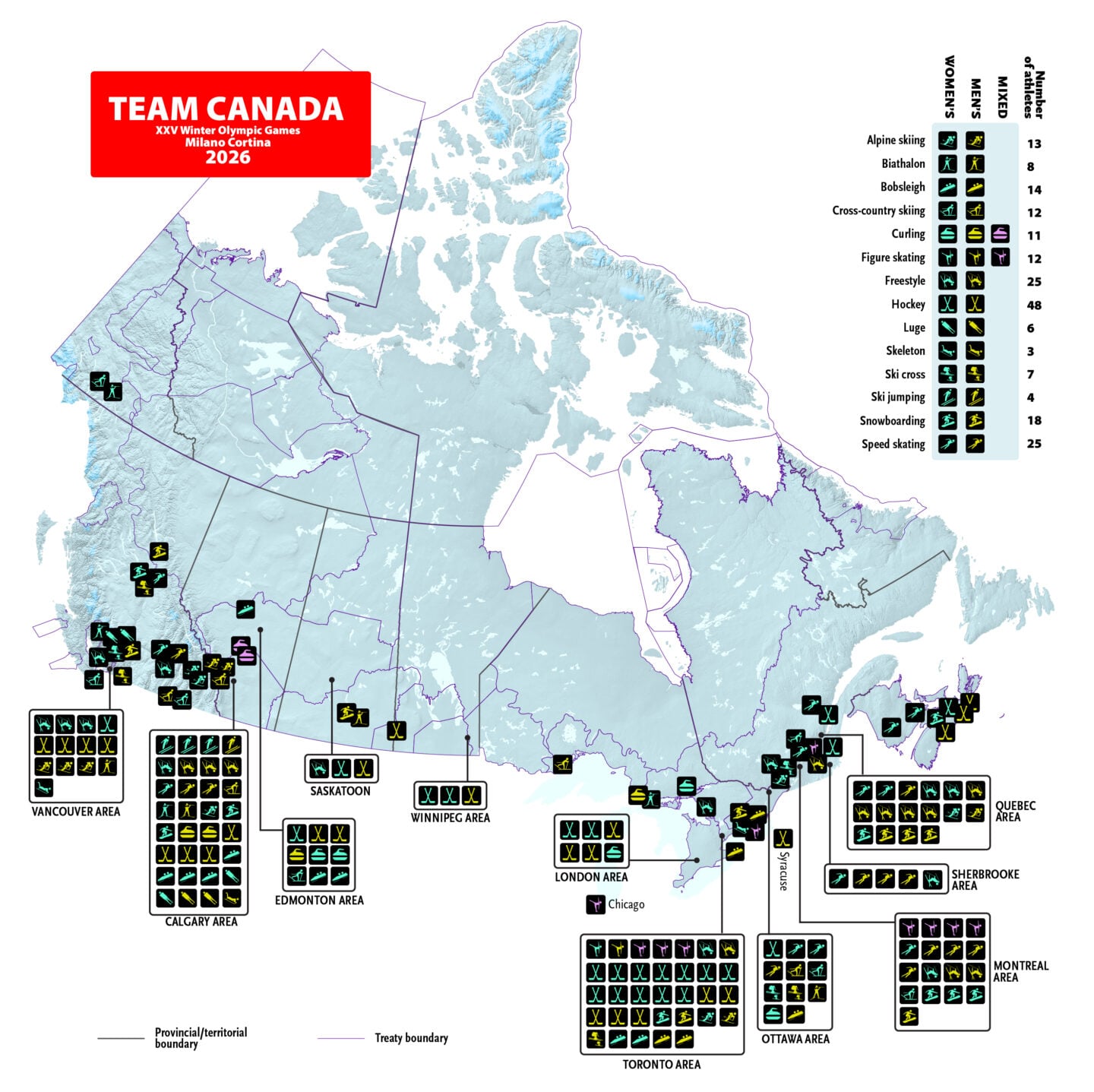
On Feb. 6, the women and men of Team Canada will march proudly at the opening ceremony in Italy, kicking off two weeks of high-stakes competitions in which Canada is expected to dominate, particularly in men’s ice hockey, freestyle skiing and short track speed skating. Canadian Geographic’s cartographer has mapped where Team Canada’s athletes come from and how many women and men are competing for Canada in each event. Read on for some interesting — and perhaps surprising — facts about the athletes of the 2026 Winter Olympics in Milano-Cortina.
Which province or territory has the most athletes competing at the 2026 Winter Olympics?
With 58 athletes, Ontario has the most representatives on Team Canada. But with its contingent of two athletes — cross-country skier Sonjaa Schmidt and biathlete Nadia Moser — the Yukon takes the per-capita gold by a good Canuck kilometre. The territory is home to 0.04 Winter Olympics athletes per 1,000 people compared to the next richest jurisdiction – Alberta, with 46 athletes competing in the Games, representing about 0.009 per cent of the population.
It’s a different story with Canada’s two other territories. The Northwest Territories and Nunavut don’t have any athletes competing in these Games. The last time the N.W.T. sent athletes to the Winter Games was in 2018, when biathlete Brendan Green and cross-country skier Jesse Cockney competed in Pyeongchang, South Korea. Nunavut has yet to send an athlete to the Olympics. Newfoundland and Labrador and Prince Edward Island will also go unrepresented at this year’s Games. Both provinces sent athletes to the 2022 Winter Games in Beijing: curlers Brad Gushue and Mark Nichols from Newfoundland and Labrador, and Morgan Ellis from P.E.I. for men’s hockey.
Athletes competing in women’s events outnumber those competing in men’s events. Of the 206 athletes competing for Canada at the Games, 107 are women and 99 are men. Last Winter Games the ratio was 106 women to 109 men.
Canada’s team features at least one athlete who doesn’t even reside in Canada. Thomas Harley, a defenceman with the NHL’s Dallas Stars and a late substitute during last year’s 4 Nations Face-Off, in which Canada’s men’s hockey team narrowly clinched victory over the Americans, was born and raised by Canadian parents in Syracuse, New York. Harley holds dual citizenship and will be representing Canada again in Milano-Cortina.
Pairs figure skater Deanna Stellato-Dudek is perhaps the most intriguing addition to this year’s team. The 42-year-old will be representing Canada at the Olympics for the first time after spending most of her athletic career competing for the Americans. Now a resident of Vaudreuil-Dorion, Que., Stellato-Dudek became a Canadian citizen in December 2024 after partnering with Maxime Deschamps, who is from Quebec. Stellato-Dudek and Deschamps are currently ranked fifth internationally.
Stellato-Dudek began her figure skating career initially as a singles skater, claiming a silver medal for the U.S. at the World Junior Figure Skating Championships in 2000, but she retired from the sport not long after due to injury. She relaunched her skating career in 2016 after attending a business retreat where she was asked: “What would you do if you knew you couldn’t fail?” Her answer: win an Olympic gold medal.
She will have a chance to do just that at Milano-Cortina, this time while wearing a maple leaf.
People & Culture
Arctic sports and Dene games test pain resistance, agility and strength
History
Games were started in 1970 to give northern athletes more opportunities for training and competition
History
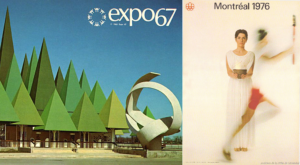
50 years after the Montreal Olympics, the city continues to be painted by the extravagant brush of its flamboyant mid-century
People & Culture
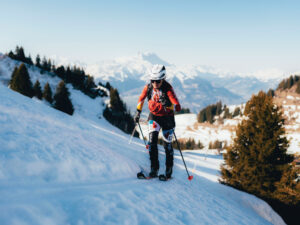
The former wildland firefighter- turned-mountain athlete shares her experience as a female in sports, the importance of representation and more