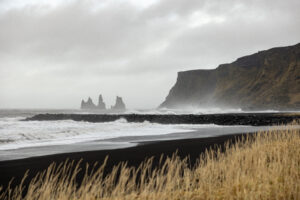
Travel
Photos: Iceland’s landscapes through the elements
Aurora-lit skies, erupting volcanoes, and glacial rivers — this journey across the land of fire and ice reveals an environment both dramatic and timeless
- 1348 words
- 6 minutes
Travel
Aboard Ocean Endeavour, RCGS Ambassador and best-selling author Bill Arnott takes readers on a journey with Adventure Canada

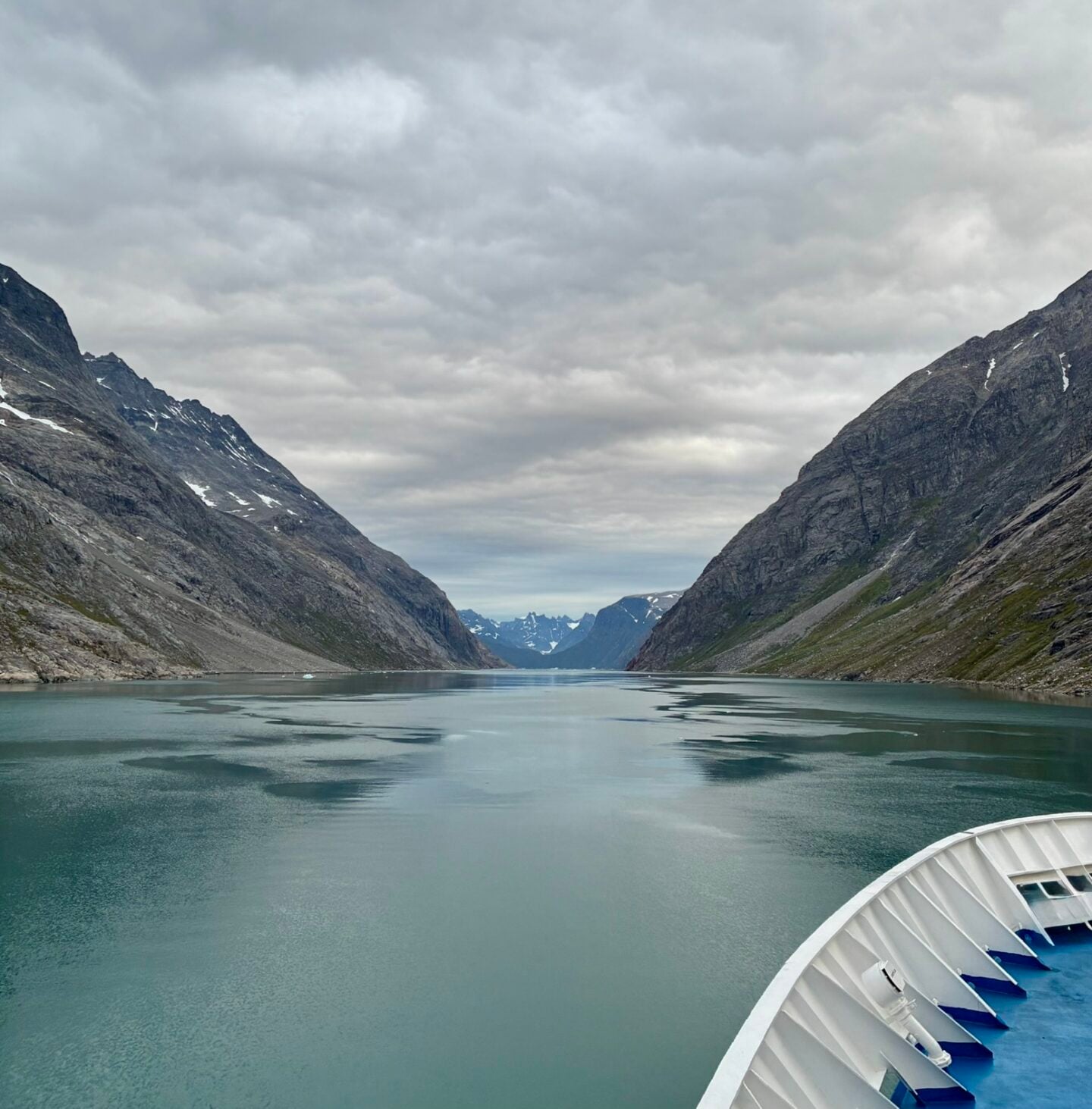
From the bow, I watch the sea peel away beneath me. Each swell breaks in a pulsing whsshhh as sea curls from the hull, the froth feathered white in our wake. The Ocean Endeavour, a 137-metre ice-class ship, is carrying approximately 300 people, half are travellers, the rest crew, plus a handful of researchers and guides. It’s my privilege to be onboard as a Royal Canadian Geographical Society Ambassador—a title I intend to use to claim prime viewing spots. Behind us, Iceland recedes, while ahead, the sun sets toward the open sea. And for the moment, I have this entirely to myself.
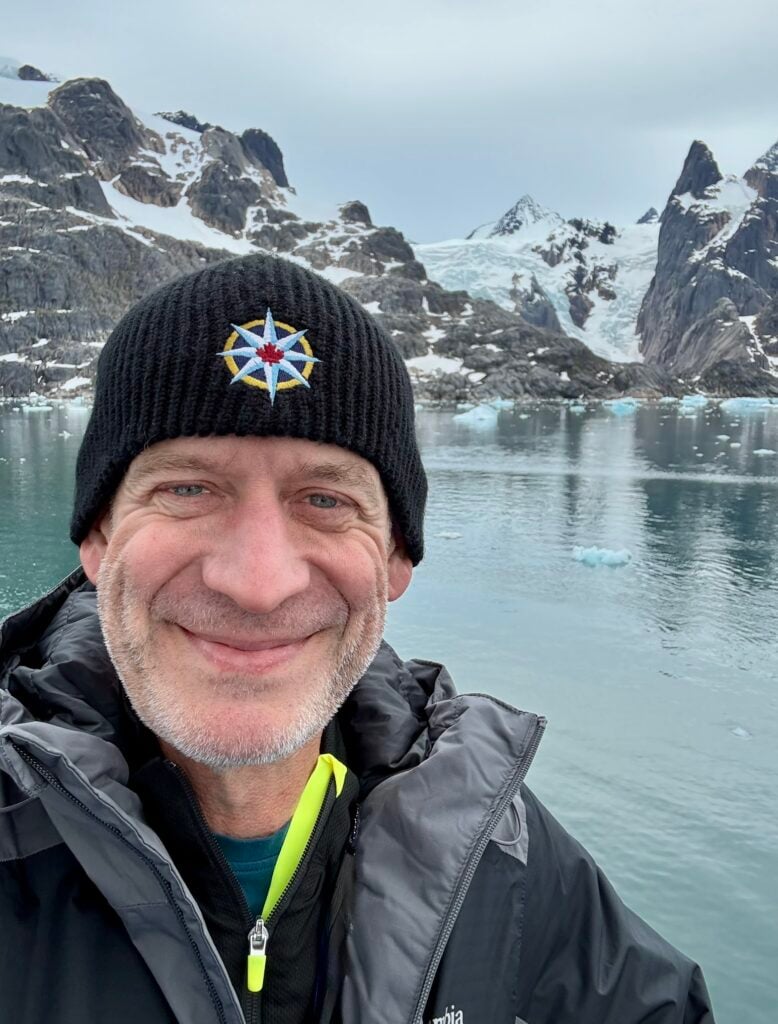
My excursion with Adventure Canada spans two weeks and two days. Most of the time, we are observers at sea, but manage to spend some time ashore. Sailing west from Reykjavik, our journey starts at the Atlantic’s top end. Our itinerary will take us to Greenland’s east coast before turning south, which my online map indicates will be a blend of the North Atlantic, Denmark Strait, and eventually, Labrador Sea. We will then head north along Greenland’s west side. The plan: to explore fjords, cut through Prince Christian Sound, a naturally carved passage on Greenland’s south end, then conclude our excursion at 66 degrees latitude north, the Arctic Circle. But first, two days at sea. An opportunity to find our sea legs and watch the ocean slide by. Today, the surface is calm; the low sun scatters sparkles across the blue-green waters. A few fulmars hang to my right, and it already feels like I’ve been here a lifetime.
Once thought to be the world’s precipice, possibly home to dragons or fabled turtles that prop up the earth, Ultima Thule is now clearly charted on maps, and in fact is no edge at all. Starting this excursion in Iceland felt epic—the birthplace of Sagas. The island, a dichotomous lump of hot water and ice, separates itself from Scandinavian kin with a unique brand of Nordic identity.
Prior to the voyage, I spoke with Cedar Swan, environmental preservationist and CEO of Adventure Canada. We discussed destinations along this itinerary, places some consider the edge of the world.
“Communities are small, isolated,” she explained. “There’s an attraction to these places, a throwback to earlier times. The ebb and flow seem like a more connected way of living.”
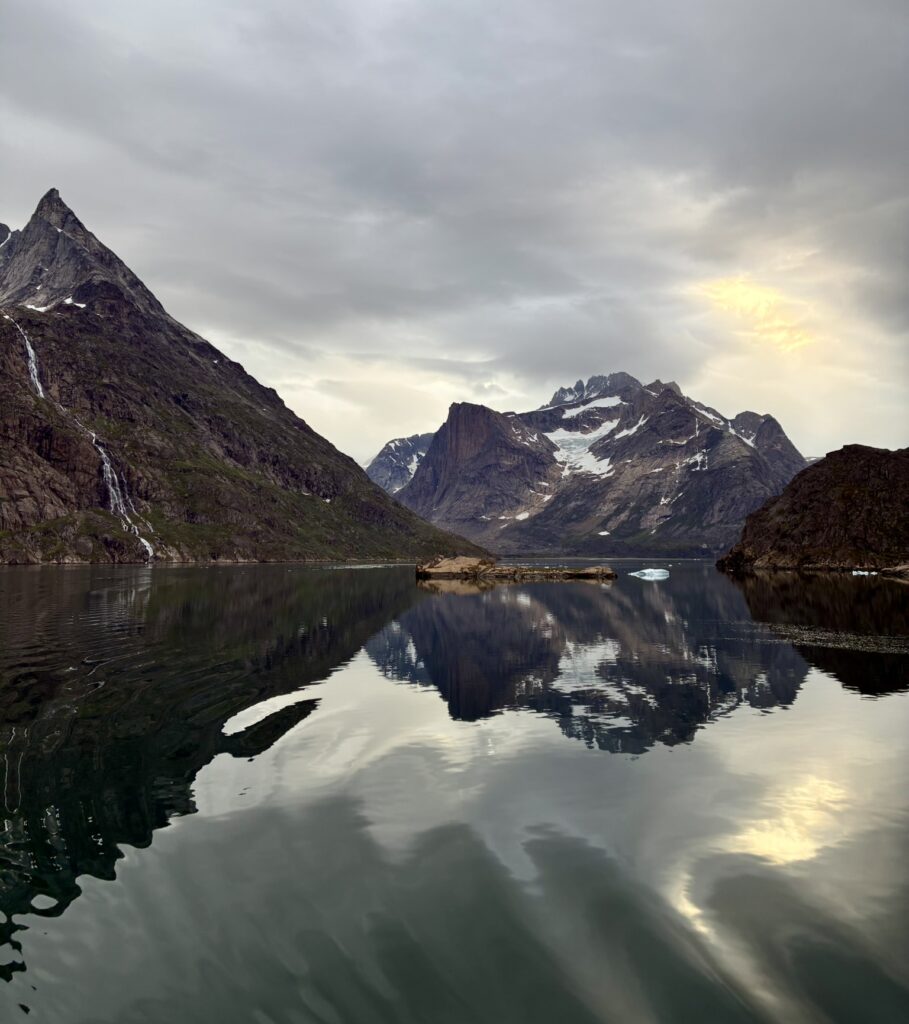
Precisely what I feel—connection, ebb and flow—after two days at sea. Toward the end of day two, we have our first glimpse of Greenland, the eastern edge of the world’s biggest island. Icebergs appear in tabular slabs, some snowy white, others the frigid blue of glacial rifts. Gulls wheel and call with the fulmars, and three minke whales roll languid to starboard.
As the coast grows, we veer south, down Greenland’s east side: Sikuiuiteq to Kangerluluk, the fjords of Lindenow and Igutsaat. The landscape is rugged, a radical blend of immediate and ancient. Plummeting gneiss cliffs, some of Earth’s oldest rock, buttress the ice sheet in fingers now cracking and drifting to sea. To avoid gale-force winds, the vessel finds shelter in a tight, craggy fjord. Weather demands a flexible schedule. The next day, sea conditions improve, and we resume our planned route.
A stop at Kuusuasia, dropping anchor, launching zodiacs, and a small group of us hike into hills where waterfalls tumble in emerald hues. In strikingly clear air, each view becomes grand. Visuals touch on the incomprehensible, shifting spatial perspective, where cliffs crane to 1000, 2000 metres, and scale dissolves. Pushing inland, I high-step through tussock, the same motion as trudging through deep-drifted snow. An Arctic hare bounds up the rock. Sheep cling to a cliff, igneous adding dark basalt stripes to the metamorphic sheet grey. And somewhere, far below, zodiacs wait to return to our vessel, now anchored in thickening fog.
An early morning transit of Prince Christian Sound, narrows with cliffs of snow and stone peaks. With the transition from East to West Greenland, the terrain better resembles its name. Hillsides of lush hummocks with dwarf willow and birch, crowberry, bilberry, and dustings of cranberry. All this speckled in buttercup yellow with the mauve of tiny azaleas. Blooms are abundant now in the northern hemisphere summer, which would pass for springtime further south. Buntings cheep with new season gusto, there’s a call of lapwings and the phlegmy-throat kraa from two ravens. Then a great ffwoom-ffwoom as a sea eagle passes; the ravens fall into formation and follow the eagle, the look of an aerial escort.
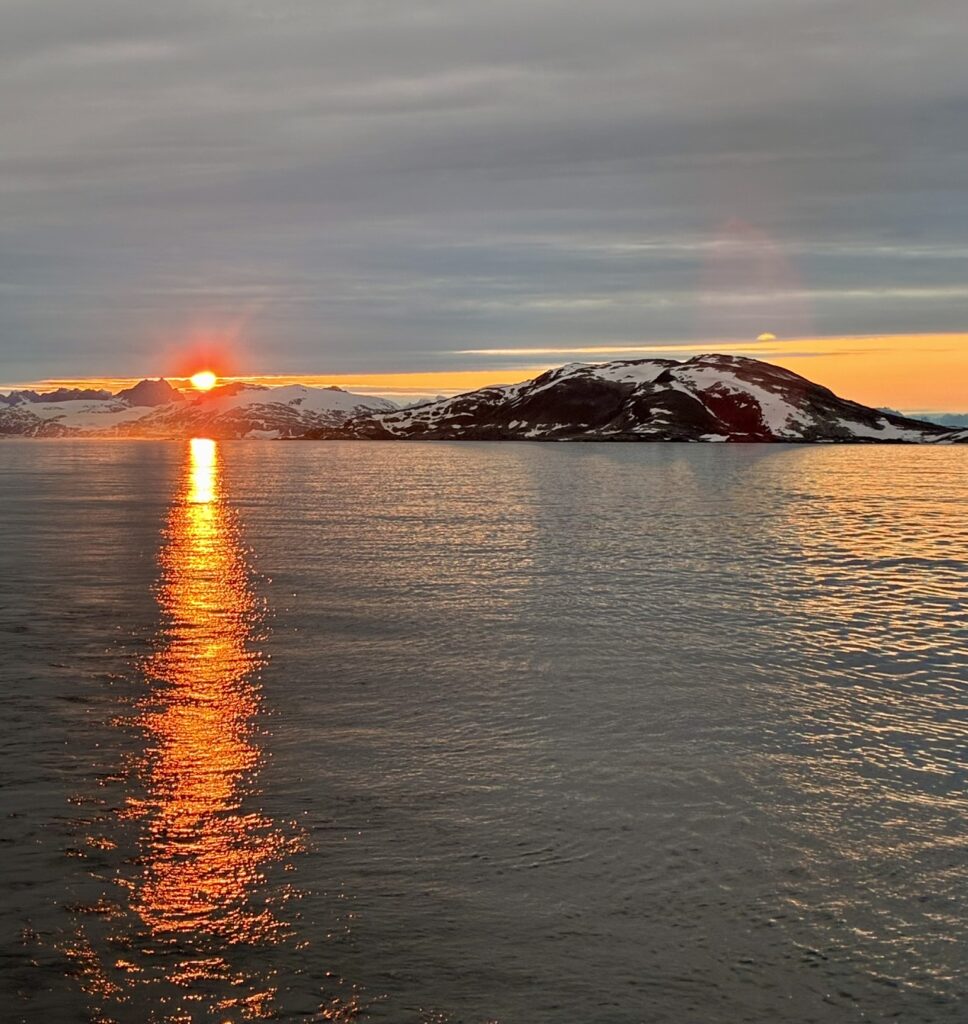
Most of Greenland’s population lives in the southwest of this island country. Which is where we are now, heading north from Qaqortoq to Nuuk, Greenland’s capital city. Here, you find industrial ports, traffic, and grocery stores. But before we reach Nuuk, we anchor again to allow passengers to zodiac to a rock-and-sand beach close to Paamiut. Shore excursions offer a variety of activities, including gentle or challenging hikes, opportunities to shop, dine, or simply take in different vistas from land. Once back aboard, a laser-beam sunrise ignites the horizon, outlining the icebergs in gold.
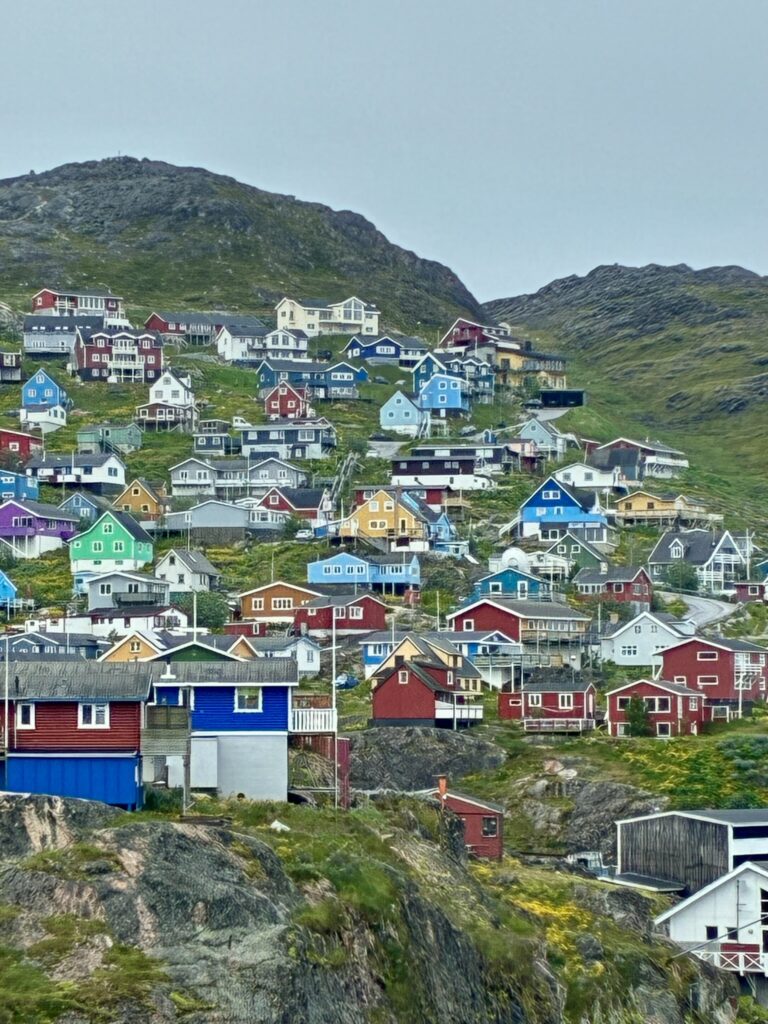
A short passage through open water, then we dock at an industrial pier in the harbour of Nuuk. An uphill stroll brings me to the urban-esque thrum of the capital: a shopping centre, high apartments, swaths of “jelly bean houses” in maritime paint. Bypassing stores and museums, I make my way to an alternate shore (every snippet of coastline is snaggletooth). Another pocket of relative silence, just the ambient calls of kittiwakes, murres, ravens and gulls, with the intermittent hum of an outboard as boats navigate bays. Near a beached dory, the sound of a ripsaw rasping through something resistant. Someone’s using a handheld saw to cut antler—the branchlike rack of a reindeer, severing it into chunks for a carver. I imagine the stag’s lifeline, tundra to tool: knife handles, a tin flute or a hand-turned souvenir.
During the journey, I sampled 10 types of fish. Some I know: salmon, cod, herring and haddock. Others I don’t bother to learn include groundfish and gamefish, as well as others that are cured, pickled and smoked. On separate excursions, I find onshore eateries offering reindeer and musk ox, eager to taste local flavours. To get there, I trod through wild sage and thyme, aromas released like a Sunday roast dinner.
Sailing again, with Nuuk in our wake, we’re now under robin’s egg sky. A barbeque is stoked on the deck of the ship, and we moor in a fjord near Kangerlussuaq, straddling the Arctic Circle. Passengers wear T-shirts, eat corn-on-the-cob. More sunscreen. Another shift in perspective, as though the world’s somehow spun upside down. While passengers reload their plates, I visit the bridge, chat with the crew, and enjoy a broad view of a glacier reflected in teal-coloured sea. Days aboard have been pleasantly filled with presentations and lectures, including glaciology, ornithology, and local language and culture.
From my lofty perch next to the captain, I savour the locale. Across Greenland, Indigenous locals are predominantly Inuit of the Thule culture. Geopolitically, Greenland is an autonomous Danish territory, but sit at any communal table and you’re likely to hear language from everywhere. The last time I was here—a decade ago—I crossed this terrain on foot, with a mix of trekking and small boats crossing fjords. One evening stands out: a meal of mussels and whale at a table of polyglots. Introductions unfolded like a round of Ouija, the pointer drifting between possible languages: Danish? Swahili? English? Romansh? (All genuine suggestions.) In the end, the one language we all knew a little was French, so dinner became moules et baleine.
Back to the present, the last leg of our journey, a long, snaking fjord on Greenland’s west side. Glacier-scraped landscape of low, rounded hills. Then a rattling clack-clack-clack as we anchor one final time, here at the head of Kangerlussuaq Fjord. Where a lone runway links Greenland to the rest of the world. Zodiacs haul us ashore, then a rickety bus follows a silty-brown river where musk ox are grazing, their appearance like stout woolly mammoths. Another bending of time and of place, before boarding a plane with new friends, and a flight to carry us home.
Travel
Aurora-lit skies, erupting volcanoes, and glacial rivers — this journey across the land of fire and ice reveals an environment both dramatic and timeless

Travel
A journey through the land of fire and ice, complete with lava flows, steaming hot springs and Icelandic folk tales

Places
Islendingadagurinn, the Icelandic Festival of Manitoba, celebrated its 133rd year in Gimli, Manitoba while recognizing Icelandic culture and heritage

Travel
Horses, glaciers and hot springs