Environment
Preserving connectivity in the Laurentian Highlands
The new Plaisance-Tremblant (P2T) Connectivity Plan is preserving space for nature in a rapidly developing area between Ottawa and Montreal
- 1909 words
- 8 minutes
Environment
How the Escarpment Corridor Alliance is balancing the needs of wildlife and people in southern Georgian Bay
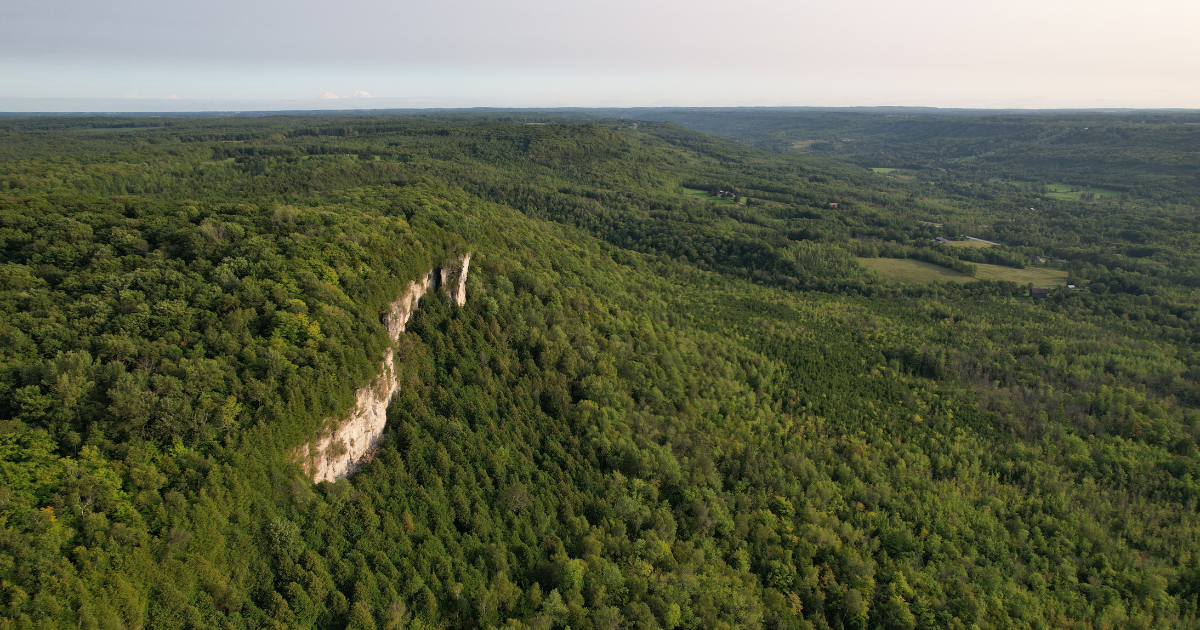
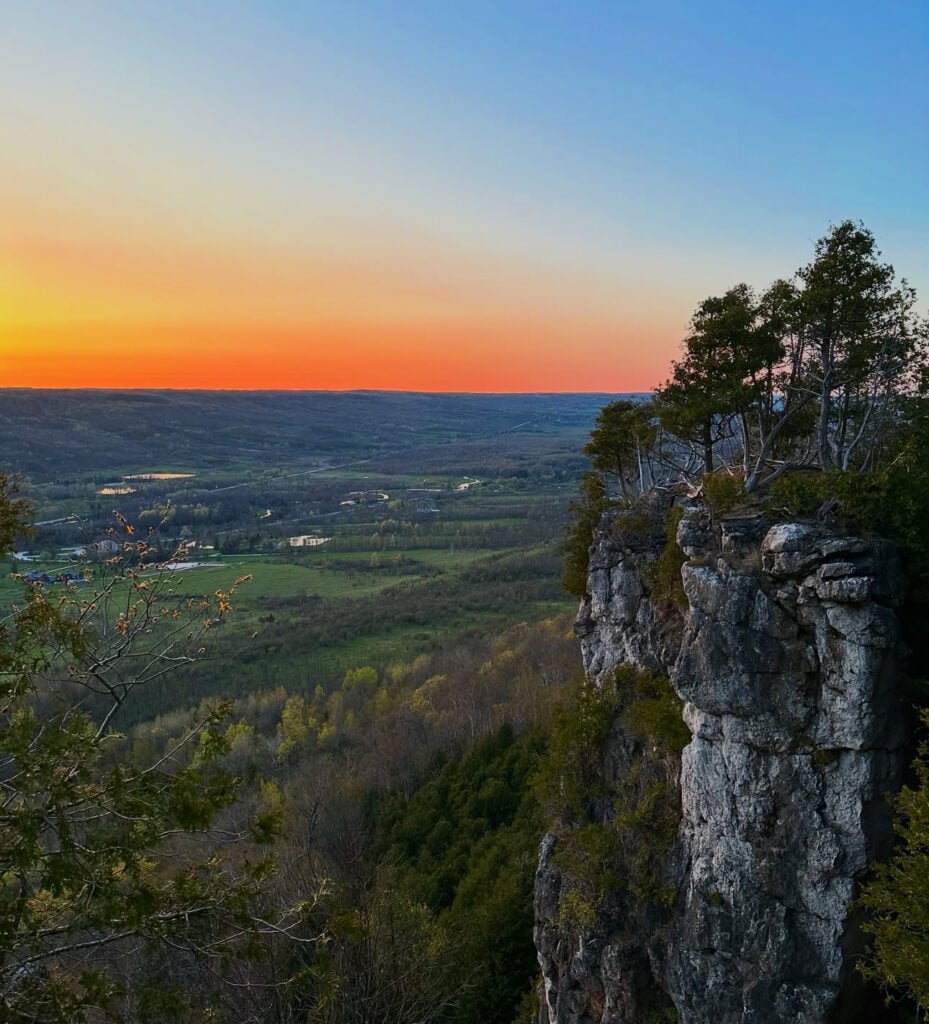
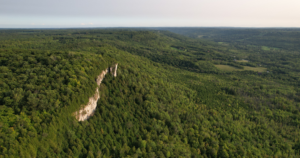
The Niagara Escarpment is south-central Ontario’s dominant geological feature. A long, linear outcrop of sharp cliffs and rocky slopes up to several hundred metres high, it enters the province at Niagara Falls, runs through Hamilton, then arcs northwest towards Collingwood. From there, it forms the backbone of the Bruce Peninsula dividing Lake Huron from Georgian Bay.
Despite traversing the country’s most populous and densely developed region, the escarpment has persisted as a ribbon of green due to its sharp relief. It hosts some of the oldest trees in eastern North America, myriad headwaters, and some of the highest overall species diversity in Canada. In 1990, it was designated a World Biosphere Reserve by UNESCO and has limited protection under the Niagara Escarpment Plan and the province’s Greenbelt Act.
Yet from an ecological connectivity perspective, it’s still wanting. South of Georgian Bay, in a segment Parks Canada recently included in its 23 priority areas for ecological corridors, connectivity mapping revealed “limited” opportunities for north-south wildlife movement beyond the narrow confines of the escarpment itself. According to that assessment, local wildlife — including numerous species at risk as well as common species like black bears and fishers — would benefit from actions “to maintain existing connectivity and restore lost connectivity between protected areas and natural habitats.”
Enter the Escarpment Corridor Alliance. Founded in 2022 by a group of South Georgian Bay-area residents, some with Bay Street credentials, the ECA has quickly ramped up its efforts to grow the protected area land base while working with landowners to strengthen ecological connectivity on their properties.
“More nature, protected and connected forever: that’s really job one for us,” says Bruce Harbinson, ECA’s director and cofounder. But the group’s vision also includes expanding recreational opportunities and nurturing the local economy built on those natural assets. “It’s not an either-or question,” he explains. “Without fully protecting and connecting more of our land, none of the rest is possible.”
A key task up to this point has been defining the boundaries of the ECA’s “area of influence.” That’s now set. It takes in a roughly rectangular 212,000-hectare block that straddles about 75 kilometres of the escarpment from north of Shelburne to near Owen Sound, much of it bound by the Southern Georgian Bay shore.
“We do hope that what we’re doing and some of the ways we’re going about it can get carried on further up and down the escarpment,” says Harbinson. “But we’ve bitten off plenty for us to chew on here.”
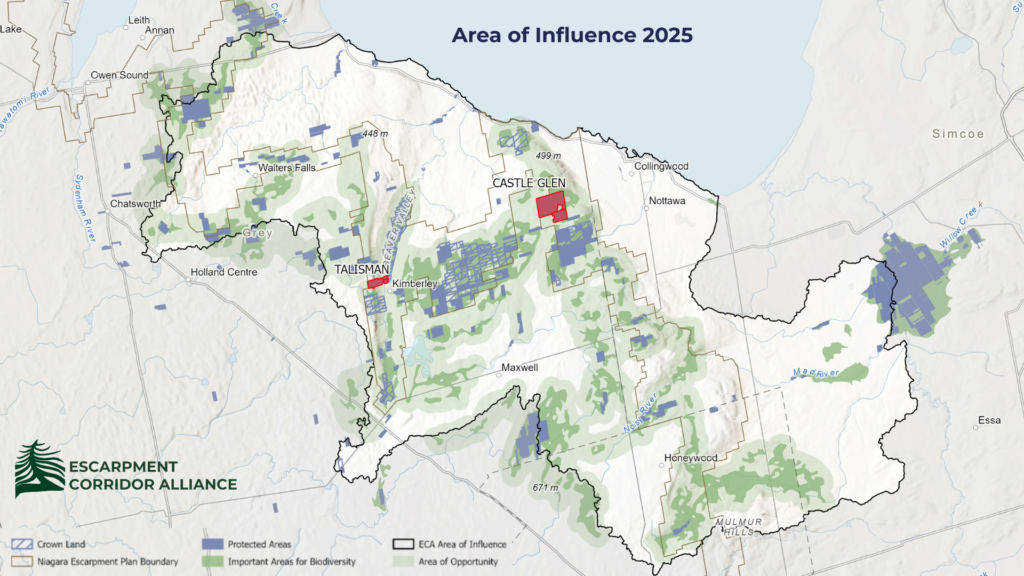
Before creating the ECA, Harbinson and its other founders had for many years campaigned against new development in a pair of key locations on the escarpment — a large undeveloped property south of Blue Mountain Resort called Castle Glen and the former Talisman ski resort, which closed in 2011.
When Castle Glen’s owner sold the site to a Toronto-area developer in 2021, raising fears that work might soon start on a residential and commercial megaproject that includes houses, a hotel and golf courses, the group took on a new approach. “We got together and reimagined what we wanted to do,” says Harbinson. “Very quickly, we moved away from a property-specific focus to this corridor concept. At that time, we literally had no idea about the global conservation movement towards corridors. It was just kind of this intuitive sense that that’s what was required here.”
Further research and outreach to others in the conservation community told them they were on the right track. They also had the good sense to know they needed to backstop their intuition with science. Jarvis Strong, the ECA’s executive director, who joined the group in 2023, recalls what happened next. “We did fundraising to hire scientists to do some environmental field work and research and geospatial studies to really look at the area at a scientific level, asking: Is there something here? Is there a need and an opportunity? Are there already existing natural corridors that are not protected? And the answers were yes, yes and yes.”
The cornerstone of that research was a six-month study by Dobbin International, global consultants in strategic spatial development planning. Dobbin took a watershed approach. It detailed the physical, hydrological and ecological attributes of five adjoining watershed basins linked to Southern Georgian Bay — Bighead River, Beaver River, Eugenia Lake, Mad River and Georgian Bay Shoreline. Along with one other sub-basin following the Pine River, immediately to the south, they now make up the ECA’s area of influence.
Dobbin’s study also pinpointed all the major ecological hotspots within those basins and used wildlife movement modeling to identify landscape corridors that connect them. These “potential pathways for connectivity” will be some the ECA’s main areas of focus going forward, says Strong.
The ECA is by no means the first conservation organization to target protecting nature on the escarpment. In fact, there are many properties within its area of influence that have already been secured by either the Bruce Trail Conservancy or Escarpment Biosphere Conservancy, both long-established land trusts. The Nature Conservancy of Canada, Ontario Farmland Trust, and Blue Mountain Watershed Trust are also active in the area. So what does the ECA add to the mix?
Harbinson and Strong say they are and will continue to work with any organization on a similar mission. “The word ‘Alliance’ … was chosen very carefully,” says Harbinson. “We need to learn from one another and partner where it’s appropriate.”
Yet, at the same time, they feel the ECA has a unique potential due to its broader area of influence beyond the escarpment itself, its specific Southern Georgian Bay focus, and the ecological corridor orientation. Fulfilling the latter means acquiring property directly, educating and supporting private landowners to up their own properties’ connectivity and biodiversity and making a case for all of the above to government.
In contrast, groups like the Bruce Trail and Escarpment Biosphere conservancies are focused, for the most part, on conserving lands on or very near the escarpment, and they work its entire length. “I think we complement each other extremely well,” says Harbinson. At the same time, “neither [of the other conservancies] has the high-intensity focus on this particular area that we feel we can bring to the table. I think we can just dramatically accelerate the amount of land under long-term conservation … through our work and our relationships on the ground.”
The ECA’s board and management only made the strategic decision to become a land trust in early 2025. Yet since then it has acquired one property and has multiple other nature preserve and conservation easements in the works.
The first property, called Sandy’s Summit, is a 10-hectare tract made up of mature hardwood forests, exposed escarpment cliffs and ancient caves. “It’s in an area called Kolapore, which is pretty much dead centre of our area of influence and is by far the largest key biodiversity area,” says Strong.
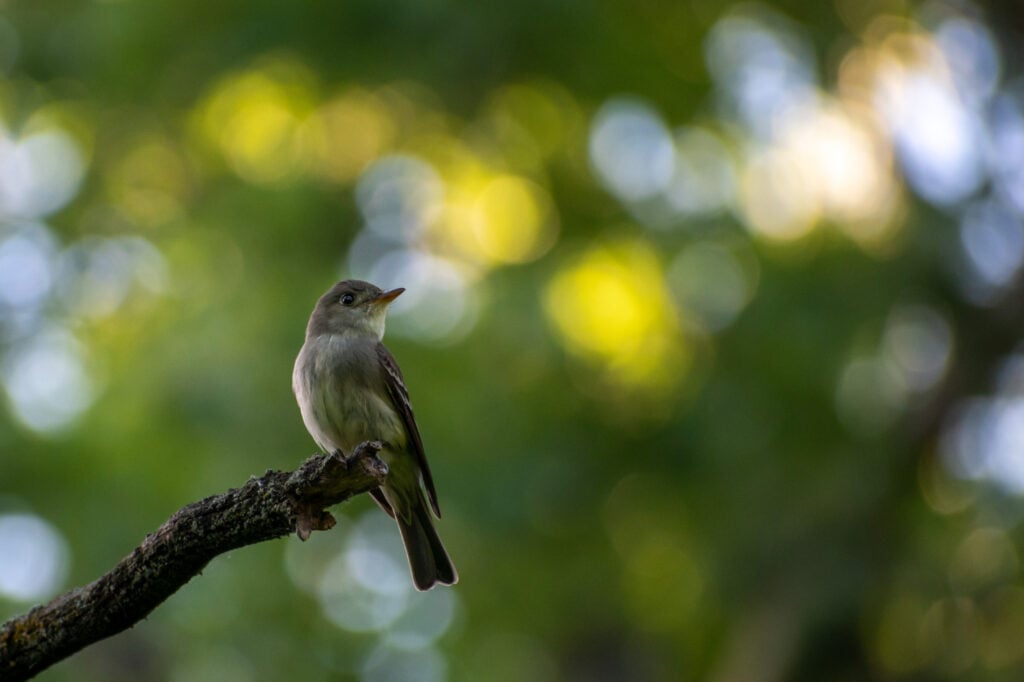
Indicative of the ECA’s mandate to enhance ecological connectivity, Sandy’s Summit is strategically located next to the Kolapore Uplands Resource Management Area, with linkages to nearby Duncan Escarpment Provincial Park. Known species at risk on the site include American hart’s-tongue fern and eastern wood-pewee. Two small wetlands at the base of the escarpment support a broad range of plants, amphibians, turtles and insects.
Late last year, the ECA also shared in another win when Bruce Trail Conservancy announced its purchase of the former Talisman property — a near-50-hectare site on the slopes of the Beaver Valley, a biodiversity-rich corridor where the river has cut well back into the escarpment. The purchase removes the threat of large-scale development and means “the vulnerable and degraded habitats of the former Talisman lands will be permanently protected [and] restored,” according to the announcement. Another line from that statement highlights the deal’s ecological significance. “The former ski slopes represent the only break in the forest canopy across a 10-kilometre stretch of the western Beaver Valley, making reforestation a key priority.” This spring, the Conservancy announced it had finalized a plan to reforest these slopes and demolish the shuttered resort buildings.
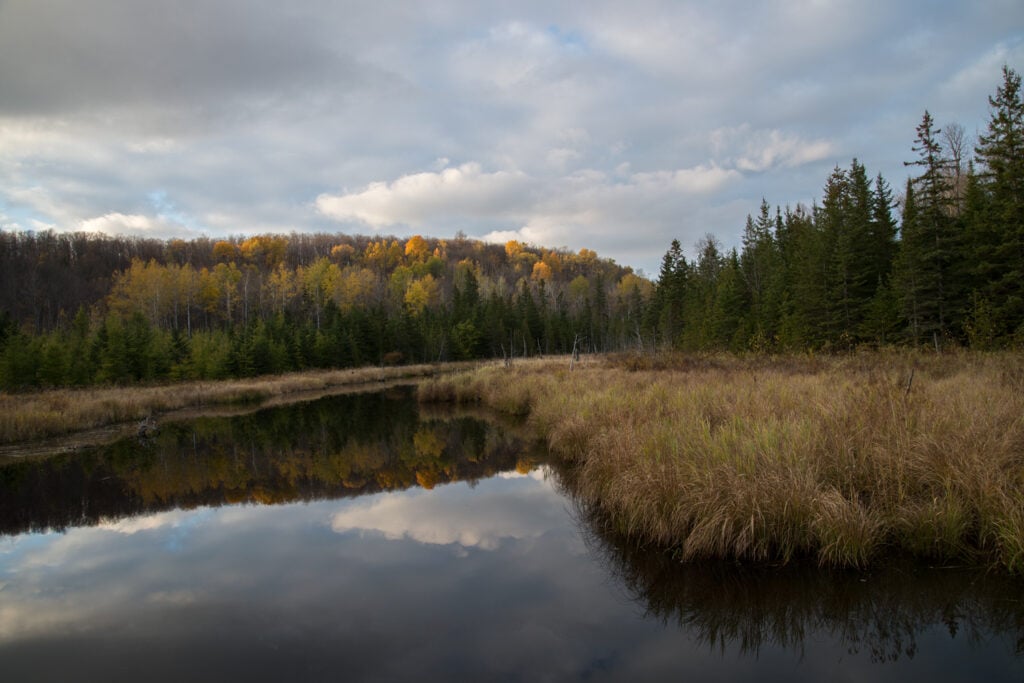
In May, the Ontario government officially confirmed boundary expansions of 20 provincial parks and nature reserves, seven of which are in the ECA’s area of influence. Overnight, these changes added another 3,452 hectares of protected area in South Georgian Bay. According to Strong, this amounts to “the biggest protected area expansion that this area has seen for decades.”
While the plan is the government’s own initiative, Harbinson says “we hope that we played a small role in this.” He also credits the “collective voice” of all the organizations and individuals that have over the years impressed upon the province the importance of protecting this region’s natural assets.
With its securement work underway, one of the ECA’s next tasks is to solidify and launch a landowner engagement program. Given that more than 60 per cent of the ECA’s area of influence is agricultural land, many of those landowners will be farmers.
“Ontario is losing 300 acres [of farmland] on average a day. So while our focus is preserving conservation land, there’s a complementary dovetail for us to be also advocating for the preservation and connectivity of agricultural lands as we go,” says Strong.
The first steps in this process will be largely a “listening exercise,” he says, “[learning] what their challenges are and then asking questions like, ‘Do you see opportunities where there could be complementary conservation activities that could also benefit your farm?’”
One area where those informal conversations are progressing is along Silver Creek, an important coldwater spawning stream for rainbow trout and chinook salmon that flows off the escarpment and through Collingwood. The ECA is also fielding applications from local farmers for several “micro grants” it plans to award this year to landowners in key areas to support experiments with corridor plantings and other management techniques.
“Conservation and agriculture can be very complementary, but they are sometimes at odds,” says Strong. “Having something tangible to work on is really the best way to build relationships.”
This story is part of a series about ecological corridors produced with support from Parks Canada. Learn more by visiting the Right of Passage website.
Environment
The new Plaisance-Tremblant (P2T) Connectivity Plan is preserving space for nature in a rapidly developing area between Ottawa and Montreal

Wildlife
During the winter, it’s not only humans that flock to the iconic falls; Niagara Falls is known as the gull capital of the world
Science & Tech
How a giant hole will help Ontario’s shift away from fossil fuels
Environment
Comment l’Escarpment Corridor Alliance concilie les besoins de la faune et ceux des habitants dans le sud de la baie Georgienne