Places

A journey into the “microverse” of New Brunswick’s Mount Carleton Provincial Park

The smallest inhabitants of New Brunswick’s Mount Carleton Provincial Park are its biggest asset

  • Oct 12, 2026
  • 746 words
  • 3 minutes
Mount Carleton in New Brunswick is famed as the Maritimes’ highest peak, but a closer look reveals an intricate microverse.
Expand Image
Advertisement
Advertisement

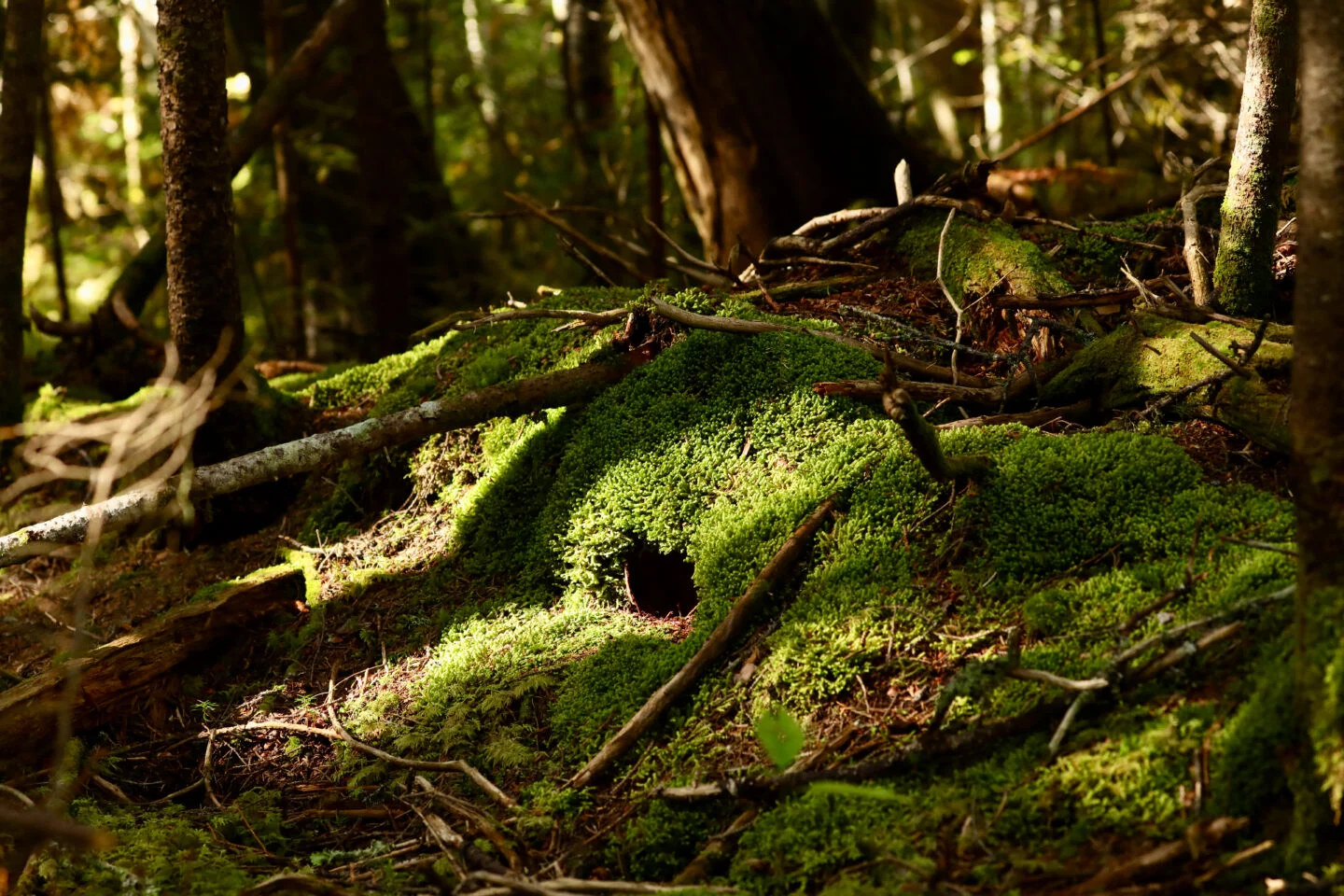
It’s easy to lose track of time in Mount Carleton Provincial Park, N.B. Autumn light filters through layers of fir, birch and spruce draped in lichens, and the occasional breeze sends yellow leaves drifting downward. Looking down reveals an intricate microverse. Fallen logs, softened by decades of decay, support a patchwork of lichens, fungi and seedlings, while insects disappear into crevices in bark and leaf litter.

Mount Carleton itself is famed as the Maritimes’ highest peak, but the park also reaches heights for the sheer density of its ecology. The mountain’s steep gradient — uncommon in eastern Canada — creates a series of overlapping climate zones and habitats, each supporting its own community of plants and wildlife. Logging has been prohibited in the park since its establishment in 1969, so its rich biodiversity is a living testament to how a forest thrives when it remains relatively undisturbed.

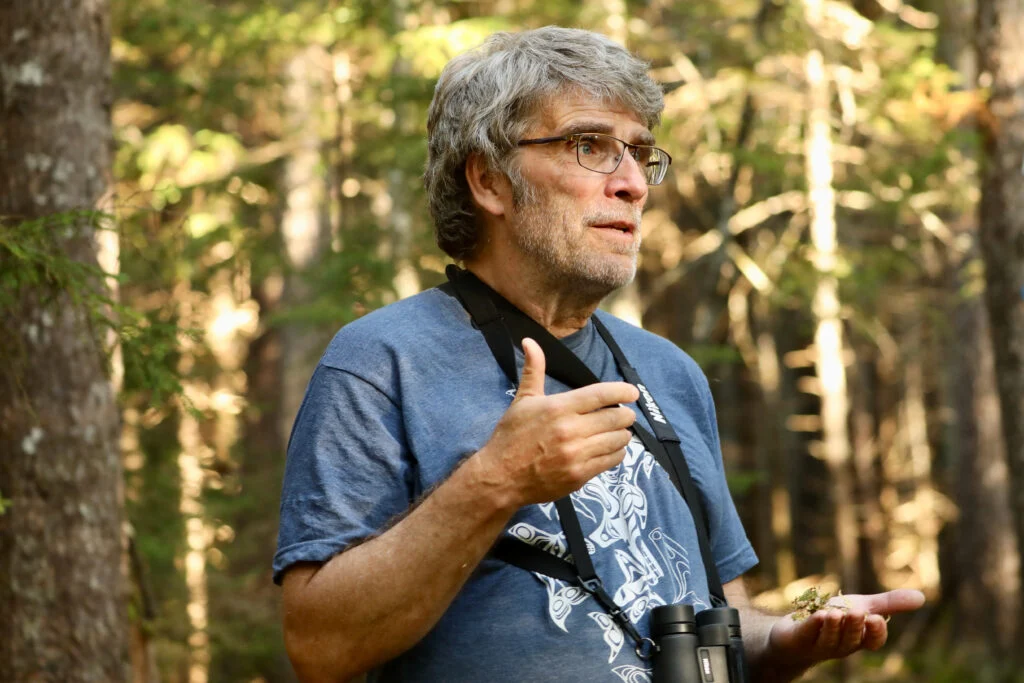
Avian biologist Roland Chiasson likens trees to bookshelves.
Expand Image

“Mount Carleton works because it still functions as a whole system. It’s multi-storey and multi-aged, so you get all these small pockets of habitat,” says avian biologist and outdoor learning specialist Roland Chiasson.

Chiasson likens trees to bookshelves, with distinct yet overlapping vertical layers. In that sense, the forest can be thought of as a library where different species inhabit their favourite shelves. On the forest floor, fungal networks digest organic debris such as fallen tree trunks, branches, leaves and dead animals. As material softens and is recycled back into soil, once-inaccessible nutrients are freed and circulated upward. What appears as decay is regeneration. Bacteria, fungi and microorganisms are the forest architects. 

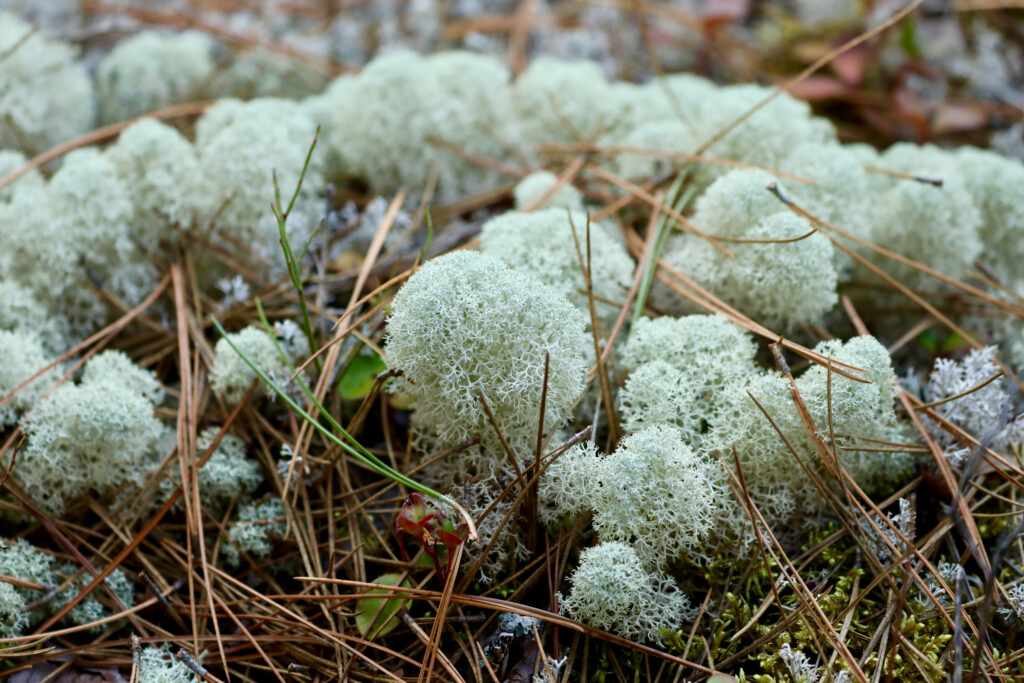
Then there are the lichens. Tufts of old man’s beard (Usnea) trail from the arms of conifers, while reindeer lichen, their delicate branches resembling tiny antlers, form vast, spongy mats across the forest floor. In hardwood and mixed-wood stands, broad, leafy lungwort clings to trunks and branches. Lichens aren’t singular organisms but rather colonies of algae or cyanobacteria living symbiotically with various fungi. They emerge where air, moisture and time meet. Millimetre by millimetre, they grow on rocks, fallen logs, bark and branches. Drawing light and gases, lichens also act as archivists, recording long-term patterns of air quality.

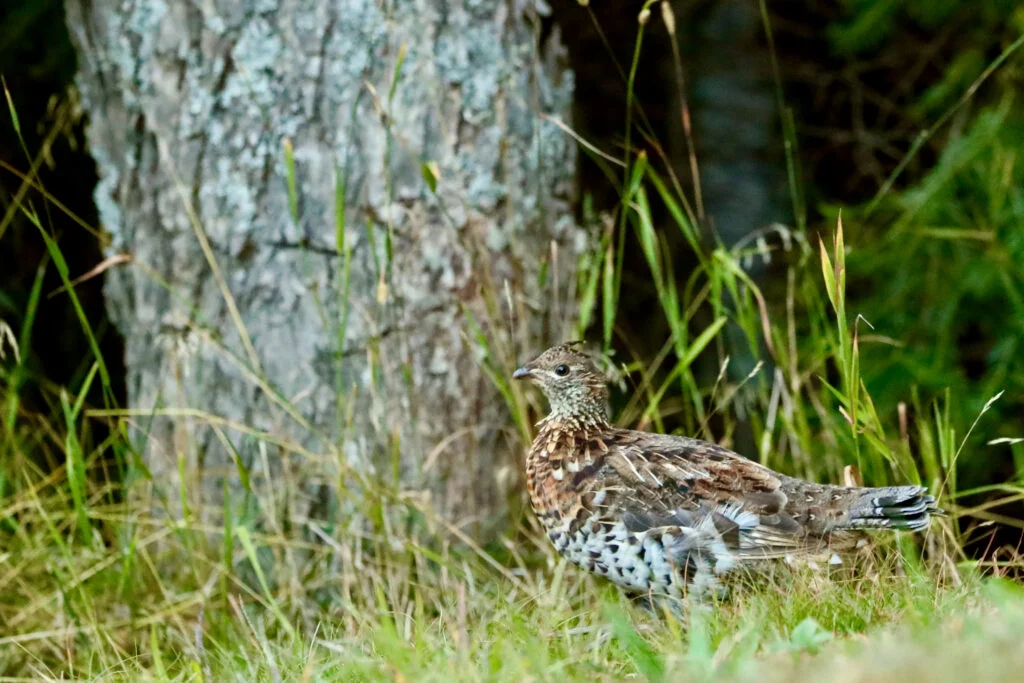
Due to its protection and the multiple habitats created by its elevation, Mount Carleton has an unusually high bird diversity for this part of the province.
Expand Image

“Lichens are sensitive indicators of environmental quality,” says lichenologist Stephen Clayden, a retired botanist and curator of the New Brunswick Museum who continues to study the lichens of Mount Carleton. The park, with its abundance of long-lived lichens, is a healthy benchmark against which more disturbed forests can be compared.

Insects join the vertical relay, moving energy up the shelves, from the forest floor to the canopy. More than 5,000 insect species, including the summit-dwelling short-tailed swallow-tail butterfly and the uncommon and declining Bohemian cuckoo bumble-bee, have been documented in the park, with new ones continuing to be discovered.

“Insect diversity tells you how many ecological niches [habitats that support specific species] a forest actually has,” says Chiasson. Simplified forests, often the result of clearcutting or plantations, generally have fewer insect species. As niches disappear, insect species decline, and the effects can cascade upward into a drop in avian diversity. Chiasson frames birds as responders, not drivers. “Birds respond to changes happening lower in the system,” he says. “When birds disappear, it’s rarely the cause — it’s the result.” 

Lichenologist Stephen Clayden says that lichens are sensitive indicators of environmental quality.
Expand Image

Mount Carleton has an unusually high bird diversity for this part of the province due to its protection and the multiple habitats created by its elevation. Occupying predictable vertical niches — these “bookshelves” within trees — birds forage where easy access to food and shelter can be found. For example, various warblers have different shelf preferences. In Mount Carleton, ovenbirds occupy the bottom shelf (the forest floor) while Blackburnian and Cape May warblers prefer the mid-level and top shelves, respectively.

Protecting intact forests in New Brunswick has long been a challenge, especially with forestry being a cornerstone of the economy. The province currently protects only about 10 per cent of its land, although the government has committed to 15 per cent by 2027 and is developing a plan to double that. Mount Carleton sits at the heart of a potential conservation network in north-central New Brunswick, but clearcutting still reaches the park’s boundaries.

It’s easy to admire Mount Carleton’s peaks, forests and lakes, but its smallest inhabitants tell an equally important story. From fungi and lichens to insects, countless overlooked organisms help sustain the ecosystems around us. We just have to look closely enough to see them.

Advertisement

Help us tell Canada’s story

You can support Canadian Geographic in 3 ways:

This story is from the September/October 2026 Issue

Related Content

Travel

New Brunswick’s wildest adventure: Hiking the millennia-old Nepisiguit Mi’gmaq Trail

An ancient Mi’gmaq migration route that follows the Nepisiguit River’s winding route to the salt waters of Chaleur Bay, the Nepisiguit Mi’gmaq Trail is now one of the world’s best adventure trails

  • 2648 words
  • 11 minutes

Travel

10 things you absolutely must do in New Brunswick – according to my two-year-old

Discovering boats, buoys and deep-fried clams on an epic family road trip in the 2022 Chevrolet Traverse RS

  • 2330 words
  • 10 minutes
A crowd of tourist swarm on a lakeside beach in Banff National Park

Places

Smother Nature: The struggle to protect Banff National Park

In Banff National Park, Alberta, as in protected areas across the country, managers find it difficult to balance the desire of people to experience wilderness with an imperative to conserve it

  • 3508 words
  • 15 minutes
Andy McKinnon

Places

Canada’s first national urban park

It’s an ambitious plan: take the traditional Parks Canada wilderness concept and plunk it in the country’s largest city. But can Toronto’s Rouge National Urban Park help balance city life with wildlife?

  • 3444 words
  • 14 minutes
Advertisement
Advertisement