History
The untold story of the Hudson’s Bay Company
A look back at the early years of the 350-year-old institution that once claimed a vast portion of the globe
- 4473 words
- 18 minutes
Mapping
As Trump’s trade war drags on, can other countries fill the gap?
As Trumpian chaos washes across the 49th parallel, many Canadians have found themselves wondering how we forgot the wise old adage about eggs and baskets. In other words, how did we get into a situation where a whopping 75 per cent of the exports that account for almost a third of Canada’s $3.1 trillion economy end up in a country whose president now claims our goods are unnecessary?
Owing to a sprawling geography and a sparse population, Canada has always had to trade, says University of Toronto economic historian Dimitry Anastakis — first with our colonial overlords, who bought furs, fish and wheat, and then with our next-door neighbour, which imported Canada’s wood, oil and eventually its manufactured goods, especially cars. “It’s always been about,‘how do we get our stuff out of the ground or build stuff later on to sell within these imperial frameworks?’”Anastakis says.
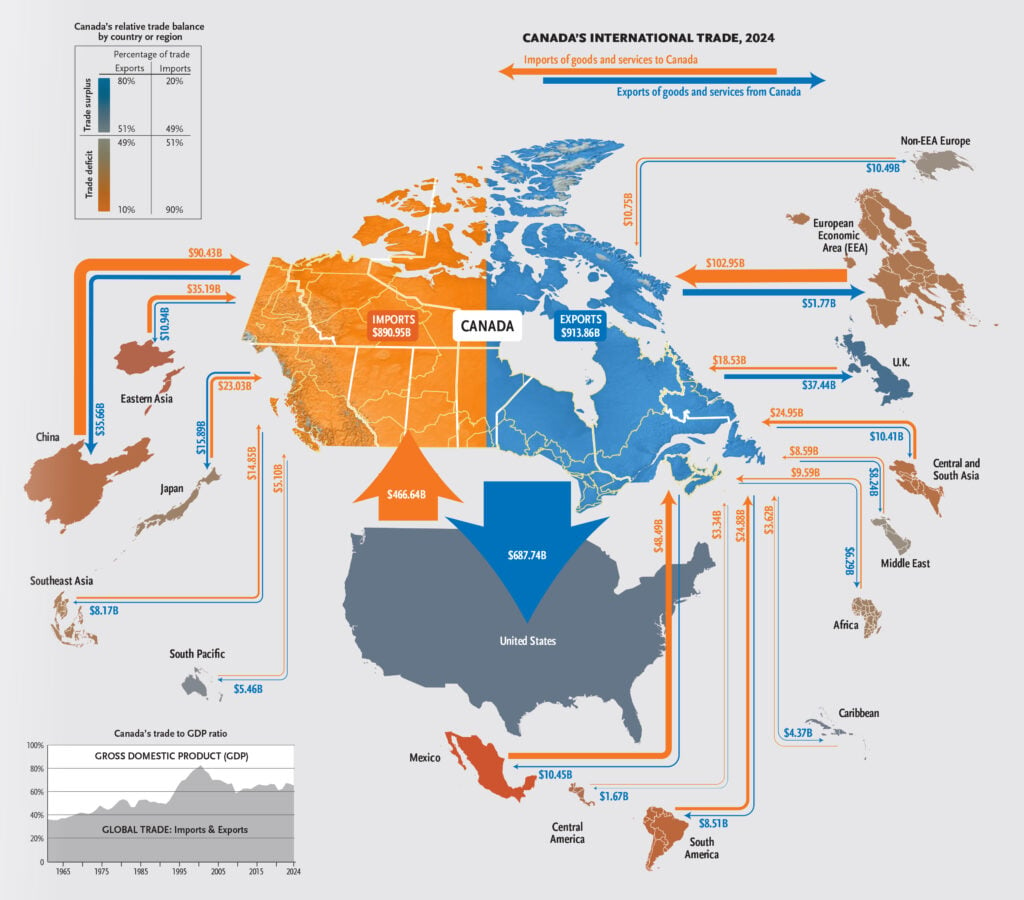
He unspools a lengthy narrative about the political forces that shaped those exports — the 18th-century mercantilism of the British empire, then free trade with the mothership, then tariffs, then more free trade, albeit with the U.S. The latter is a history that begins with the “reciprocity” deals negotiated in the late 19th century and continues through the mid-1960s Autopact, the 1988 Free Trade Agreement, NAFTA and CUSMA. Yet over decades of policy gyrations, north-south trade remains a constant. As recently as the early 1980s, interprovincial trade accounted for a larger portion of Canada’s GDP than our exports. But the trendlines crossed with the early 1990s adoption of NAFTA and now we are far more dependent on shipping goods into the U.S. and overseas than to other parts of the country.
During his time in office, former prime minister Stephen Harper began weaning Canada of its dependence on the U.S. by signing numerous free trade agreements outside North America. Mark Carney continues this work, seeking new arrangements with India, South America and the European Union, including moves to make Canadian military procurement less oriented towards U.S. defence contractors, notes Anastakis.
However, Carney is working against two centuries of precedence and deep economic integration between neighbours, says Anastakis. ”We’re not going to wake up in five or 10 or 15 years and suddenly the export balance is 60 per cent or less with the United States. That would be an incredibly disruptive and costly way of doing things.
This story is from the July/August 2026 Issue
History
A look back at the early years of the 350-year-old institution that once claimed a vast portion of the globe
Wildlife
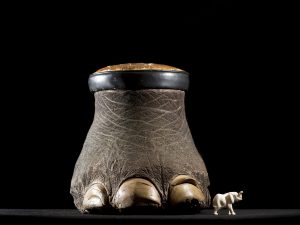
An estimated annual $175-billion business, the illegal trade in wildlife is the world’s fourth-largest criminal enterprise. It stands to radically alter the animal kingdom.
History
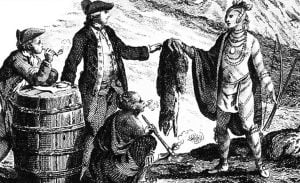
Hooked on new TV show Frontier? Here are the real-life titans of Canada’s first industry.

History
A new book by Ken McGoogan traces the experiences of Scottish Highlanders evicted from their homes to pre-Confederation Canada