Places
Snakes on a plain: Manitoba’s Narcisse Snake Dens
Each spring, a disquieting tangle of tens of thousands of gartersnakes emerges from their winter home, forming the world’s largest gathering of snakes
- 4126 words
- 17 minutes
Wildlife
Researchers in P.E.I. enlist the help of citizen scientists to get closer to a definitive answer
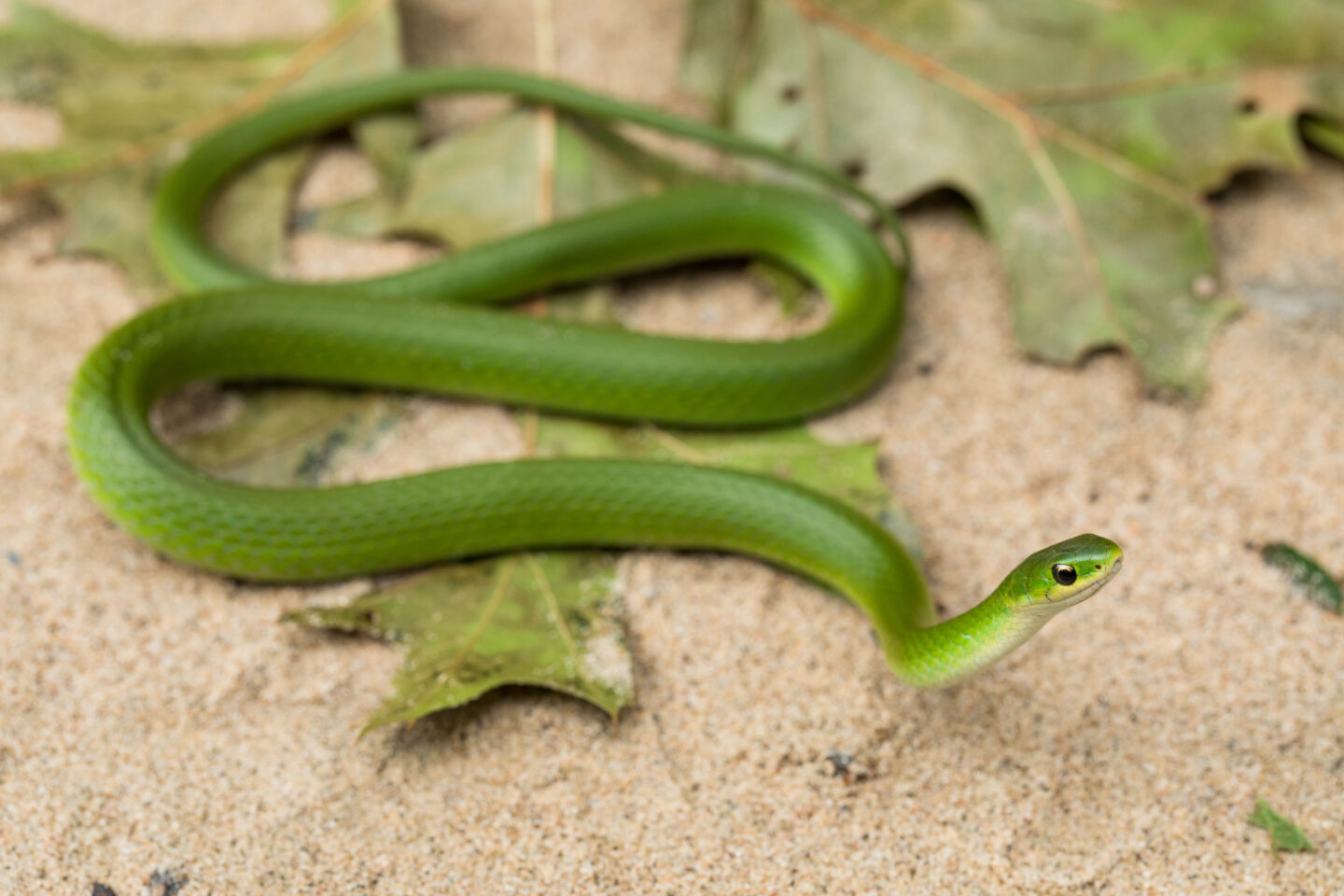
For a literal snake in the grass (whose blades it conveniently resembles), the eastern smooth greensnake is really a harmless wisp — nothing like the metaphorical idiom for treachery coined by the Roman poet Virgil in 37 B.C.
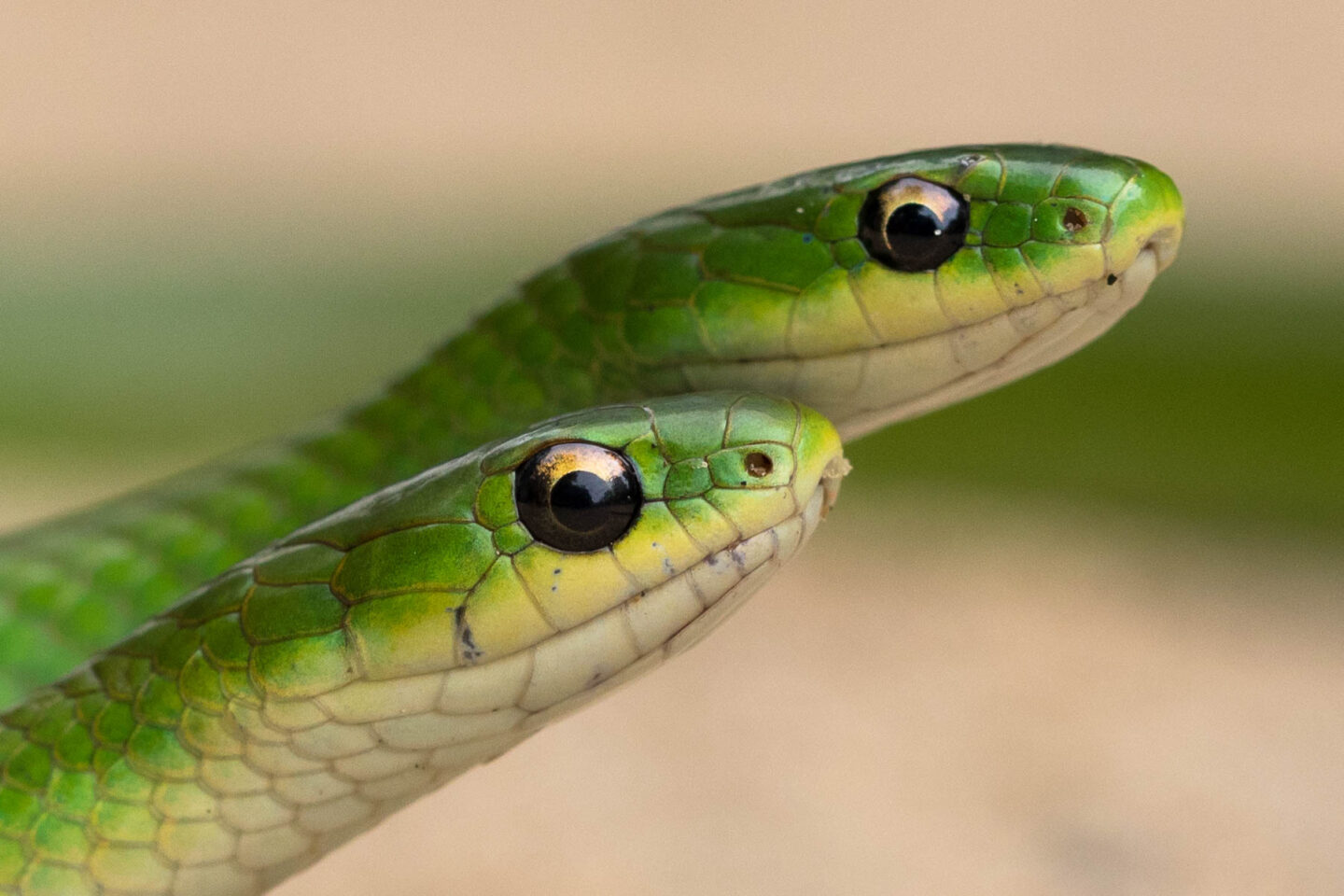
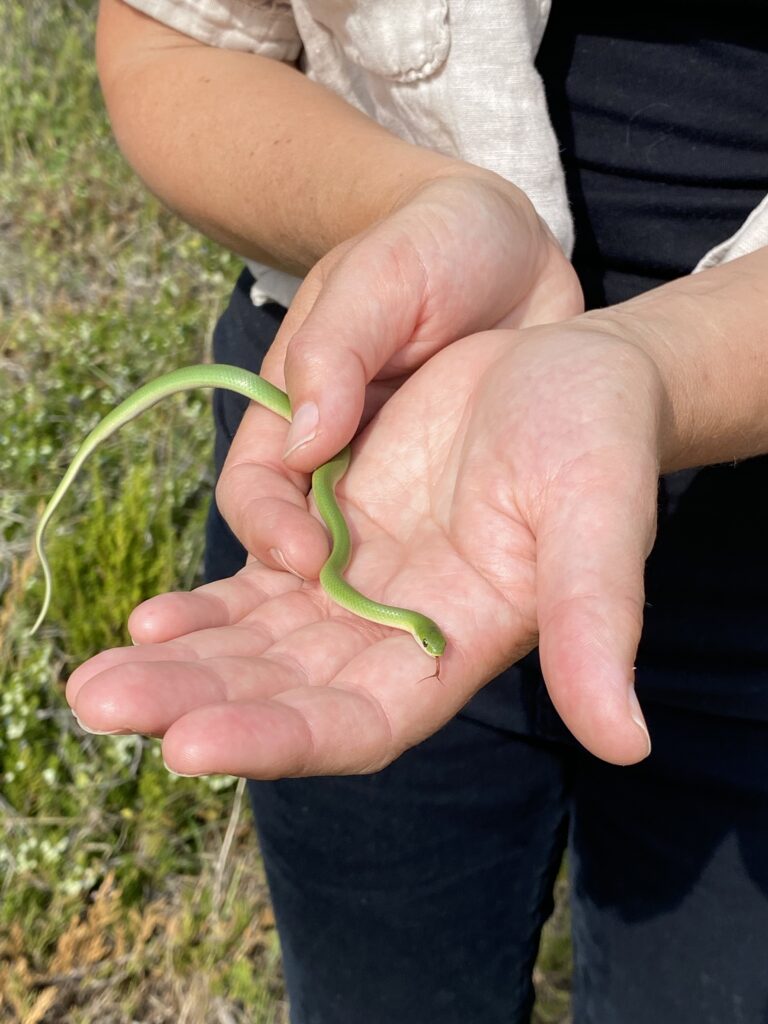
With adults seldom longer than 50 centimetres, this small, docile creature features a can’t-be-real kind of beauty, its emerald-green back and cream-coloured belly conferring superb camouflage in its preferred haunts of dense vegetation. This crypsis, or ability to hide, also ensures it’s seldom spotted by humans — even in areas it’s known to inhabit.
The species has never been assessed by the Committee on the Status of Endangered Wildlife in Canada (COSEWIC), the federal body established by the Species at Risk Act (Canada’s federal conservation law, administered in part by Environment and Climate Change Canada, to provide independent scientific assessments of species at risk). While it is now classified as a mid-priority candidate species, it’s hard to know how this elusive snake is truly faring without a whole lot of snake lovers watching for it.
Which is why Prince Edward Island’s Forests, Fish and Wildlife division asked Islanders to keep an eye out for the smooth greensnake last summer. Forest conservation specialist Julie-Lynn Zahavich, who oversees the initiative, says this all-hands-on-deck approach will help the province understand the snake’s population dynamics — a first step toward conservation if it appears to be threatened. “We only have three reptiles on P.E.I.,” she says. “And while red-bellied snakes and maritime gartersnakes are pretty common, there hadn’t been an eastern smooth greensnake sighting in quite a while.”
Though outreach by the province in 2016 netted a few observations, these confirmed only that the species was still around. According to Zahavich, persistence of this significant knowledge gap is behind the interest in closing it. “There’s a lot of thinking going on about its apparent rarity, but we haven’t really dug into it,” she says when I catch up with her on a late-winter phone call. “We know they’re found across the island, but not what kinds of areas they’re limited to or at what densities.”
The question on the table is this: are smooth greensnakes really as rare as they seem here — or just crazy hard to find? Reasons to believe it’s some of both date back to the earliest reports of its presence on the island.
Late 19th century writings on the herpetofauna (reptiles and amphibians) of P.E.I. “seem to be compounded of equal parts observation, hearsay, and imagination,” wrote the National Museum of Canada’s J. Sherman Bleakney in his 1958 biogeography of Canada’s herpetofauna. With the smooth greensnake’s presence on P.E.I. based solely on such unverifiable reports, Bleakney hedged by listing it as rare. That status was echoed by Francis Cook in a 1967 publication focused on P.E.I.; Cook, however, at least had tangible evidence: four specimens collected on the island by someone who’d donated them to the National Museum.
Though these kinds of early-literature uncertainties are typically cleared up by time — i.e., more study by more scientists — it never happened with P.E.I.’s smooth greensnake. As it turns out, this uncertainty wasn’t confined to the island’s population.
The species’ current “patchy” range is what’s left of a once broader distribution south of Pleistocene continental glaciers that subsequently shifted, following the retreating ice front northward and leaving discontinuous pockets behind. Though best known from the Great Lakes region and northeast U.S., range fragments linger as far west as Utah, New Mexico and Texas. In Canada the species is found, with interruptions, from southeastern Saskatchewan to the Maritimes — including Cape Breton Island and P.E.I., which it reached via land bridges some 10,000 years ago.
Even within this wide swath, the snake’s distribution appears to be uneven, its status described in a century of reports from Ontario as “scarce,” “localized,” “rare” and “uncommon.” It is a snake that can go unnoticed for years where it occurs, either because it’s just plain hard to see or exists in low and localized densities — it may be numerous in one small area and rare or absent in nearby areas.
To address such “hyper-localization,” Zahavich looks to cast a wide net across the island and establish standardized monitoring protocols through a network of 25 local watershed groups. “We started in 2025 with the Morel River group in eastern P.E.I., where most recent sightings were,” she says. “They had five sites, and we chose four others based on a habitat model we’d developed for the species.”
In Canada the species is found, with interruptions, from southeastern Saskatchewan to the Maritimes — including Cape Breton Island and P.E.I., which it reached via land bridges some 10,000 years ago.
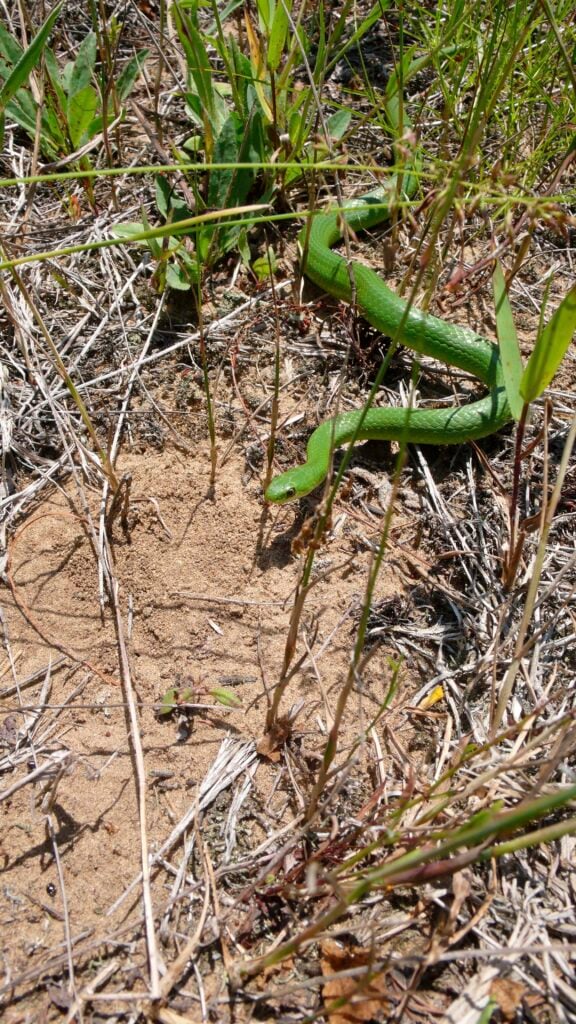
Visiting each a dozen times during optimal conditions from May through October, searchers did both visual-encounter surveys (walking, turning over rocks and logs) and artificial coverboard surveys (for which they placed boards on the ground that snakes might hide under). Despite just three sightings, social media outreach they’d done to solicit public engagement yielded considerably better returns; after parsing information received via phone and email, they logged 20 reliable sightings from across the province.
These sightings will help refine Zahavich’s habitat model for choosing further monitoring sites. That’s because “critical habitat” for a species includes a variety of features required to meet an animal’s needs. The smooth greensnake is largely insectivorous, consuming spiders, crickets, caterpillars and the like, burrowing into soft substrates as well as climbing shrubs and tall grasses in search of food. But though such opportunity is mainly found in open habitats — moist meadows and fields, wetland edges, forest clearings, open woodlands — the species has needs beyond those of foraging. Hibernation, for instance, often communal, takes place in small mammal burrows, rock crevices and ant mounds that provide refuge below the frost line. Post-mating females lay an average of seven cylindrical eggs in late summer in rotting logs, stumps, vegetation or other warm environments. These hatch rapidly in one to three weeks; hatchlings, measuring nine to 16 centimetres, are highly vulnerable until they mature in about two years. Predators include birds, small mammals and other snakes.
Zahavich notes that data are lacking on all these life-history components in P.E.I. “We just have no baseline,” she says. “Now we’ve learned what works to establish monitoring sites and hope to gather data into the future that can show whether populations are increasing or decreasing over time.”
There are many questions yet to be answered. For instance, have agricultural chemicals limited insects that would sustain larger populations? In the scientific literature, smooth greensnake deaths and population declines have been linked to insecticides, herbicides and the compounding effects of habitat loss. Small size, limited reproductive output and high rates of juvenile mortality may also make the species sensitive to environmental changes such as prey reductions resulting from the drying of meadow habitat due to climate change or groundwater depletion.
“If conservation measures are needed,” says Zahavich, “and we know there are sites important to the species — like, say, hibernacula — we’d work with landowners on a spectrum of options.”
In the meantime, Islanders can help by keeping their eyes peeled and cameras ready for this delicate green phantom.
This story was created in partnership with Environment and Climate Change Canada.
Places
Each spring, a disquieting tangle of tens of thousands of gartersnakes emerges from their winter home, forming the world’s largest gathering of snakes
People & Culture
The best-selling author and explorer has already found nine of the 25 snakes, will he find the remaining 16?
Travel
A bucket list experience observing the world’s largest concentration of snakes
History
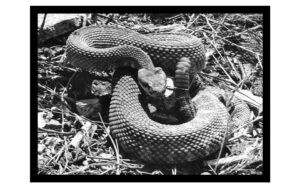
A look at the devastating environmental toll and the unlikely positive influence a historical conflict with rattlesnakes had on Canadian herpetology