Exploration

Canadian astronaut Bob Thirsk on space exploration, life in orbit and inspiring the next generation

Robin Esrock speaks with the record-setting space explorer about life aboard the International Space Station, space tourism and the future of human exploration

  • Feb 12, 2026
  • 2,453 words
  • 10 minutes
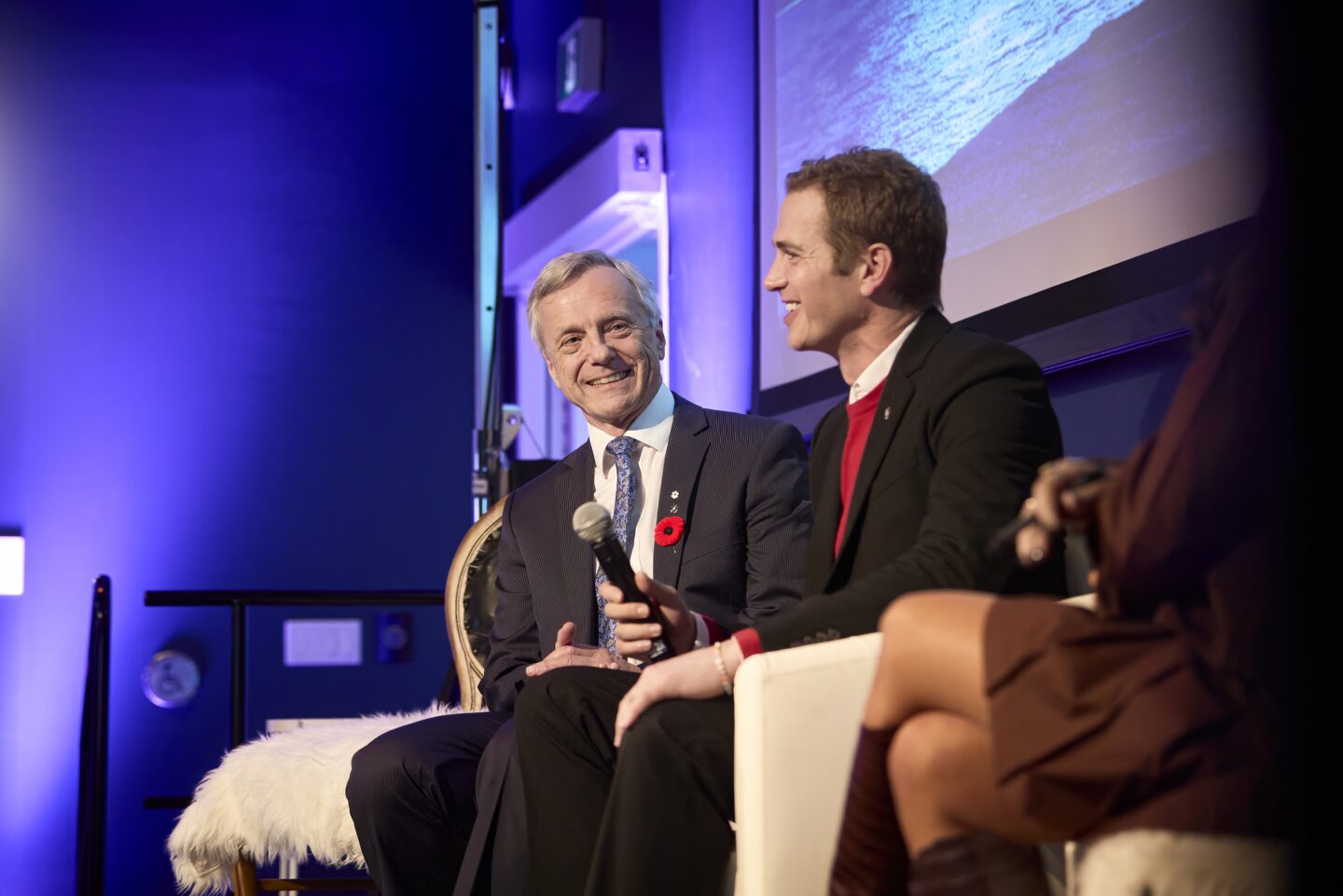
Robert "Bob" Thirsk (left) and Golden Globe-nominated Canadian actor Hayden Christensen at the Royal Canadian Geographical Society’s 96th Geographica Gala, held on Nov. 5, 2025 in Ottawa. (Photo: Melody Maloney/Can Geo)
Expand Image
Advertisement
Advertisement
Live Net Zero Email Service

Canada has produced out-of-this-world talent in sport, literature, business, entertainment, science, and politics, among other fields. Few, however, can take the accolade literally. Born in New Westminster, B.C., astronaut Robert “Bob” Thirsk’s passion for science and engineering has pushed the outer limits of human exploration and proved the sky is not always the limit.

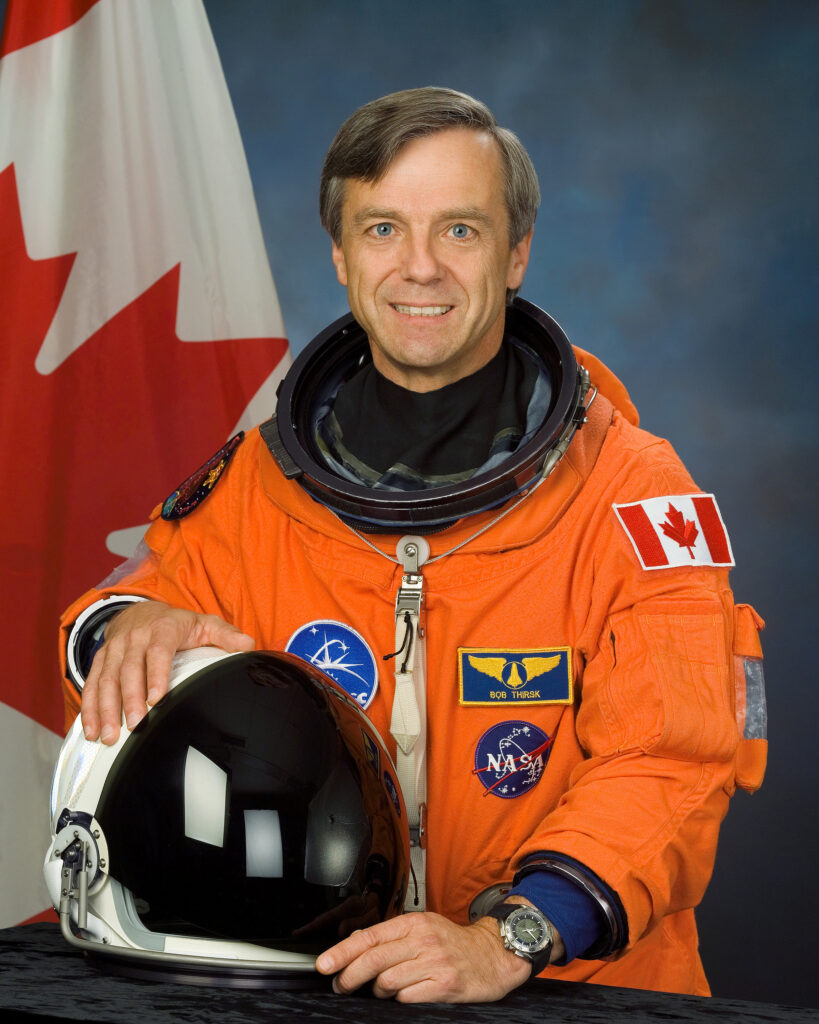
Robert "Bob" Thirsk's official photo for the Canadian Space Agency (2019). (Photo: Canadian Space Agency)
Expand Image

After earning a master’s degree in mechanical engineering from MIT, Thirsk went on to study medicine at McGill University, deepening his understanding of human physiology and disease. With this invaluable educational combination, he was selected as a Canadian Space Agency astronaut in 1983, becoming a central figure in decades of international missions. His first came in 1996 aboard NASA’s Space Shuttle Columbia, followed by a six-month mission on the International Space Station in 2009. Thirsk continues to hold the Canadian record for the most cumulative time in space.

Now based in Ottawa, Thirsk remains a passionate advocate for exploration, innovation and lifelong learning. He has inspired generations of young Canadians to pursue careers in STEM and frequently speaks about the importance of curiosity, teamwork, and resilience. We connected over Zoom to discuss his career, the rise of space tourism, geopolitics, sci-fi movies, and where humanity might venture next.

This interview has been edited for length and clarity.

Robin Esrock: You followed an academic path that could have led to any number of successful directions. How did you end up being an astronaut?

Bob Thirsk: I was a child of the 1960s and 1970s, when the world was moving quickly on many fronts, especially in the space program. The first person flew in space in April 1961, and only eight years later, two people walked on the moon. Amazing! I can remember watching the images on TV, then running out to the backyard and looking up at the moon, trying to reconcile in my mind what was going on. 

In the 60s, we also had amazing world leaders, and we did inspirational feats that served to measure the best of our energies and skills. In my last year of engineering, one of my professors took me aside and asked me what I wanted to do with my life. I told him about my interest in space, and he recommended I get a medical degree to go with my engineering degree. His advice took me by surprise, but it made sense, because a lot of the barriers that prevent us from exploring deeper space are medical: how do we protect astronauts against the harmful effects of weightlessness, against ionizing radiation, against the effects of isolation and confinement? I did another engineering degree, picked up the pre-med courses, and then went off to medical school. It worked out well. A year and a half after I graduated, I was selected as a Canadian astronaut. I’m very grateful to that professor who gave me that good advice.
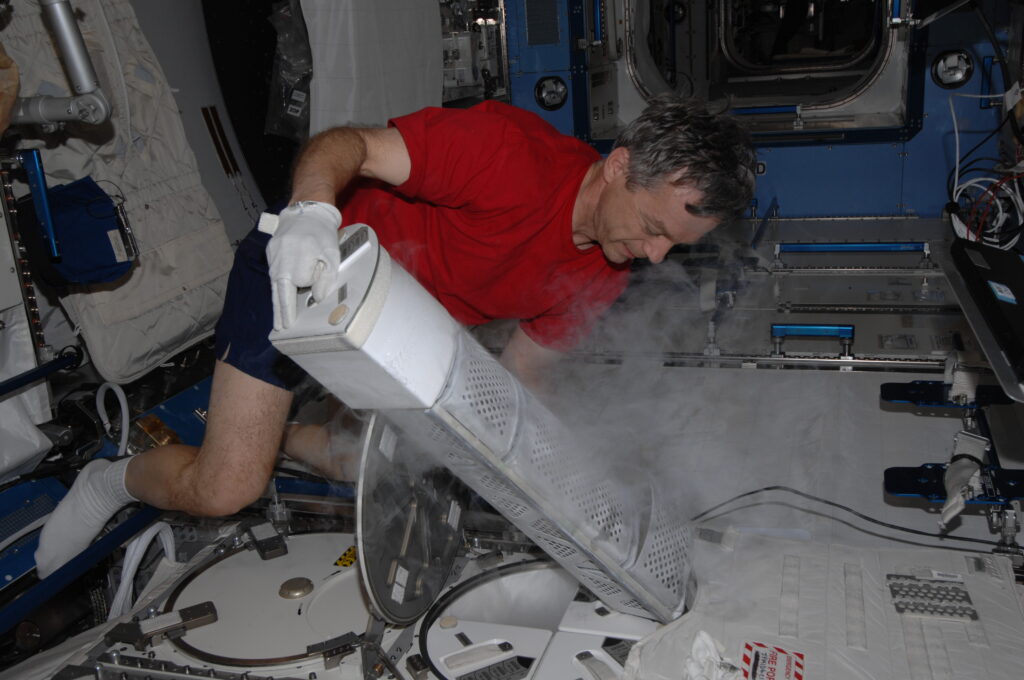
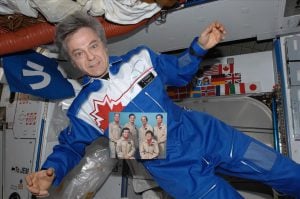
Bob Thirsk onboard the International Space Station. (Photo courtesy Robert Thirsk)
Expand Image

RE: The right teacher at the right time can change the world. When you first saw Earth from orbit, did it have a life-altering impact? 

BT: On my first flight and shortly after our arrival in orbit, I was helping my crewmates reconfigure the space shuttle from a launch vehicle to an orbiting laboratory. I was beavering away on my assigned tasks since I didn’t want to fall behind the mission timeline. But a crewmate tapped me on the shoulder and said, “Bob, look.” Out the window, I saw the Atlantic, the sun glinting off the ocean, and beyond the ocean was the curvature of Earth’s horizon. Beyond that was nothing but black space. That’s the moment I realized that I had fulfilled a childhood dream. 

The primary emotional impact was admiring the beauty of our planet: the deserts, the oceans, the coastlines, the glaciers. British Columbia is probably one of the most beautiful regions in the world from space. I hope everyone has an opportunity to share in that, at least vicariously. Once you’ve been up there for several weeks, or maybe a few months, your eye gets a little more discriminating. You can start detecting some of the smaller details on the planetary surface, and that’s when you get disappointed, because you see the impact of human activities on the natural ecosystem: the oil slicks in the ocean, the deforestation. When you’ve been in space for a period of time, regionalism or nationalism goes to the back of your brain.

“British Columbia is probably one of the most beautiful regions in the world from space. I hope everyone has an opportunity to share in that, at least vicariously.”

RE: Do you get a sense of vulnerability, a detachment? Like being broken away from a universal mother. I’m getting a little esoteric, but in space, we’re removed from the primary thing that’s given us life.

 BT: The answer is yes and no. There were six of us aboard the space station. We had our own little culture and community, detached from the seven billion people living below. We faced different issues, and we felt vulnerable as well. The walls of the modules that make up the space station are only a couple of millimetres thick. It wouldn’t take much to get hit by a piece of space debris and have a very bad day. On the flip side, it takes thousands of people, plus many international organizations, to prepare a spacecraft and train a crew. We were very cognizant of the people on the ground and were tight with the hundreds of people supporting us.

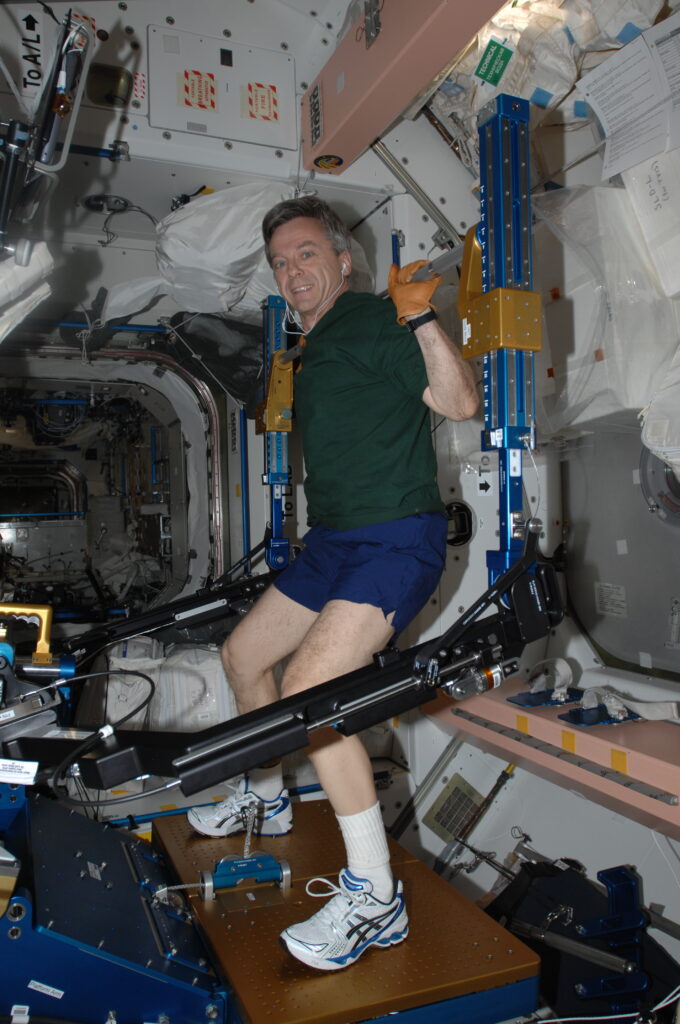
Astronauts must do 90 minutes of exercise every day. (Photo courtesy Robert Thirsk)
Expand Image

RE: What does a typical day look like aboard the International Space Station, and how much of it is routine versus extraordinary?

BT: I was awake from 6 a.m. to about 10 p.m. We live by Greenwich Mean Time, by the way. The workday is usually from around 7 a.m. until about 6 p.m. In addition to research, there’s housekeeping, maintenance, and repair work. The workday schedule also includes three meals and an hour and a half of exercise every day. After 7 p.m., the ground tries to leave us alone, so the crew has three hours to socialize and attend to personal matters. During our downtime, we’re looking out the windows. While there’s a well-stocked library aboard the Station with hundreds of DVDs and books, I never watched a movie or read a book during my time in space. If I had even five minutes of downtime, I would be at a window gazing down on this beautiful planet. My priority would also be to contact my family with the phone we had on board.

RE: We always hear about astronauts conducting scientific research and experiments in space, but we don’t hear much about how those experiments affect life on Earth. Can you recall any space experiments that had a real-world impact on people’s lives?

BT: If you haven’t heard of some of these examples, it’s an indictment of the space program’s communications efforts. There are thousands of applications and spin-offs of space research that meet the socioeconomic needs of Canadians and world citizens. The one I’m probably most proud of is neurosurgical robots. The University of Calgary worked with a leading Canadian space company called MDA to adapt robotic technology for the space shuttle into a hospital-based neurosurgical robot called neuroArm. The neuroArm robot has the same dexterity as the world’s best neurosurgeon but is more precise and tremor-free. It’s performed hundreds of successful operations. 

If there’s one area of society that has benefited from investment in space research, it’s the medical community. A lot of the wireless technologies that you find in hospitals today came from the Apollo space program. The space program also advanced processing technologies for MRI, CT and other imaging systems.

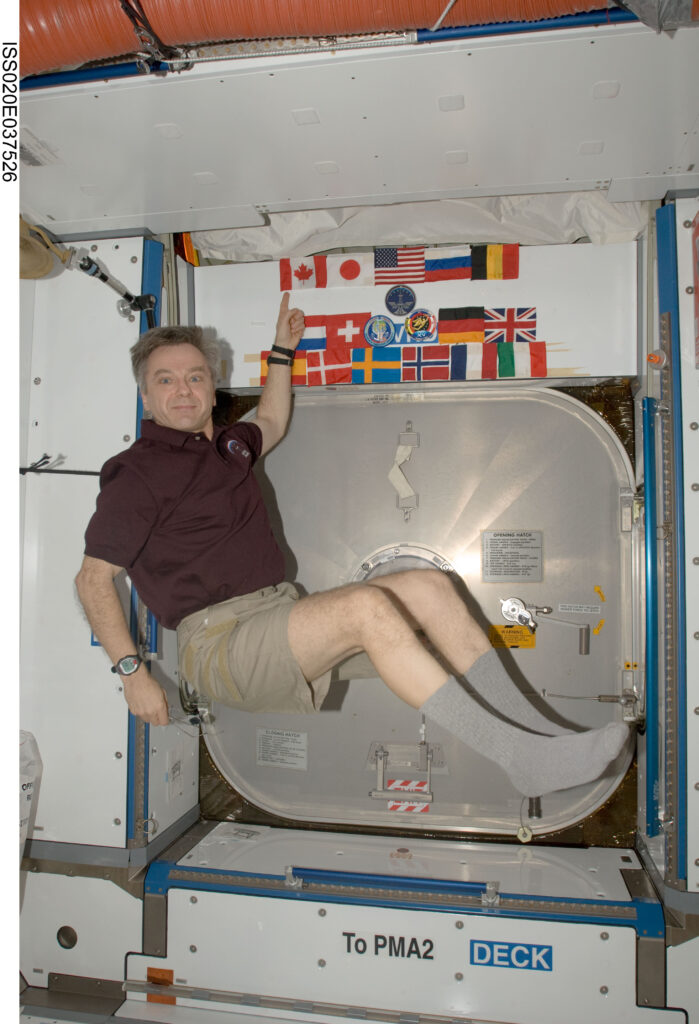
Pointing out the Canadian flag in space. (Photo courtesy Robert Thirsk)
Expand Image

RE: Modern technology is moving quickly, yet it feels like there is a lack of political leadership. With climate change and AI, it feels like we’re at a crossroads, just as science comes under attack. 

BT: You’re referring to rising protectionism and a backlash against science; let’s hope this worrisome trend is an aberration. My response to our current situation is that the most meaningful space endeavours are international, evidence-based and collaborative. Canada can no longer rely on a single partner, such as the United States; we need to diversify our partnerships. In Canada, our federal leaders are still very supportive of spaceflight. 

RE: As the world becomes more siloed, are Ukrainian scientists still working with Russian and American scientists on the big picture, or has it become really fractured?

BT: What’s happening aboard the International Space Station with international crew members does not reflect what is happening down here on Earth. Geopolitical chaos does not rise to the level of orbit. Everyone in orbit is focused on the mission objectives. Crewmembers of all nationalities have a common vision to extend the capabilities of humanity into the inner solar system, to inspire society to take on audacious objectives, and to encourage the next generation of young leaders to consider educational paths in science, technology, engineering, and math. 

Rational strategic collaborations are getting stronger. We’re all keen to explore the next major destination in space, which will be Mars. I envision humanity will be on Mars in the next 20 years. Future astronauts will not only be operationally and technically talented people, but will also serve as ambassadors of Earth. 

Wouldn’t it be wonderful if a future six-member crew to Mars included a representative from each continent of the planet? We cannot explore deep space unless we use the financial, industrial, and technological resources of many countries.

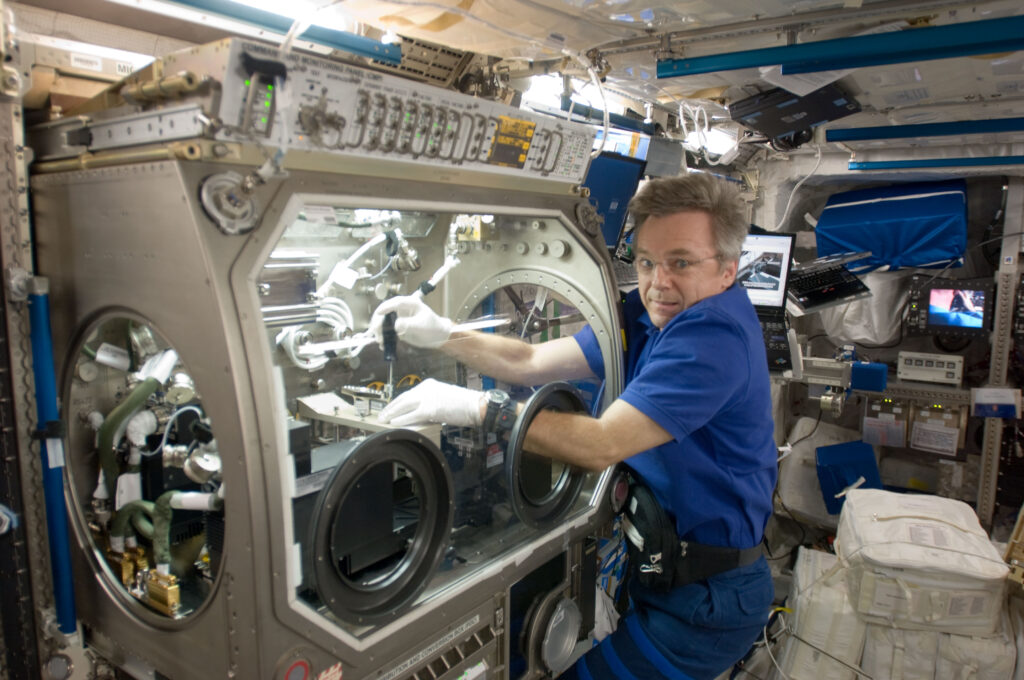
Bob Thirsk conducting experiments onboard the International Space Station. (Photo courtesy Robert Thirsk)
Expand Image

RE: I’m a travel writer who specializes in unique experiences. Do you think space tourism will realistically become a thing?

BT: It is a thing now, but unfortunately, it’s restricted or limited only to the very elite. I hope that in the decades to come, space will become available to many more citizens of limited means. The hope is that, in the years to come, the private sector will take over Earth observation, cargo delivery, and human transport without government subsidies. 

It will help to get more people into space to communicate the experience — the view of Earth from space; the fragility, vulnerability and isolation of our planetary home. I look forward to a day when we can have thousands of people spending time in space and returning to tell their story. 

RE: My 12-year-old daughter and I enjoy watching Neil deGrasse Tyson clips on YouTube. Now she tells me she wants to be an astrobiologist! If you could give some advice to young Canadians looking to the stars, what would it be?

BT: Astrobiology would be a very exciting vocation to pursue. The story of the 21st century may well be the discovery of life elsewhere. I think that will be another moment in civilization, when everyone sits back and says, “Wow!” We’ll be thinking about the bigger picture of life and collaboration. My advice to any young person or anyone with a dream to do something audacious is to get a solid education. We have to provide the resources and encourage young people to consider graduate school, followed by opportunities for relevant work experience.

“The story of the 21st century may well be the discovery of life elsewhere.”

RE: OK, but first, I’ll just start trying to get her to do her math homework!

BT: Now that I’m reflective and near the end of my career, I also want to emphasize that the difference between a good astronaut and a great astronaut is found in mastery of the non-technical skills. I’m talking about personality traits like self-care, self-management, teamwork, group living, leadership and cross-cultural skills. Your daughter can start working on these skills now by volunteering in her community, and pursuing common missions with people from different backgrounds and with different perspectives. These kinds of collaborative activities will help develop the skills that astronauts and many other professionals value today.

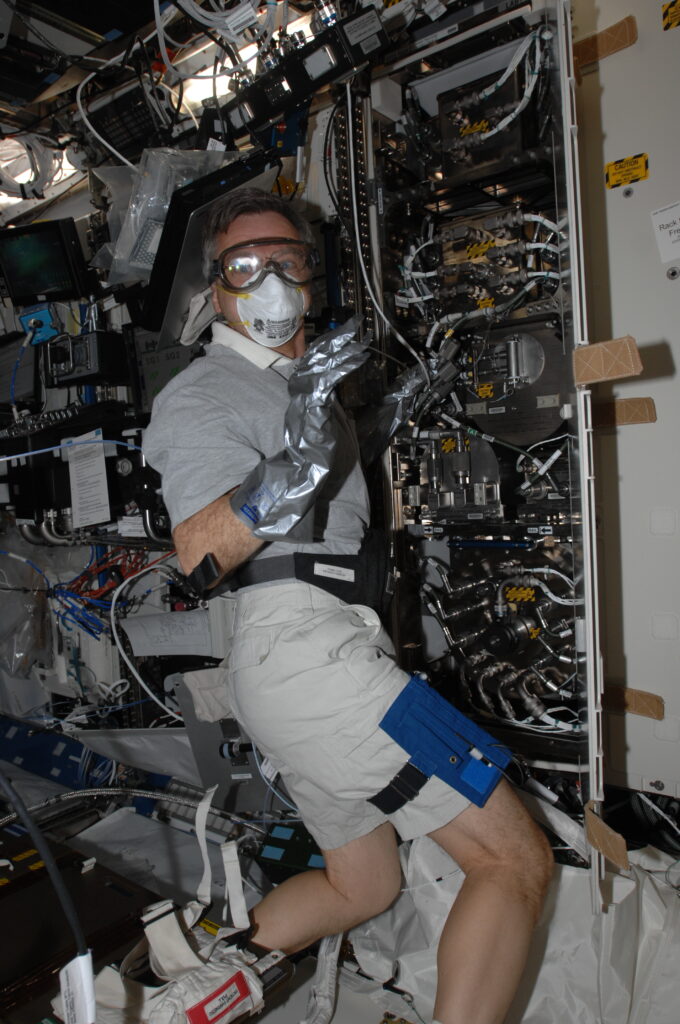
Wiring up the International Space Station. (Photo courtesy Robert Thirsk)
Expand Image

RE: Are you excited about any science fiction movies or books? Does any of it come close to reality?

BT: The movie 2001 took my breath away, portraying what space exploration was all about. The Apollo 13 movie with Tom Hanks was not only a great Hollywood movie, it was essentially a documentary. The Martian, with Matt Damon, was a great movie, and a lot of the technologies that you saw depicted in the movie exist today or are in development. For example, you can see the Mars rover at the Johnson Space Center in Houston, and the growing of crops on a planetary surface is a technology being developed at the University of Guelph. I thought Canadian author Emily St. John Mandel’s book about time travel [Sea of Tranquillity] was pretty gripping. 

RE: Looking ahead in 50 to 100 years, are we going to have colonies in space? Research hubs, drones, androids? With AI looming, is the era of the human astronaut numbered?

BT: Robots and AI are very good at monitoring spacecraft systems, running through data quickly and looking for patterns, but humans are great at everything else, especially mobility, judgment, ethics, and making decisions when there’s not enough information. It’s a matter of combining the skill sets together. Fifty years from now, you will probably see humans working with robots or automated systems in a partnership that will allow us to achieve even greater objectives. 

One of my favourite movie series is Star Wars, where you have a partnership between Luke Skywalker and R2-D2. Luke handled the on-the-spot and higher-level decision-making, while R2D2 oversaw the spacecraft systems. It’s a good model for the way things will go in the future. I hope we don’t have colonies in space. The colonization concept has not served humanity very well, so I think we’ll have to rethink that. I do hope that someday there will be a permanent research base on the moon. Maybe your daughter or your granddaughter will be exploring the ice moons of Jupiter and Saturn, looking for life there.

“I hope we don’t have colonies in space. The colonization concept has not served humanity very well, so I think we’ll have to rethink that.”

RE: Finally, what’s on your Canadian Bucket List?

BT: My wife and I would like to visit Churchill to see the polar bears. I don’t think Canadians spend enough time up north. The backcountry of Canada’s western National Parks are some of my favourite destinations. I think it’s important to expose our kids to these outdoor experiences, so they can fully understand the importance of conservation and the majesty of our planet.

Advertisement

Help us tell Canada’s story

You can support Canadian Geographic in 3 ways:

Live Net Zero Email Service

Related Content

Science & Tech

Artemis II astronauts have returned safely to Earth following historic mission around the moon

Canadian Geographic is following this history-making mission, which saw Canadian Space Agency astronaut Jeremy Hansen become the first Canadian to fly around the moon

  • 5285 words
  • 22 minutes
Canadian astronaut David Saint-Jacques in spacewalk training at NASA’s Neutral Buoyancy Laboratory in Houston, Texas.

Science & Tech

How to train your astronaut

From enduring extreme isolation and psychological strain to operating high-tech robotics and undergoing an intense physical fitness regimen, here’s a glimpse at what it takes to head to space

  • 1370 words
  • 6 minutes
Canadian Space Agency astronaut Robert Thirsk

Exploration

Timeline of the Canadian Space Agency

The significant CSA events since Alouette’s launch

  • 772 words
  • 4 minutes
Canadian astronauts pose inside the Living in Space Exhibition

Exploration

Canadian Space Agency astronaut profiles

The men and women that have become part of Canada’s space team

  • 1067 words
  • 5 minutes
Advertisement
Advertisement