Mapping

For peat’s sake: Why Canada’s “waste lands” are worth saving

Canada’s peatlands are vast, underappreciated and could be a vanguard against the impacts of climate change

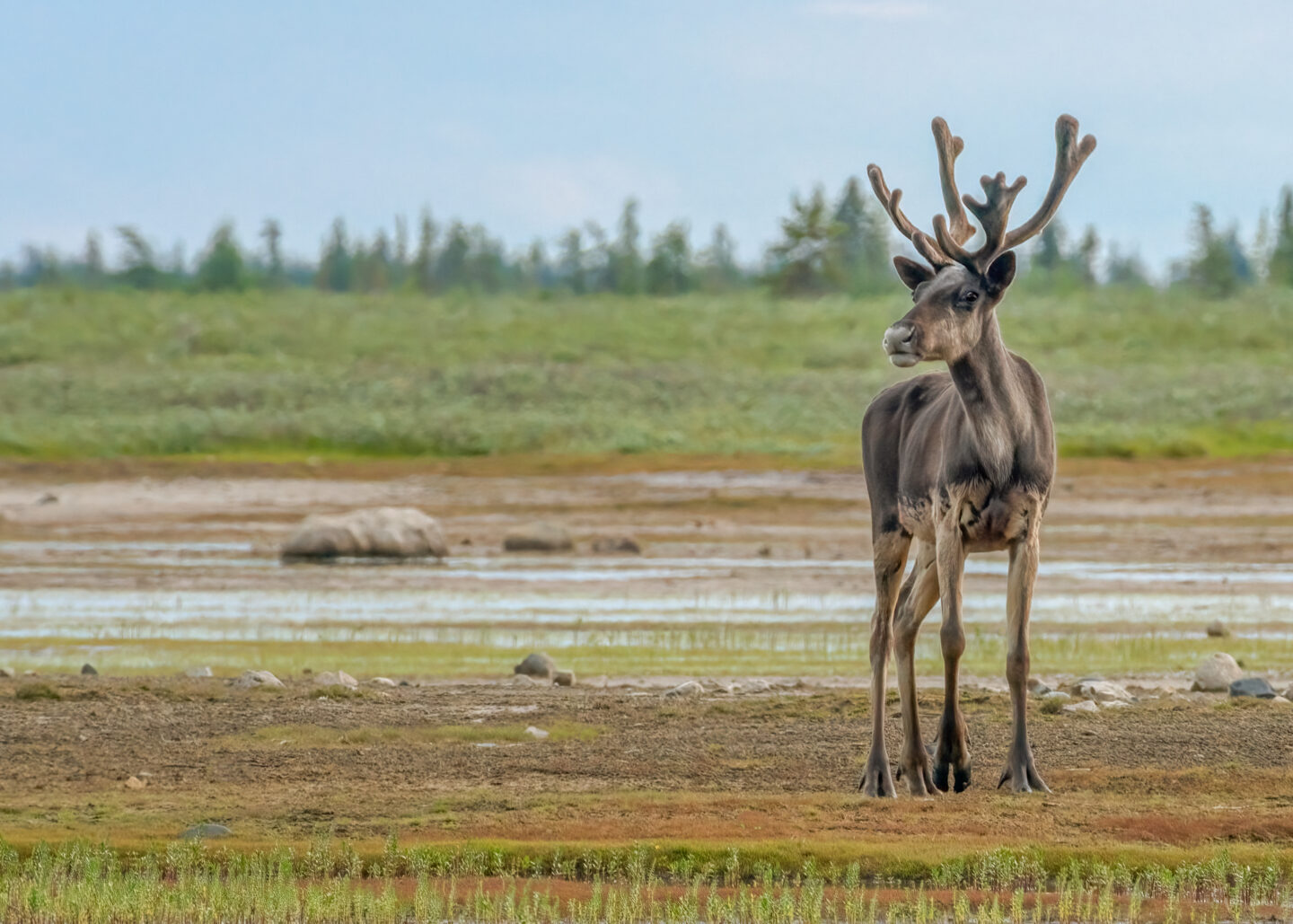
A caribou stands alert along the Hudson Bay coast in Polar Bear Provincial Park, Ont. (Photo: Aaron Todd/Can Geo Photo Club/IG @aaronktodd)
Expand Image
Advertisement
Advertisement
Live Net Zero Email Service

In 1949, a top-secret plan was hatched to detonate 12 Hiroshima-sized atomic bombs in the Hudson Bay Lowlands, a peatland where polar bears den, caribou overwinter and millions of birds nest or stopover. Canadian and British military strategists considered the region to be “a waste land suitable only for hunting and trapping.” The plan was never carried out only because the British decided northern Canada would be too cold for their scientists. (The bombs were dropped on islands off the coast of Australia with devastating effects.)

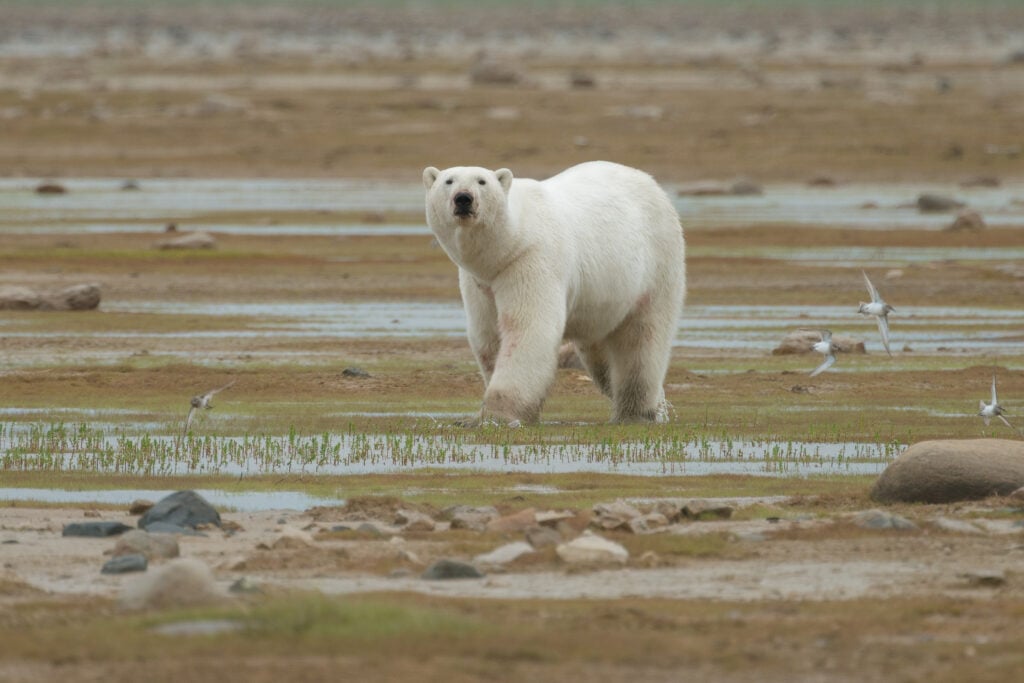
A lone polar bear patrols the shores of Hudson Bay in Ontario’s Polar Bear Provincial Park. Photo: Aaron Todd/Can Geo Photo Club/IG @aaronktodd)
Expand Image

This anecdote is emblematic of how peatlands such as bogs and fens, and to a lesser extent swamps and marshes, have suffered a bad rap over the centuries. They were often viewed as the haunts of will-o’-the-wisps, jack-o’-lanterns and moss people, as well as the source of diseases such as cholera and swamp fever. Many of them were drained for those reasons. Peat — from places such as Alfred Bog outside Ottawa, Burns Bog near Vancouver and Holland Marsh near Toronto — was mined to produce cheap fuel to heat homes, manufacture firebombs and make way for agriculture. Peat continues to be harvested throughout the country to produce soil conditioners. Seismic exploration conducted for Alberta’s oil and gas industry has disturbed at least 1,900 square kilometres of peatland and increased methane emissions by 4,400 to 5,100 tonnes per year.

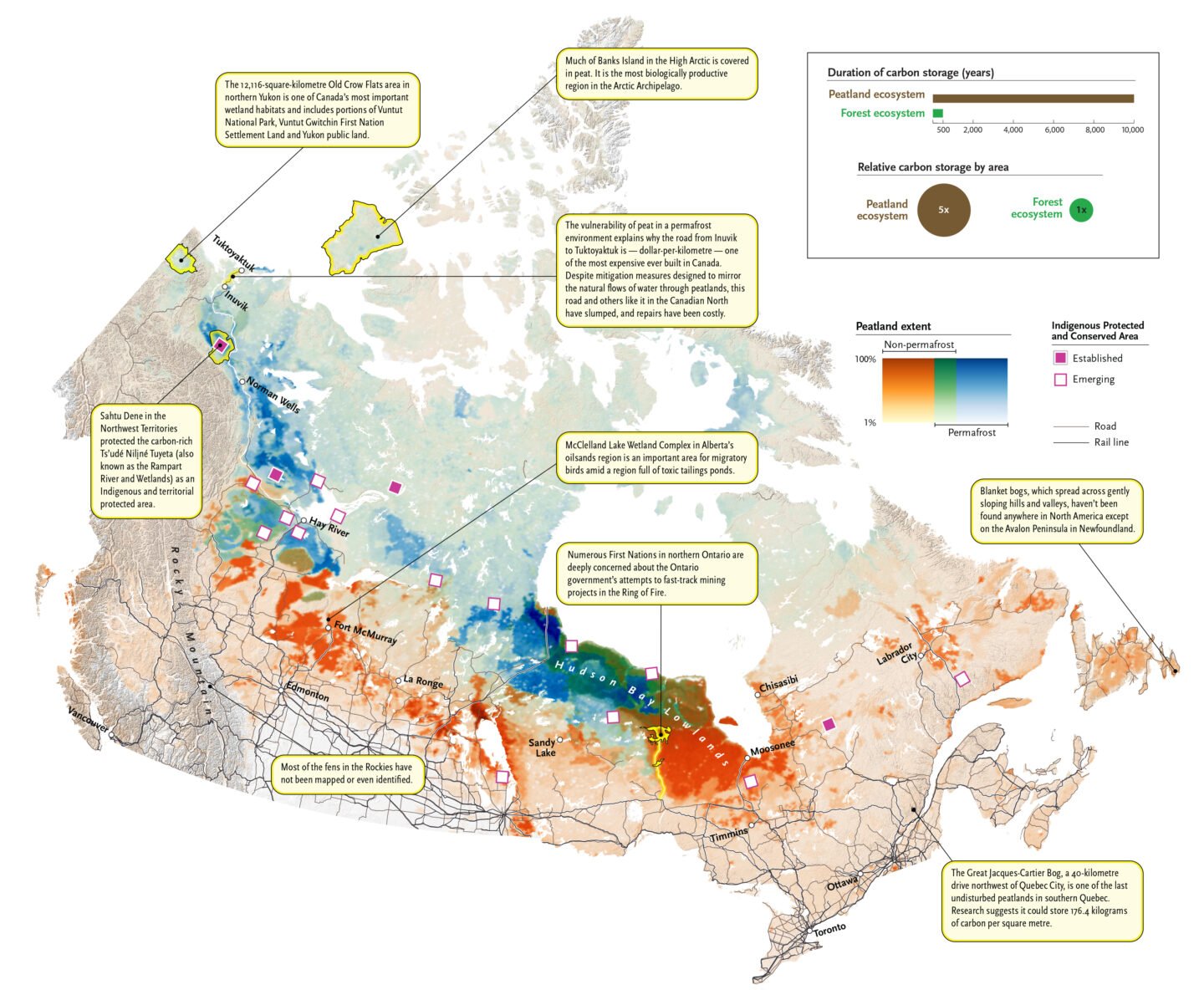
Peat is partially decayed vegetation that has piled up over centuries in water-logged, oxygen-starved conditions. Peatlands, often referred to as muskeg in Canada, account for 90 per cent of Canada’s wetlands and cover about 113.6 million hectares. While peatlands make up just three to four per cent of the Earth’s landscape, they pack a big punch, especially in Canada, which is home to a quarter of the world’s peatlands. The Hudson Bay and James Bay lowlands store five times more carbon than the equivalent area in the Amazon rainforest. A healthy peatland can stop or slow a wildfire. And peatlands can mitigate flooding because mosses can hold up to 25 per cent of their weight in moisture. 

The degradation of peat continues as permafrost thaws and wildfires burn bigger and more often. And yet there is a glimmer of hope in that Indigenous Peoples and scientists are working to safeguard, restore and reframe Canada’s expansive peatlands as a landscape worth saving.
Data credits: Peat extent data: “Maps of Northern Peatland Extent, depth, Carbon Storage and Nitrogen Storage (2021).” Dataset Version 2, 2020. Bolin Centre Database. https://doi.org./10.17043/hugelius-2020-2. Carbon Storage Statistics and IPCAS: “Northern Peatlands in Canada: An enormous Carbon Storehouse, Wildlife Conservation Society Canada.” storymaps.arcgis.com/stories/19D24F59487B46F6A011DBA140EDDBE7
Expand Image
Advertisement

Help us tell Canada’s story

You can support Canadian Geographic in 3 ways:

Live Net Zero Email Service

This story is from the September/October 2025 Issue

Related Content

Peatland

Environment

Saving the peatlands: Water loss in northern peatlands can accelerate global warming, scientists say

The drying of peatlands in Canada heightens the risk of wildfires and can turn into a carbon source instead of a carbon sink

  • 747 words
  • 3 minutes
Boreal wetland Algonquin Provincial Park

Environment

It’s time to start paying attention to Canada’s peatlands

A huge part of Canada's northern geography, peatlands are critical to regulating our climate — and more

  • 818 words
  • 4 minutes

Environment

Bringing back the peatlands

In a promotional video for the Canadian Association of Petroleum Producers, Patrick Moore marvels at…

  • 709 words
  • 3 minutes
Illustration by Guy Parsons

Environment

Canada’s dirty secret

Canada leads the developed world in per capita production of garbage. What’s behind our nation’s wasteful ways? 

  • 4225 words
  • 17 minutes
Advertisement
Advertisement