Wildlife
Knowing nature for what it is with Connel Bradwell
The biologist and filmmaker on his latest documentary Animal Pride, an exploration of queer animal behaviour
- 1511 words
- 7 minutes
People & Culture
More than three decades after it began as a grassroots ski week, the Whistler Pride and Ski Festival stands as a reminder that visibility on the slopes is both hard-won and transformative
When it comes to queer visibility in winter sports, Canada leads the way. At the 2010 Winter Olympics, we hosted the first Pride House (an open venue for allies to celebrate together) in the history of the Games — right here in Whistler. We’ve sent more than 40 openly LGBTQ+ athlete contingents to Milan–Cortina 2026, setting a new record for representation. And, of course, we recently gave the world Heated Rivalry — the queer hockey romance turned cultural phenomenon that’s proving Canadian queer stories resonate far beyond our borders.
From the ice to the alpine, Canada’s 2SLGBTQIA+ community is carving out space in winter sports and queer mountain culture. And with the 2026 reimagining of the Whistler Pride and Ski Festival, that claim feels both triumphant and defiant.
In 1992, Whistler Pride began as a grassroots gathering of a handful of gay skiers. Today, it has grown into a multi-day festival that’s proving what true inclusivity in outdoor mountain culture can look like. These mountains have long been places where communities have gathered, found each other, and carved out space, both literally and socially, on slopes. But 2026 isn’t just another edition. It marks a reset, arriving at a moment when Canadian queer culture feels ascendant, proving that visibility on the mountains (and on the ice) is as hard-won and as vital.
As Canada’s longest-running gay ski week and one of the world’s largest queer winter festivals, Whistler Pride has framed its reimagining as both a homecoming and a declaration. Under a new partnership between Tourism Whistler and TFD Presents, Festival Director Tommy D took on the challenge of producing the reimagined festival in just seven weeks.
“We had an opportunity to try something bold,” he says. “The first thing that had to change was pricing. Accessibility isn’t just a value, it’s a practice.”
The reimagined programming doesn’t just refresh the festival — it widens the circle. In previous years, a single producer oversaw nearly every event. This time, the model was dismantled. “Widening the circle meant fundamentally shifting that model,” says Tommy. “Instead of gatekeeping, we invited multiple producers, promoters, and community leaders into the conversation from day one. Not as competitors, but as collaborators.”
Who had been missing? “Women. BIPOC community members. Locals. Independent producers. People who couldn’t afford high ticket prices. People who didn’t see themselves reflected in the programming.”
For 2026, the answer is visible in the crowd. A sold-out sapphic night — created specifically for lesbians, bi women, and anyone who identifies more with this crowd — fills a room for an event that, in previous years, never existed. BIPOC and trans drag performers from across Canada take the stage as headliners, and rather than one event per night at the conference centre, removed from the Whistler community and costing hundreds for tickets, multiple evening events across several of Whistler’s favourite venues, priced less than half of previous years, mean more options in a village ready to host. For those on a budget, free programming like Queens on Ice, a community skate hosted in partnership with the Whistler Rainbow Connection, and no-cost trivia and karaoke nights mean Pride isn’t gatekept by a cover charge.
The result is a lineup that feels intentionally expansive — drag performers from multiple seasons of Canada’s Drag Race share the stage with artists from the broader performance circuit, creating a roster that feels familiar to superfans and electric for first-timers. Beyond the diverse nightlife events, which sold out completely, the week layers in community-building programming: guided ski groups that welcome nervous beginners alongside confident riders, daily après events, and the festival’s emotional centrepiece: the Rainbow Ski Out and Village Pride Parade.
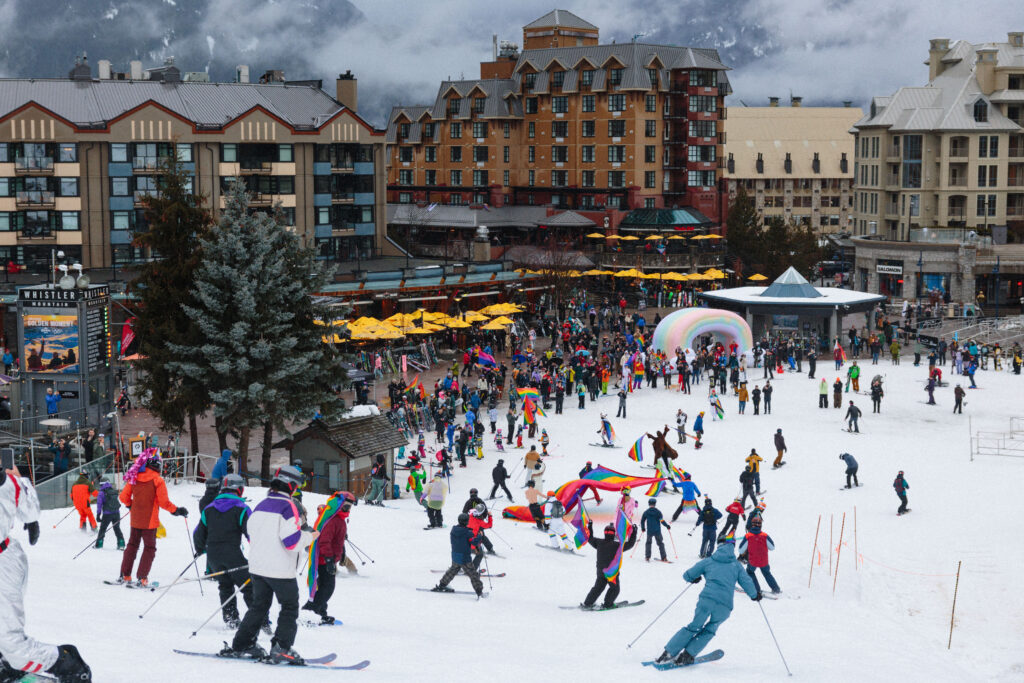
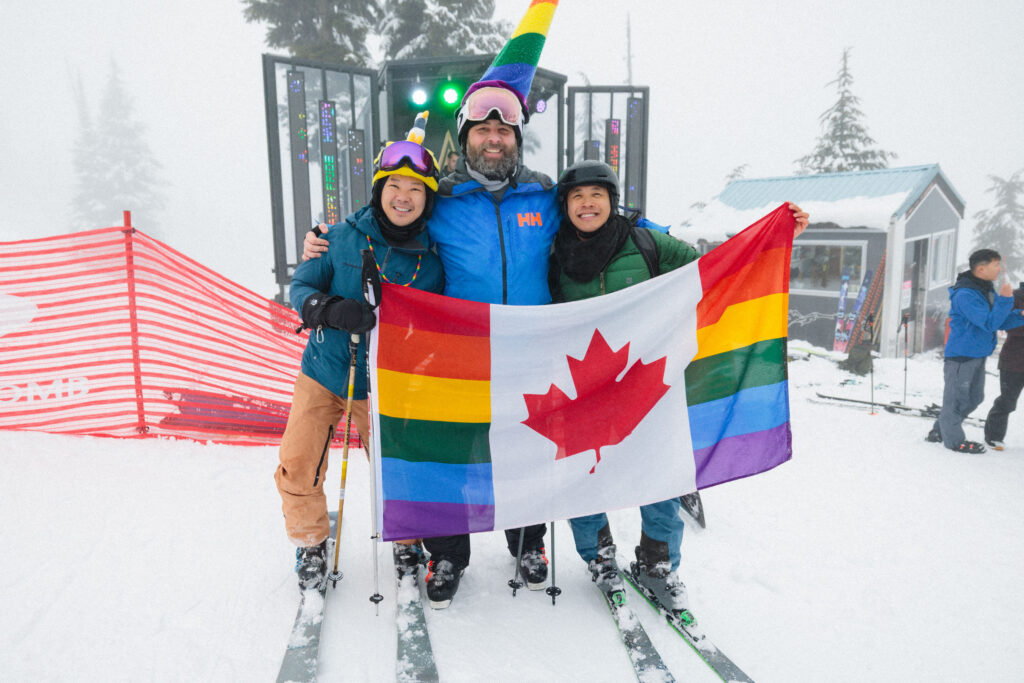
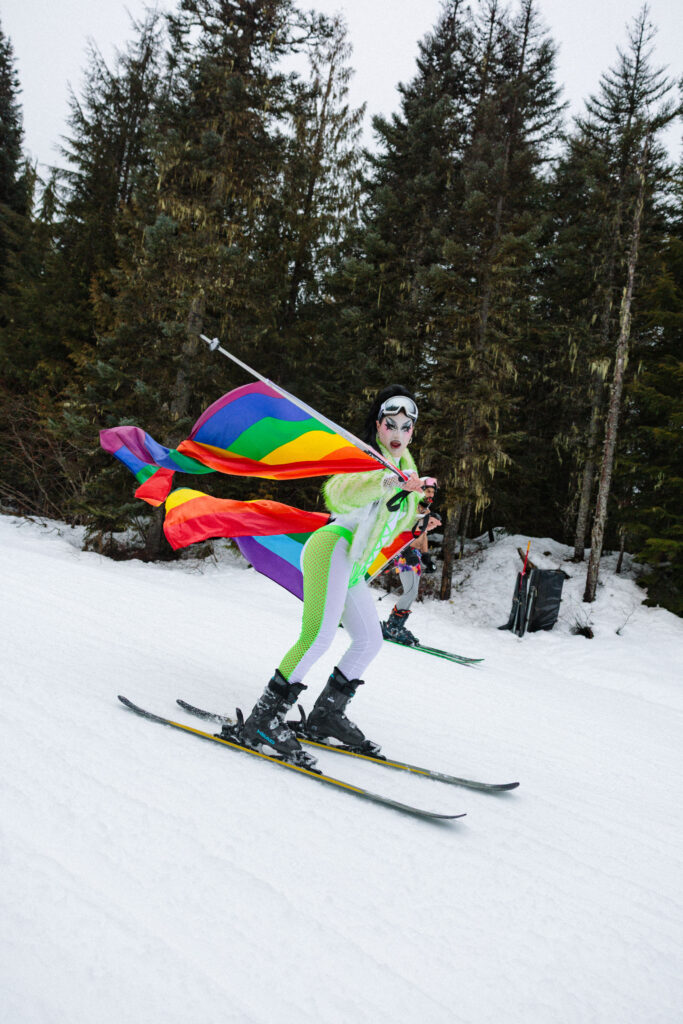
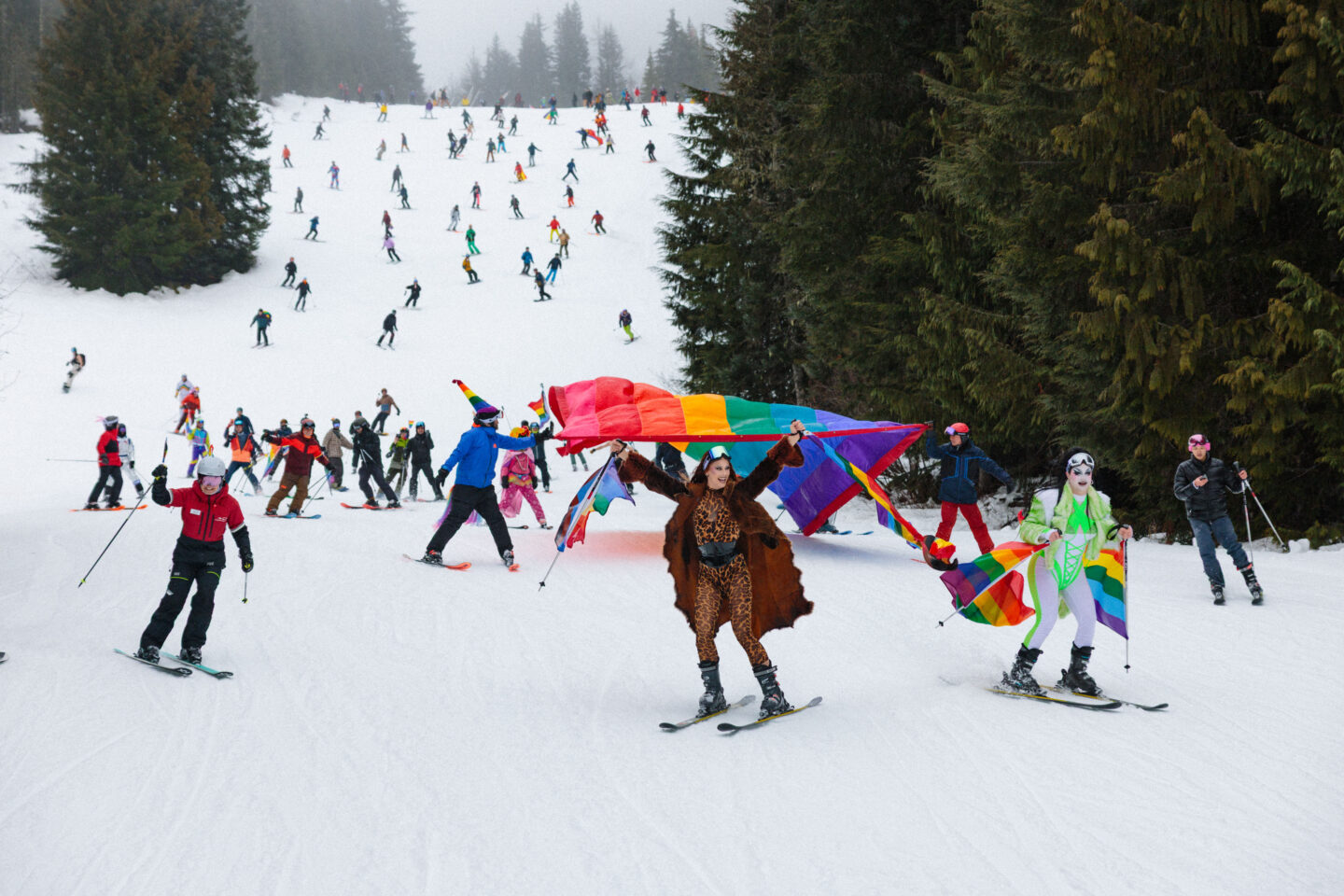
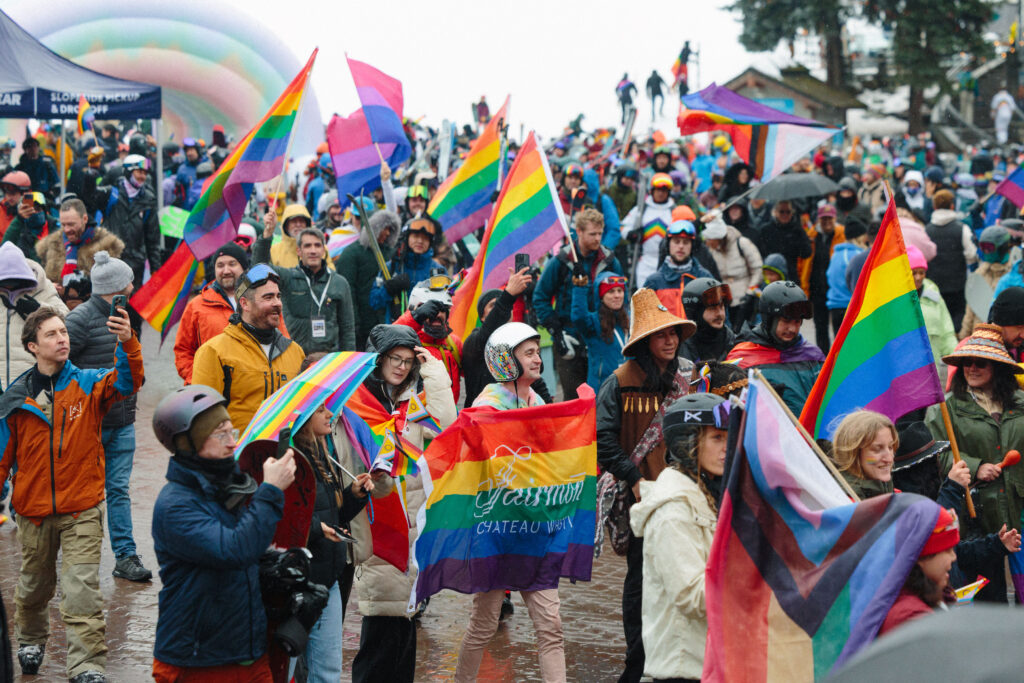
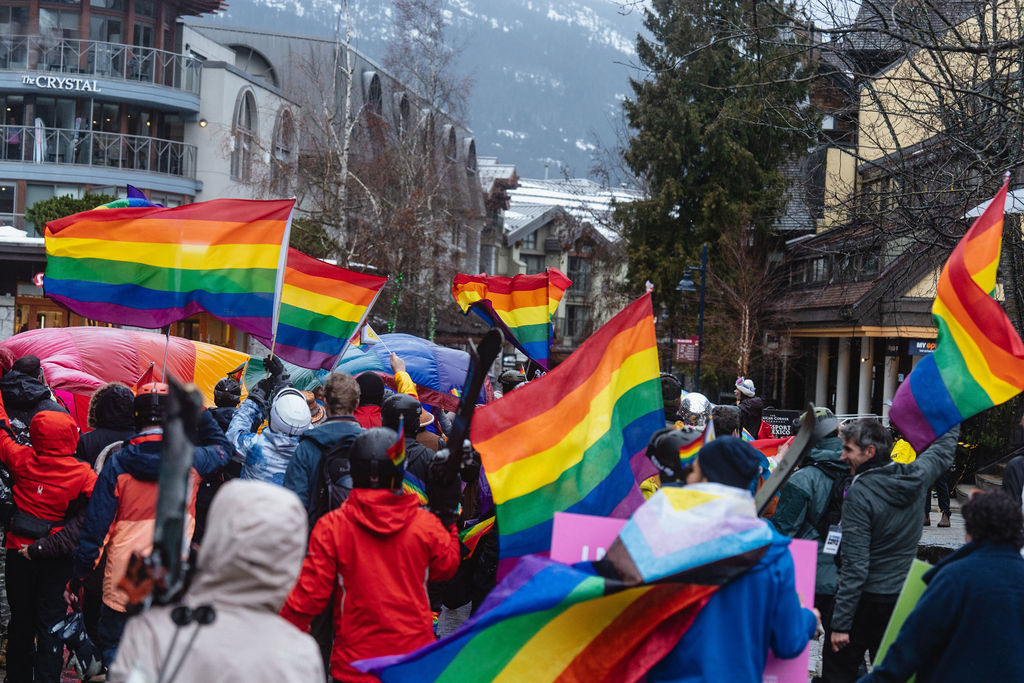
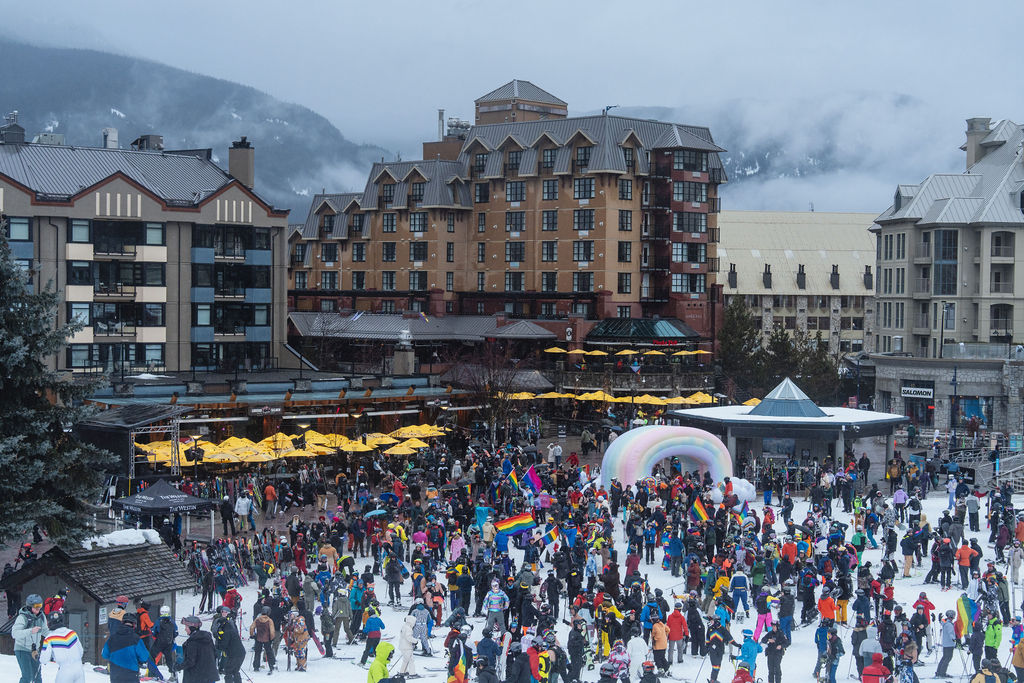
Skiers and snowboarders pour in from every direction. The descent turns wonderfully chaotic: cheers echo across the slopes, rainbow flags trail behind riders, and winter gear clashes beautifully with drag glamour. At the base, the celebration continues into Whistler Village. Now, the parade is led by Venus, the first Indigenous winner of Canada’s Drag Race and Squamish Lil’wat Nation members from the Squamish Lil’wat Cultural Centre. As the parade begins its march through the village, the procession quickly swells beyond its programming. Locals and tourists merge with participants until it’s no longer just a festival event but a village-wide claim on public space. Tourists step away from their meals and shopping. Whistler locals step away from their workday. Everyone lines the route to cheer, film, and bear witness.
For me, this is when the significance registers.
Celebrating queer visibility within the festival’s programming through guided ski groups, après gatherings, and sold-out nightlife creates community among those who came for exactly that. But the village showing up as witnesses and participants, not as vendors or sponsors, reveals something deeper. The permanent rainbow crosswalks beneath our feet, the Pride flags that fly year-round (not just during festival week) — this is what it looks like when belonging isn’t scheduled for one week, but woven into how it operates.
I spent nearly two-thirds of my 36 years grappling with identity, unsure where I fit or whether mountain communities had room for people like me. This kind of embrace doesn’t go unnoticed.
I left my mountain home of Banff eight years ago, not because I didn’t love it, but because I needed what it couldn’t yet offer: a visible queer community, infrastructure, and space to exist without explanation. I found that in Vancouver — my community, mountains, nature, and not long after the move, my partner — all in the same place. But mountain towns move at their own pace.
The mountains were never the problem. It was the communities built around them that needed to catch up.
In the years since I left Banff, something has shifted. Banff Pride now hosts year-round programming, a week-long Pride celebration that draws marquee drag talent, and sustained community initiatives, creating the kind of visibility that puts it on the international stage alongside festivals like Whistler Pride. Similar work in the mountains is being done with events like Peak Pride at Sun Peaks in the B.C. interior and Pride at Mount Washington, and with tourism organizations like Travelling Out in the Thompson Okanagan, which bring these communities and events together.
The behind-the-scenes work matters just as much. In Revelstoke, Julianna Howatt — a professional mountain guide with more than four decades of backcountry experience — spent most of her career navigating avalanche terrain while compartmentalizing her identity as a transgender woman, fearful that being outed would cost her everything. After retiring from guiding and surviving a traumatic climbing accident, she came out and helped found the Open Mountains Project, a non-profit dedicated to fostering inclusive mountain culture through backcountry programming and mentorship. Her story, documented in the film Beauty in a Fall, which premiered at the Banff Centre Mountain Film and Book Festival, captures what so many of us lived: the fear that mountain communities had no room for people like us, and the hope that, with enough courage and community-building, they could.
What was missing when I left Banff is now being built by those who stayed, those who returned and those, like Julianna, who refused to let the mountains belong only to a narrow few. Visibility and belonging in Canada’s mountain communities aren’t just emerging organically. They are being deliberately and bravely constructed by people willing to do the work.
The mountains were never the problem. It was the communities built around them that needed to catch up.
In Whistler, partners like Tourism Whistler, Fairmont Chateau Whistler, Whistler Blackcomb and even independent village bars don’t treat Pride Week like a marketing opportunity or a tourist draw. They let the festival reshape the village and serve as a stage for year-round progress. As Tommy puts it: “An embracing resort doesn’t just put a rainbow on its website for a week. It’s action and participation. And this year, the way Whistler showed up, it was embrace.”
Wildlife
The biologist and filmmaker on his latest documentary Animal Pride, an exploration of queer animal behaviour
Travel
A milestone anniversary spotlights North America’s largest ski resort, where family memories take hold and generations return year after year
Travel
Whistler is world-renowned for its powder, but the picturesque mountain village has plenty going on off the slopes as well
Travel
Leslie Anthony shares the best of the big hills