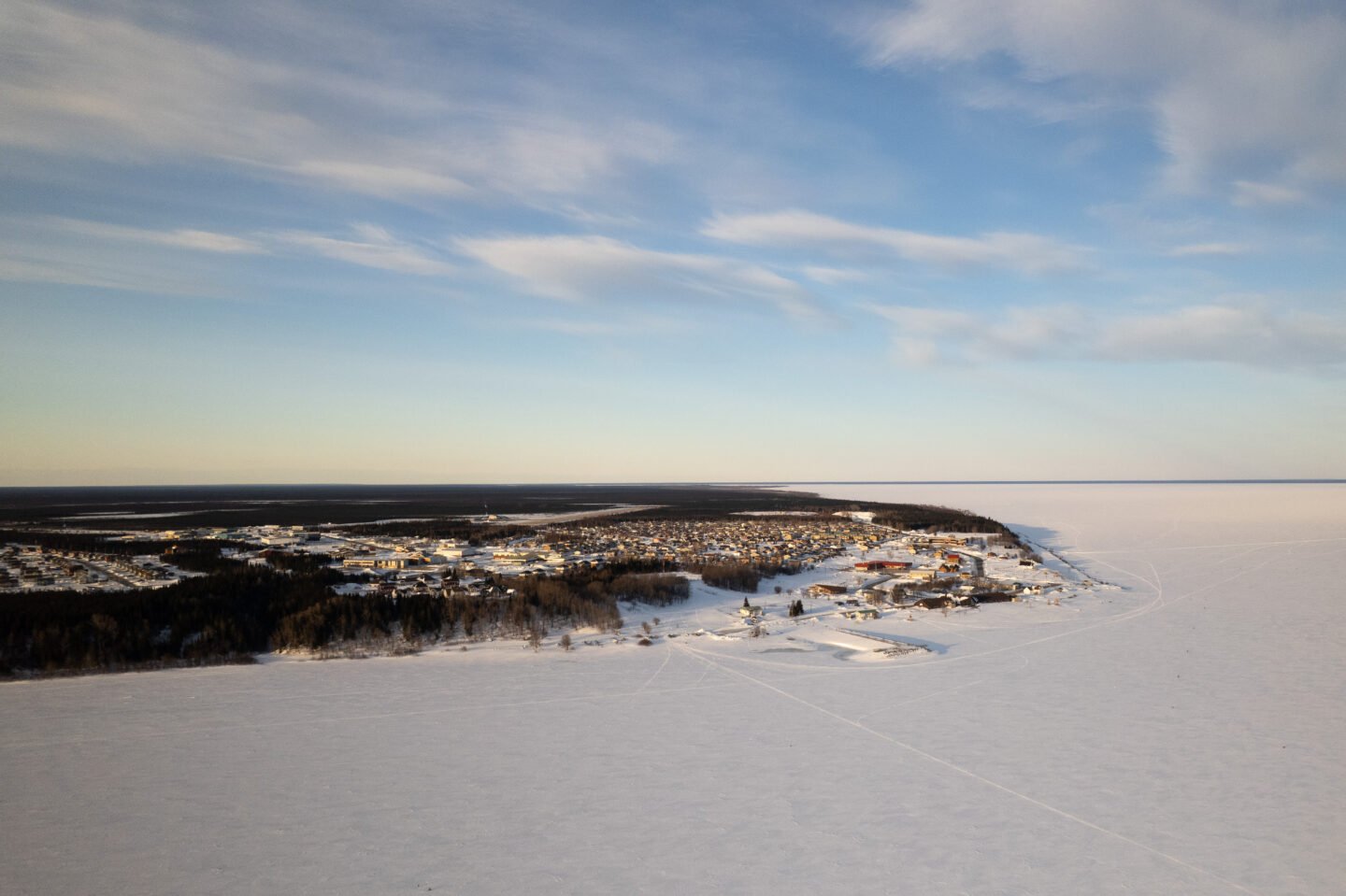
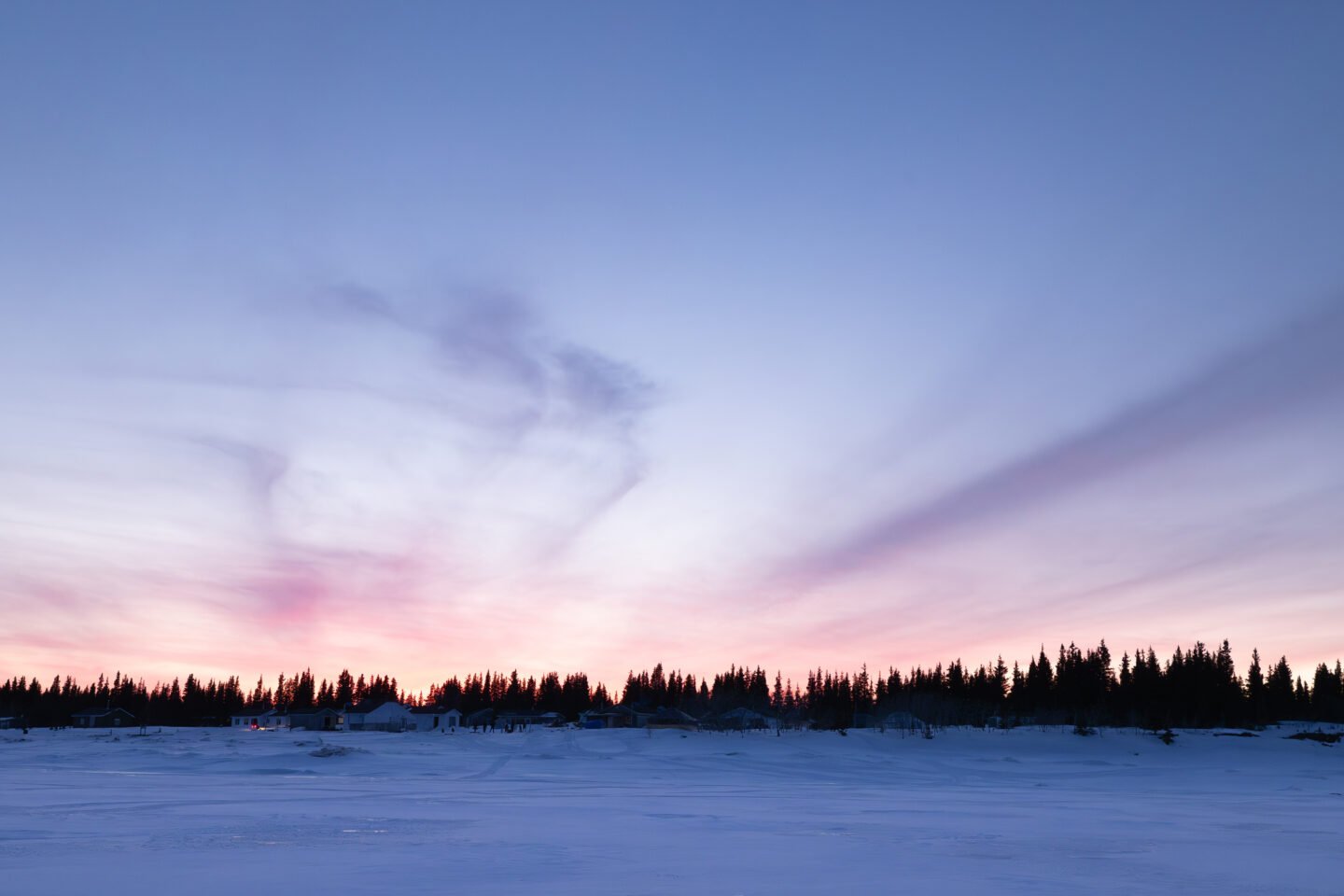
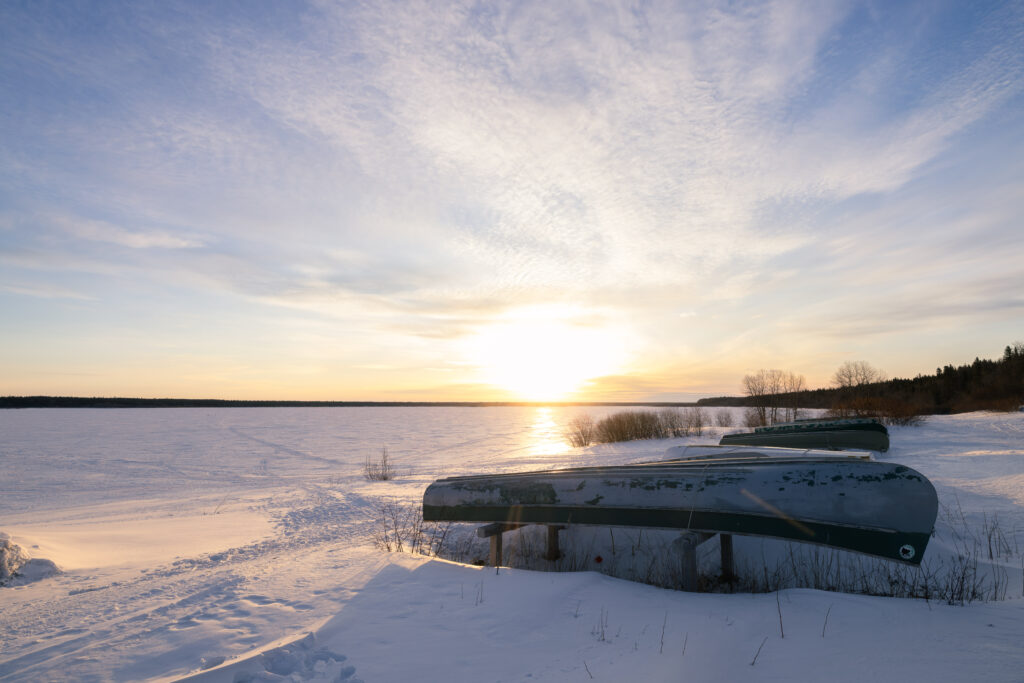
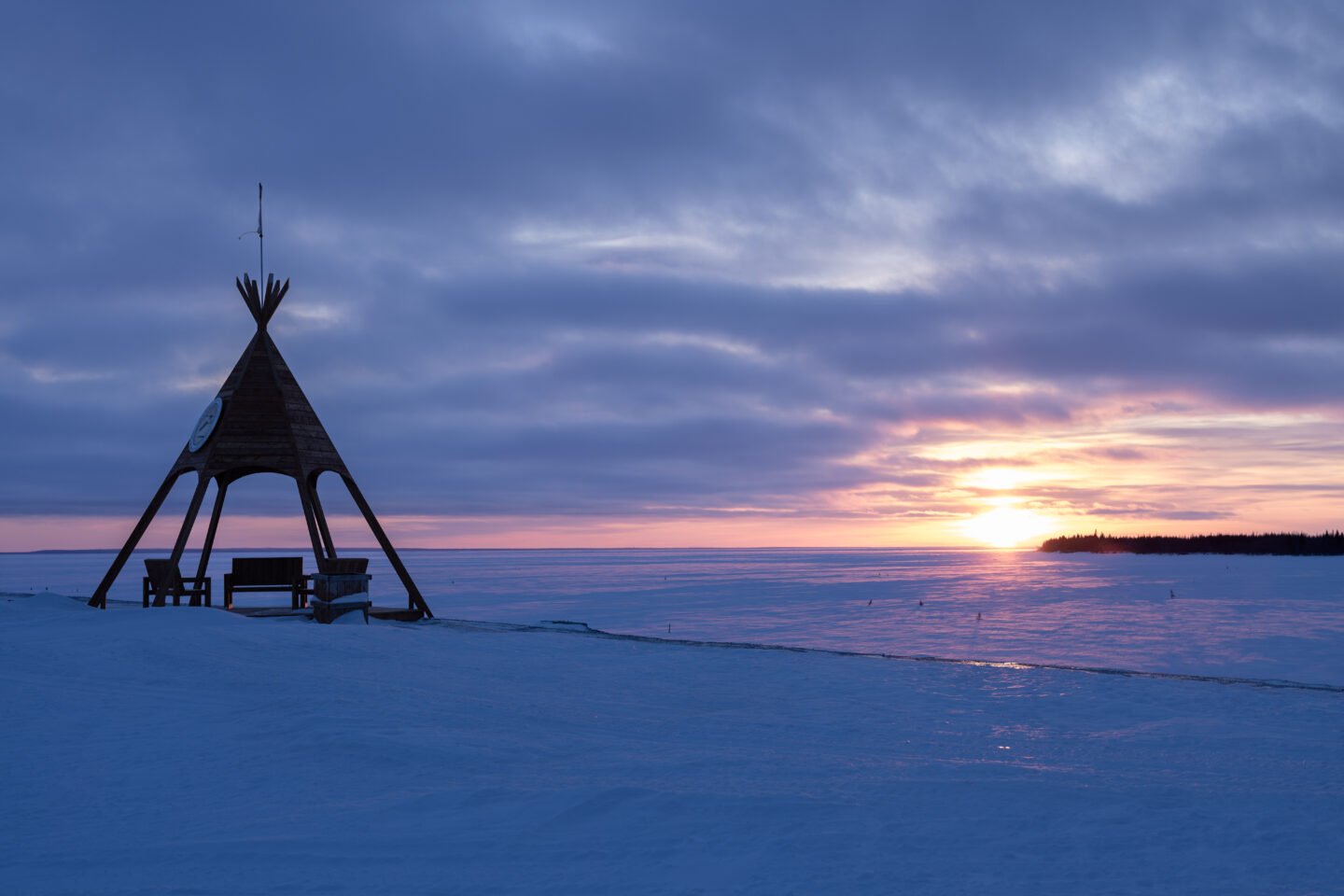
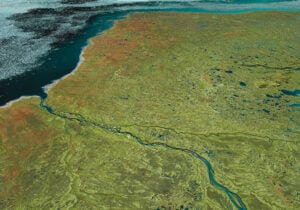
Despite a scattering of buildings, the shore of the Rupert River looks almost identical to what Médard Chouart Des Groseilliers would have seen when he arrived here for the first time in 1668 — and how it’s looked since time immemorial. It’s April, and the river is frozen. The band office, lodge, church and old Hudson’s Bay Company building mark the edge of Waskaganish, Que., the beginning of the Arctic Ocean and an iconic piece of Canada’s history. But it takes some imagining to place the Hudson’s Bay Company on these shores.
Before the company closed its doors for good on June 1 this year, the closest Hudson’s Bay store was more than 900 kilometres south of Waskaganish, in Gatineau, Que. Long separated from the company’s origins as a series of trading outposts, the department store stood in a shopping mall surrounded by streets named for a former governor general, religious leaders and the explorers who “discovered” Canada. It was far removed from Charles Fort, later renamed Rupert House, the company’s first outpost established on the shores of the Rupert River 357 years ago. It’s here, in sterile malls like these across the country, that Canada’s most iconic company closed its final chapter.
Now, after a 355-year history, the company that shaped Canada has fallen, with changing retail habits and a lack of financing leading to the liquidation of all its stores. While people across the country grapple with what that means for Canada, the community of Waskaganish remains far removed from the outcome despite their deep ties to the company.
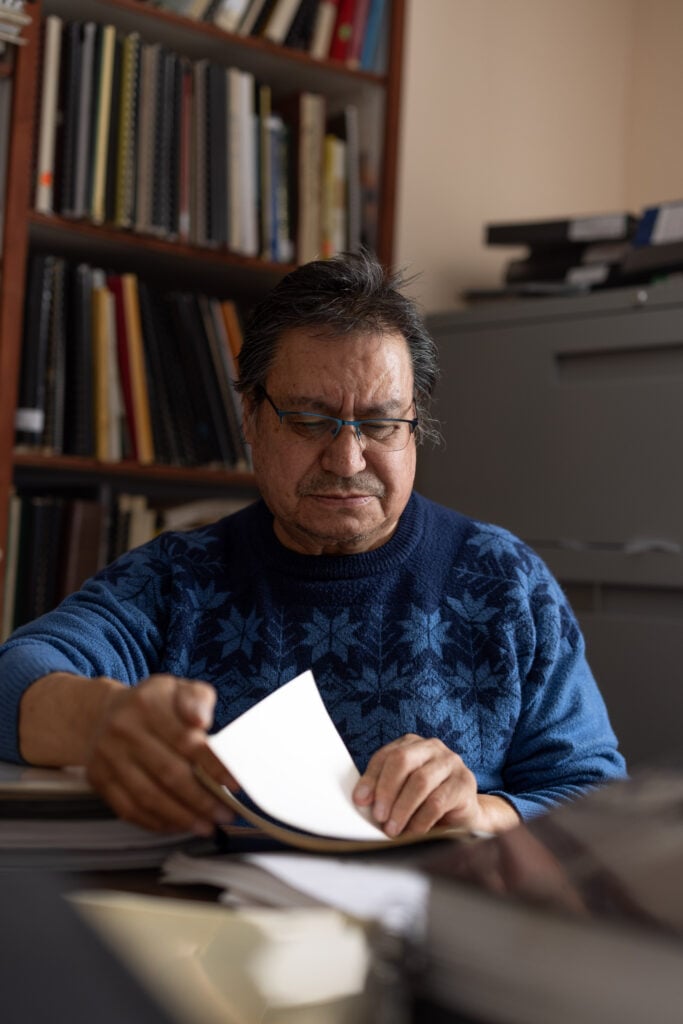
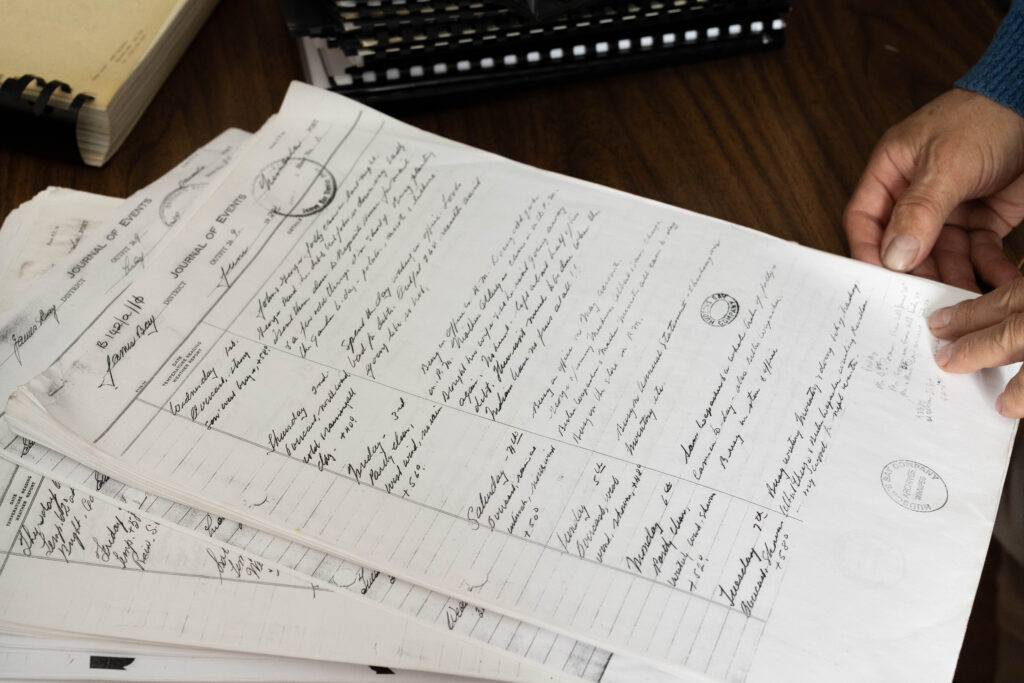
On Rupert Street, a stone’s throw away from the shoreline where the Hudson’s Bay Company started, Sinclair Diamond is typing away at his computer, surrounded by a shelf of old books. On the table behind him sits a collection of journals and records collected from Hudson’s Bay stores throughout Quebec’s James Bay region, or Eeyou Istchee in Cree.
Diamond is the cultural facilities officer in Waskaganish. “I was really interested in finding out who my ancestors were … who I was related to, how I was related to them,” Diamond says. “For the community, we’re so interconnected. So basically, almost everybody is related in some way to your neighbour or whoever you see in the village.”
Diamond started the community’s genealogy project, relying heavily on church records and Hudson’s Bay archival material to learn more about ancestry in the community. He scrolls on his computer, shows the genealogy database and proudly exclaims that there are more than 13,000 entries dating back to the 1800s.
“When you read these journals, it’s almost like you’re actually there,” Diamond shares excitedly. He recounts a story of a young Cree man who didn’t have a suit for his wedding and was given one from the Hudson’s Bay Company factor, the employee in charge of an outpost. “I used to read them at night, and it’s almost like somebody is telling you a story.”
One thing Diamond has uncovered from the genealogy project is how much Scottish ancestry is mixed into the Cree community from intermarriage with Hudson’s Bay employees. Scottish surnames such as “Moar” and “McLeod” are common to hear in Waskaganish, he says.
But while ties run deep, the fall of Hudson’s Bay doesn’t really matter to the community, says Diamond. As he dives into genealogy records and archival materials, the company’s purpose to him is as a historical record for collecting useful information. Information that’s important for people in the community to know so that they “don’t have to get married to their cousin,” he chuckles.
On the floor below, Stacy Bear, Waskaganish’s culture and tourism operations manager, is flipping through a book of old articles sent to her from the Hudson’s Bay Company archives in Manitoba.
When asked what role Hudson’s Bay plays in modern day Waskaganish, she laughs. “Practically no role — apart from me going to Ottawa shopping.”
She thinks about it for a few more seconds.
“When I think of both histories,” Bear says, referring to more than 7,000 years of Cree history in James Bay and the more recent history of the Hudson’s Bay Company, “they’re all very interesting to me.”
“I don’t have horrible bad grudges against the Hudson’s Bay Company. I accept things as they are or as they happened. That’s kind of my philosophy.”
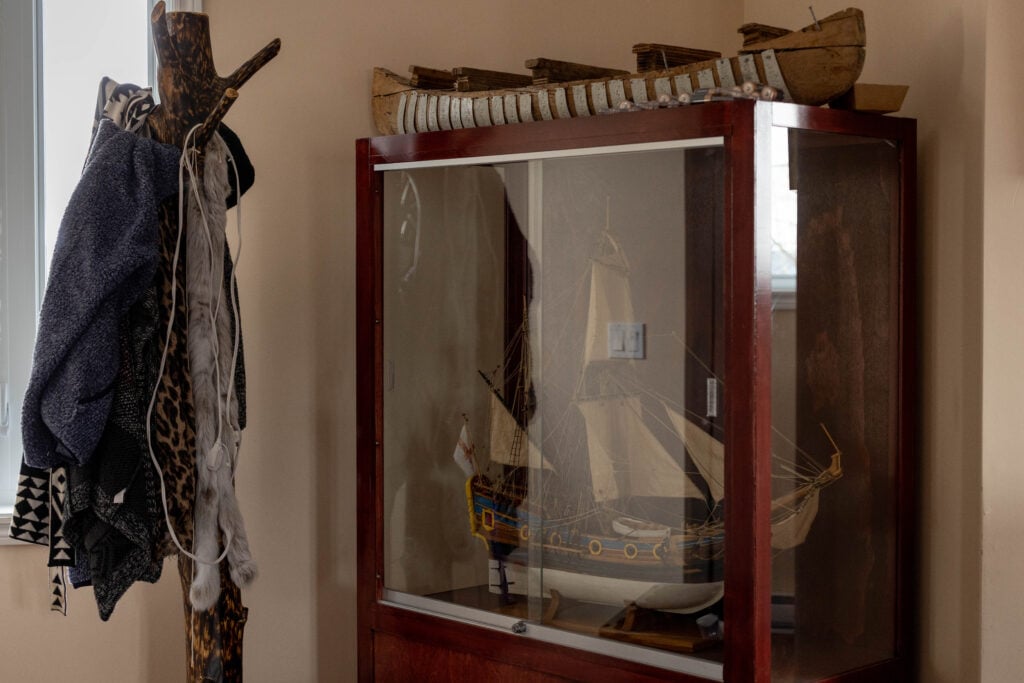
Bear gets up and walks over to a display shelf. Behind the glass lies a replica of a wooden ship.
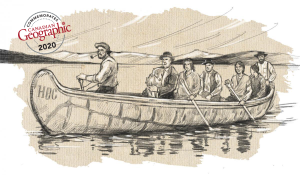
Nonsuch was one of two ships acquired for Pierre Esprit-Radisson and Des Groseilliers’s expedition from England to James Bay in 1668. The expedition was backed by King Charles II to explore the infamous land of beaver that Radisson and Des Groseilliers had learned about from Indigenous traders while on expedition as coureurs de bois west of Lake Superior. The small ship reached the mouth of the Rupert River on September 29, 1668, and it was here that Des Groseilliers established Charles Fort in present-day Waskaganish.
Three-and-a-half centuries later, in 2018, the community of Waskaganish was gifted a miniature replica of the ship to commemorate the 350th anniversary of the community’s first contact with what would become the Hudson’s Bay Company.
“It was hard for me to celebrate, honestly,” Bear recalls. “But I know it was an exciting event for the community, so I took part in it anyway, even though it kind of went against my beliefs a bit.” That first contact, she says, “was the start of the decline of our culture that now I am trying so hard to go back to.”
“I saw it as the people who came and took more than they gave.”
From the moment Des Groseilliers set foot on the shores of James Bay, the beginnings of a complex trade network were set into motion. After returning to England with proof that all the rumours they heard about the incredible size and quantity of beaver in the area were true, the Hudson’s Bay Company was born. On May 2, 1670, King Charles II signed a charter granting the “Governor and Company of Adventurers of England, trading into Hudson’s Bay” a monopoly over the entire Hudson’s Bay watershed.
To realize their dreams of profit through the sale of beaver furs and pelts, the newly established company set up multiple trading forts throughout the bay towards the end of the 17th century. Local Cree people would meet the Europeans at the forts to trade their furs for European goods, including weapons and cookware, that improved the comforts of life. Intermarriage between Europeans and Cree deepened relationships between the two parties, sometimes serving diplomatic purposes to strengthen trust for the benefit of trade. But trade wasn’t always fair.
Over centuries, the Cree people’s reliance on European goods, which could be purchased only from the Hudson’s Bay Company outposts, grew stronger, giving the company a complete monopoly over trade in the region.
Some residents in the community, such as filmmaker Neil Diamond, recall stories of injustices growing from that monopoly and codependence. He remembers hearing that to buy a gun, Cree trappers needed to stack a supply of beaver pelts that matched the height of the gun — the heaviest Hudson’s Bay employee would then sit on the stack of pelts to reduce their height, requiring the Cree trapper to supply even more pelts to buy the weapon.
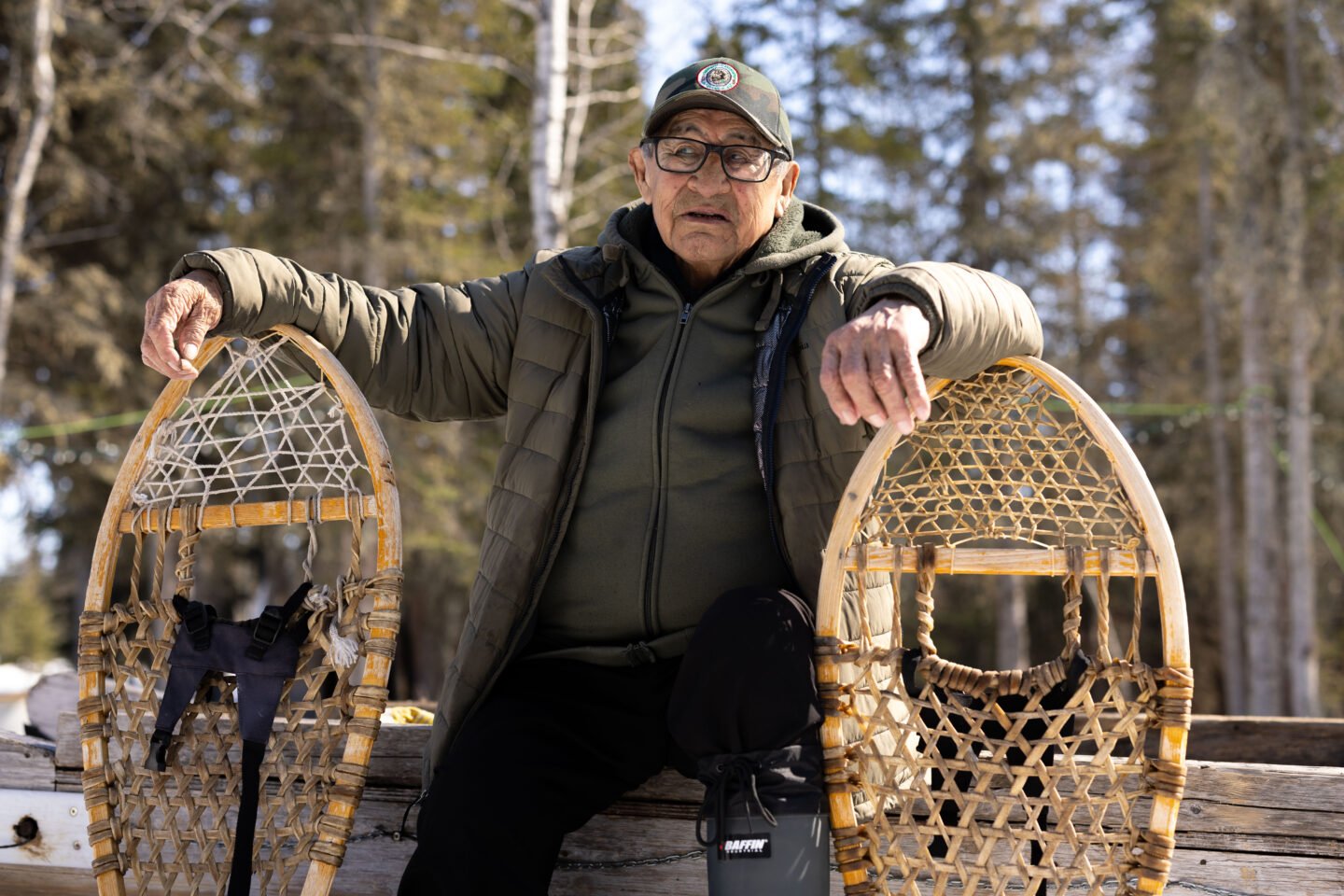
The deep distrust formed by these inequalities in trade is still felt by some of the older generation. More than 60 kilometres north of Waskaganish, at his hunt camp on Charlton Island, 82-year-old Waskaganish resident Jimmy Trapper still feels the sting of seeing Elders in the community who didn’t have an understanding of written numbers or the English language get ripped off by a company employee.
“They didn’t do it right. That’s why he [the company] is bankrupt,” Trapper laughs. “If he did it right, he wouldn’t be bankrupt, according to me.” Trapper continues chuckling and shares that he’d rather see the company held accountable with reparations to traders than go bankrupt.
But Trapper, who’s spent his life trapping furs around James Bay, says it wasn’t all bad and that the company treated his generation better than his father’s by improving prices, although he gives the credit not to the company but to Cree hunters and trappers having a better understanding of western-style commerce and English.
While stories like Diamond’s and Trapper’s carry a negative connotation about the relationship between locals and the company, the community also had strong allies depending on who was working at the outpost. The late James (known as Jimmy) and Maud Watt, a company employee and his wife even left a lasting, positive, legacy on Waskaganish’s modern-day history. James, a highlander born in Scotland, served as the post manager of Rupert House (the previous name for Waskaganish) from 1922 until his death in 1944. Maud took up several roles in the community advocating for the well-being, education and health of Indigenous people. In 1970, she was awarded the Order of Canada for this work and for helping to conserve the beaver population in the James Bay area.
During the winter of 1928 to 1929, Cree people in Waskaganish were facing an economic crisis and famine driven by the significant decline of beaver populations from overharvesting as a result of the centuries-long fur trade. Beaver was a staple in the Cree diet, and both James and Maud understood the gravity the decline of the beaver presented for Cree people, not to mention the business interests of the Hudson’s Bay Company.
James and Maud worked with local Cree hunters to come up with a conservation plan to revive the beaver population in the James Bay area. Maud embarked on a long and arduous journey to Quebec City, intent on bringing the community’s conservation vision in front of Quebec government officials. She crossed over 100 kilometres of sea ice by dogsled to Moose Factory and Moosonee, Ont., then travelled another roughly 300 km south through the forest to Cochrane, where she connected with the railroad system that would take her to her final destination.
Maud charmed her way into a meeting with Louis A. Richard, Quebec’s deputy minister of colonization, game and fisheries. After that meeting, largely thanks to Maud’s persuasion, the Quebec government established a beaver preserve around Waskaganish.
She returned to Waskaganish with a lease from the province for 7,200 square miles (almost 19,000 square kilometres) for a beaver preserve. Eventually, the lease was taken over by the Hudson’s Bay Company. The preserve led to the revival and sustainability of Waskaganish’s beaver population, which is seen as healthy today.
The conservation success story is largely due to the trapline system designed by the community of Waskaganish, adopted by the Hudson’s Bay and implemented by Cree families. The system designates parcels of land known as traplines to local families for traditional hunting, trapping and wildlife management. Each trapline is led by a “tallyman” in the family, a title worn with pride on traplines to this day.
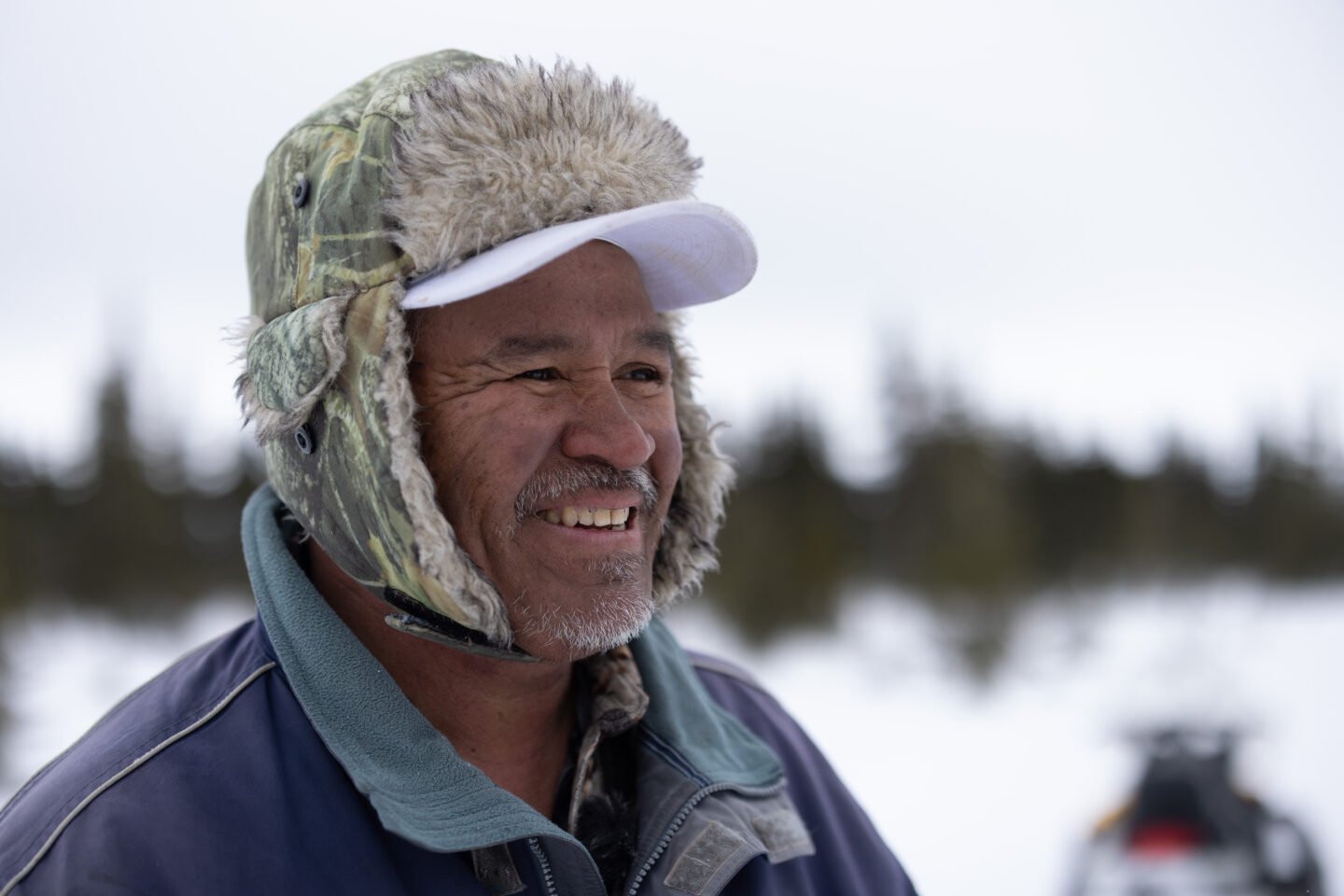
East of Trapper’s camp — across beaver ponds, tall black spruce and a shifting coastline of sea ice — lies Charlton Depot, a former staging ground for Hudson’s Bay ships that came from Europe to disperse in smaller boats to outposts on the bay, including Waskaganish. The depot is better known today as the Jolly camp — and Anderson Jolly, humorously called “camp boss,” is the tallyman.
His grandfather, the late Anderson Jolly Sr., was appointed the first tallyman of the island by the Hudson’s Bay. If it wasn’t for the fact that Jolly Sr. was asked to take care of the beaver population on the island, his family likely would have stayed at their hunt camp closer to Waskaganish.
“That’s why we ended up hunting here,” Jolly says with a smile.
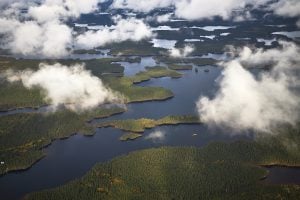
Today, though, there’s little reminder of the Hudson’s Bay Company on these shores. Beaver populations are stable, a testament to the success of the trapline system, and the Hudson’s Bay staging ground has been replaced by cabins occupied by the Jolly family. The Jolly family is here to prepare for the spring goose hunt, a tradition that dates back to time immemorial. Known today as Goose Break, it’s a time of year most Cree families look forward to. Schools close, work stops, and families head to their traplines to spend time together and hunt. At the Jolly camp, wood has been gathered and placed inside the teepees for cooking — all that awaits is the arrival of the geese. The hum of the generator and Wi-Fi connection give the camp a sense of modernity.
Jolly is glad his grandfather was given the island to watch over. “I really love it here. I really love staying here.” There might be no running water, but besides a snowmobile-haul worth of goods, the land and surrounding water provide all they could need.
For the most part, Jolly has nothing but good things to say about the company, but he acknowledges different generations have different opinions. At 61, his own take comes from personal experience, his love for his island and his grandfather’s stories.
One story in particular lights up his eyes. When his grandfather was returning from Charlton Island with a season’s worth of beaver furs to trade at the Hudson’s Bay store in Waskaganish, drifting sea ice caused the furs to float away and become entirely unreachable. The situation was dire — losing an entire season of furs would be disastrous for the Jolly family. When they reached the Hudson’s Bay outpost and explained what had happened, the manager didn’t just honour the price of the lost furs, but he even hired Anderson Sr. to get more.
When asked if the Hudson’s Bay Company had been good to Anderson’s family, he responds, “I’d say yes.”
The Jolly camp feels worlds away from the department stores where people rushed to get deals on iconic Hudson’s Bay point blankets, jewellery and shoes. For Jolly’s part, he’s not too concerned with the company’s fall.
“I don’t ever think of that. It’s in the past,” he says. “The thing now is it’s not the company anymore.”
Cree filmmaker Neil Diamond feels similarly.
He looks out the window of his friend’s home in Waskaganish and takes a sip of coffee, deep in thought about the company’s lasting legacy here. Fresh off the release of his film Red Fever, which examines how Indigenous culture has influenced Western culture and identity, Diamond has long been fascinated by the effects of history and Indigenous culture on the present day. To make the film, he even travelled to England, where he bought a felt beaver hat that could have been made from beaver trapped in Waskaganish.
A contemplative look on his face shows he’s gathered his thoughts.
“It’s a quintessential, Canadian historical company, right? And it was born here,” he says with a slight hint of pride.
As a kid, Diamond remembers a barge coming in once a year from Moosonee, Ont., full of supplies that needed offloading to the Hudson’s Bay store. Along with other kids in the community, Diamond was hired seasonally to help unload the barge, making a small amount of cash for his efforts. One of the only places to spend it was at the store itself.
“When I was growing up, that was the store here. I think I was maybe eight or nine when they built the bigger building there,” he says.
“It was very rustic. All the items were behind the counter. You couldn’t just wander through the aisles. You had to go up to the counter and ask for whatever you wanted. And the guy would … bring it to you.”
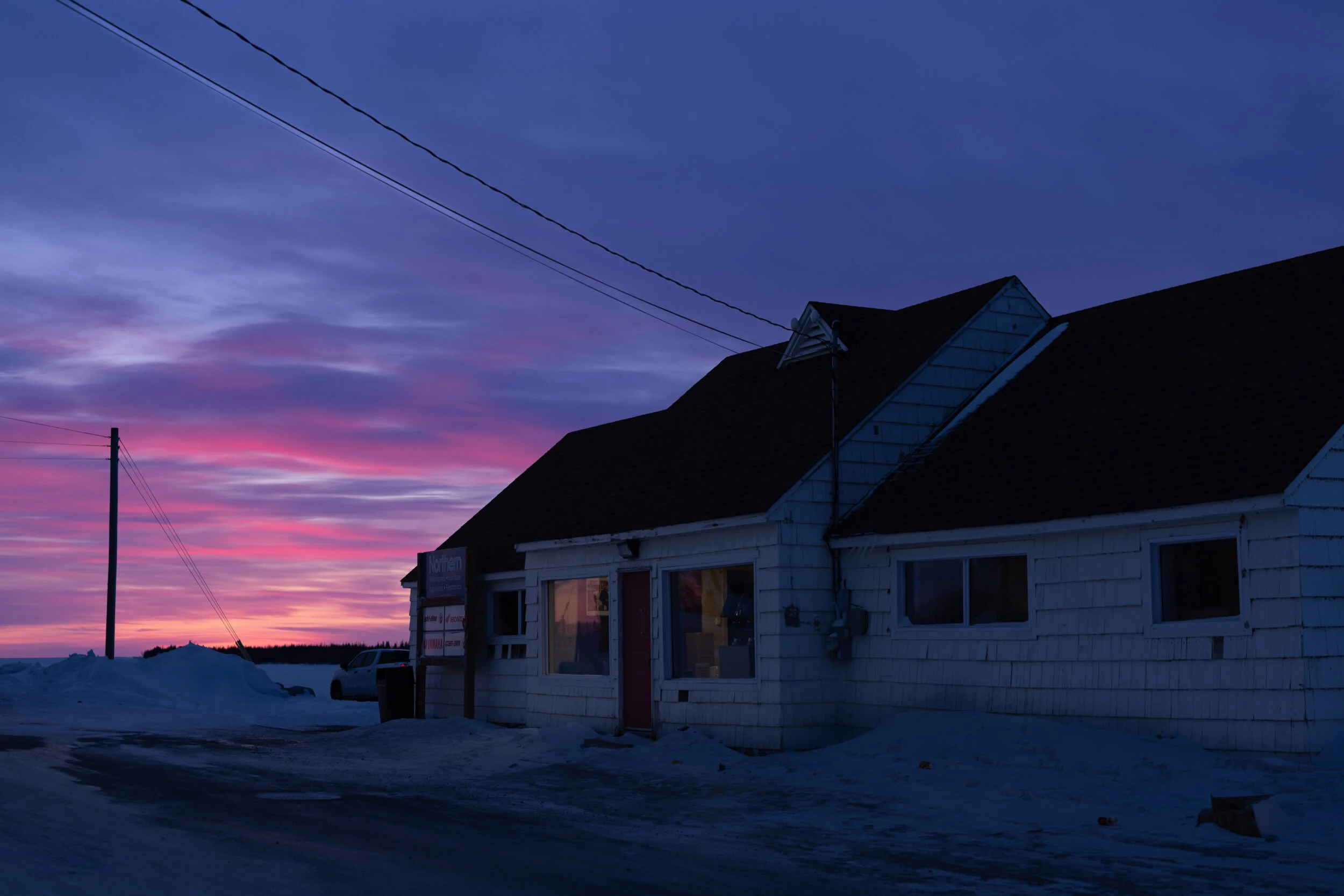
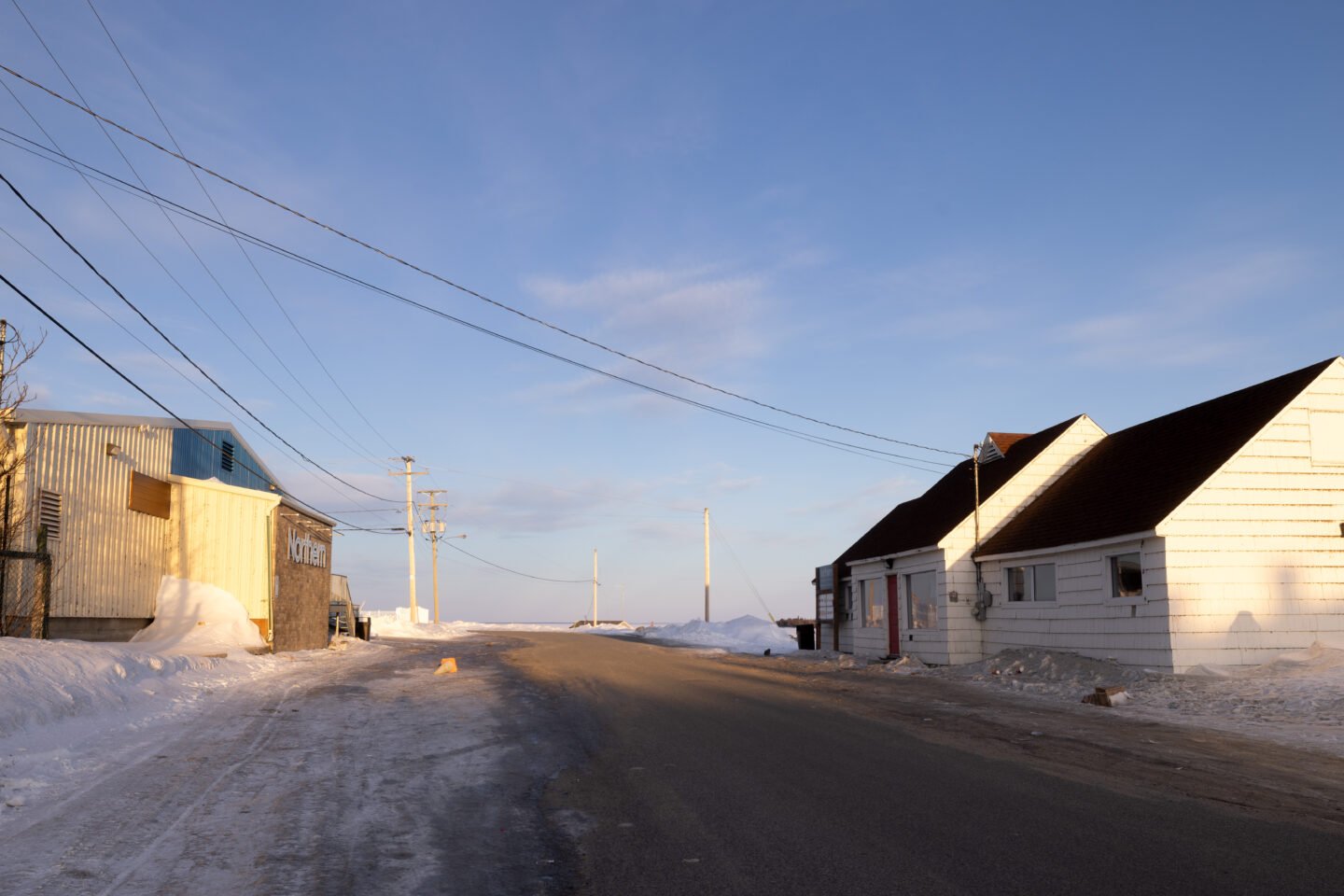
The original Hudson’s Bay store still stands at the edge of town by the river. Alongside the newer building across the street, it’s now operated by the North West Company under its “Northern” brand. In 1987, a group of financiers bought the company’s Northern Stores division, naming the venture after the infamous Montreal-based fur trading conglomerate, the North West Company, in 1990. The takeover ended the Hudson’s Bay Company’s several-century monopoly in northern communities, effectively replacing one monopoly for another.
“All of a sudden it was the Northern Store, and what the hell happened?” Diamond exclaims.
“I don’t have the same feeling I do for the company. The company! You see? That’s how people referred to it, as the company,” he says. “It’s not even the Hudson’s Bay company. It’s the company.”
“I guess it’s a bit of nostalgia, right?”
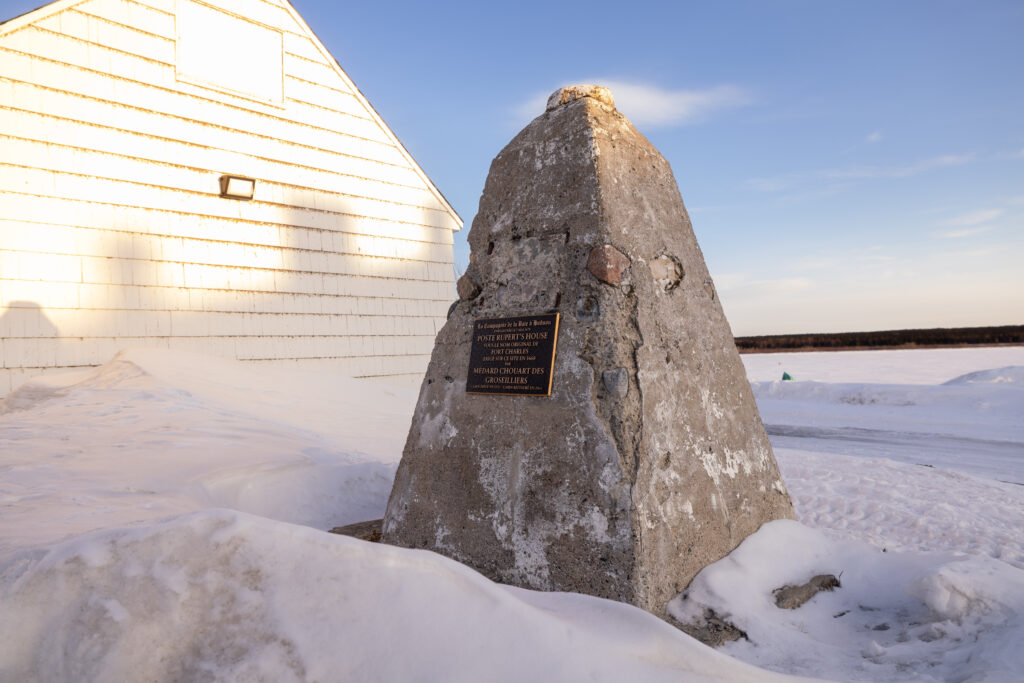
A light drizzle is beginning to melt away the large snowbanks and snowmobile tracks between the Rupert River and the road. Bear drives through the slush past the Northern store. It’s been 35 years since the “Northern” branding was placed on the buildings previously run by the Hudson’s Bay, and other than a cairn with a historical plaque and a few signs along the river discussing the history, the company’s presence is all but gone.
This shoreline, Bear claims, is riddled with company history. Archeologists have dug up numerous artifacts, including musket balls, from the days of the Hudson’s Bay Company.
At the end of the road is a boat ramp heading towards the river. Bear turns around to avoid it and stops at the Catholic mission. She turns off the truck, hops out and looks at the fence.
“The driveway right there,” Bear says pointing to the corner of the slanted fence post, “is where we think the first fort was.”
Apart from the cold wind coming down from the Arctic, the frozen river and the surrounding landscape are still. The department stores liquidating gold jewelry and designer shoes are just a faraway thought.
“It’s just a piece of history,” Bear says. “You don’t really hear anybody talk about the Hudson’s Bay Company anymore. A lot of the Elders, whose lives it played a big part of, are no longer with us.”
Her interest in Hudson’s Bay history comes from her deeper passion for Cree culture and cultural revitalization in the community — a passion stemming from her own journey of relearning Cree culture, which was lost when her mother was sent to residential school.
In her current position, Bear is responsible for bringing cultural events to the community and is deeply driven to pass down culture to the community’s youth. She thinks learning about the history of the Hudson’s Bay Company is important because it leads to a deeper understanding of how it influenced local Cree culture.
“I say the history is a part of our culture because when it comes to, let’s say cooking, we cook bannock,” says Bear.
“These are not Cree things, but they became Cree things through trade. A lot of these things that we adopted come from the Scottish, like boudin,” referring to a boiled Cree desert bread.
Bear says other changes, like the use of guns for hunting and the English language, have ingrained themselves into modern Cree culture.
“In a lot of ways, it benefited us too. It’s not like they completely robbed us. They brought useful tools like guns and knives and needles and stuff like that.”
While the relationship with the Hudson’s Bay Company in Waskaganish is complicated, and different depending on who you ask, the one thing that’s for certain is that it’s definitively over.
The closing department stores in the south don’t resemble anything close to the trading posts once scattered around James Bay. Here in Cree territory, a powerful revitalization of Cree culture is taking place — that’s the focus in the community, not the closure of department stores almost 1,000 km away.
That’s not to say the Hudson’s Bay won’t serve some role in the future of Waskaganish. With a growing tourism sector, Bear hopes to leverage the company’s legacy to entice visitors. But when they come, they’ll learn that the company was just a small part of the history here and that the true tourism experience comes in the form of Cree culture and land-based activities.
“I’ll tell them a little bit about it,” Bear says. “They’re welcome to come here and see the original birthplace of the company and the people who helped build it. Then we show them a bit of our culture.”
The ultimate closure of “the company” appears to be of little concern in Waskaganish — it’s only a small epoch in an estimated 7,000-year story. It’s Cree culture, here, that stands the test of time.