Travel
Van life: A nine-day solo road trip through Northern B.C.
I traded my apartment for a van and discovered the freedom of exploring “The Great Wilderness” on my own schedule
- 2639 words
- 11 minutes
Places
A road trip “up island” reveals outsized curiosities with backstories to match

My nonagenarian father had an itch to see the town at the opposite end of Vancouver Island from his home in Victoria, so I joined him for the six-hour drive “up island” to Port Hardy. The town is named for Captain Thomas Hardy, in whose arms at the Battle of Trafalgar Lord Nelson famously uttered his final words: “Kiss me, Hardy.”
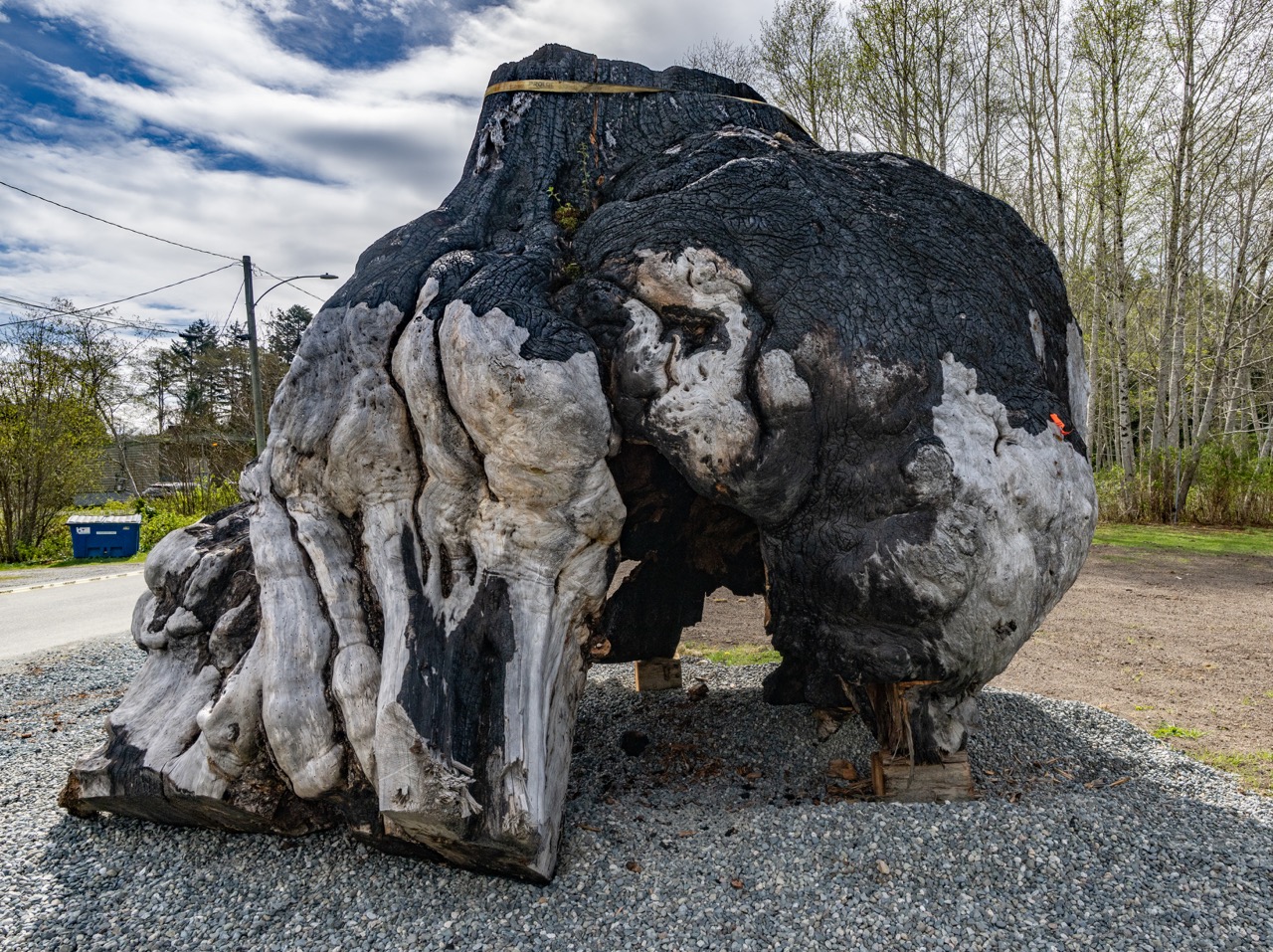
We set off from Victoria early, passing the world’s tallest freestanding totem pole — no guy wires — and by lunch had arrived in Port McNeill, a salt-stung town of about 2,300 people on the edge of the Salish Sea. The town grew out of a logging camp, and logging remains the central industry. As we entered town, a forest of road signs urged us to visit its “#1 Attraction – Largest Burl in the World.” Yes, burl, as in the bulbous, tumour-like growth that appears on trees. It is thought that trees develop burls as a stress response to insects, bacteria, fungi and other pathogens, which sends the tree’s cells into overdrive to create a protective scar. But “the exact mechanism that causes burl formation is not fully understood,” as New Hampshire forester Greg Jordan writes. “If it were, burls would probably be produced commercially for use by artisans.” Indeed, furniture makers and woodturners pounce on burls, whose swirling, unpredictable grain adds beauty to violins, cutting boards and even vehicle interior trim.
We arrived at the Harbour Lookout Family Restaurant and Pizzaria too late to order the Loggers Breakfast (three eggs, bacon, sausage, ham, hash browns, toast and waffle or pancake), so it was over Reuben sandwiches moistened with Thousand Island dressing that we read up on the world’s largest preserved tree burl on guinnessworldrecords.com. The burl was discovered in 2005 on the trunk of a 525-year-old spruce tree, an hour’s drive from Port McNeill, and moved to town through volunteer sweat and logging equipment — the tree itself destroyed in its wake. The burl is 20 feet by 20 feet and weighs 66,000 pounds, i.e., seven hippopotamuses.
We perused the reviews on Tripadvisor:
Giant tree tumour. ★★★
Very unique and interesting natural wonder. ★★★★★
Beautifully displayed. One can walk around the whole burl. ★★★★
It is debatable whether one should venture out of the way to view this attraction. ★★
We asked our teenaged server where the burl was located.
Server (waving vaguely): Up thataway.
Us: Close enough to walk to?
Server: Near the baseball field.
Us (none the wiser): Ah.
Server: But it … burned.
Us: It what?
Server (shrugging): A couple teenagers, not long ago. But it’s still the biggest burl in the world.
The server was oddly placid about the damage to her town’s greatest attraction. I wondered if she knew the teens — it being a small town, they could have been classmates, friends, even her siblings — or if she was instinctually protective, not wanting her peers to be reduced to a single adolescent blunder.
The burl caught fire and burned through an entire spring night in 2023 while members of the Port McNeill Volunteer Fire Department struggled to put it out. Two teens were caught on camera at the scene carrying what was assumed to be a jerry can of gasoline and accused of arson. The community’s anger was such that one of the accused couldn’t leave his home, even after it was determined, receipts presented, that the “jerry can” was in fact a jug of apple juice. The source of the fire was a smouldering cigarette butt, which may or may not have belonged to the teens. The exonerated youths joined efforts to restore the burl.
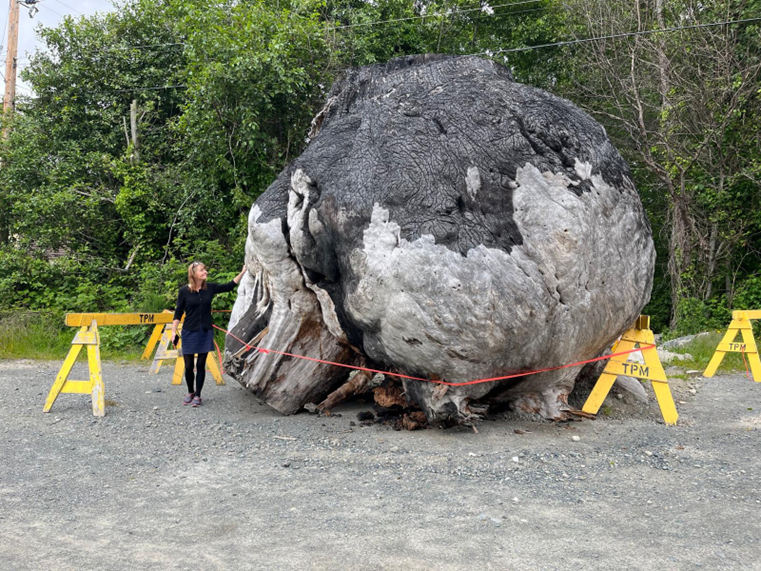
After our lunch, we wandered thataway and found the burl, encircled by non-committal caution tape. Even charred and smelling of charcoal, it was massively impressive. We were wonderstruck.
I later wrote in my journal:
Bulging, verrucose protuberance. Singular, charred. A wart-like goitre, or goitre-like wart, a planet spinning unto itself with a momentum that might heave and detach from the tree as the moon detached from the Earth, to take shape as a thousand spinning salad bowls and palm-polished newel posts, or a single tourist attraction. A burl like this was not just wriggling in the embrace of its fate but crashing against life with all that it had.
It did not matter that the burl was blackened. In a way, it doubled our pleasure, for hadn’t we seen the world’s biggest burl and the world’s biggest charred burl?
Burltastic. Most interesting burl. Wow! ★★★★★
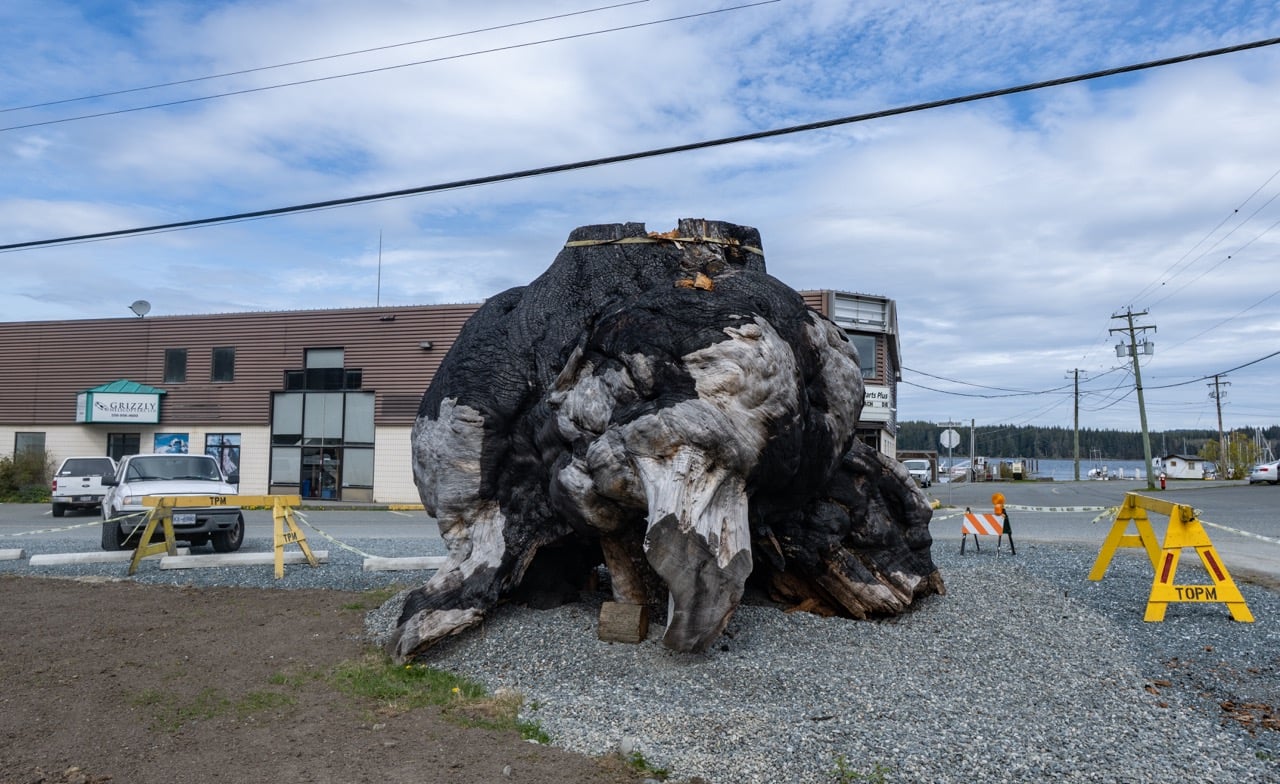
The town has made several attempts to relocate the burl to a more visible spot, but despite promises, several crane companies just couldn’t complete the task. Finally, this March, the town realized that the log loader moving a refurbished 1938 steam donkey to the harbour for display just might be up to the load. And it was. The town found a home for the burl in an overflow parking lot and put up a sign: “The World’s Largest Burl has moved to Parking Lot D and she’s a Pretty BIG neighbour!” Grass was planted, and high schoolers in the trades program have built picnic tables and planters, turning the lot into a “gathering place,” says Port McNeill CFO Brenda Johnson. This summer, families will be able to picnic by the burl.
Port Hardy was humbler than it had appeared in my father’s dreams. It is an absent centre, where fishers and hunters gear up to be elsewhere. A Tripadvisor reviewer suggested a visit to Carrot Park. The K’wagu’l pole with eagle, salmon and bear was meaningful, but the carrot, like some weird offspring of the burl, was more surprising.
A very large, orangey wooden sculpture of a carrot with a bite taken out of it (looks like rodent teeth marks!). ★★★★★
The 10-foot root vegetable with a chomp taken out of it commemorates the 1976 Carrot Campaign, when residents shipped cans of carrot juice to the capital to protest how for 80 years they had been bamboozled by politicians promising an overland highway — a carrot being dangled just out of reach. The protest worked: we had arrived, in fact, on the achieved highway.
A hub surrounded by wilderness, Port Hardy can afford to spread out. My father, recovering from a recent fall and using a cane, needed entire minutes to cross the extraordinarily wide roads. During one such Odyssean crossing, a pickup truck pulling requisite trailer and fishing boat stopped alongside him. The 30-something driver rolled down his window to ask my father how he was doing. They chatted about the sun emerging overhead and how high the fish would be jumping. Then the driver asked my father his impressions of Port Hardy. “Meeting you has been a highlight,” my father answered. The moment was nearly as sublime as witnessing the largest burl in the world.
Travel
I traded my apartment for a van and discovered the freedom of exploring “The Great Wilderness” on my own schedule
Wildlife
Salmon runs are failing and grizzlies seem to be on the move in the islands between mainland B.C. and northern Vancouver Island. What’s going on in the Broughton Archipelago?
Wildlife
An alien crayfish has touched down in North America. Can Dr. Crayfish save us?
Environment
Alberta’s largest city has a lofty goal to restore some of its roadsides, boulevards and other open spaces to a more natural state. Here’s a look at some biodiversity-friendly projects already underway.