History

The fateful decision that led to the sinking of the SS Edmund Fitzgerald

Fifty years ago this November, the Great Lakes freighter Edmund Fitzgerald went down in a fierce storm on Lake Superior, with all hands lost. In this excerpt from his new book  The Gales of November, journalist John U. Bacon reveals the fateful decision that put the mighty ship on the path to disaster.

  • Oct 09, 2025
  • 1,647 words
  • 7 minutes
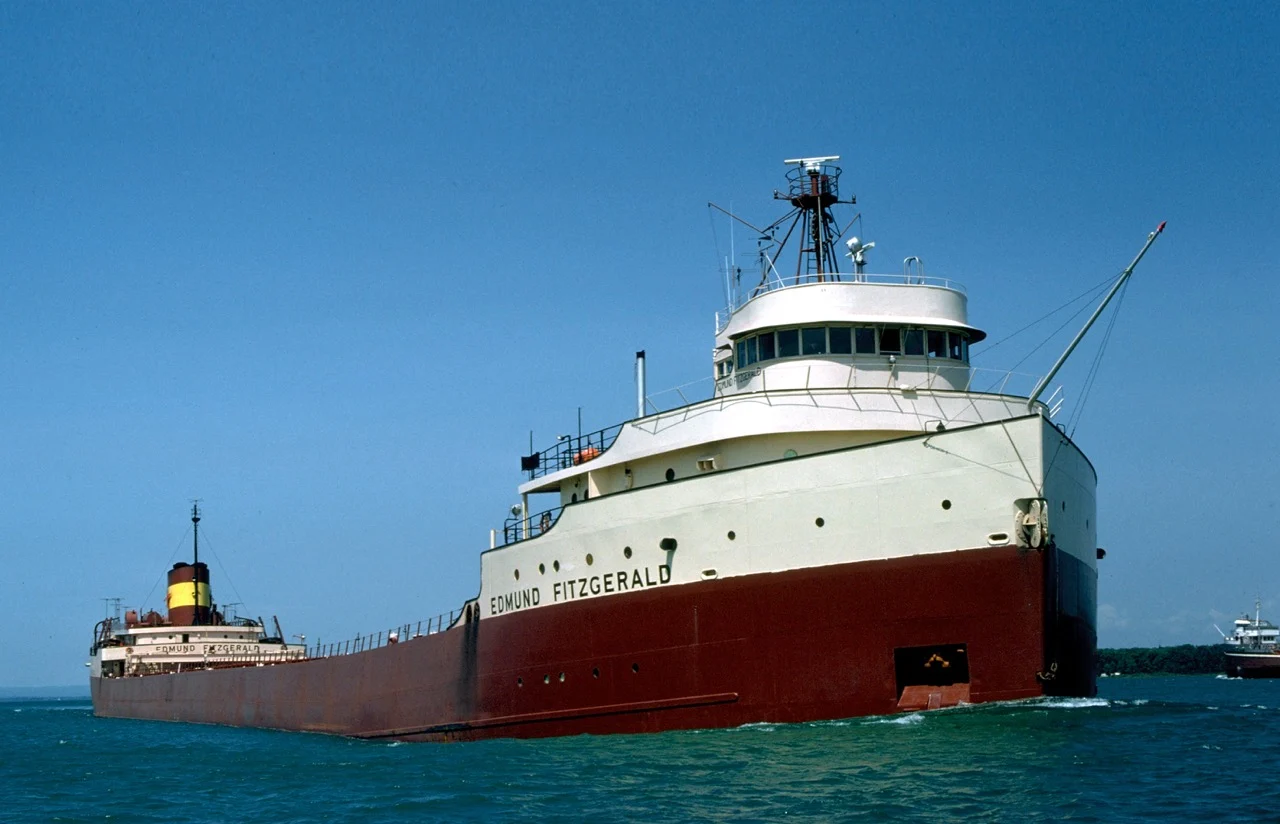
The SS Edmund Fitzgerald in August 1975, just months before her sinking. (Photo: Roger LeLievre)
Expand Image
Advertisement
Advertisement
Advertisement

Sunday, November 9. 5:00 p.m.

A few minutes before the sun set at 5:15 p.m., the Arthur M. Anderson pushed off from Two Harbors. The slightly faster Fitzgerald soon caught up to the Anderson off the southeast shore of Isle Royale, the forty-five-mile-long U.S. national park.

Due to their ships’ comparable capabilities, and their own competitive instincts, both captains knew their ships would be getting to the Soo Locks at about the same time. But at the start of the trip the two ships were more allies than adversaries, pairing up to navigate Lake Superior together.

That afternoon the National Weather Service had posted a “gale warning,” a level of caution the NWS had created after the 1913 Storm of the Century showed it needed intermediary warnings, not just hurricane alerts. A gale warning predicts winds blowing thirty-nine to fifty-four miles per hour. But the NWS projected the wind would barely reach the gale range, which meant about forty miles per hour.

[Fitzgerald’s captain Ernest McSorley] and Cooper knew better than to take any November storm lightly, but with the waves running only three to six feet, it was nothing to make either captain change his plans to take the most direct route across Lake Superior: a straight shot from the Head of the Lakes to the tip of Michigan’s Keweenaw Peninsula, then southeast to Whitefish Bay. That was what both men knew best, having followed that path almost every time they traversed Lake Superior.

Later, Patrick Devine, the Fitzgerald deckhand whom Bruce Hudson had replaced that September, would look over the weather forecasts for Lake Superior that night and wonder why McSorley and the other captains had sailed at all.

“My theory is they knew a storm was coming,” Devine reflects, “but they were rolling the dice, figuring they could outrun it.”

They had before. By dinnertime McSorley’s innate aggressiveness returned, pushing the Fitzgerald a little ahead of the Anderson. But Dudley J. Paquette, captain of the Wilfred Sykes, sensed trouble.

After Paquette pulled the Sykes out of Burlington Dock No. 1 two hours behind the Fitzgerald, Paquette began to suspect even the NWS gale warning underestimated the coming storm, and he also believed that it would cross Lake Superior, not slide below it. Paquette, considered one of the era’s best forecasters in the captain class, knew taking the usual southern route would expose ships to the big lake’s brutal 350-mile fetch, where high winds can churn across the lake’s entire length to multiply the size of the waves on the eastern side.

Instead of the straighter, faster line, therefore, Paquette opted for the longer, better-sheltered course called the northern route. This would send the Sykes closer to Isle Royale and Superior’s western shore to provide greater protection from the winds sweeping across the plains, then almost straight east across the northern half of Lake Superior all the way to the lake’s eastern coast, then south to Whitefish Bay.

When Captain Paquette told the crew members in the pilothouse his decision, they warned him that if the storm didn’t arrive as he was predicting, he would catch hell from the company office in Chicago for taking the long way to the Soo Locks — about fourteen hours longer, in fact. Paquette knew they were right, but he was so convinced a bigger storm was coming that he was willing to risk being chewed out by corporate headquarters.

The Sykes would be taking the northern route.

Paquette’s ship was sailing close enough to the Fitzgerald and Anderson that he could overhear several conversations between McSorley and Cooper on the marine band radio. He was not surprised to hear McSorley, already ahead of the Anderson, tell Cooper that he would be taking the faster, straighter southern route, and Cooper agreed to do the same.

“My theory is they knew a storm was coming, but they were rolling the dice, figuring they could outrun it.”

Sunday, November 9. 7:00 p.m.

By 7 p.m. the National Weather Service noticed the storm system that started out of California had reached Iowa, and was gaining speed. It issued a gale warning for all of Lake Superior, correcting its earlier prediction that the storm would slip just below the big lake. Now, the NWS meteorologists said, the storm would cut diagonally across Lake Superior, producing waves from five to ten feet. That might not sound like much, but because the Fitzgerald had only 11.5 feet of freeboard, ten-foot waves wouldn’t give the ship much margin for error.

If McSorley’s first idea was to outrun the storm, five hours of sailing on increasingly choppy seas, a few conversations with Captain Cooper, and a revised NWS forecast all made McSorley think better of it. After talking again, both McSorley and Cooper decided to take the northern route after all.

Advertisement
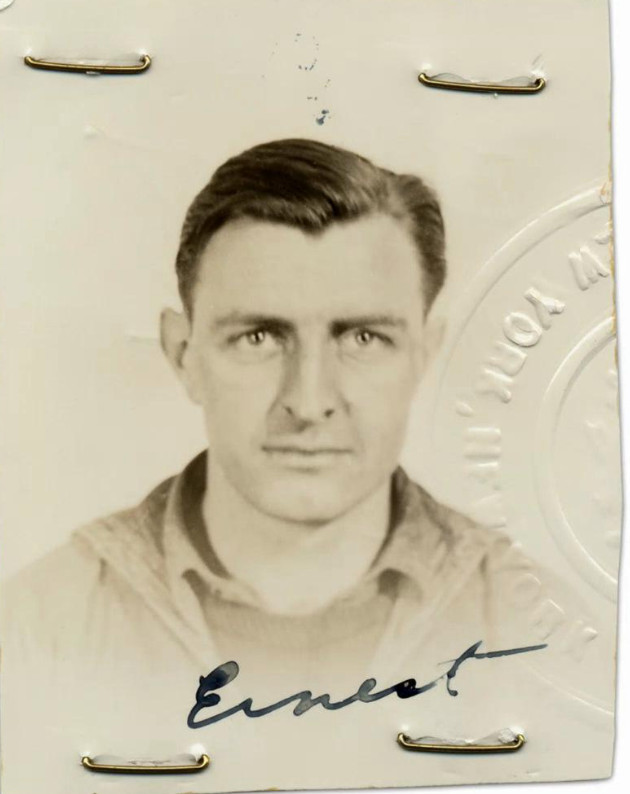
Ernest McSorley, Fitzgerald’s captain, in 1932. McSorley had planned to retire at the end of the 1975 shipping season. (Photo courtesy Great Lakes Shipwreck Historical Society)
Expand Image
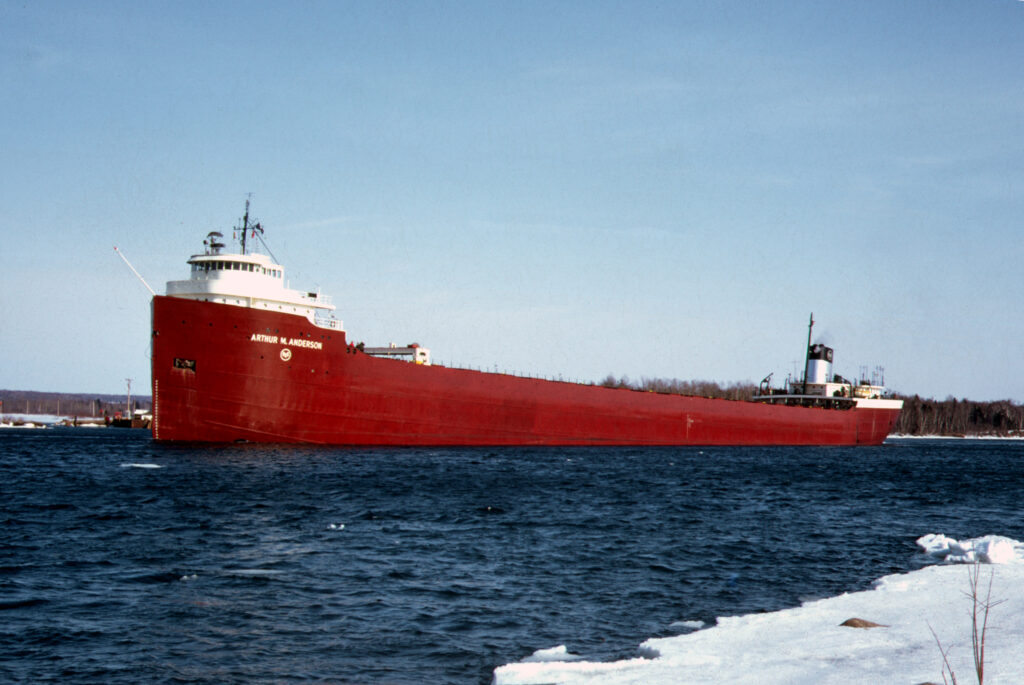
Another freighter, the Arthur M. Anderson, was sailing with Fitzgerald that fateful night and was the last vessel to make contact with the doomed ship. (Photo: Roger LeLievre, courtesy Great Lakes Shipwreck Historical Society)
Expand Image

Besides, this was McSorley’s last run. While he still had his competitive pride he also knew that, unlike Captain Paquette, he was unlikely to incur the wrath of the corporate bean counters no matter when the Fitzgerald delivered her taconite to Zug Island. And even if he did, what could it matter? He’d be home, for good.

Taking the northern route was a prudent choice, befitting a seasoned captain facing harsh conditions. But the decision to take the safer path was not without consequence. Sailing the northern route would commit the captains to running along three sides of Lake Superior: the western shore, the northern shore, and then a hard turn south down the eastern shore to Whitefish Bay. That last leg would leave their ships completely unprotected from the full force of the lake’s fury, with the biggest waves on the lake hitting their ships for hours — and broadside at that, which would make their vessels roll side to side in the troughs the entire way south — which would be unpleasant at best, and dangerous at worst.

By Sunday evening both captains knew they faced a “pay me now or pay me later” dilemma: contend with the winds and waves coming up behind their ships right away, or take shelter along the Canadian shores in relative comfort before bracing for the worst on the final southern stretch. By going north, they were taking out a loan their ships would have to pay later.

Expand Image

The decision also came embedded with a hidden risk: While both captains took the southern route almost 50 times a season, or 100 trips if counting both directions, they followed the northern route only a few times each year, if that. Neither Craig Ellquist, who had worked as a deckhand on the Fitzgerald during the worst months of 1974–75, nor Patrick Devine, who served on the Fitzgerald in the summer of 1975, can recall McSorley taking the northern route on a single trip during their time onboard.

“Never,” Devine says. “It had to be a real humdinger of a storm to go that way.”

“It took a lot longer,” Ellquist adds, “and we weren’t out for joyrides.” In fact, November 9 was probably the first time all season that McSorley had opted for the alternate path, which captains pursued only under extreme conditions. Once McSorley directed his ship to sail north, the comforting familiarity he felt pulling out of the Head of the Lakes, past markers he’d seen thousands of times, would leave him, and be replaced with winds, islands, and shoals he saw only once or twice each season, at most.

Because the northern path would also take about 14 hours longer than the Fitzgerald’s usual route, it could give other threats time to grow. Both captains nonetheless opted for the northern route, knowing it was one of the few cards they had to play.

By taking the longer but ostensibly safer route, McSorley had made a rare decision to play it safe — or at least safer than his usual course of action. If McSorley was simply trying to beat the Anderson to the Soo Locks, he would have taken the lower route and saved fourteen hours, waves be damned. Perhaps a few years earlier he would have done just that, maybe even a few weeks earlier. But not on this day, and not on his last trip.

The first crucial decision had been made, and both captains knew there would be no turning back.

For the crews on both ships, the route less taken sent a clear signal. “There’s always talk in the galley about whatever’s going on,” says Anderson engineer Barthuli, who maintained his ship’s bilge pump, bow thruster, and other equipment. As soon as he clocked out he would go straight to the galley to catch the first half of the dinner hour, which ran from 4:30 to 5:30 each evening.

“It’d been a nice day, but once we saw we were heading north, instead of straight for the Keweenaw, we knew it was going to be shitty. When the wind’s blowing out of the west, you stay along the north shore because that’s going to be calm no matter what. That’s the whole point of going that way, to avoid the worst of it. So just the fact that we’re running on the north shore tells us it’s gonna blow. Cooper never would have gone that way otherwise.”

The new route meant the trip to the Soo Locks would stretch from a typical thirty-hour journey into a gruelling forty-four hours through heavy seas. The crews ate quietly, steeling themselves for what might lie ahead.

They already knew this much: It wasn’t going to be another ordinary crossing.

Excerpted from The Gales of November: The Untold Story of the Edmund Fitzgerald. Copyright © 2025 by John U. Bacon LLC. Used with permission of the publisher, Liveright Publishing Corporation, a division of W. W. Norton & Company, Inc. All rights reserved.

Advertisement

Help us tell Canada’s story

You can support Canadian Geographic in 3 ways:

Related Content

Exploration

Gales of November: John U. Bacon on the untold story of the SS Edmund Fitzgerald

Episode 112

Fifty years after the sinking of the SS Edmund Fitzgerald, bestselling author John U. Bacon revisits the tragedy that changed Great Lakes history

  • 60 minutes

Exploration

Exploring “Superior Maximus,” the deepest point in the Great Lakes

Follow along live as a team of filmmakers reveals the depths of Lake Superior in unprecedented detail

  • 2208 words
  • 9 minutes
Whitecaps come rolling in on a blustery yet beautiful day near Wawa, Ont.

Travel

Photographing Lake Superior

A fall photo tour captures the spirit of Canada's largest Great Lake

  • 2196 words
  • 9 minutes

Environment

Great expectations for the Great Lakes

More than five decades on, the landmark Great Lakes Water Quality Agreement still governs important cooperative work between Canada and the United States to restore the Great Lakes to sustainability

  • 1532 words
  • 7 minutes
Advertisement
Advertisement