
People & Culture
Biinaagami: A call to revitalize our waters
Announcing a new initiative to connect to and protect the Great Lakes-St. Lawrence watershed
- 774 words
- 4 minutes
Exploration
Follow along live as a team of filmmakers reveals the depths of Lake Superior in unprecedented detail
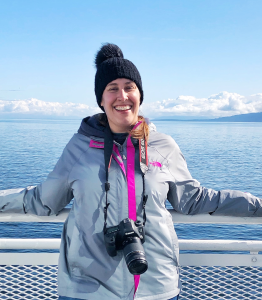
“Superior Maximus, here we come!”
Seated at the wheel of the Tale Spinner, Jocelyn Bentley pushes the throttle forward as far as it can go, and the small aluminum landing craft surges across the glassy surface of Lake Superior. A monitor displaying a bathymetric chart shows the boat cutting straight down the centre of a submarine canyon marked in darkest purple. As it travels, astonishing depth readings flash up on another monitor: 387 metres. 390. 401.
Bentley is part of a team of documentary filmmakers led by underwater explorers Yvonne Drebert and Zach Melnick who are revealing the unseen depths of the Great Lakes in hopes of raising awareness of the richness and importance of freshwater ecosystems. I’ve joined them in Munising, Michigan for a pivotal moment: tomorrow, the team is planning to drop a cutting-edge ROV into this canyon and stream images of it to the public in realtime. The dive will mark the first time in 40 years that “Superior Maximus” — the deepest point not only in the world’s largest lake by surface area but in all of the Great Lakes, by a long shot — is seen with human eyes.
Bentley and Melnick are sounding the canyon with multi-beam sonar, searching for deep spots and geological features that offer the best chance of delivering on the team’s ultimate goal: to film giant siscowet lake trout and — maybe, hopefully — a kiyi, a deepwater fish found only in Lake Superior and never seen alive in its natural habitat. But their excitement is cut short; weather radar shows heavy thunderstorms moving in on land and out of an abundance of caution, the call is made to return to shore. The decision of where to drop the ROV — fittingly named Kiyi — will have to be made on the fly tomorrow.
Fortunately, a test of the livestream itself earlier in the day went off without a hitch, though Melnick’s script reminds viewers that “this is a real expedition; things may not go perfectly.” Melnick has been obsessively checking the wind and wave height forecasts on Windy.app. Winds stronger than 15 knots would be a no-go; currently the forecast is for winds up to 12 knots by stream time.
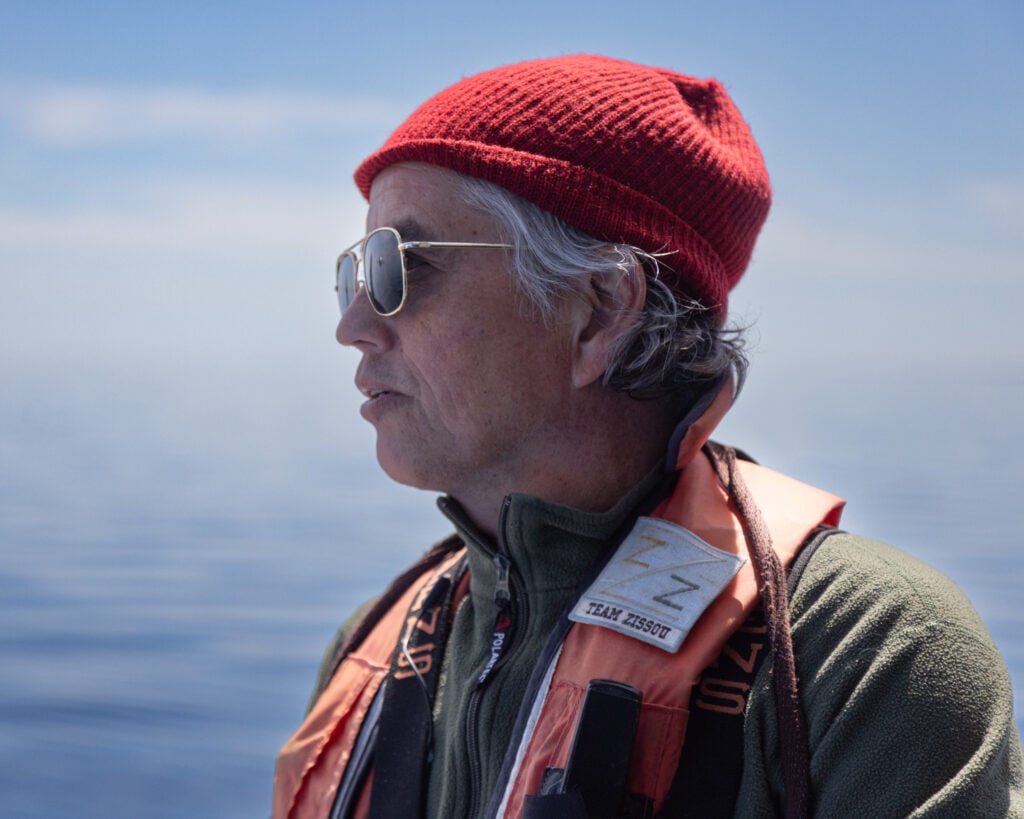
Forecasts this morning are showing stronger winds than hoped for by the time of the stream, but the only way to know for sure if it will be safe to deploy the ROV is for Melnick and Drebert to go out with a smaller crew on the Tale Spinner and assess for themselves. In Munising, it’s foggy and significantly cooler in the wake of yesterday’s thunderstorms, but as I learned yesterday, conditions 55 kilometres offshore bear little resemblance to the weather on land.
The plan right now is for the rest of the team to join Melnick and Drebert at the dive site on the Lake Char, a larger boat operated by the Michigan Department of Natural Resources. Shawn Sitar, a fisheries biologist with the department, is keenly interested in seeing Superior Maximus through Kiyi’s lens. He’s looking for any clues as to why “zombie trout” — emaciated siscowet trout — have been turning up in his nets with increasing frequency over the past few years.
Siscowet trout are a type of lake trout that live in the deepest parts of Superior. They are adapted to have very high body fat content, so to find some weighing only about a third of what a healthy siscowet should weigh is cause for some concern.
“At first glance, it appears to be a famine event,” Sitar told me yesterday. “But we want to make sure there’s not some other issue going on.”
Sitar and his colleagues are also working to rule out disease and contaminants as causes for the siscowets’ poor body condition. Being able to observe the fish in their habitat will hopefully point their inquiry in the right direction.
Sitar said unfortunately, plastic pollution is an all-too-common sight even on remote islands in Superior. Commonly found items include hard hats, likely lost from the ore boats that ply the lake, and Mylar balloons. “You walk along the shoreline, and you can see the chronology of things that get into the lake.”
The Lake Char was still churning its way through dense fog, captain Chris Little making liberal use of the horn, when Melnick made the call to cancel today’s stream. Although the Tale Spinner initially encountered calm waters above Superior Maximus, the wind quickly began gusting to 20 knots, which would have made it too risky to deploy the ROV (and too uncomfortable for the team). They’re now aiming to begin the stream at 11 a.m. tomorrow, June 7.
The team is disappointed, of course, but as Drebert put it, waiting for calmer waters means there’s a better chance of actually enjoying the experience.
I spent the hourlong cruise on the Lake Char speaking more with Sitar about what he hopes to see at Superior Maximus.
“It’s an exciting event to see a place that I’ve been researching that I could never see, and [have] just basically been trying to infer, deduce what’s going on down there,” he said. He figures the chances of seeing fish are low, since the lake bottom is not very productive. “But just to see the bottom — the deepest extent of the Great Lakes — is pretty exciting to me.”
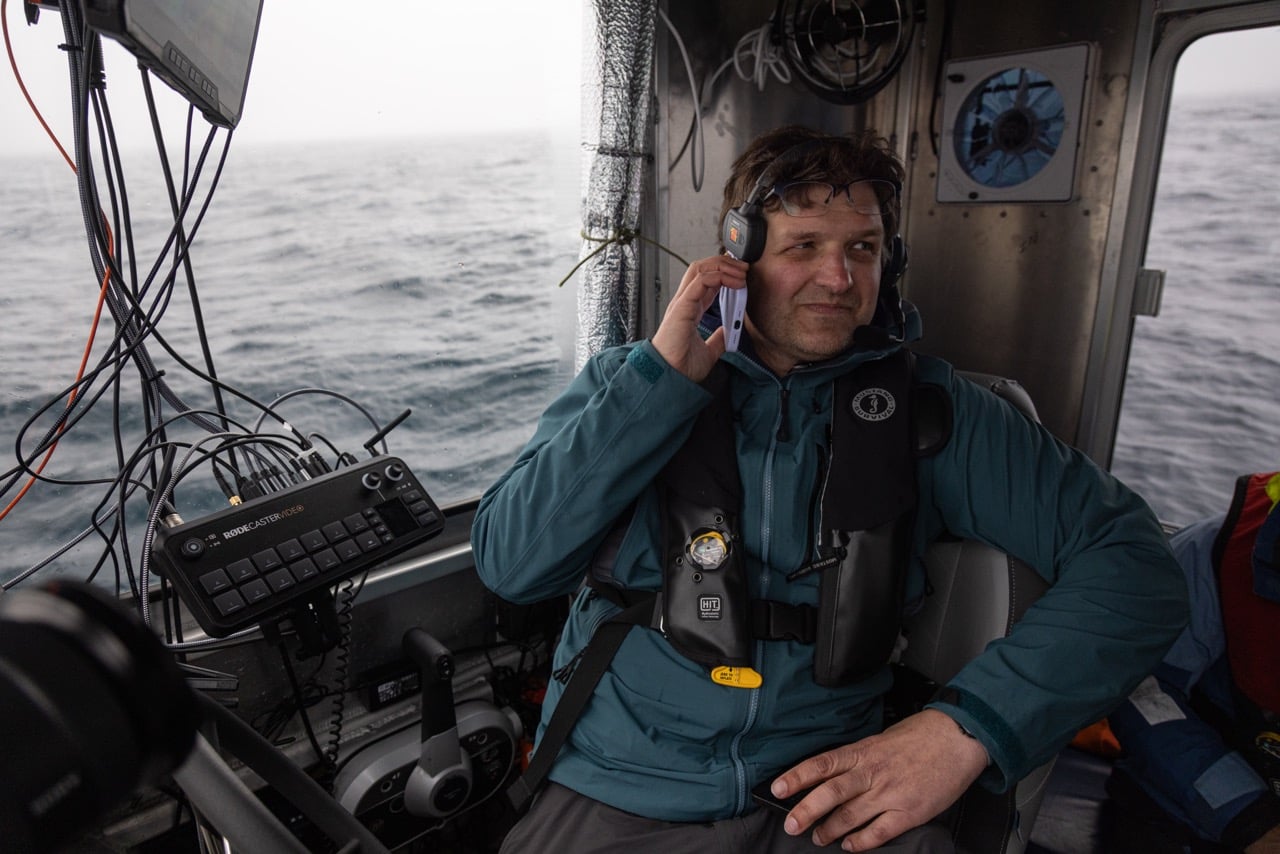
So far, thick fog appears to be the only obstacle the team faces today as they make a second attempt to dive their ROV to Superior Maximus. Yesterday, to pass the time on the cruise out to the dive site, those of us on the Lake Char took bets on whether the stream would go ahead (yes) and whether we would see a kiyi (probably not). Over breakfast this morning, we discussed whether we would find a time capsule.
That’s because Kiyi’s visit to Superior Maximus will actually be the third time Superior’s deepest extent has been glimpsed with human eyes.
The first time was in July 1985, when American limnologist Val Klump descended to 400 metres in the Johnson Sea Link II submersible. The Sea Link submersibles were state of the art technology at the time, designed in the early 70s by Edwin Albert Link — also the inventor of the flight simulator — to facilitate deep exploration in cold water. In the 1980s, the National Undersea Research Program made Sea Link II and its platform, the RV Seward Johnson, available for Great Lakes research. Klump was studying the role of sediments in lake biochemistry; he would go on to become the first person to reach the deepest point in Lake Michigan as part of the same expedition. Brief footage from the Superior dive shows a sandy expanse dotted with small boulders and tiny mysis — shrimp-like crustaceans that feed on phytoplankton and zooplankton and migrate daily up and down the water column — darting out of Sea Link II’s path.
Sea Link returned to Superior Maximus a year later, this time to place a time capsule to commemorate Michigan’s 150th anniversary. The capsule, a slender cylinder, is signed by members of the Michigan Polar-Equator Club, which in the 1970s placed trail markers across the state along the 45th parallel to mark the halfway point between the North Pole and the equator. It also contains a letter from James Blanchard, then Governor of Michigan, expressing his hope that in 2037 — the year the capsule is slated to be retrieved — Michiganders are still taking good care of the state’s lands and waters.
“We hope we have turned over to you the stewardship of our environmental resources in better condition than we received them,” the letter reads. “And we charge you with the task of keeping our natural resources in our state something of which we can always be proud.”
So, how likely is it that Kiyi will encounter the time capsule today? Not very, says Melnick. Superior Maximus isn’t just one point, it’s actually an area about 30 kilometres long, and we don’t have exact coordinates for the capsule. But the team on board the Tale Spinner will finish the multi-beam sonar scan they had to cut short on Friday due to thunderstorms to find an interesting-looking target for Kiyi.
We’ve arrived at the dive site. The team is now making final preparations for the stream.
“Artemis got nothing on us with all these cams right now,” Melnick jokes.
“And there’s no sculpins in space,” adds assistant camera and livestream co-host Andrew Budziak.
Underscoring what Sitar told me on Friday about plastic pollution in the lake, the Lake Char paused briefly about halfway to the dive site to retrieve a pink and purple beach ball.
“It’s usually Mylar balloons,” mused co-captain Kevin Rathbun, giving the ball a couple of test bounces on the deck.
Visible light disappeared at 100 metres. At 280 metres, Kiyi passed the maximum depth of Lake Michigan, the second deepest of the Great Lakes, and kept descending. At 350 metres, a sandy plain studded with a few rocks appeared. Bottom-dwelling deepwater sculpin, each no longer than a human hand, fled from Kiyi’s lights, leaving trails in the silt. Melnick spoke soothingly to them: “Sorry, dudes. I know this is not ideal.”
As Melnick continued to fly Kiyi above the sandy slope, a small aggregation of rocks appeared. The largest of the rocks bore a fringe of tiny pink hydra, deep-living invertebrates similar to anemones that anchor to rocks and feed on zooplankton drifting through the water column.
“This right here is a great example of the value of this [kind of exploration],” remarked Sitar. “This is the type of rock that is necessary for lake trout to lay eggs in, so it’s verifying there is habitat down here.”
Down, down. Forty-five minutes into the dive, at a depth of 390 metres, Kiyi’s lights picked up a metallic gleam: a Busch beer can, half-buried in the silt and nestled against the side of a boulder fringed with tiny pink hydra. Garbage is thankfully not a common sight in Superior’s depths, Melnick said, but the sighting was a sobering reminder that there are not many places on Earth humans have not left their mark.
After an hour and fifteen minutes, Kiyi reached the end of its tether, so it was time to end the stream. We saw neither siscowets nor the elusive kiyi, but Sitar was reflective as the team slowly retrieved the ROV from the depths. The size and number of deepwater sculpin sighted in this region of Superior Maximus seem to challenge the theory that the “zombie” trout are emaciated due to a famine event. “The food web is in pretty healthy condition, so it makes me wonder about the siscowets,” he said.
Following the livestream, the team visited two more drop sites. The first was a steep slope on the edge of Superior Maximus littered with massive boulders similar in size and composition to the Pictured Rocks for which Superior’s southeastern shore is famous. There, we spotted burbot, another benthic fish that is an important prey species for siscowets. In other lakes, Melnick has found the burbot to be curious and trusting, often coming right up to Kiyi’s lens to investigate it, but these burbot, accustomed to living in total darkness at 340 metres, shied away from the light, taking refuge beneath the boulders.
At the second, shallower site, we spotted our first trout of the day: a small school of lean trout, the inshore morph of lake trout. Leans were almost wiped out throughout the Great Lakes in the 1950s due to a combination of overfishing and invasive sea lamprey, but have made an impressive recovery, especially in Superior, thanks to interjurisdictional restoration efforts. These looked to be in excellent condition, measuring anywhere from 30 centimetres to over a metre in length, though they, too, regarded Kiyi with more suspicion than interest.
I am leaving Munising today, but the team will spend another two weeks here filming in different parts of Superior Maximus. There’s still a chance — albeit a small one — that they’ll stumble across the time capsule. And there are specific scenes they want to capture to paint the most vivid possible picture of the unique ecosystem at the lake’s deepest extent. They want to film mysis making their nightly migration from the bottom to the surface. They want to show siscowets feeding — especially if there are “zombies” in their midst. And they have data from scientists in both the U.S. and Canada that will hopefully allow them to finally see a kiyi. Every day that the weather allows them to go out, they’ll go out.
Completing this first dive to Superior Maximus “is more the opening of a chapter than the ending for us,” says Melnick. “You don’t find anything in a single dive; it’s about doing it again and again until you discover something cool.”
People & Culture
Announcing a new initiative to connect to and protect the Great Lakes-St. Lawrence watershed
Environment
More than five decades on, the landmark Great Lakes Water Quality Agreement still governs important cooperative work between Canada and the United States to restore the Great Lakes to sustainability
Wildlife
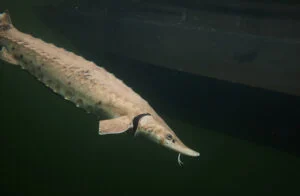
Lake sturgeon populations have plummeted in the Great Lakes watershed. Here’s how First Nations are collaborating with scientists to save an ancient relative.

Travel
A fall photo tour captures the spirit of Canada's largest Great Lake