Wildlife
The big bad wolf?
Exploring our love-hate relationship with the wolf
- 2255 words
- 10 minutes
Wildlife
Photographers recall taking the pictures gracing Canada Post’s latest series, while hoping they help Canadians connect with Canada’s largest wild canines

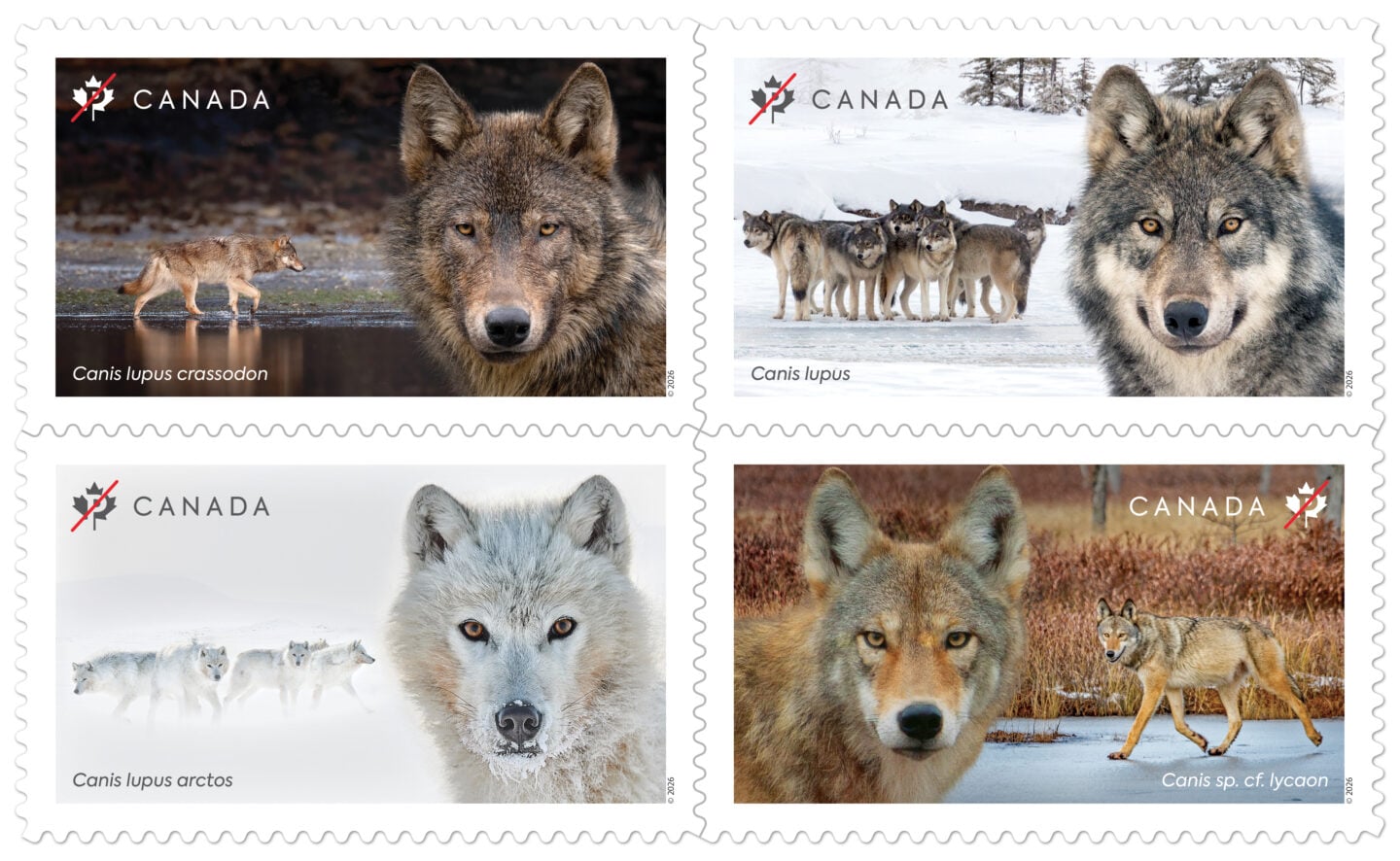
Four photographers’ special moments with wolves are coming to a mailbox near you. Their images have been immortalized in a series of postage stamps by Canada Post showcasing wolf populations from across the country. Getting the photographs for the stamps required long days hiding out, motionless, often in harsh weather.
The series features a grey wolf, coastal grey wolf, arctic grey wolf and eastern wolf. The eastern wolf was recently reclassified as a separate species — Canis lycaon — while the coastal and Arctic wolves are considered a subspecies of the grey wolf, Canis lupus. The photographs are part of Canada Post’s 2026 stamp lineup, which features subjects focusing on Canadian identity. Most of the wolf populations featured in the series are thriving, and that’s something Canadians should be proud of, says Eli Yarhi, manager of stamp development at Canada Post. The images are also available on postcards.
“Hopefully this is a reintroduction for many Canadians to this proud and incredible species,” says Yarhi.
Behind the pictures are memorable experiences for the photographers who captured them.
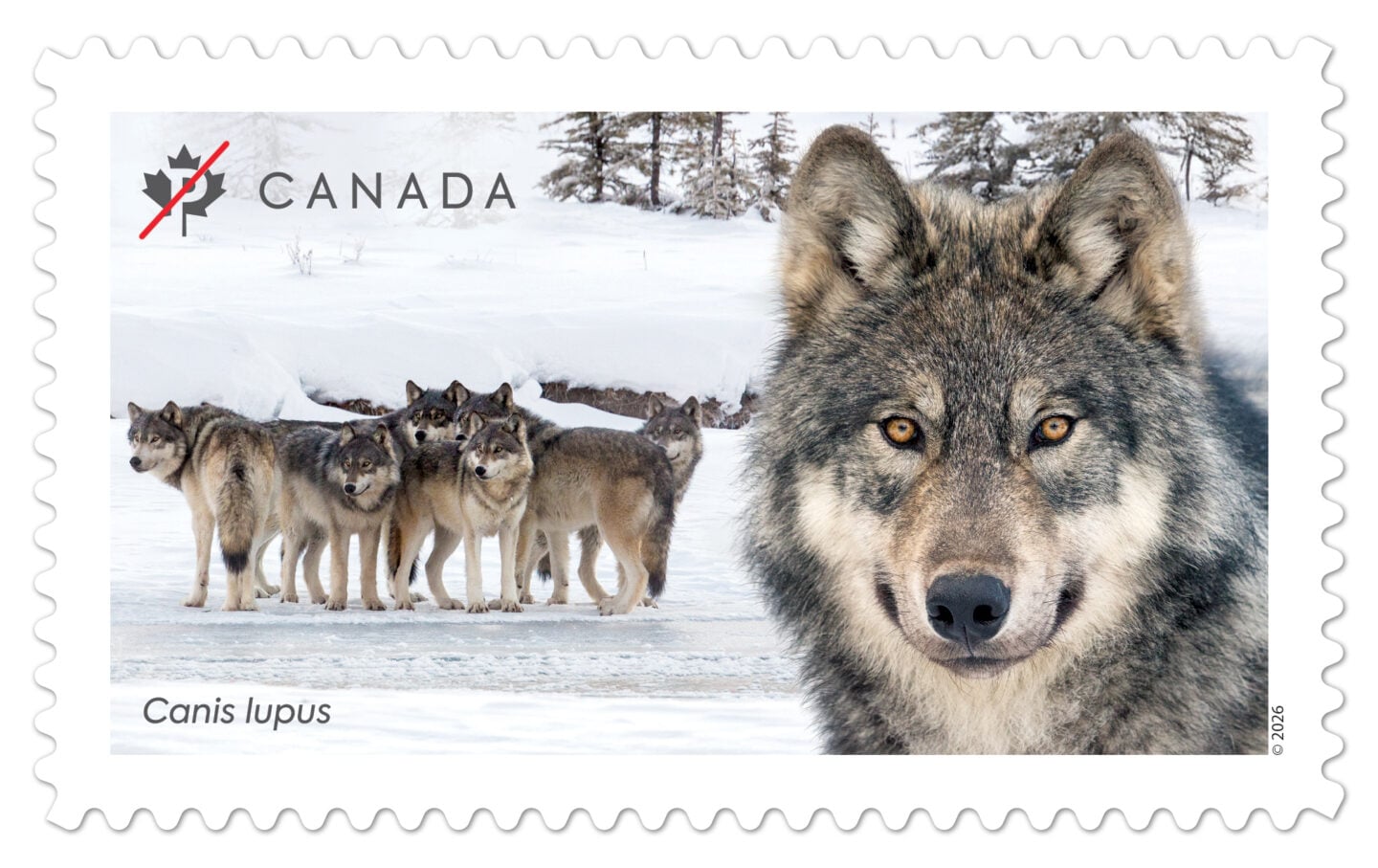
Early in the morning, John E. Marriott went for a hike at Banff National Park hoping to find signs of grey wolves. He walked in the snow for a while until he noticed a few pups walking along some railway tracks. Marriott immediately hid in the willow bushes ahead of them. He tried to blend in with the landscape with his white camo clothing, while making sure his scent didn’t give him away. One pup noticed him, though, or at least the lens hidden in between the branches. The curious eight-month-old pup walked straight toward the bushes and stopped about 25 metres away. Marriott stood very still as his finger held the camera shutter button down. The faint clicking sound interrupted the quiet, a sound that the wolves could have easily mistaken for a woodpecker in the distance. The pup stared in his direction for 30 seconds and then joined the others as they walked out of sight.
Wildlife conservation work sits at the core of Marriott’s passion for photography. Marriott says he wants to draw a connection with his images between viewers and animals to encourage people to support conservation efforts. He co-founded Exposed Wildlife Conservancy, a charity focused on protecting apex predators. Grey wolves are the largest members in the wild of the family Canidae, which includes domestic dogs, and can be found across Canada. Up until around 200 years ago, wolves could be found all across North America, Europe and Asia, but their range has been reduced due to hunting and habitat loss.
“These stamps are celebrating an iconic animal, one that’s persecuted too much right now,” says Marriott.
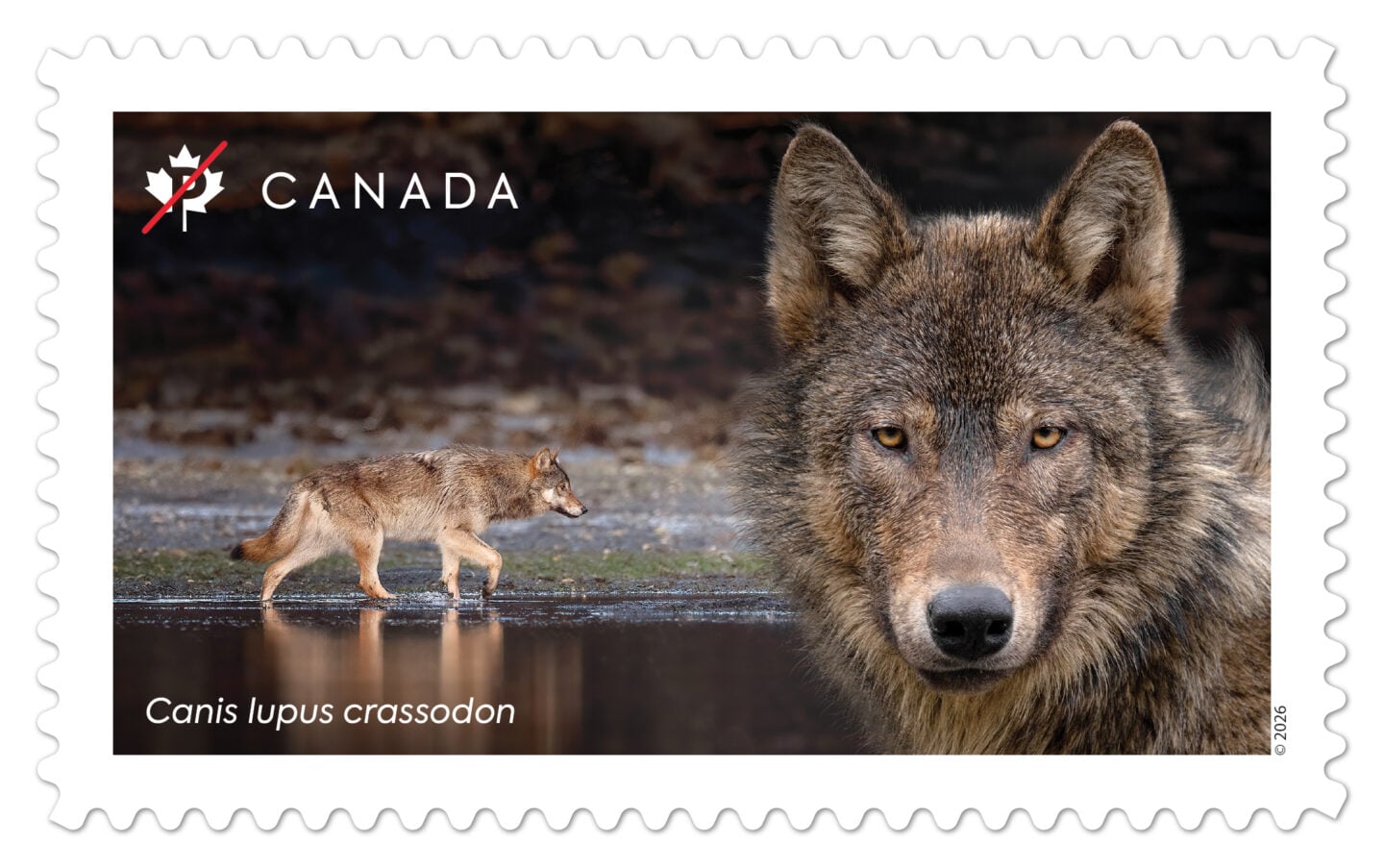
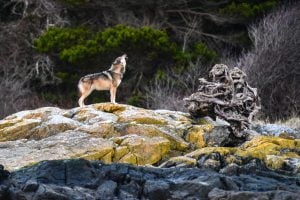
To reach the dead humpback whale on a Vancouver Island beach, Michelle Valberg and her companion, Tom McPherson, had to walk through sticky mud at low tide for 10 kilometres. Why such an arduous feat? Because they knew coastal grey wolves would swing by to eat it. These wolves, found all along coastal British Columbia to southwestern Alaska, are powerful long-distance swimmers. Marine foods constitute up to 85 per cent of their diet, which includes salmon, seals and sea otters.
Valberg and McPherson watched the tide rise and fall for hours, hidden behind a band of rocks that resembled a cave. Valberg focused on taking everything in as the inescapable smell of dead whale filled her nose, knowing she was one of few people who would ever experience this. The hours stretched on as she waited for the wolves to wander close enough to get her shot until finally, one wolf approached the pair out of curiosity. “Wink,” so named because of its droopy eyes, stayed for half an hour. It sat, lay down, ate, hid behind a rock and drew closer. Without disturbing the animal, Valberg finally got her picture.
For Valberg, it’s crucial to ensure that she doesn’t influence the animal’s behaviour in any way, and avoid being detected. She hopes these stamps help raise awareness among the public about why it’s important to protect them.
“The more we can show how beautiful these animals are, the more people will hopefully be connected to these creatures,” says Valberg.
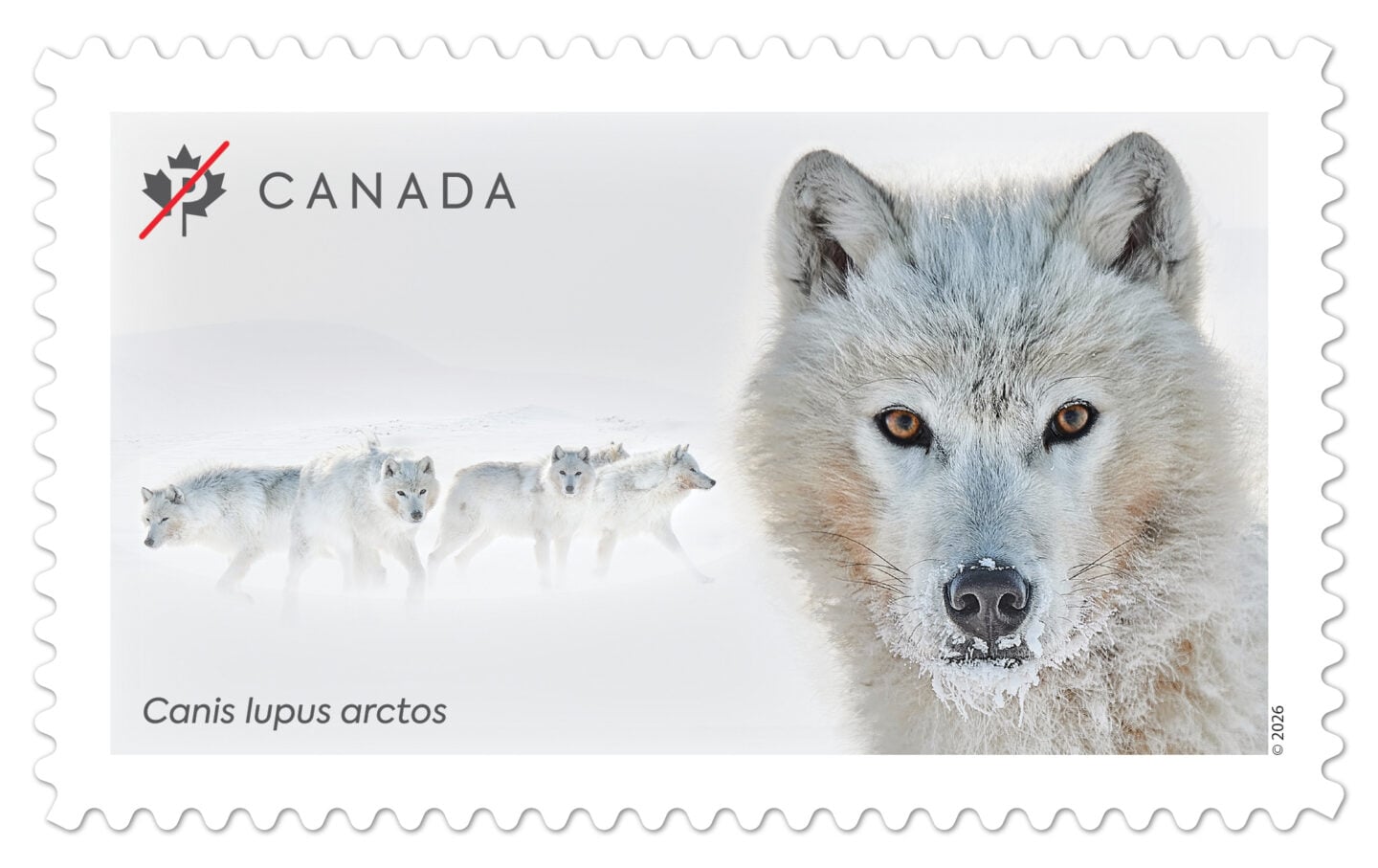
After spending 11 days trying and failing to find traces of Arctic grey wolf, Ejaz Khan couldn’t handle it anymore. He could no longer stand being alone with his brain constantly questioning himself. So, Khan and Raymond, the tracker accompanying him, packed up, feeling disappointed and took off. But suddenly, the snowmobile came to a stop. The normally serious Raymond was smiling as he pointed to the small figures ambling towards them. Arctic grey wolves rarely encounter humans and freely roam their habitat, which ranges across the Canadian High Arctic to the coastal areas of northern and eastern Greenland.
Eight wolves stood less than three meters away from the pair. Not sure what compelled him to do so, but as the wolves began to retreat, Khan followed them, leaving behind his camera. The male alpha’s fur stood up when it noticed Khan following, and then it pushed its front paws into the snow — it would not allow Khan to take a step further. The tense moment intensified with the sound of Raymond cocking his gun, ready to shoot if the animal charged. The alpha male and Khan held eye contact as the former stepped back. After a few moments, the wolf pack finally turned and walked to the top of a hill. Khan took a picture as the alpha male looked straight at him. They once again connected with each other. Before heading away, the wolf turned back one last time and gave Khan a look, one that said, ‘This is not the last time.’ Khan hopes he sees the wolves again, as it’s an experience he’ll never forget.
“What I have captured is less than one per cent of (the wolves’) beauty and the landscape,” he says.
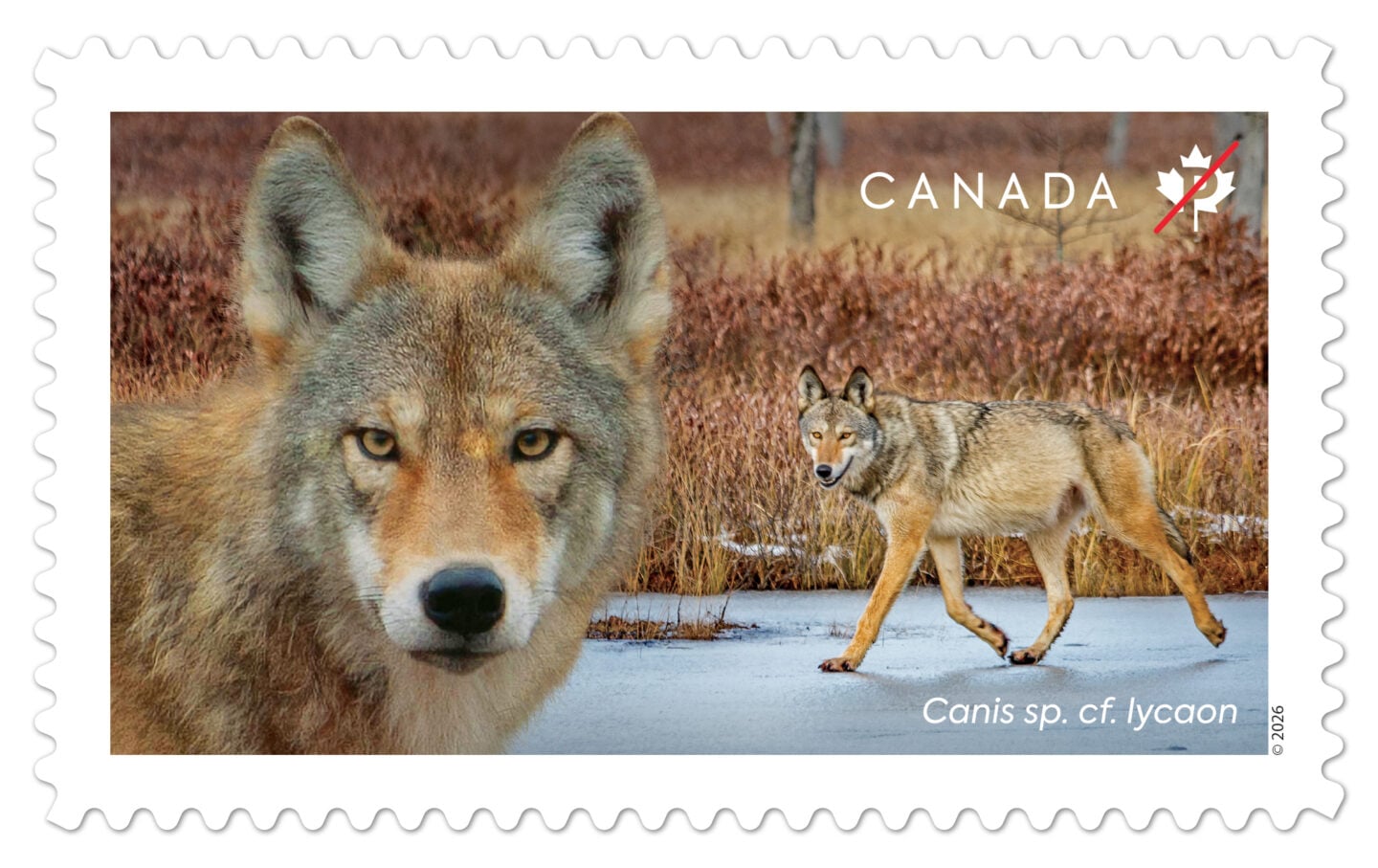
Over the years, Michael Runtz has learned how to easily locate eastern wolves in Algonquin Provincial Park — by howling himself. One day, Runtz howled at daybreak to fool the wolves into thinking he was one of them so they would approach him. To blend in, Runtz wore earth-toned clothing that he hadn’t washed for weeks. This way, the detergent perfume wouldn’t give him away. It seemed to work since he later saw a wolf move through an opening in the woods. He quietly moved ahead to the next opening, hoping the wolf would follow through. The wolf did, and never even noticed him; it just kept walking while Runtz stood motionless behind some vegetation, taking pictures. His heart was pounding, not out of fear, but out of sheer joy at having a close view of the animal.
The eastern wolf roams around the deciduous and mixed forest landscapes of southwestern Quebec and central Ontario. It’s currently classified as “threatened,” meaning it could become an endangered species if threats such as diseases, hunting and collisions with vehicles cause their numbers to decline.
The wolf is an almost mythical animal that historically has been portrayed as highly dangerous, says Runtz, noting the influence of common childhood fairy tales, such as Little Red Riding Hood and Three Little Pigs. But he later learned that they aren’t really a danger to us. Hence his delight that people will see these beautiful animals on the postage stamps where they will be respected and admired.
“[The wolf’s howl] is one of the most recognizable and profoundly moving sounds of the wild,” Runtz muses. “It resounds through Canada from coast to coast and all through the North; it truly is part of the Canadian identity.”
Wildlife
Exploring our love-hate relationship with the wolf
Wildlife
First Nations and scientists work side by side to better understand — and protect — coastal wolves living in the Great Bear Rainforest
Wildlife
At a fly-in wilderness lodge on Hudson Bay, guests immerse themselves in a rarely studied wolf pack
Wildlife
An enchanting and evocative look at the unique relationship between a solitary, island-dwelling wolf and a renowned wildlife photographer