Travel
The spell of the Yukon
An insider’s account of the modern-day gold rush
- 4210 words
- 17 minutes
People & Culture
The fire that destroyed Dawson City’s historic Westminster Hotel erased more than a landmark
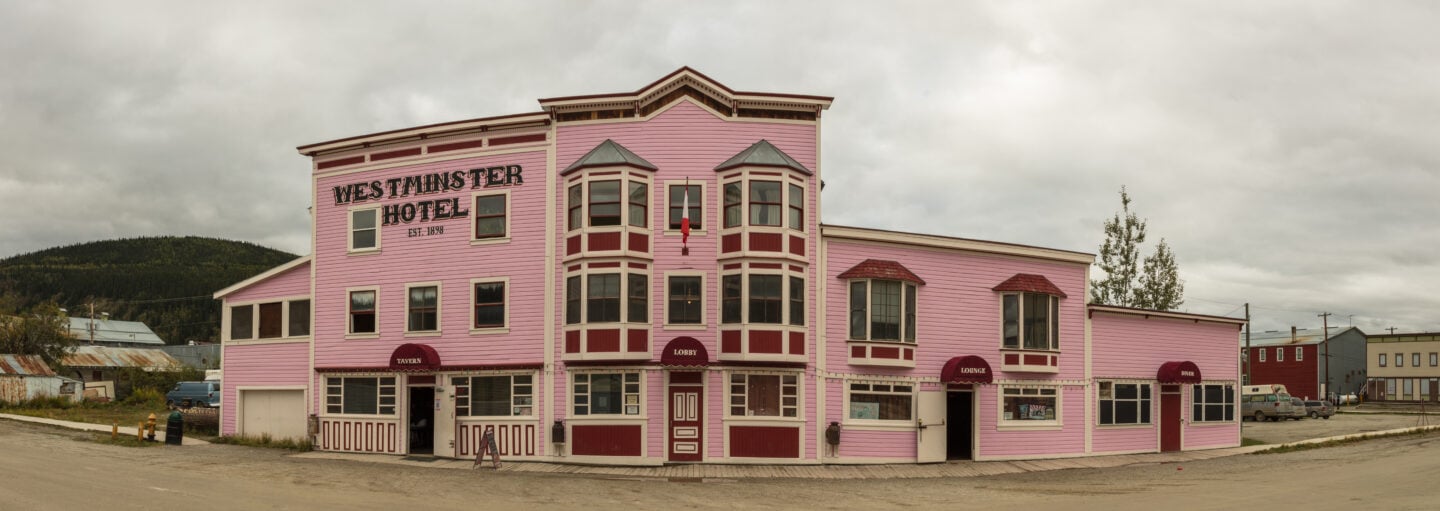
Dawson City, a gold rush town along the Yukon River, has lost a beloved community emblem. On Sunday, May 17, the Westminster Hotel, known lovingly to locals as the Pit, burned in a structural fire that is believed to have been human-caused. The building had been closed since January due to winter flooding; no one was injured in the fire.
For community members, it comes as an untimely end.“It’s a huge loss,” says local Jon Wilkie. “It was a big part of the Yukon.” Since 1898, “it was our culture, our heritage, our history, our home.”
In the wake of this devastation, the community is sending off the Pit with wonderful stories, from late nights spent in the lounge to early morning euchre games, bumping live music, intimate funerals, and local fundraisers — to name a few.
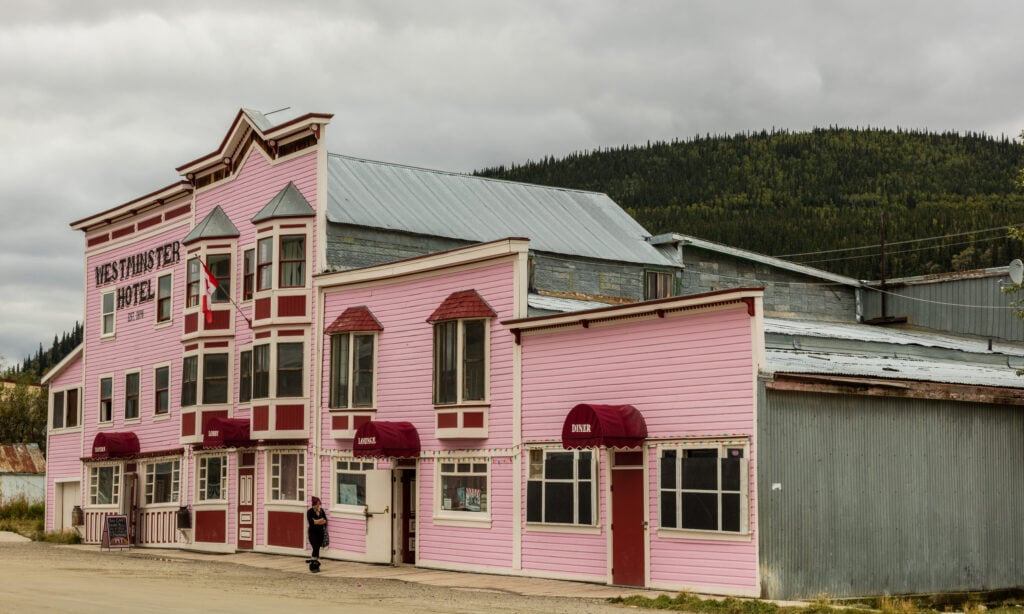
For many residents, the Pit was much more than a place. “It was the nerve centre of our community, and now the heart and soul I know has gone up in flames,” says Wilkie.
The Yukon, the smallest of the Canadian territories, is known for its harsh winters and short, dark days. And in the summer, a stream of constant light. Put on the map by the historic Klondike Gold Rush, the city continues to see miners trying their luck more than a century later.
A second-generation gold seeker, Wilkie travels most winters but has yet to find a bar as “divey” as the Pit.
“The flooring there was all wobbly, so you wouldn’t even have a drink yet, and you’d walk in there and already feel like you’re stumbling around,” says former Dawson City resident Aaron Knight.
“The place didn’t have a single level spot. The stairs were so crooked, you’d walk up and think they were going to collapse,” says Wilkie. “It looked like it was going to fall over any day.”
The Westminster Hotel’s ground floor bar had two sides: the tavern, better known as ‘the snake pit,’ and the lounge, or ‘the armpit.’ Duncan Spriggs, who owned the bar for 20 years beginning in the early 1990s, recalled how it got its infamous nickname.
“It was back in the days of prohibition in the United States,” which was more temperate in Canada. “For a while, you were only allowed to sell beer. Well, people wanted whiskey. So, in the back of the hotel in the ‘30s and ‘40s, there used to be a room where boys played poker and drank whiskey. When they emerged from the room, they were a bit snakey.” And so it became the Snake Pit, and then eventually the Pit.
George McConkey, who will ring in 50 years in Dawson this month, remembers it as a “throwback to the old Yukon,” captured in relics and portraits of patrons who’d passed on.
A birch canoe hung from the ceiling, and a World War I British Army helmet sat on the bar next to a mounted bison head, which patrons often filled with cigarettes. “If you borrowed a smoke, you’d leave another in the mouth for the next person,” says Knight.
The centrepiece was a series of murals from celebrated local artist Halin de Repentigny. Each one painted as “Dawson in his imagination, as it might have been back in 1904,” says Spriggs. Tucked in the back of the bar was “a trick-of-the-eye mural,” which made the room seem as if it continued forever.
Wilkie grew up in the Yukon. “My youth in Dawson City was spent waiting outside the [Pit’s] door to turn old enough to actually have a drink there,” he says. “It was a momentous day when I finally stepped inside… It’s been a part of my life for my whole life.”
The Westminster Hotel sold a lot more than just cold beer and ‘Pit ration’ hotdogs. It was enmeshed in the local economy. “People [went] there to buy and sell gold. There were always miners in the pit with gold,” says Wilkie. It also served as a makeshift employment centre. “Never mind a resume. Go to the Pit, get wasted with a bunch of redneck goldminers, and they’ll hire you.”
When Spriggs took over the Westminster Hotel in 1991, it was only operating seasonally. With a facelift and much-needed repairs to restore its “original 1904 tavern glory,” Spriggs got it “rocking and rolling.” Rumour has it Spriggs bought the bar after being barred from entering. An exaggeration or not, “I was one of my best customers,” says Spriggs.
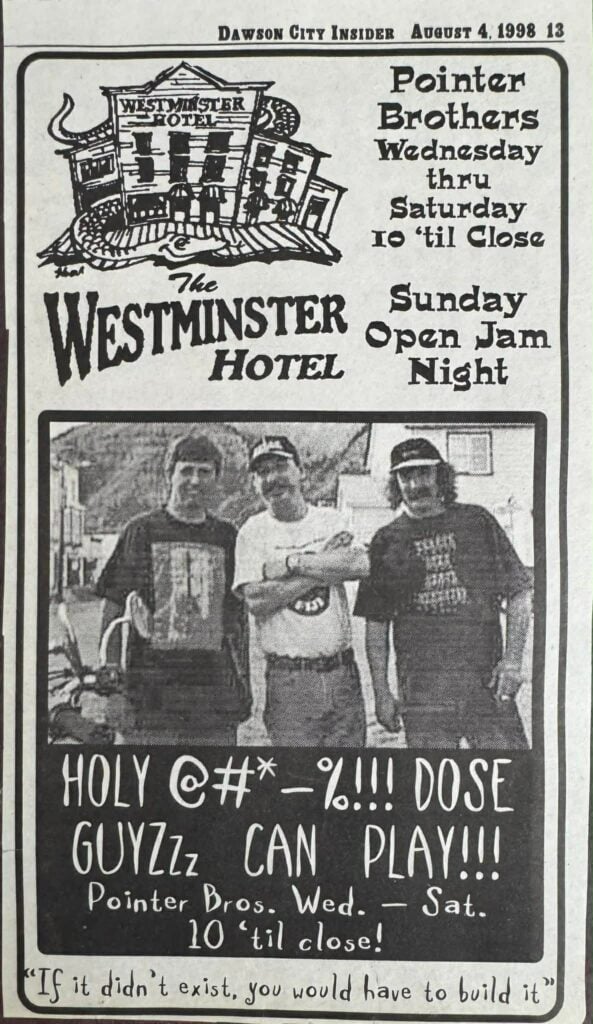
The Pit went from a slow operation to live music five nights a week. George McConkey was one of the bar’s longest-running performers, known by locals as Harmonica George. Moving to Dawson at the age of twenty from Toronto to pursue the Yukon’s “wide-open, uninhibited spaces,” McConkey has been playing solo and duo gigs since the ‘90s, often alongside a local staple, the Pointer Brothers.
Of his decades on stage, one night has stuck with McConkey. It was the night he met his wife, Brenda — she was working the room while he was playing the stage. Thirty-four years later, they are still together.
In the weeks following the fire, residents have been piling around barstools at another beloved local bar, Bombay Peggy’s, to reminisce.
“Some of my best memories were tragedies,” says Spriggs. “A house burning or a woman who got mauled by a bear” that led to Pit fundraisers. “People would show up very, very generous in their bidding — paying twice the price that they would have if they just went to the store.” In 2002, Spriggs won the Commissioner’s Award for services to the community.
Coming together in hardship is what Dawson City does. The liveliness of the Pit and the charm of its sunken shape, which brought together locals and travellers for decades, will be carried on through intimate retellings. “It doesn’t just go away,” says Spriggs, “but gets replaced in some way.”
Travel
An insider’s account of the modern-day gold rush
People & Culture
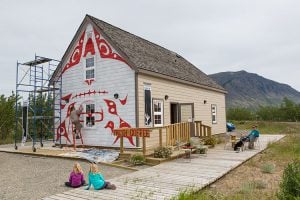
After spending more than a century in the shadow cast by the Klondike’s precious metal heyday, First Nations heritage is stepping into the limelight in the Yukon

People & Culture
Director Bill Morrison discusses Dawson City: Frozen in Time and the bizarre story of the Dawson City film collection

People & Culture
Highlighting the new interpretive trail featuring a series of permanent art exhibits and 15 wayfinding markers showcasing traditional place names and the Dawson Trail’s historical legacy