Places

Inside the Toronto lab where ecologists study Canada’s most venomous spider

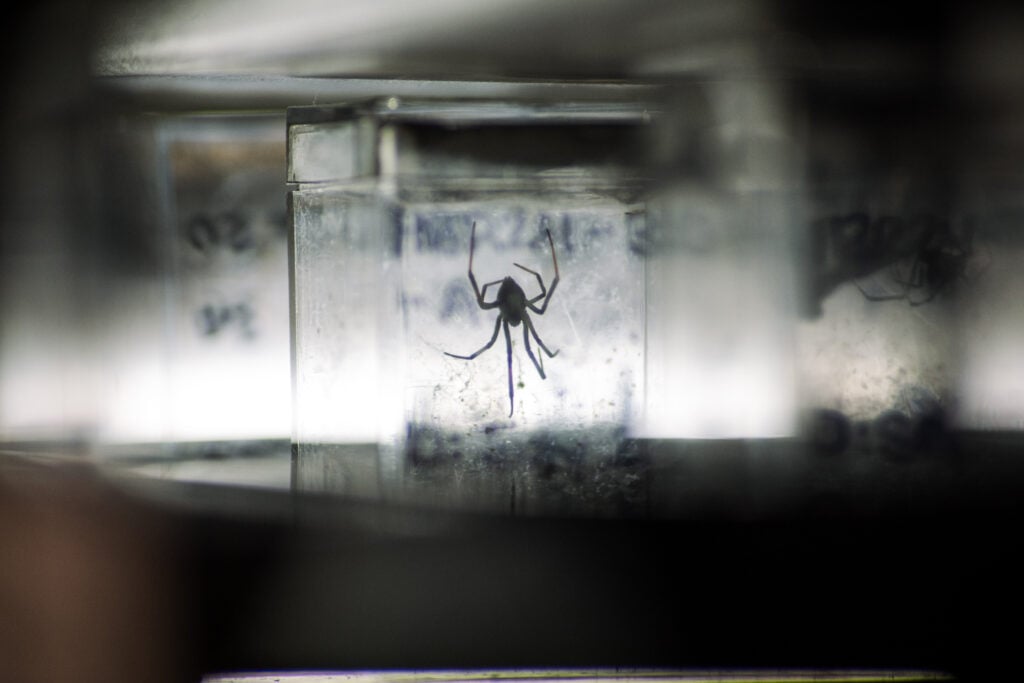
Arachnologist Maydianne Andrade’s lab at the University of Toronto Scarborough is home to as many as 100,000 black widow spiders at any given time

Arachnologist Maydianne Andrade has dedicated her career to studying the black widow spider.
Expand Image
Advertisement
Advertisement
Live Net Zero Email Service
Advertisement

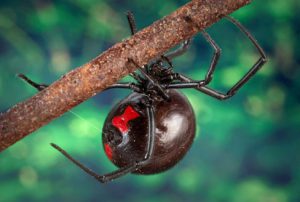
A male black widow spider cautiously approaches a female as she waits at the centre of her tangled web. Her bulbous black body, bearing its distinctive red mark in the shape of an hourglass, is three times larger than his. Shifting side to side, he begins vibrating his abdomen and plucking the strands of her web to convince her he is a potential mate and not a meal. This strange courtship dance can last from 20 minutes to eight hours. If she responds positively, the male will wrap her forelegs in his silk in a form of spider bondage, then mount her body and insert a claw-like appendage called a pedipalp into her genital opening and deposit his sperm. If not: dinner.

The unfolding scene is being closely watched on a monitor by a trio of students at the University of Toronto Scarborough. They are enrolled in a course on evolutionary biology taught by arachnologist Maydianne Andrade, whose five-room, two-storey lab houses the world’s largest captive population of black widow spiders. The lab has as many as five or six species of the world’s 35 black widow species on site at one time, including the two found in Canada, and a total of nearly 100,000 spiders.

Through experiments conducted both in the lab and in the field, students learn how sexual selection, social behaviour and ecological conditions affect the mating strategies and morphology of the spiders. They then discover whether the spiders are still able to reproduce successfully when environmental or population conditions change. The lessons learned, says Andrade, may help us understand the global biodiversity crisis and point to conservation strategies.

“Spiders are the top terrestrial predators of insects, so understanding how they can thrive in the environment helps us learn more about the food web that we all depend on,” she says. “The more we know about how species can or can’t maintain their health and reproduction, even when environments are changing rapidly, will help us apply those general ideas across different species.”

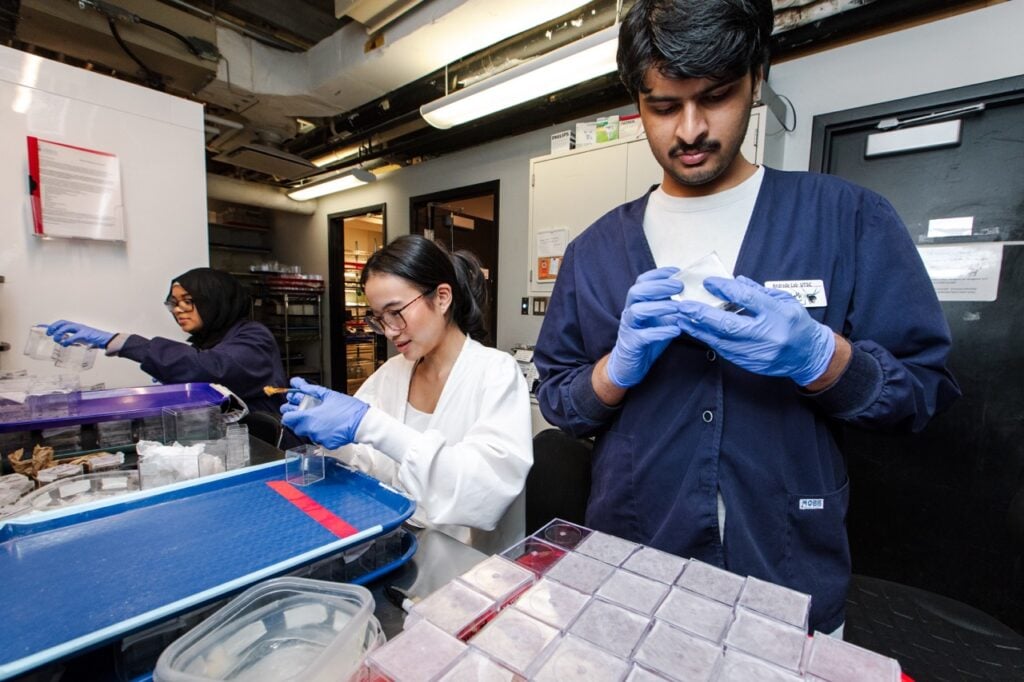
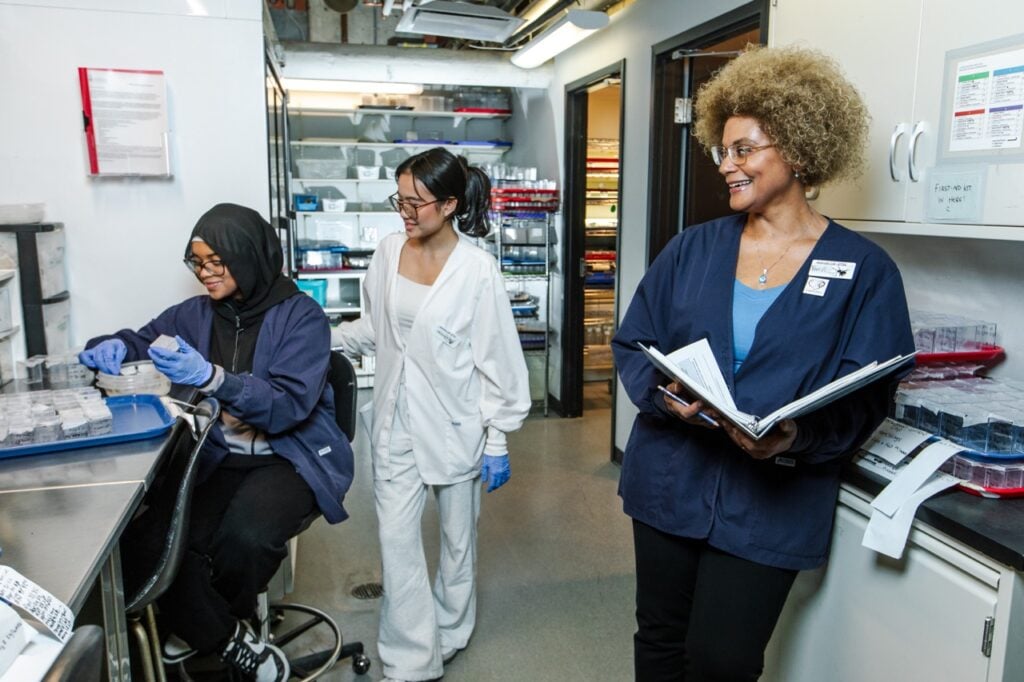
Undergraduate students like Afnan Said, left, and Maren Tan, centre, work alongside Andrade, studying the reproductive behaviours of black widow spiders under changing conditions.
Expand Image
The lab has as many as five or six species of the world’s 35 black widow species on site at one time.
Expand Image
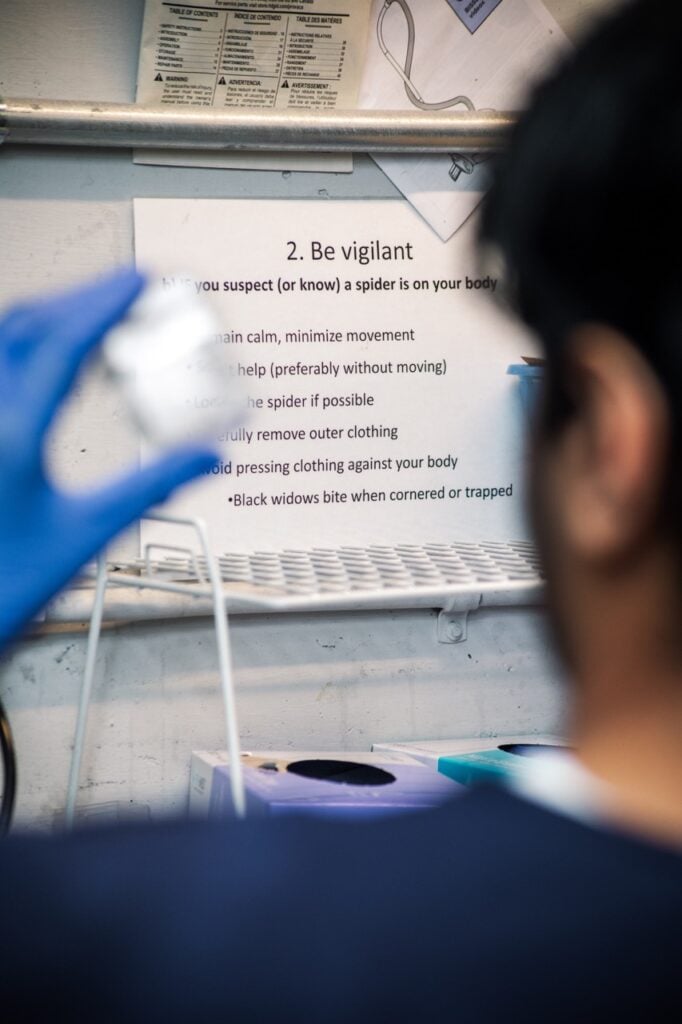
Although the bite of the black widow is rarely fatal for a healthy adult, anyone working in Andrade’s lab must conform to a strict set of safety protocols.
Expand Image

Considering that the black widow produces a neurotoxin 15 times more toxic than that of a rattlesnake, it’s not surprising that the lab created waves when it opened in 2000. “Many people were terrified,” admits Andrade.

However, she says the concerns were unjustified: the bite of these shy and retiring spiders is rarely fatal for a healthy adult (though it can cause a range of nasty symptoms requiring prompt medical attention). Even so, the lab must conform to strict safety protocols that include two sets of locked doors and twice-weekly vacuuming. Entry is restricted to those who are trained in biosecurity protocols, and students must ensure no skin is exposed when handling the spiders.

Experiments take place under the glow of special red lights, as the spiders are most active at night, and mating activity is filmed from above and watched on monitors in another room.

Andrade chose to study black widow spiders because they display extreme behaviours that confound our expectations. She focused her PhD on the most cannibalistic of the black widows, the Australian redback. After penetrating the female during mating, the male will perform a somersault and position his body directly above her fangs. The sex continues as she eats him alive.

Other scientists had proposed that the males sacrificed themselves to literally feed their future offspring, but Andrade proved their behaviour is really an act of self-interest, allowing a male to copulate for longer, thus boosting the chances that his genes are passed on in the competition that takes place inside the female if she mates with other males. The discovery made headlines and catapulted Andrade to academic fame.
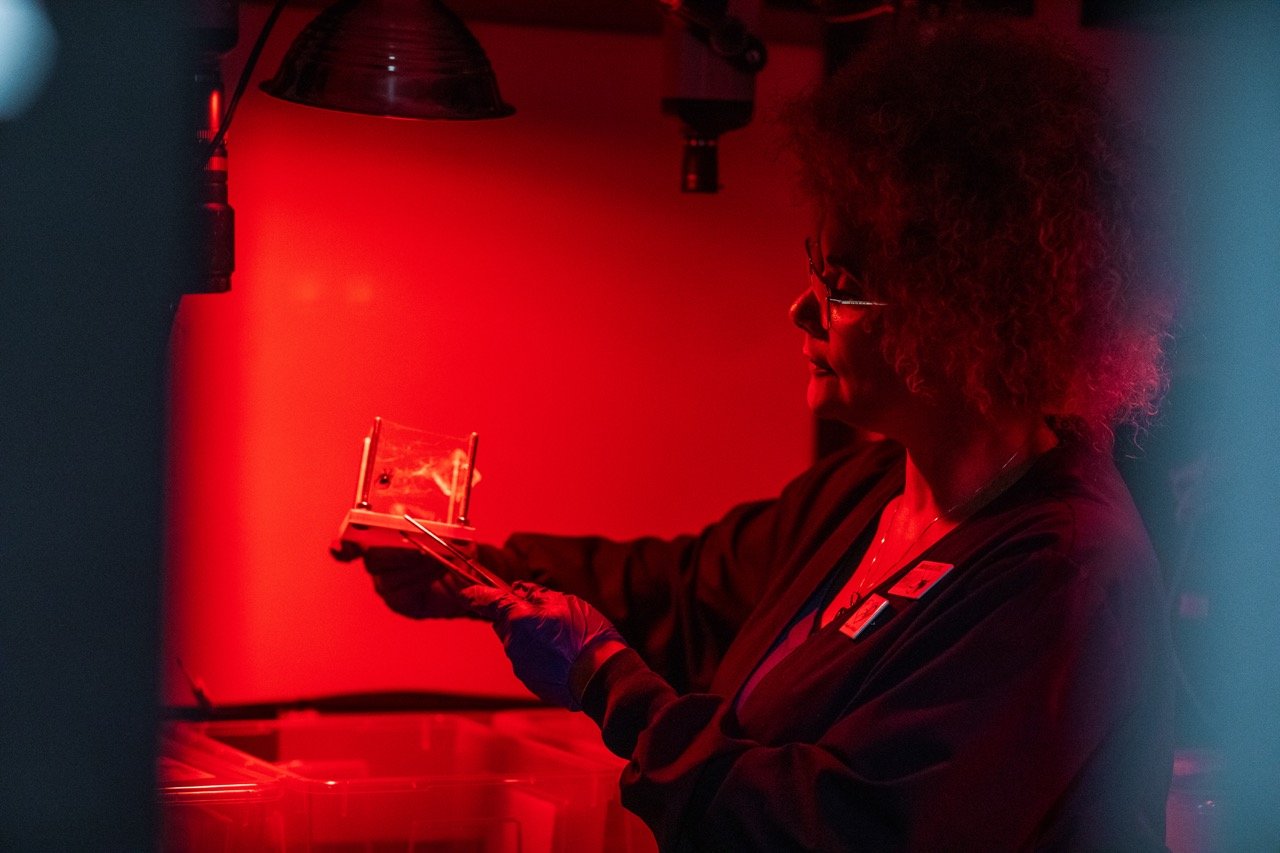
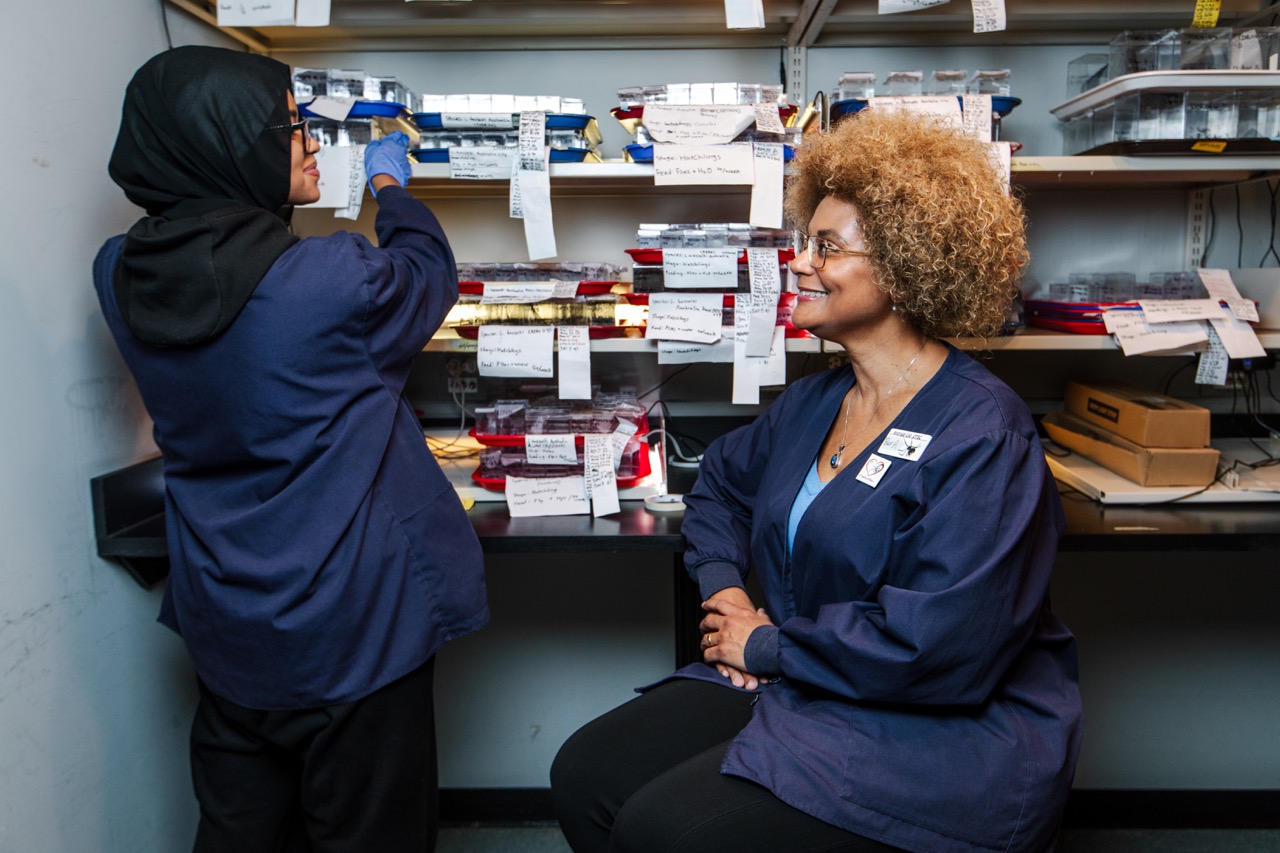
Andrade chose to study black widows because they display extreme behaviours that confound expectations.
Expand Image
From left: Afnan Said, Maren Tan and Aravinth Premnazeer examine captive black widows in the lab.
Expand Image

During her time at U of T, Andrade’s influence has spread far beyond the arachnid realm. Notably, the Jamaican-born scientist has spearheaded several initiatives aimed at tearing down barriers for other Black scientists.

Today, the fear of Andrade’s lab has largely subsided, and many undergrads appear to take a vicarious pride in the fact that venomous spiders are studied on campus. But she still encounters people who question not only why spiders should be studied but even why they should exist. Andrade points to the role they play in controlling the insect population. As well, the black widow’s silk is so strong and flexible that researchers are trying to create a synthetic prototype for potential architectural and biomedical applications.

As for Andrade, even after more than three decades of research on black widows, she still finds them fascinating.

“They keep revealing new things about their behaviour or their ecology that’s puzzling,” she says. “They’re constantly surprising me.”

Advertisement

Help us tell Canada’s story

You can support Canadian Geographic in 3 ways:

Live Net Zero Email Service

This story is from the September/October 2025 Issue

Related Content

Wildlife

Study: Male black widow spiders eat their mates too

Female black widow spiders are known for the rather cruel treatment of their mates; the ‘widow’ in the name gets its origin from the female spider’s unromantic habit of…

  • 191 words
  • 1 minutes
Gotsǝ́ mı̨́ “spider web” in sunlight. Photo: Jean Polfus

Environment

What spiders can teach us about ecology

The spider's web is the perfect metaphor for the interconnections between species, people and place

  • 958 words
  • 4 minutes

Wildlife

Wildlife Wednesday: study finds California sea lions are getting bigger

Plus: juvenile salmon migration timing is changing, candy-striped spiders are catching big prey and $500,000 worth of baby eels seized in Enfield, N.S.

  • 1020 words
  • 5 minutes
A man stands at the edge of a lake during sunset

People & Culture

The biggest year in Canadian birds

A tale of joy and persistence: Logging Bruce Di Labio’s birding “big years” almost 50 years apart

  • 4123 words
  • 17 minutes
Advertisement
Advertisement