
People & Culture
Tintamarre: Inside the raucous Acadian parade in Clare, N.S.
The tintamarre showcases the vitality of the Acadian culture — and some supersized papier-mâché heads
- 1501 words
- 7 minutes
People & Culture
Untangling the roots of a hardy heirloom apple with ties to the Acadian deportations
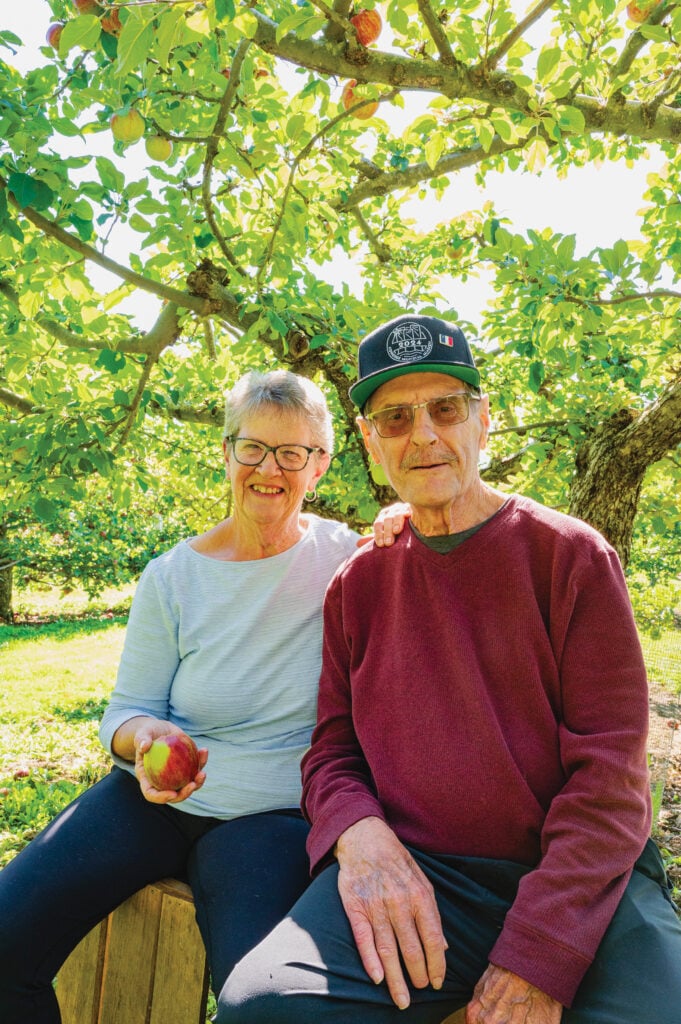
On a Saturday afternoon in April, as trees in southwest Nova Scotia pushed tender buds into a warming world, a burly, dark-haired man stood at the front of a chapel in Pointe-de-l’Église, N.S., spreading the gospel of a single apple variety. Beneath glowing stained-glass windows, more than 50 apple lovers, cider makers and history buffs had gathered to hear Simon Thibault, an Acadian cookbook author and journalist, tell the tale of an apple called the Belliveau and its connections to his own family tree.
The green-and-red-striped apple dates to the late 18th century, when its sweet, crisp flesh and long-keeping qualities helped sustain early French settlers on Mi’kmaq lands. Those settlers called themselves Acadians, an identity Thibault now wears proudly. But that wasn’t always the case.
I first struck up a friendship with Thibault a decade ago, around the time he began writing his first cookbook. As two food-focused writers working in Atlantic Canada’s small journalism community, we connected over culinary projects and our favourite heirloom apples as we visited farmers markets, Thibault playing disco tunes on my car’s stereo. On those drives, I found myself entranced by his tales of his Acadian forebears, who were forcibly expelled from Nova Scotia by British troops in 1755 in the Grand Dérangement, or Acadian deportation. I had graduated from university with a joint journalism and history degree, followed by a French-language certificate in Quebec City to better understand our country. So why did I know so little about the Acadians?
Thibault says that’s something he’s encountered since he was a boy. He’s more surprised when other Canadians do know about his people than when they don’t. After all, the British were systematic in their effort to wipe out the Acadians, from dividing families to killing dissenters to robbing them permanently of lands they had lived on for generations. “The most effective genocide is one no one knows happened,” Thibault told me once, with a dark chuckle. “Being Acadian means constantly having to define yourself to others, but most of all, to ourselves.”
In Pantry and Palate, Thibault crafts a culinary tale of Acadian hardship, perseverance and beauty, drawn from his collection of community cookbooks, tattered ancient pamphlets and family recipes on crinkled notecards, primarily inherited from his mother, Jeanne. Their shared urge to collect and understand, he says, has its basis in the trauma of the 1755 deportations. “And food,” he says, “is the most easily digestible way to explain culture.”
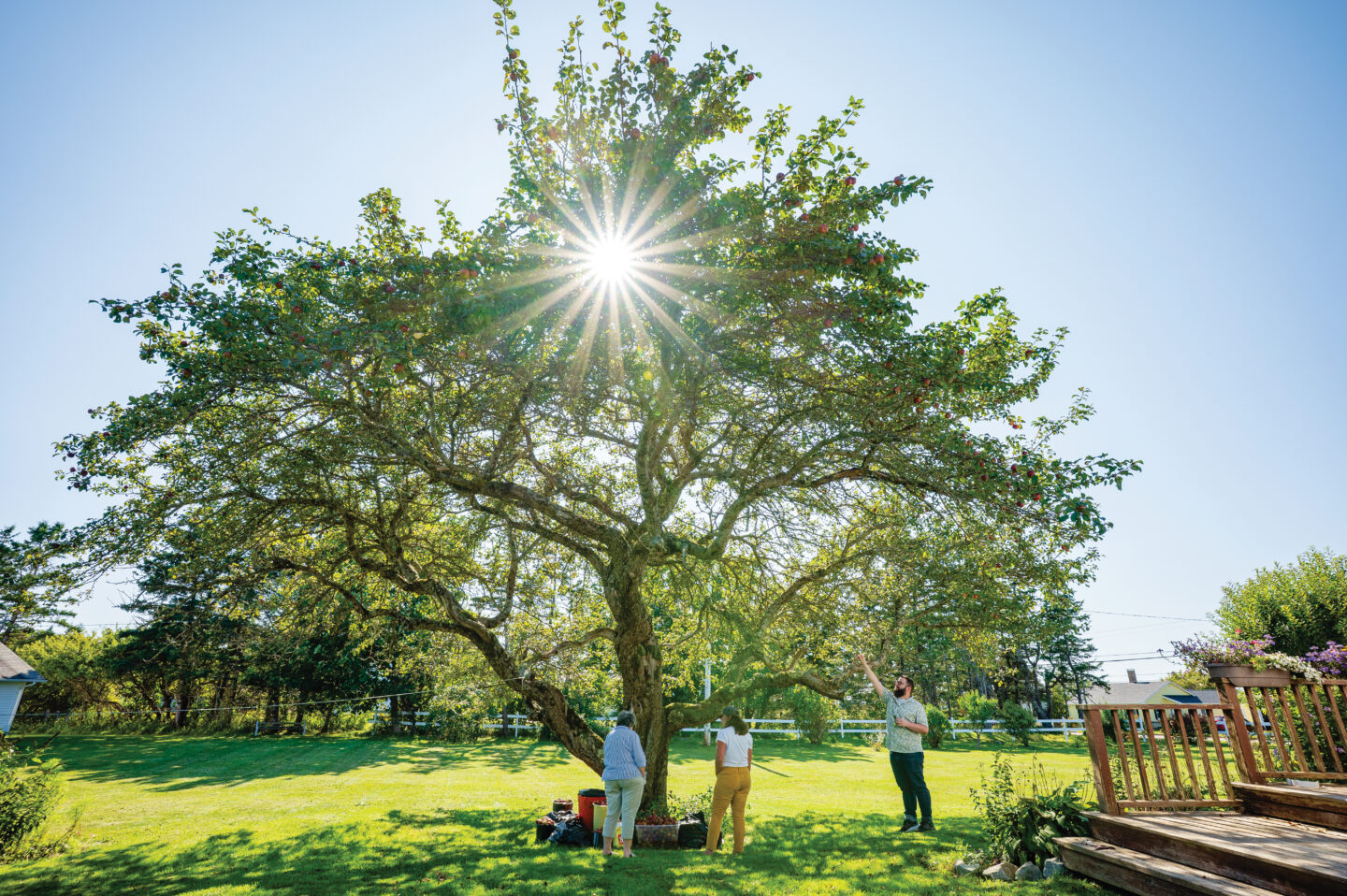
Near the book’s end, Thibault waxes eloquent on apple pie and addresses the hazy provenance of the Belliveau, an heirloom apple grown by his parents Jeanne and Hector on their hobby farm in Clare, N.S., where he grew up. For Thibault’s ancestors, he knew, apples were both pleasure and subsistence: a reliable annual crop offering a backstop against starvation in lean years. But this apple — laced with cultural folklore, culinary heritage and a tangible link to his genetic lineage — represented something more.
As a foodstuff, apples helped fuel the earliest conquests of lands inhabited for thousands of years by the Mi’kmaq. In 1604, merchant Pierre Dugua de Mons, military commander Jean de Poutrincourt and navigator Samuel de Champlain sailed across the Atlantic Ocean and into a river mouth between modern-day New Brunswick and Maine. To provision their journey, the French explorers bore casks of fermented apple juice, less effervescent and intoxicating than today’s cider, that provided them with a shelf-stable source of hydration, calories and much-craved alcohol. Still, that first winter, at least 35 men — around half of the colonists — died of scurvy and malnutrition. “The cold was so intense,” wrote Champlain in a diary entry, “that the cider was divided by an axe and measured out by the pound.”
In those early years, every bite counted, and apples, once established, provided a reliable food source.
Subsequent waves of French settlers brought with them tools, seeds, livestock and young fruit trees. Every bite counted during those years, and apples, once established, provided a reliable food source. Unlike the Quebecois French, who sailed deeper inland along the St. Lawrence River, the Acadians formed a distinct society along the Bay of Fundy with its own dialect, music and cuisine. They diked wetlands and grew grain, hunted game including moose and hare, and generally stayed on good terms with their Mi’kmaq neighbours. (The origin of “Acadian” likely comes from the Mi’kmaq word “cadie,” for “piece of land.”)
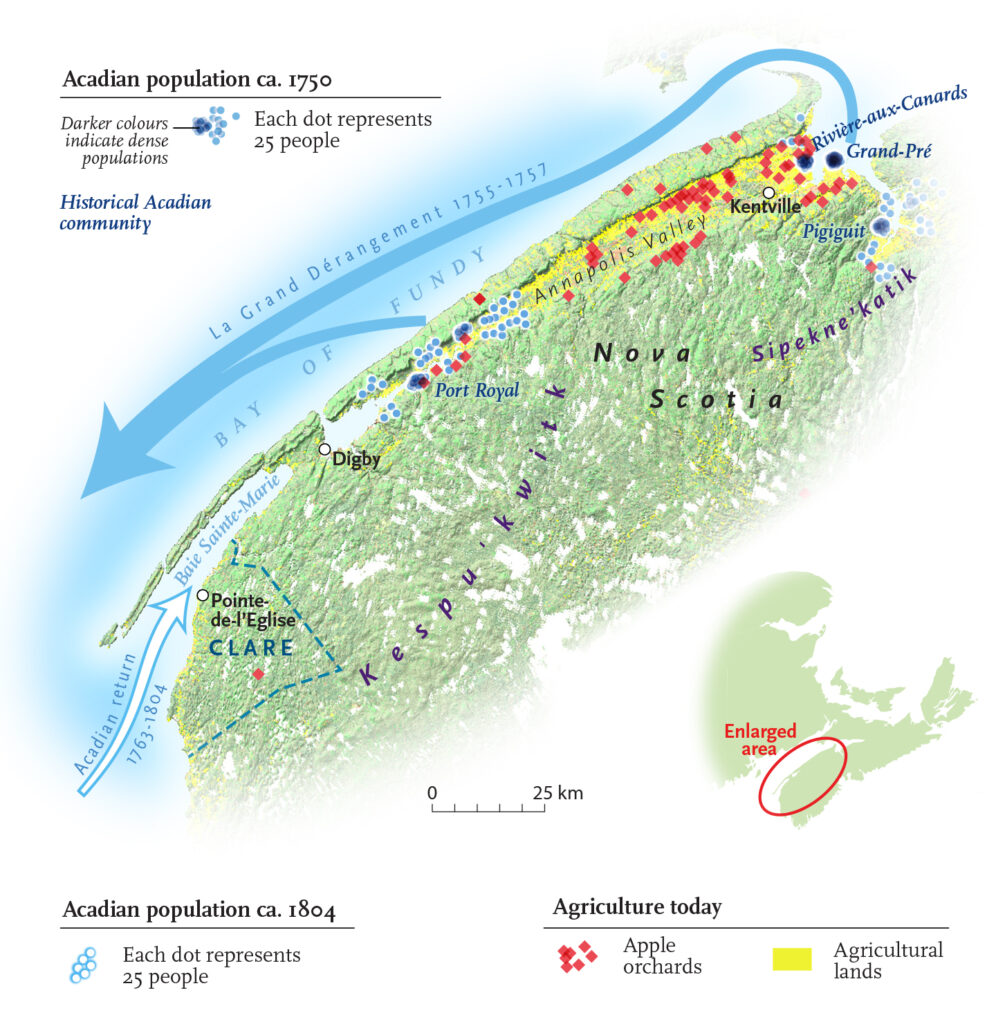
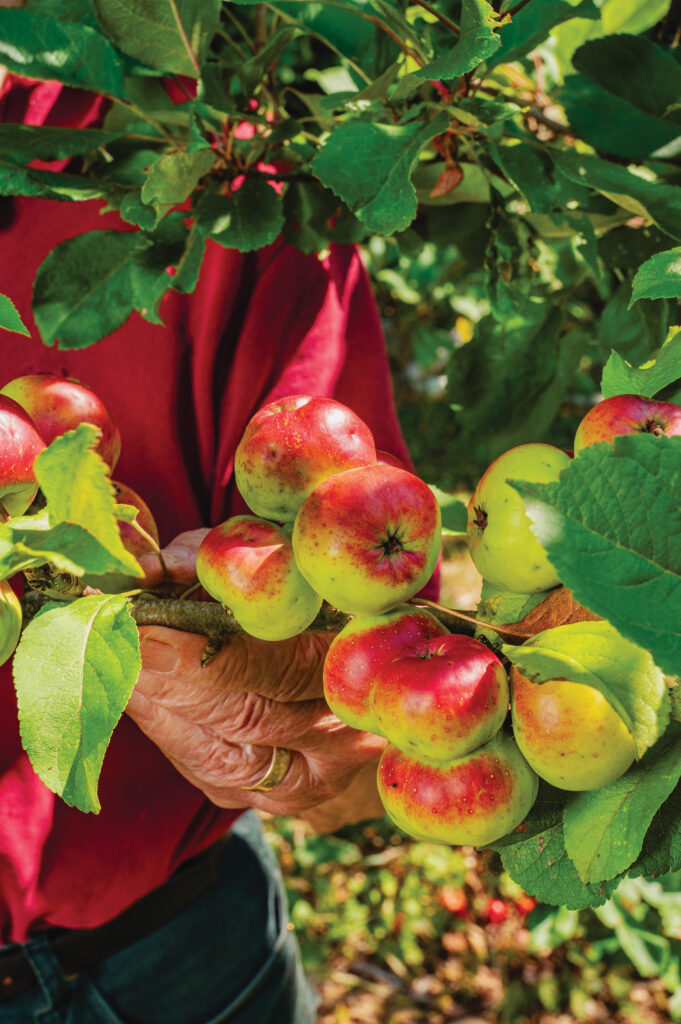
By 1612, according to Jesuit records, the Acadians’ earliest trees were bearing fruit in Kespu’kwitk, which had been renamed Port Royal by the French. By the end of that century, a recorded 54 families tended a total of 1,500 fruit trees, or roughly 28 trees per family. The French botanist and surgeon Dièreville visited the outpost on his tour of Acadia and deemed it a “petite Normandie pour les pommes.”
When the British Crown claimed the region from the French under the 1713 Treaty of Utrecht, about 2,500 or so Acadians continued farming their lands after declaring themselves neutral in the conflict. Within three decades, the population of Acadia exploded to around 10,000 people. But the paired realities of the region’s agricultural productivity and the rapaciousness of empire meant the Acadians wouldn’t be safe for long.
In 1755, Charles Lawrence, lieutenant governor of Nova Scotia, following orders from England’s capitalist Lords of Trade, demanded an oath of allegiance from Acadian leadership. When they refused, Lawrence ordered the seizure of the Acadians’ lands and weapons, and so began Le Grand Dérangement — the Great Upheaval, or Great Deportation. “We are now hatching the noble and great project of banishing the French Neutrals from this province,” wrote British officer John Winslow. “The part of the country which they occupy is one of the best soils in the world, and, in the event, we might place some good farmers on their homesteads.”
British soldiers forced thousands of Acadians onto overcrowded ships at gun and bayonet point from major settlements across present-day Atlantic Canada. In the melee, women carried newborns alongside men pulling carts laden with their elderly parents. Some hurriedly buried silver, legal documents and other prized possessions in the dirt, fearing robbery by British soldiers and hoping their banishment would be brief. Some fled into the woods.
Ironically, the most definitive proof of the chaos wrought in the deportation comes from detailed British paperwork taken at the time. In addition to the names of Acadians transported away from their homes, military administrators recorded the burning of 686 homes, 11 mills and two churches built over four generations. Cattle lingered near the charred remains of homes; abandoned dogs howled over the ruins.
In the frenzy of loading the ships, which didn’t carry enough food or supplies to sustain their passengers, British soldiers separated wives from husbands, children from parents. Most expected to be apart from their families for only a few days. Instead, the vessels sailed south to different destinations — from Massachusetts down to Georgia — dividing families to reduce chances of revolt. (A large number ended up in Louisiana, forming the diasporic Cajun community that lives there today.)
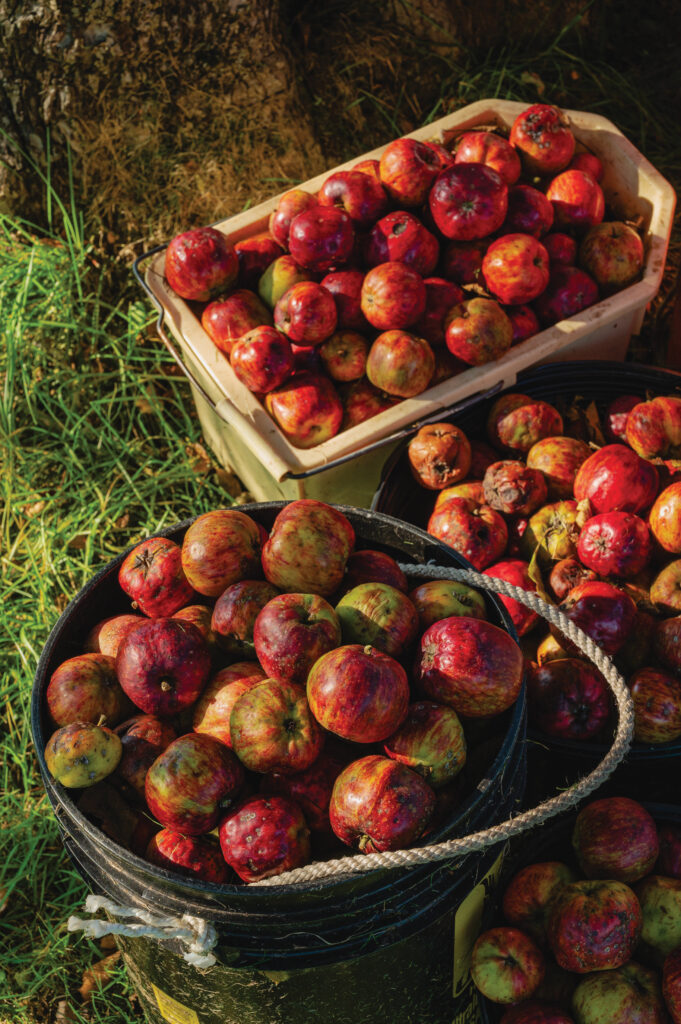
Other than a few attempted mutinies, the nefarious strategy worked. In moments, children became orphans, and many families shattered. Two years after the deportation, one British officer described sailing past decimated Acadian villages ringed by fields of apple and pear trees bending under the weight of unpicked fruit.
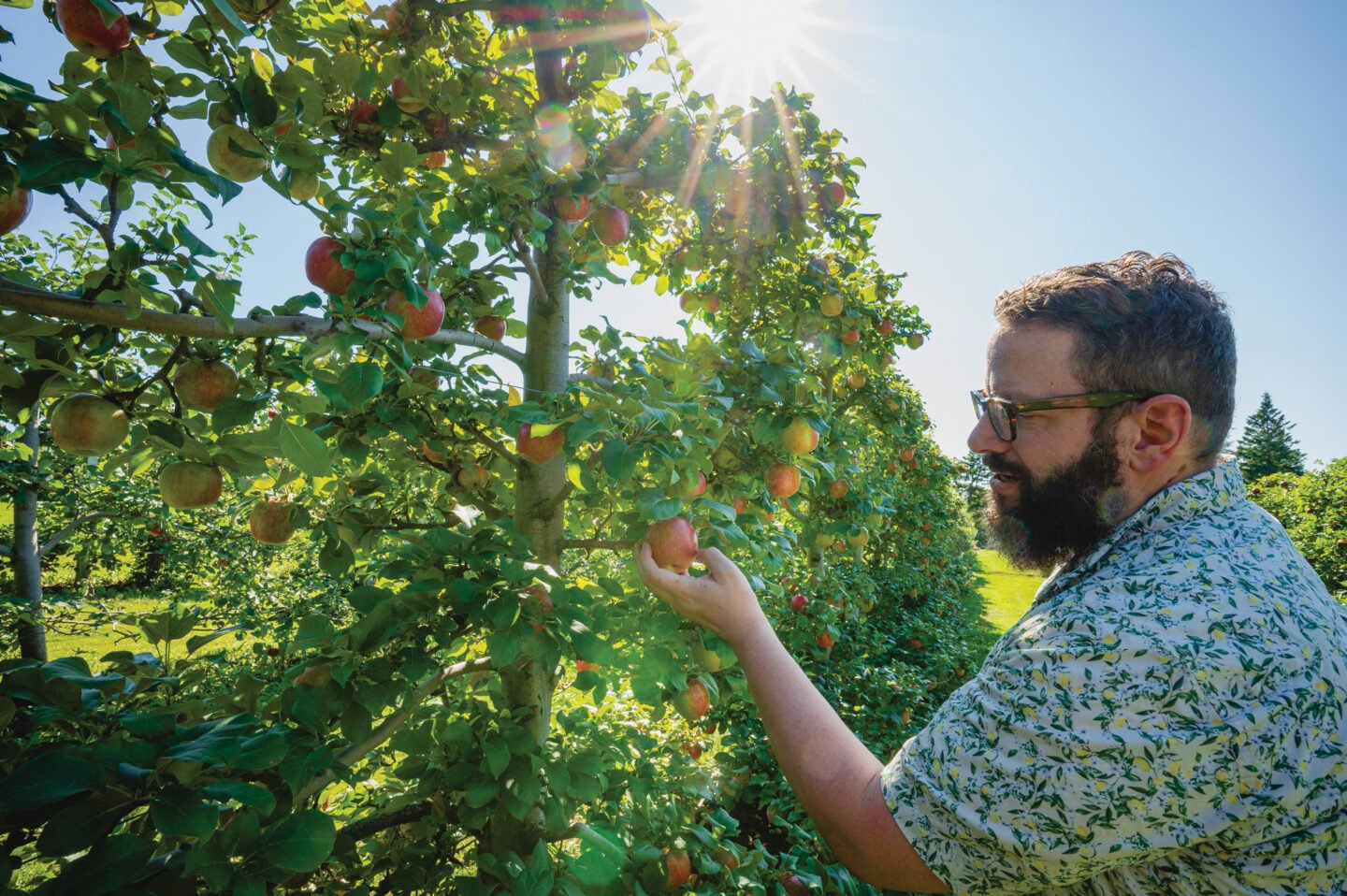
To stand in an orchard in spring, amid fluttering pink petals and myriad pollinators, is to witness procreation in real time. Each blossom is a potential future apple that, barring frost or other catastrophe, will ripen by harvest.
No matter the pollinating “father,” all apples from a single tree will look and taste similar. But inside that fruit’s seeds, bound within five stiff carpel chambers, lies a riot of heterozygous genetic material that would, if planted, result in apples with widely varying characteristics. To know what apples to expect, farmers graft twigs of each desired variety onto commercially available root balls. And so each grafted tree bears the identical genetics — and fruits — of its mother tree.
For hundreds of years, apple farmers have carefully hand-pollinated their favourite trees with the pollen from other hardy, tasty or otherwise favoured trees to see what fruit might emerge. Typically, the process is a bust, resulting in bland, mealy or intolerably tannic or unremarkable apples. Sometimes, though, those experiments hit paydirt. “Every McIntosh is a graft of a graft of the original tree that John McIntosh salvaged from the brush of his Ontario farm in 1811,” writes Rowan Jacobsen in Apples of Uncommon Character. “Every Granny Smith stems from the chance seedling spotted by Maria Ann Smith in her Australian compost pile in 1868.”
Given that apple trees can bear fruit for hundreds of years, planting an orchard bridges space and time. “Because he had thought about it as it was in that moment, with fruit on the trees and the trees in full maturity, it still contained him,” writes Helen Humphreys in The Ghost Orchard, of standing in an orchard planted by poet Robert Frost. “The poet may die, but the poetry continues.”
This single-track lineage makes the apple, in some respects, the ultimate monoculture crop. It also provides, when established through genetic testing, a tangible and profound genetic link across the centuries. “It is an intimate act, tasting an apple — having the flesh of the fruit in our mouths, the juice on our tongues,” writes Humphreys, of Quaker pomologist Ann Jessop’s tasting of a White Winter Pearmain apple in 1790. “I bite into the same kind of apple … and taste what she did.”
By 2019, I had left the Maritimes to study science journalism at Columbia University in New York City, although Thibault and I stayed frequently in touch. Inspired by the Acadians, I wrote an essay on the myths and truths of the expulsion seen through the lens of Simon Thibault’s family. While researching it, I stumbled across the Belliveau apple — and a mystery.
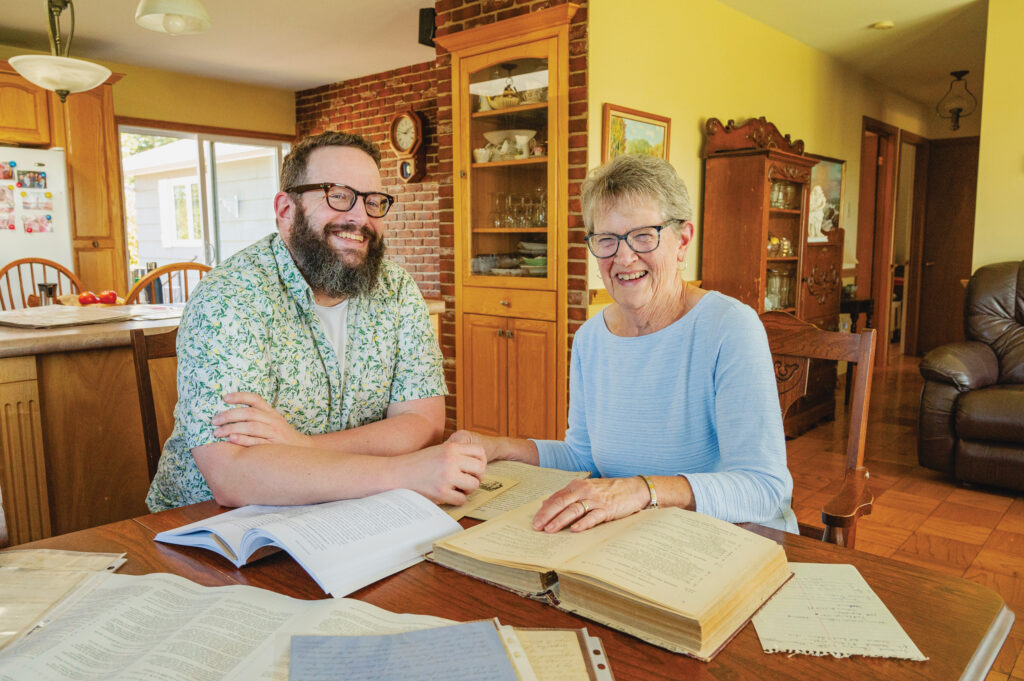
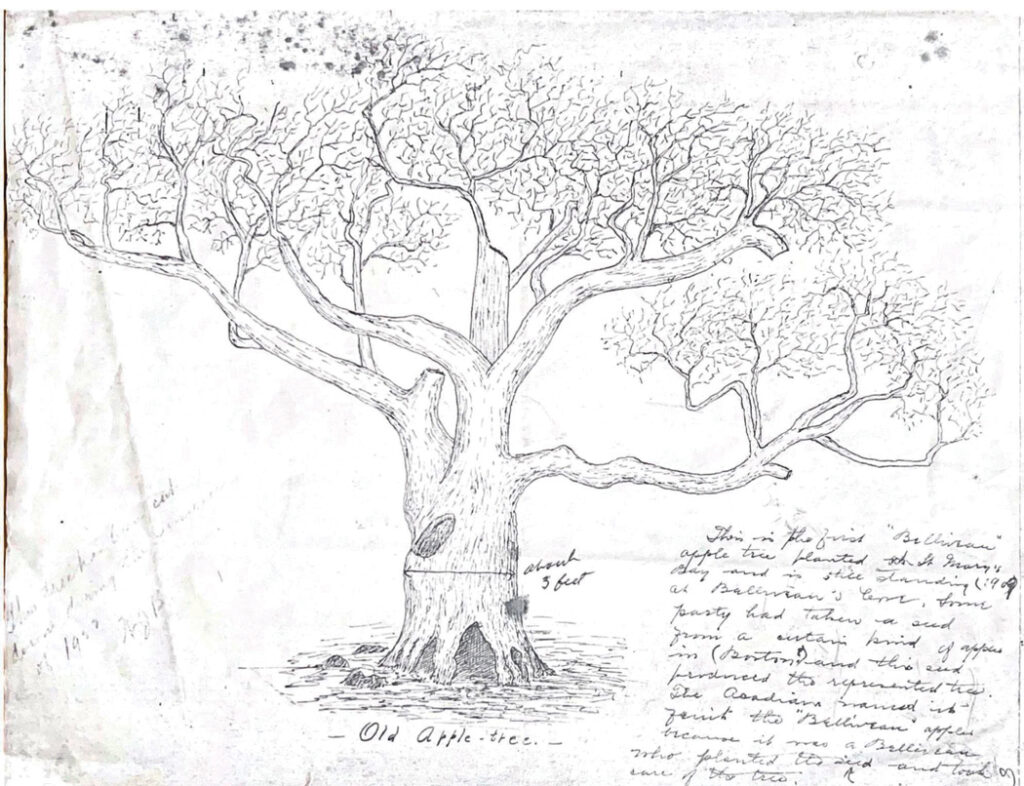
One 1932 tourism pamphlet about Acadian pomiculture, written by an ancestor of Thibault’s, recorded Belliveau apples showing up in St. Mary’s Bay, N.S., around 1769, brought there from Annapolis Royal by “one Mrs. Frederic Belliveau.” Undeterred by the era’s misogynistic naming convention, and with access to Jeanne Thibault’s records and modern-day genealogical websites, I read, cross-referenced and sketched family trees until I finally found Mrs. Belliveau’s birth name: Marie-Modeste Leblanc. She had been 11 years old — only a few years older than my son — when she was deported from Nova Scotia alongside her family.
By the mid 1760s, the British permitted some Acadians to return to the region, although they didn’t let them resettle on their lush former lands. In 1768, 24-year-old Marie-Modeste married Frederic Belliveau, and the pair headed westward from Annapolis Royal to Baie Sainte-Marie, or St. Mary’s Bay, a French-speaking Acadian community nestled along a long, narrow inlet. There, Marie-Modeste planted a single apple tree, from either seed or scion taken from her family’s forsaken homestead.
Discovering Marie-Modeste’s name transformed how I saw the Acadian deportation.
Discovering Marie-Modeste’s name transformed how I saw the Acadian deportation. Here was a real flesh-and-blood woman before me, someone who overcame inconceivable hardship and survived. I imagined her standing on a windswept ledge, a loom-woven cotton skirt whipping against her ankles, holding a Belliveau apple. I pictured her biting into it, drawing sustenance from it, her life and its life intertwining like DNA’s genetic helix, proof of the strength of a matrilineal line against historical churn and oblivion.
Soon after the deportation, even without the Acadians’ stewardship, their former orchards thrived. As newly arrived British and early American settlers took over the Acadians’ lands, they used the “thickets of lusty seedlings” that had sprung up in abandoned meadows in the Acadians’ absence as root stock, grafting scions of their own favourite varieties onto their shoots. For the next 200 years, those trees formed the basis of an apple industry that helped fuel the British Empire.
In 1862, Nova Scotian growers entered a slate of apples into competition at the London Horticultural Society show, where “no less than eight medals were awarded them, one of silver.”
As growers pursued efficiency and productivity with a goal of driving down costs and, by extension, apple price, they winnowed varieties planted in their orchards, focusing on popular varieties like Gravenstein, McIntosh and Red Delicious. Large orchardists bought smaller producers, felled old varieties to graft new ones onto existing rootstock, and countless apples disappeared. In 1929, Marie-Modeste’s original Belliveau tree was felled.
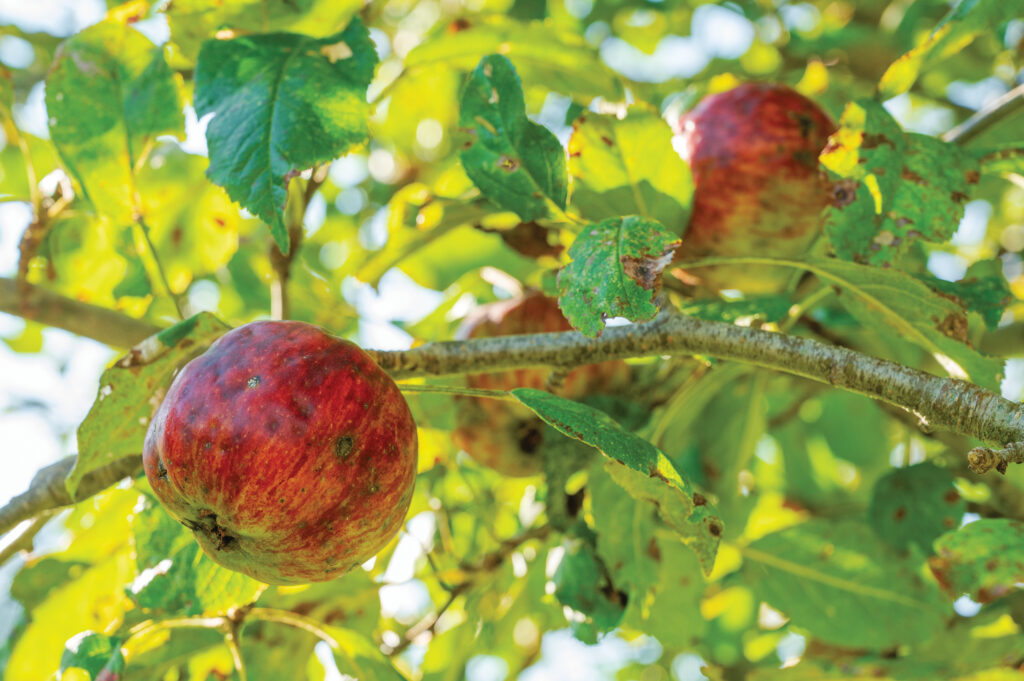
By the early 1940s, as Canada joined the fray of the Second World War, apple shipments to England plummeted, quickly demolishing demand. Between 1935 and 1939, Nova Scotia’s annual production of the fruit peaked at around six million bushels; by 1963, it was half that. It’s impossible to know how many heirloom varieties were lost in the attrition, but also very probable that some of those felled trees that were ripped out to make way for grape vines — the region’s new burgeoning industry — were Belliveaus.
Sitting in a musty-smelling Manhattan basement, with proof of Marie-Modeste and the Acadian deportation scattered around me, I wondered: with only a handful of Belliveau trees remaining, were Thibault and his Acadian neighbours doomed to lose yet another tangible link to their past?
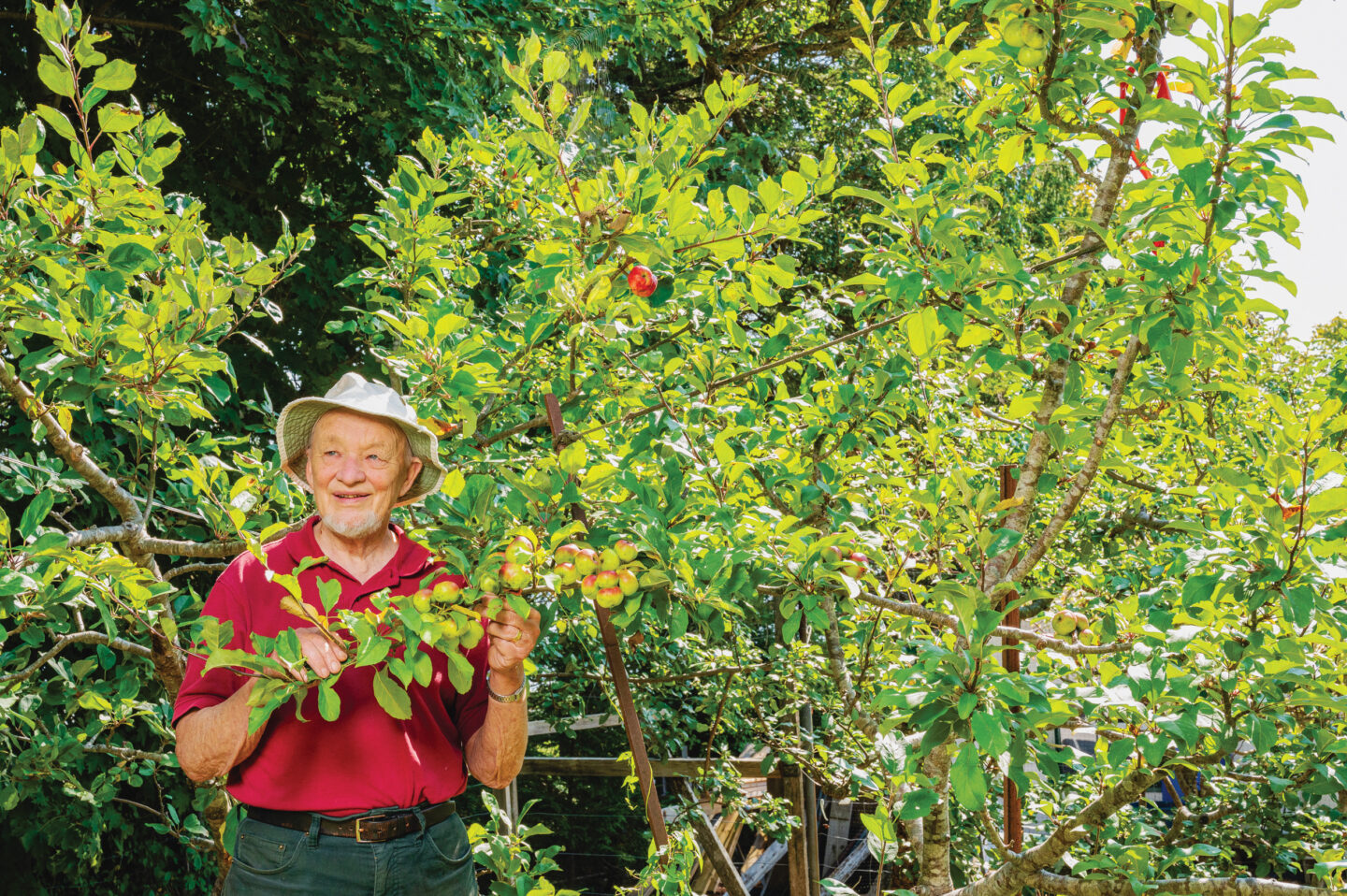
For retired emergency room doctor David Maxwell, who started an antique apple orchard outside Lunenburg in the late 1990s, a Belliveau was the perfect addition to his collection, which includes varieties such as the Fameuse and Pomme d’Api.
In spring 2017, Hector Thibault sent Maxwell an envelope containing two tiny shoots ready for grafting. To his delight, they took well and grew quickly, a promising glimmer that hinted at why, hundreds of years prior, the Acadians had such luck propagating their own Belliveaus.
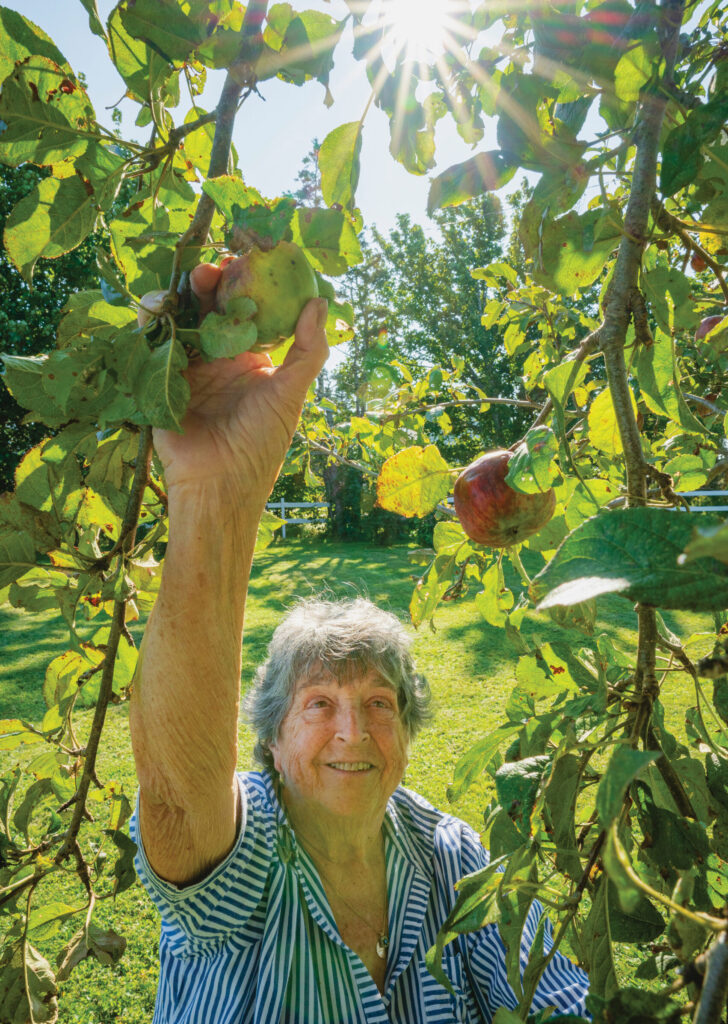
For Maxwell, that the apple looked fated for extinction seemed like a solvable problem. He reached out to New Brunswick’s Verger Belliveau orchard, which is owned by a distant Belliveau cousin, to see if they were interested in helping to keep the variety alive. To his chagrin, they weren’t.
In 2022, at his wit’s end, Maxwell sent Belliveau scions to his friend and Ontario heirloom apple grower Bill O’Keefe, desperate to find another home for the Belliveau’s genetic material. On his farm, O’Keefe Grange, Bill and his wife Lyn have amassed one of Canada’s largest collections of rare apples, numbering over 560 varieties. Again, the hardy cuttings took swiftly.
In 2023, his last season before retirement, University of Guelph researcher Paul Kron arrived on the O’Keefe Grange for his final year of work on the Ontario Heritage and Feral Apple Project, a research program dedicated to identifying and preserving the genetics of soon-to-be-lost and obscure varieties. He took a sample of a young leaf from one of the farm’s Belliveau trees and placed it in a labelled paper envelope. Back at his lab, he pulverized the sample into a slurry to prepare it for genetic testing and then analyzed the tree’s DNA. The result, according to Guelph plant biology professor Brian Husband, showed a slim possibility that Fameuse, an old French Canadian variety, could be related to the Belliveau. This clue provided a tiny glimpse into the apple’s genetic lineage. If orchardists want to have their Belliveau trees propagated by commercial growers, a “Belliveau” genotype will have to be identified and standardized.
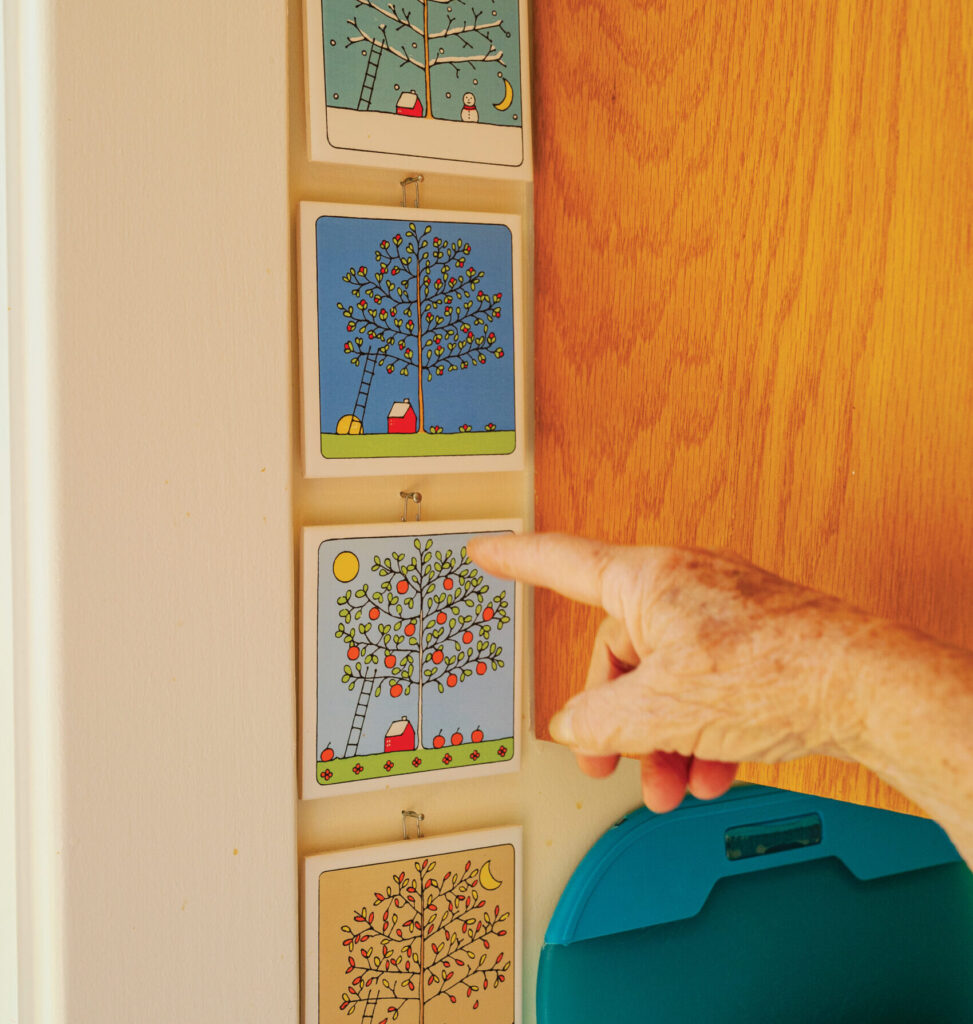
Around that time, Thibault and I started working together to learn more about Marie-Modeste’s almost lost apple. The problem with stories about trees, we learned, is that myth, legend and mistakes often work their way into the narrative. We visited the Annapolis Royal Historic Gardens, which is located on lands owned by the Belliveau family before the deportation. They have a few Belliveau trees, and every time they post online about them, they receive a trickle of comments from curious Acadians and apple growers who want to obtain one.
As we dug through archives and family charts, assisted by Jeanne Thibault, we stumbled across something that added another layer of meaning to this tale. What we found in the genealogical records was that, fittingly, Thibault’s mother descended from Marie-Modeste. I caught myself looking back through pictures of Jeanne Thibault and her own mother, Rosalie, searching for a sign of what Marie-Modeste looked like. Was she short, like Jeanne? Did she have the same curly hair? Her mischievous smile? And could she have imagined that, generations after her death, her apple tree would feed her distant relations?
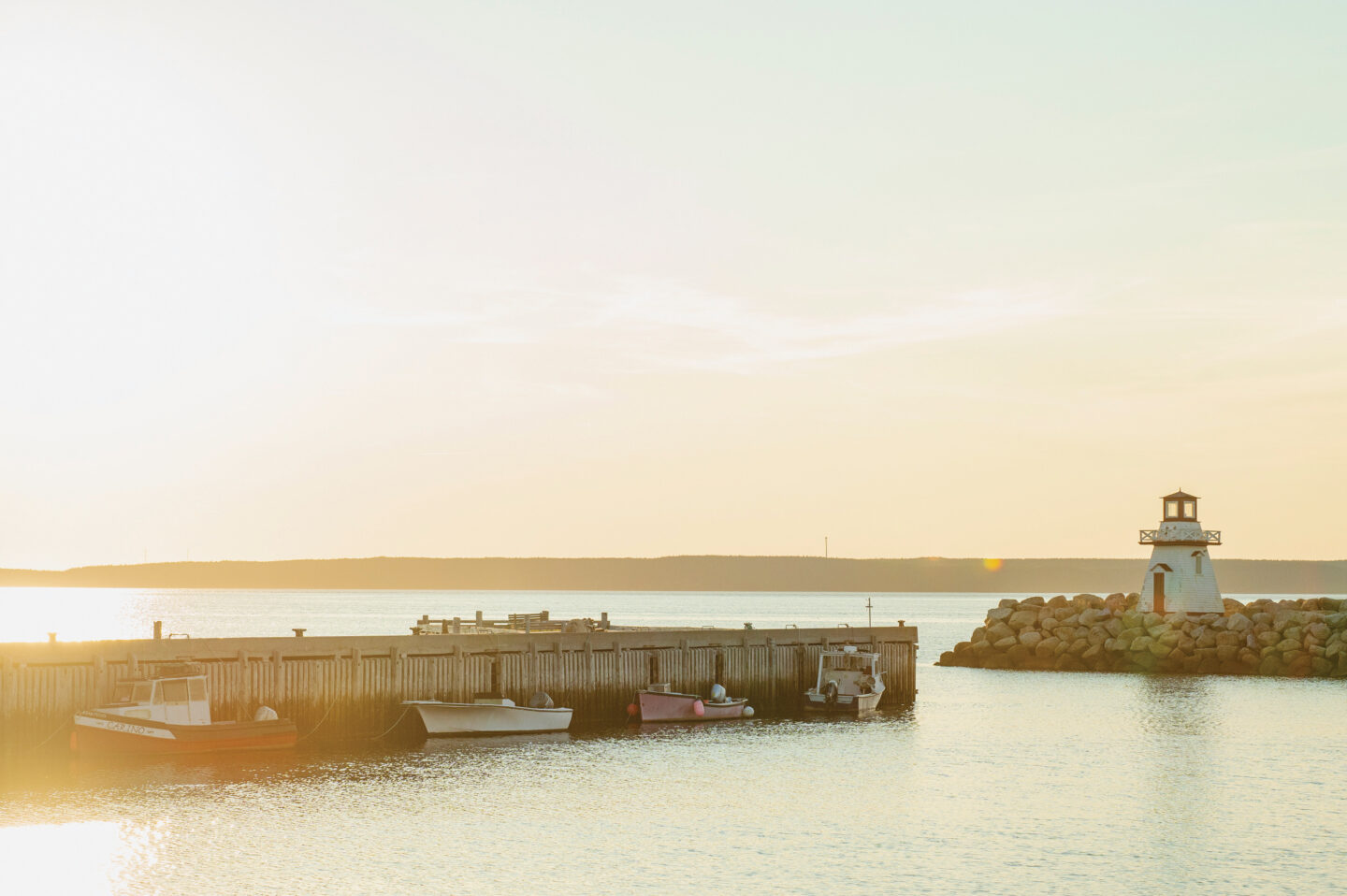
Following his talk on that mild spring day, Thibault invited cider-maker Denise Flynn to take the stage. Flynn, the Acadian owner of the Corberrie Cider Company in Clare, brought along 30 twiglike scions taken from an ancient Belliveau tree that grows in the yard of another descendent of Marie-Modeste, Coline Campbell. In the hazy light of the stained-glass windows, as the afternoon sun sank in the sky, Flynn showed the assembled crowd of curious community members and passionate orchardists how to graft scions onto either a new rootstock bulb or a branch of an existing apple tree.
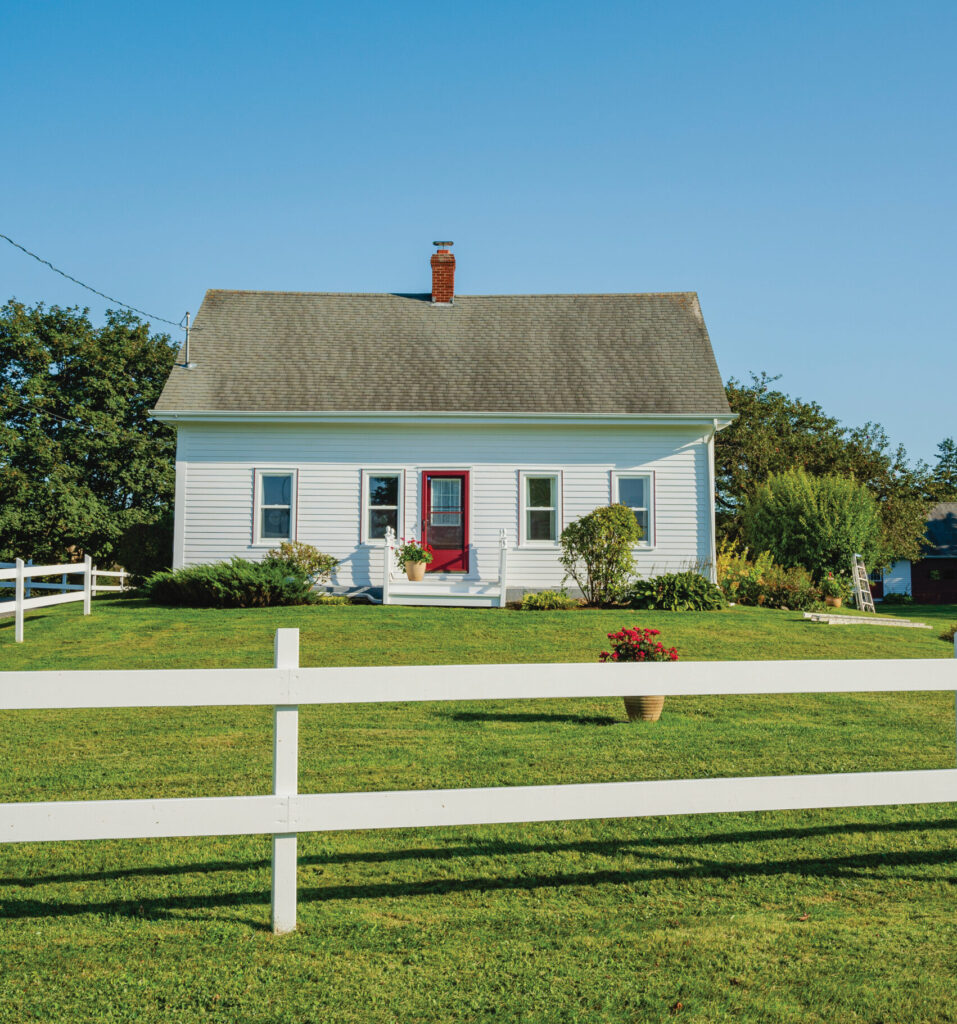
By the time the event ended, all the scions were claimed by enthusiastic future caretakers of new Belliveau trees. Perhaps, Thibault dreams, Flynn could one day make a single-varietal cider from the traditional apple.
As for the future, Thibault plans to send Belliveau leaves, and possibly others taken from a handful of mystery trees some believe to be Belliveaus, to a lab in Oregon for genetic testing. Knowing whether the trees are identical, and even which parent trees were crossed to produce the Belliveau, he says, is the next step in protecting Marie-Modeste’s pomological legacy and in making our research available to future generations.
“This apple is an example of how a community sustains not only itself in terms of nutrition but also the collective brain trust of distributing knowledge,” Thibault says. “Which is what, as Acadians, has ensured our survival.”

This story is from the September/October 2025 Issue
People & Culture
The tintamarre showcases the vitality of the Acadian culture — and some supersized papier-mâché heads

People & Culture
Descendants of French-speaking Acadians in Louisiana saw their culture and language slip away in the 20th century. Now, a new generation of proud Francophones is leading a resurgence.
History
In 1755 all Acadians who wouldn't declare allegiance to Britain were ordered to leave Nova Scotia. Here's where they went.

People & Culture
National Acadian Day is celebrated in Canada each year on August 15