History
150 years of soccer in Toronto
Toronto welcomes the FIFA World Cup to Canada, after a century and a half of the beautiful game
- 936 words
- 4 minutes
Science & Tech
From an Abbotsford, BC farm to the Canadian Men’s National Team’s greatest World Cup win: how it took hundreds of thousands of dollars, dozens of workers and one whole year to grow the perfect FIFA soccer field

When you look at the sport of soccer, it seems pretty simple: You kick a ball around, trying to put it into the other team’s goal more times than they put it into yours.
But when you’re talking about a world-class event like FIFA’s World Cup, the surface the game is played on has to be just a bit more high-end than a playground field. Just as a clean sheet of ice is crucial for the IIHF world hockey championships and a smooth tarmac is vital for F1 motorcar racing, the turf for FIFA soccer has to be top-notch. And the requirements are specific.
Vancouver’s largest stadium, BC Place (known as BC Place Vancouver for the duration of the World Cup), normally has an artificial turf field used for Canadian Football League and Major League Soccer games. For the 2026 World Cup, FIFA requires pitches to be natural grass, but they can be reinforced with synthetic fibres.
Why is playing on artificial turf such an issue? There are two main concerns: the risk of player injury and the way the ball behaves.

Natural grass provides a cool, safe surface but demands heavy maintenance and wears down under high traffic. Artificial turf takes a licking and keeps on ticking — but that’s not always the case with players. Alan Ferguson is the senior pitch manager for FIFA, with several decades of experience. He says athletes would much rather play on a natural surface than a synthetic one.
“When you’re constantly running on a synthetic surface, the recoil from your leg movement coming off the surface is sometimes sharper and quicker than what it would be on a natural field, where there’s a bit of shock absorbency,” he says. “That force coming back up through their bodies puts a lot more stress and strain on joints, on the bone structure.”
Hybrid turf offers the best of both worlds by reinforcing natural grass with five per cent synthetic fibres. It offers the aesthetic feel of real grass with better durability.
As for how the ball plays, if you’ve ever kicked a ball on grass and then kicked it on artificial turf, you’ll have notice how differently it can react. The hybrid turf for this World Cup helps reduce that issue drastically, if not eliminate it completely.
“The way the balls are constructed now, they need the grass to be a bit moist so they actually skip off the surface and move at a consistent pace,” says Ferguson. “When you play on a synthetic turf, very often when the ball contacts the surface, the surface acts as a bit of a brake, and the ball doesn’t travel to its intended target.”
So, if one player passes to another — say over 15 or 20 metres — and that ball comes up short, an opponent may have more time to come in and challenge for the ball, creating needless contact. On a natural field, where the pitch is irrigated before the game, the ball is more likely to skip smoothly along the surface and reach its intended target, reducing the chances of those tackles.
“It is a contact sport, but we like to take away the high-risk challenges,” says Ferguson. “I think playing on the types of hybrid surfaces we do has helped manage that. It’s never going to eliminate it, but it can greatly reduce it.”
The construction of the turf used for this tournament involves some exact science, particularly since there are so many different venues in so many different climate zones.
Then there is Vancouver’s indoor environment.
A traditional soccer stadium is open, so there’s natural light, good airflow and a traditional soil or sand base to grow the grass on, with drainage and irrigation built in. In BC Place, the existing artificial turf sits on concrete.
Ferguson says that created a huge challenge. A few years after the 2015 Women’s World Cup, which was held in Canada and played on artificial turf, FIFA partnered with University of Tennessee and Michigan State University on a five-year research project to develop a system for this year’s men’s World Cup dubbed the “shallow pitch profile.” A specifically modified growing medium and base to build a soccer pitch that lasts for two months, it’s being used in stadiums across North America.
Once FIFA got the science down, then they had to actually produce it. FIFA and BC Place worked together to find a local grower for the turf: FIFA identified potential suppliers who then had to respond to the request for proposals to BC Place to land the contract.
Bert Bos of Bos Sod Farms in Abbotsford, B.C., was chosen. The fact that his sod already grows on sand (a characteristic of the shallow pitch profile) was a big plus, as not all sod producers do that.
Still, Bos says they needed to change up the way they normally produce sod. He attended FIFA field days at American universities to learn more about the requirements.
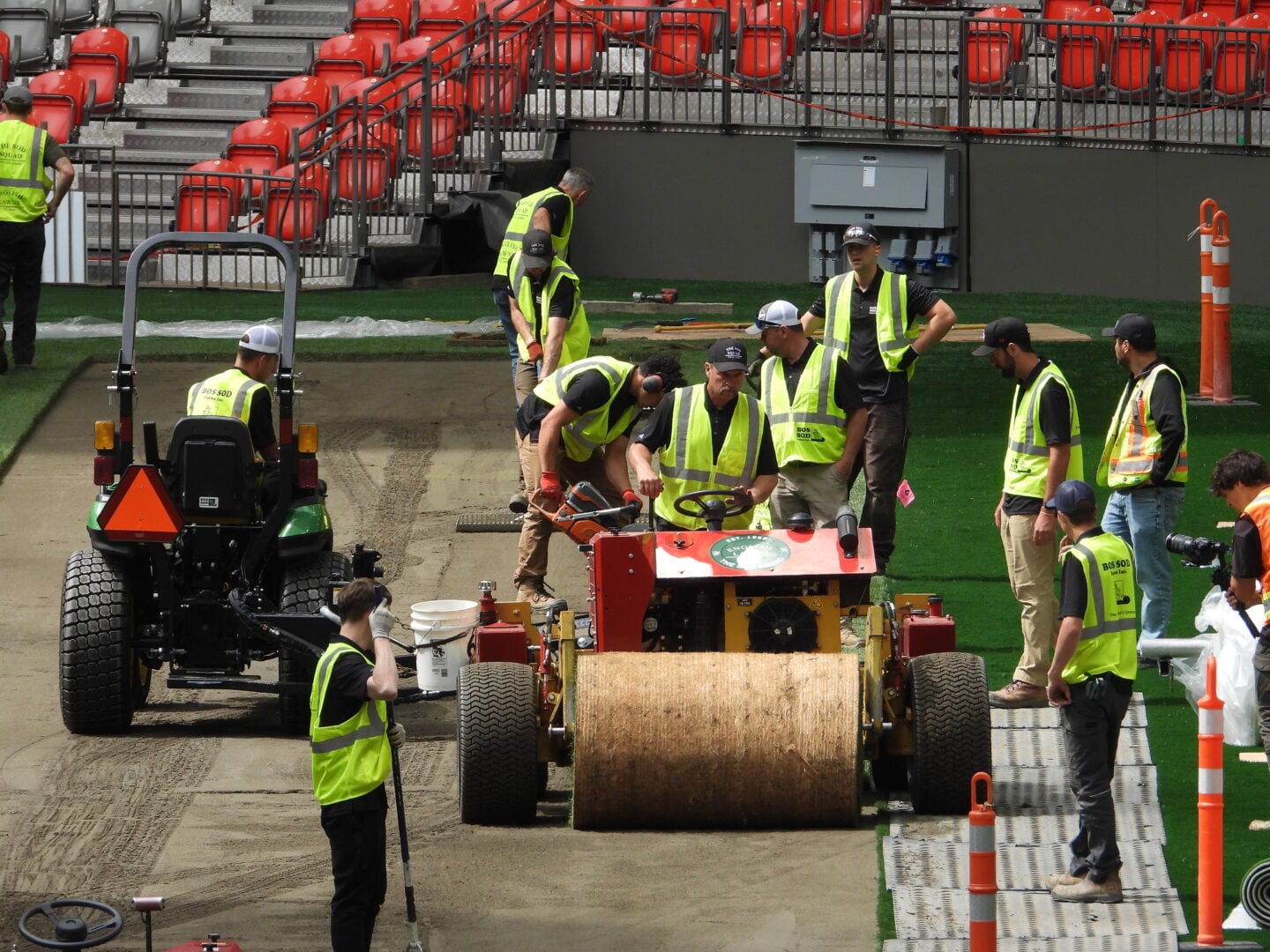
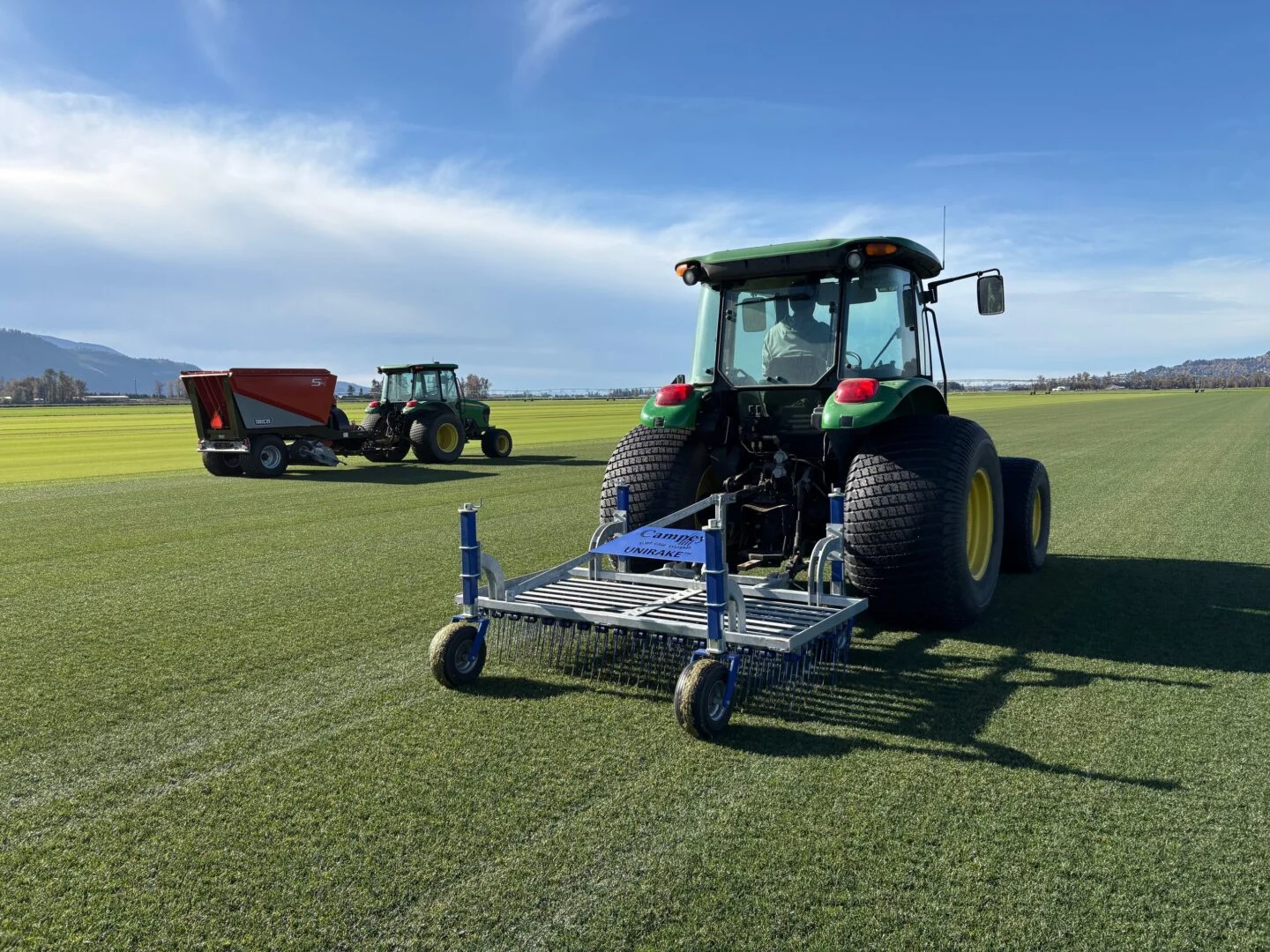
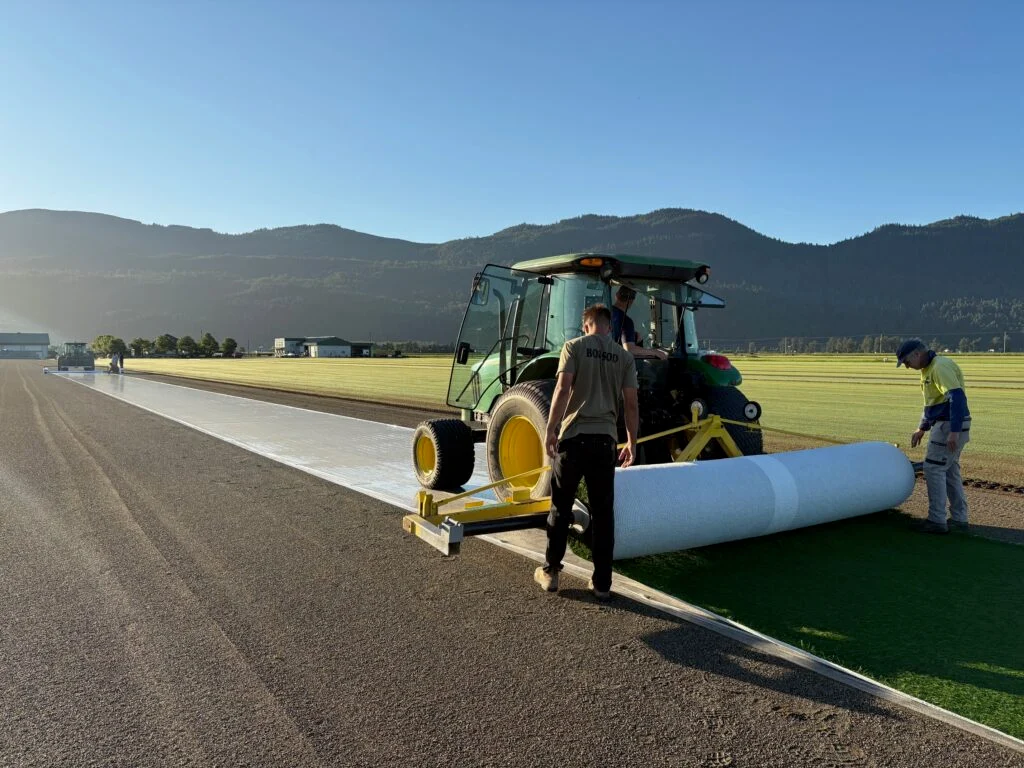
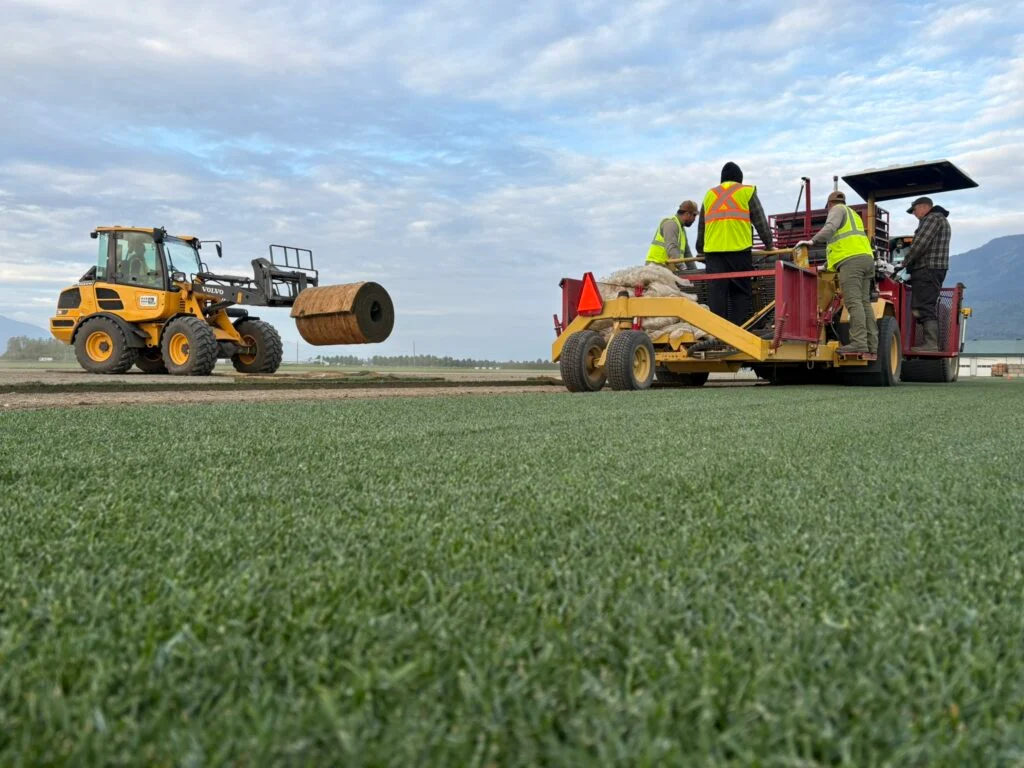
“We used the same basic machinery,” he says, “but we did make some modifications.” Those modifications included changes to the “top-dresser, plastic applicator, hybrid carpet unroller, rotary brush, custom rake, pull broom and mower,” as well as “custom-size rollers for verti-cut units, a custom harvester for side-cutting hybrid turf and for rolling up by machine” and changes to the “sod installer and side seamers.” Who knew there was so much technology involved growing sod?
They approached the moisture and nutrient requirements differently, as well.
“We monitored moisture extremely tightly: we were doing moisture checks three times per day. Normally we don’t do it to that extent.”
As for the nutrients, Bos and his team did something he calls “spoon-feeding,” applying small amounts of nutrients every seven to 10 days rather than loading the sod with a single, larger amount up front.
The grass Bos Sod Farms planted in June 2025 was installed in the stadium almost a year later, between May 7 and 9, 2026. The installation involved some tricky logistics to get it into the stadium. Ferguson compares the logistics planning and timing to that of a military operation.
“Very specialized equipment harvests it into giant rolls,” he says. It’s then loaded into climate-controlled tractor trailers.
The trailers left Bos Sod Farms between the early morning and the afternoon — the first leaving at 4 am — maintaining the grass at a cool 2 C. The goal was to ensure the installation crew did not wait long for the sod and to keep the harvest and installation time under 14 hours, says Bos.
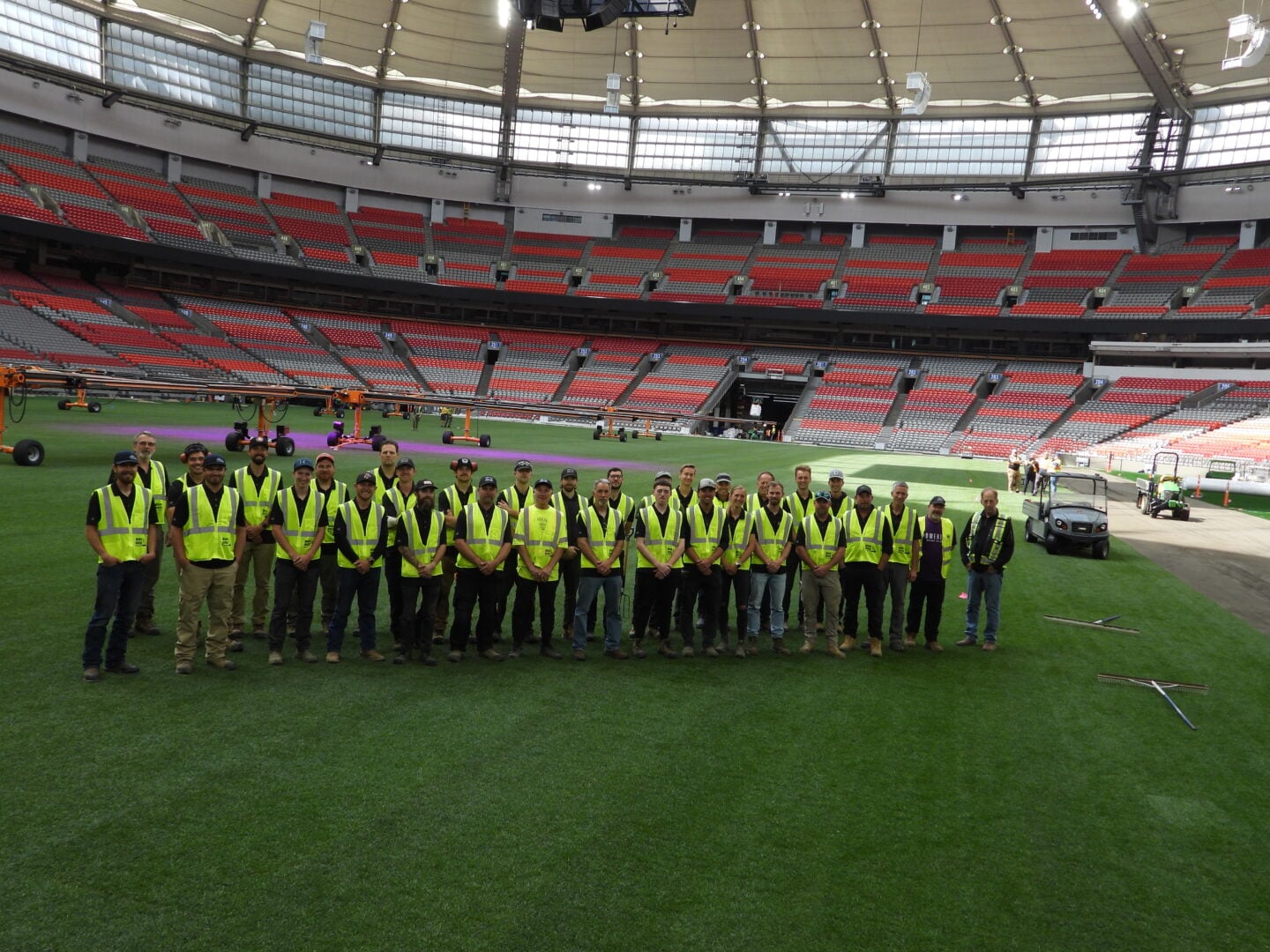
A receiving team of 30 people in the stadium uses another set of specialized equipment to take the sod off the trucks, bring it into the field, roll it out and join it all together like a giant jigsaw puzzle.
Once down, it has to be watered. Like some other North American venues, BC Place did not previously have an irrigation system. Each venue presented its own challenges, so a number of different technologies were used to meet the FIFA requirements for vacuum ventilation and irrigation. In Vancouver, BC Place built up the playing field by about 35 centimetres and built a temporary irrigation system below, which also provided space for the vacuum ventilation.
The financial resources required for this type of operation vary, Ferguson says, depending on the difficulty level.
“The average sod field comes in at around US$300,000 to US$350,000 ($425,000-$495,000),” he says. That figure rises to around US$2 million ($2.8 million) when factoring in all the changes in the big stadiums, including civil engineering, tech, equipment and people. “The easier the place, the lower the cost; the harder the place, the higher the cost,” says Ferguson. Although BC Place has a retractable roof, the stadium also had to bring in mobile UV lights to keep the grass healthy.
Was it worth it? When Jonathan David scored the Canadian Men’s National Team’s sixth goal of the night on the BC Place playing field in the group stage game against Qatar, it certainly felt like it.
The numbers can seem astronomical, especially for a game that many of us — fans and players alike — played as youngsters in schoolyards and parks, with sweaters for goalposts and whatever ball was closest at hand. The BC Place field is a far cry from quickly checking for broken glass or rocks before trying to kick more balls into our opponent’s net than they could kick in ours.
But this is “the beautiful game,” and on the biggest stage, beauty comes at a price.
History
Toronto welcomes the FIFA World Cup to Canada, after a century and a half of the beautiful game

People & Culture
With the 100th Grey Cup set to kick off this November, the Canadian Football League and its rough-around-the-edges charm is winning converts
Environment
Struggle and success in Atlantic Canada, where aquaculturists strive to overcome climate change and contamination while chasing a sustainable carbon footprint
Environment
Already gaining steam before the pandemic, interest in urban farming — and hunger for hyper-local food — has soared. A look at three Canadian takes on the urban farming phenomenon