Places

Lake Ontario will remain Lake Ontario at Canadian Geographic

U.S. President Donald Trump’s executive order renaming Lake Ontario “Lake America” holds no water for the Royal Canadian Geographical Society

  • Aug 30, 2026
  • 997 words
  • 4 minutes
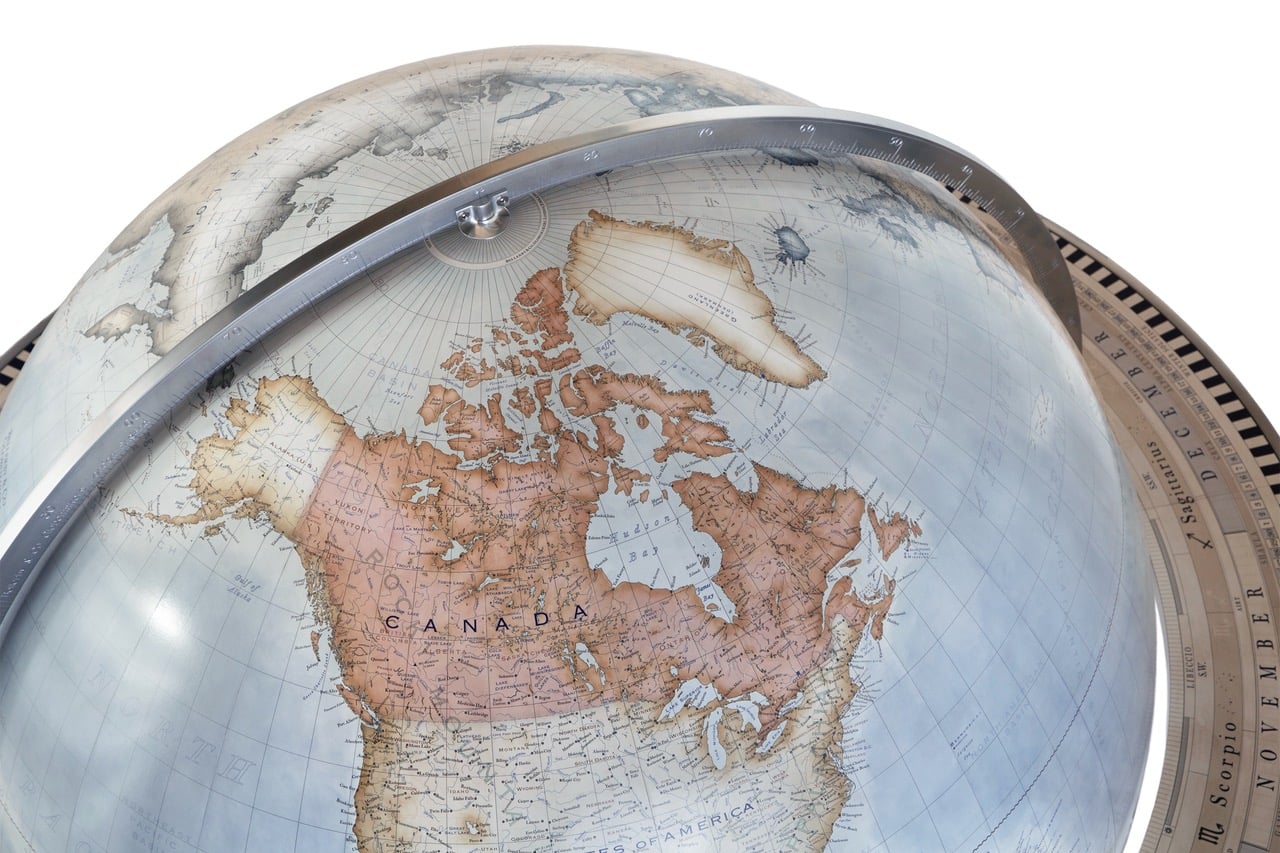
The Royal Canadian Geographical Society’s “Canada Globe,” handcrafted by Bellerby & Co. globemakers, retains the original names of geographical features recently renamed by U.S. President Donald Trump.
Expand Image
Advertisement
Advertisement
Advertisement

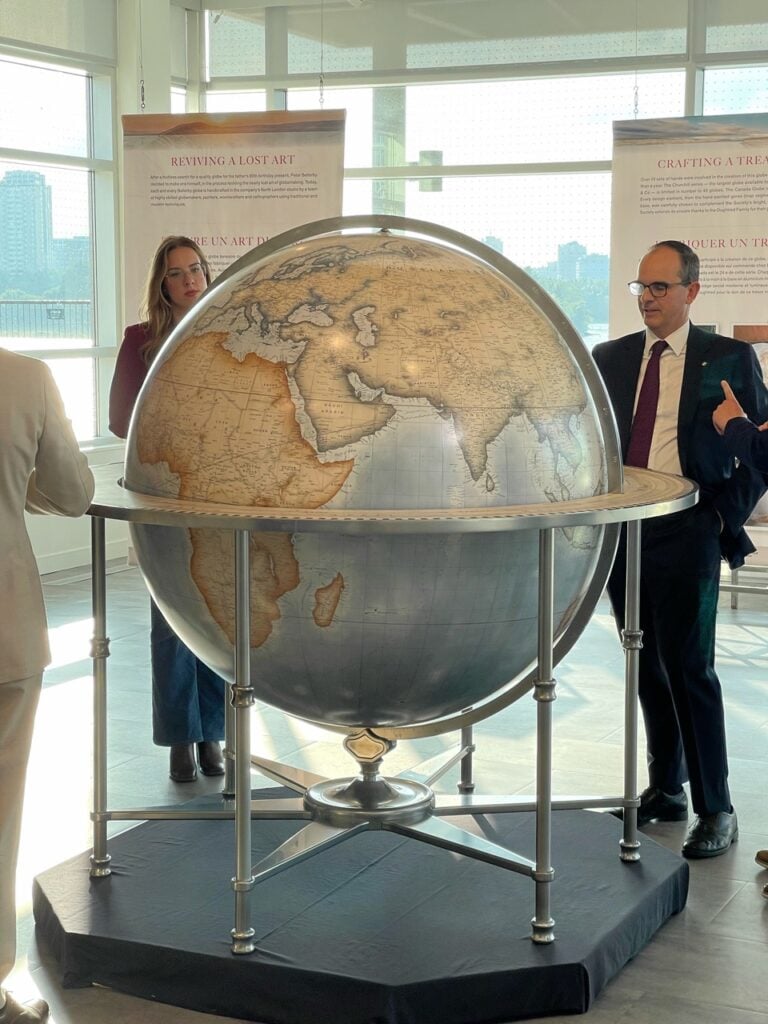
This week, the Royal Canadian Geographical Society moved a huge globe into the newly-renovated Sir Christopher Ondaatje Reading Room at its Ottawa headquarters. The Canada Globe, as we like to call it, includes the Society’s coat of arms and its motto, “Ducit amor patriae — Love of country leads me.” The custom globe is a physical statement on Canada’s place in the world.

Handcrafted by Bellerby & Co. Globemakers of London and measuring 127 centimetres across, the Canada Globe is the largest Bellerby globe available for commission and the only one in Canada. It was unveiled one year ago, and has defiantly protected names and places recently expunged by the Trumpian lexicon of geography.

During his first weeks in office in January 2025, U.S. President Donald Trump signed an executive order directing federal agencies to rename the Gulf of Mexico the “Gulf of America.”

A month later, U.S. government departments and agencies updated their international geographic standards to reflect the change, and on February 9, 2025, the United States celebrated “Gulf of America Day.”

That same month, as our team observed these geographic pronouncements from snowy Ottawa, we reaffirmed our belief that names matter, as sovereignty matters. Our recently-commissioned Canada Globe would both reflect our love of country and be a symbol of resistance in a world of high-octane rhetoric and constant declarations from south of the border about making Canada the “51st State.”

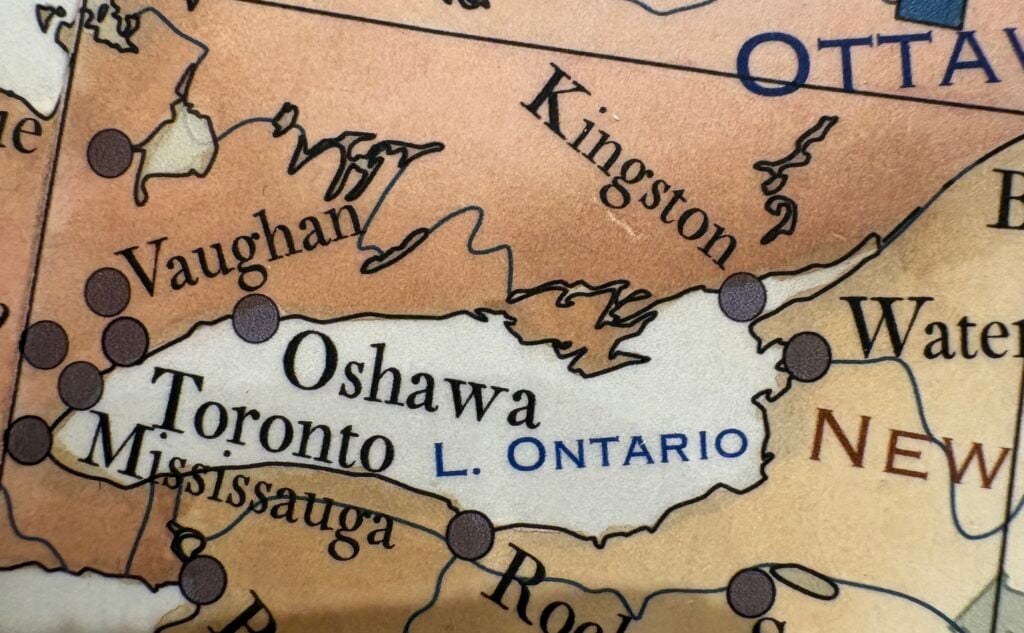
If you visit our headquarters at 50 Sussex Drive in Ottawa and give the Canada Globe a spin, you will see that the Gulf of Mexico is still the Gulf of Mexico. Denali is still Denali. Denali means “the high one” in the Koyukon language and describes the highest peak in Alaska. Trump signed a separate executive order in 2025 to revert that magnificent mountain to its previous name, Mount McKinley.

The original design for the Canada Globe had North America all in the same colour, consistent with other continents, but RCGS CEO John Geiger insisted that Canada be painted in “Imperial pink,” a colour that reflects our constitutional monarchy, historic ties to the United Kingdom and membership in the Commonwealth of Nations.

A phrase from beloved Canadian author Margaret Atwood graces the Canada Globe and represents our dedication to a world of discovery: “These expeditions have no end. Through the tangle of each other, we hunt ourselves.”

Canadian culture, identity, and a respect for the cultures of peoples around the world are reflected in the Canada Globe. These are values that we believe represent the best of what Canada should aspire to be.

And so, despite yet another executive order from the Oval Office in Washington this past week, on the Canada Globe and in our programming, Lake Ontario will remain … Lake Ontario.

The custom-made “Canada Globe” features many distinctive Canadian touches, including the coat of arms and motto of the Royal Canadian Geographical Society and a quote from beloved Canadian author Margaret Atwood. (Photo: Charlie Woolf/Can Geo)
Expand Image

There are many reasons for this. The first, of course, is that you can’t simply pick up a sharpie, write your signature in bold strokes on a document and erase a word that predates the U.S. Declaration of Independence of 1776 and Canadian Confederation of 1867.

“Ontario” is derived from the Mohawk word Oniatarí:io, meaning “beautiful lake.” The Anishinaabe know it as Niigaani Gichigami, “leading big lake.” More than 185 First Nations reside in the Great Lakes watershed; were they consulted about this name change?

The Great Lakes don’t need anyone to make them “Great Again.” We all know they are great. The Great Lakes-St. Lawrence watershed is critically important to our way of life, holding 20 per cent of the global supply of surface freshwater and providing drinking water to 45 million people who live on either side of the international border.

All of us are incredibly fortunate to have benefitted from this geographic wonder. We reject the politicization of something that has sustained life for millennia.

Three years ago, the RCGS and Canadian Geographic launched an educational program called Biinaagami, an Anishinaabemowin word that means “pure, clean water.” The initiative is rooted in Indigenous knowledges that teach us about our shared responsibility to protect the Great Lakes-St. Lawrence River watershed.

Through the distribution of free classroom resources, community outreach, Giant Floor Maps, digital storytelling, augmented reality, experiential learning, and the establishment of community water hubs and ecosystem restoration, Biinaagami aims to rebuild just and healthy relations between wildlife, people and place in the Great Lakes-St. Lawrence watershed. We will continue this work in the interest of all those who depend on Lake Ontario and the other lakes.

Ten years ago, in January 2016, Canadian poet and musical icon Gord Downie was walking along the frozen shore of Lake Ontario when he was inspired to write a love song to the body of water that he had always called home. In “The Lake,” which was included on the album Introduce Yerself, released after Downie’s death, the former Tragically Hip frontman described the lake as a place “that sparkles and dances, with all the warmth and calm of a hand to my chest.

“I realized today, you’re Lake Ontario, the love of my life.”

Lake Ontario forever.
Expand Image

Water is in constant motion; it is never static, and like maps, it changes and evolves and responds to the environment that it moves through.

We are living in a world where longstanding alliances are shifting and splintering. But if you were to poll the people who live on the shores of Lake Ontario, I suspect renaming the lake would not rank as a priority for the population living on either side of the border.

That gives me hope. That people — real people who live, work, swim and drink from this incredible watershed — recognize that the Great Lakes and St. Lawrence River are the loves of our lives, and that we need to work together to protect them for our collective survival.

Lake Ontario is that kind of place, that kind of word, with that kind of history.

On the Canada Globe, and in the pages of Canadian Geographic, it will remain Lake Ontario.

Advertisement

Help us tell Canada’s story

You can support Canadian Geographic in 3 ways:

Related Content

Environment

Great expectations for the Great Lakes

More than five decades on, the landmark Great Lakes Water Quality Agreement still governs important cooperative work between Canada and the United States to restore the Great Lakes to sustainability

  • 1532 words
  • 7 minutes
a sturgeon swims down into dark waters

Wildlife

“To learn all the gifts from nmé, you have to work with him in the water”

Lake sturgeon populations have plummeted in the Great Lakes watershed. Here’s how First Nations are collaborating with scientists to save an ancient relative.

  • 5894 words
  • 24 minutes

Places

The heartbreaking decline of Great Lakes ice cover

The story of two intrepid explorers crossing the Georgian Bay on foot during a freeze-up that may never return

  • 2078 words
  • 9 minutes

People & Culture

Love affair with Lake O’Hara: On the trail of the Group of Seven’s J.E.H. MacDonald

A sweeping new exhibit at the Whyte Museum of the Canadian Rockies celebrates MacDonald’s “O’Hara Era” through paintings, diaries, letters and artifacts

  • 758 words
  • 4 minutes
Advertisement
Advertisement