Wildlife
Unpacking the mystery of grizzly bears in Wapusk National Park
In the Hudson Bay Lowlands, polar bears have reigned supreme. Increased sightings of a new predator have everyone on high alert.
- 5236 words
- 21 minutes
Wildlife
Photographer Stephen Wilkes blends time to capture day and night in a single frame. Here, he shares the stories behind seven images created in Canada.
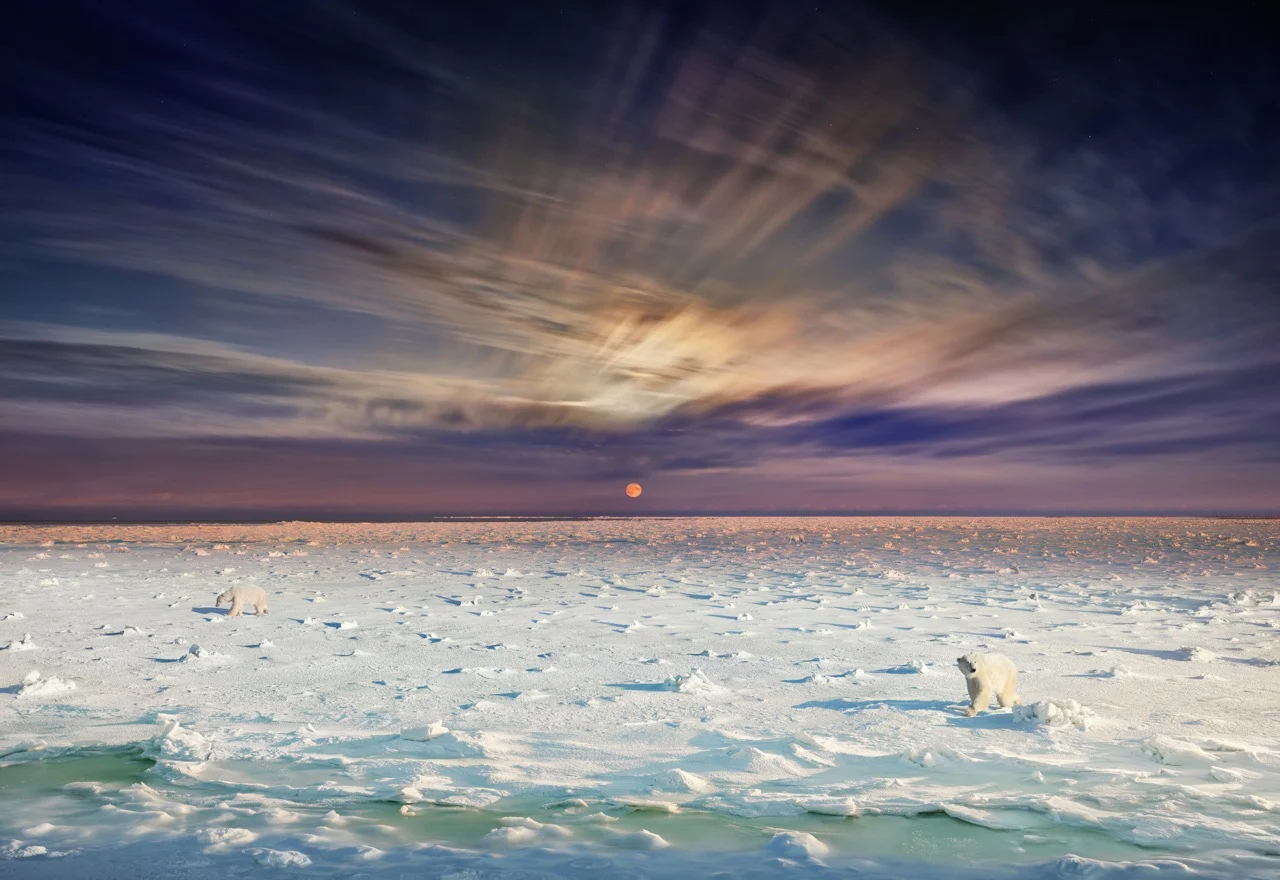
The interior of the tent is frigid. It’s winter in Churchill, Man. and night is coming on, but photographer Stephen Wilkes can’t risk any heat distortion ruining the shot.
Wilkes is waiting for a “supermoon” to appear over the still-forming ice of Hudson Bay. He’s also waiting for polar bears.
A fellow photographer cautioned that the bears haven’t been crossing this expanse of ice because it has been too warm for them. Luckily for Wilkes, there has been a two-day cold snap and the bears are finally on the move. Walking across the ice in search of food, the animals are hungry, frustrated and fatigued. “You can sense their uneasiness,” says Wilkes.
Wilkes is here to tell the story, in his own unique way, of how the changing Arctic climate has impacted polar bears in this region and how they will need to adapt to survive. Over the next 24 to 48 hours, he will capture 1,500 to 2,500 separate images. Then, with his team, he will edit the best 50 together to create one seamless image depicting a full day and night of activity on the ice. This postproduction process can take a month. The final image will join a series of some 80 compositions Wilkes has created since 2009 called Day to Night.
Each of the final images blends time seamlessly and incorporates different narratives of what happened in that space during the day. Day gives way to night along any of the axes. Time can sometimes even roll out over the diagonal of the photo.
“Time is this fleeting thing that it’s very hard to put a face on, but in my pictures, you get to see time change and move in a way. It became a whole new way of looking and seeing the world,” says Wilkes.
Wilkes says he aims to portray not just at-risk species, but also the diverse habitats they depend on and the connections within and between ecosystems. “I want to bring you into these worlds, and I want you to experience that place the way I do. So much of my work is about the depth, the details that you get to see, the gesture, being able to almost feel like you’re sitting there with me in the field experiencing what I saw with my own eyes.”
Over the past 10 years, Wilkes has created seven Day to Night images in Canada, with support from the National Geographic Society. Read on to learn more about each of them.
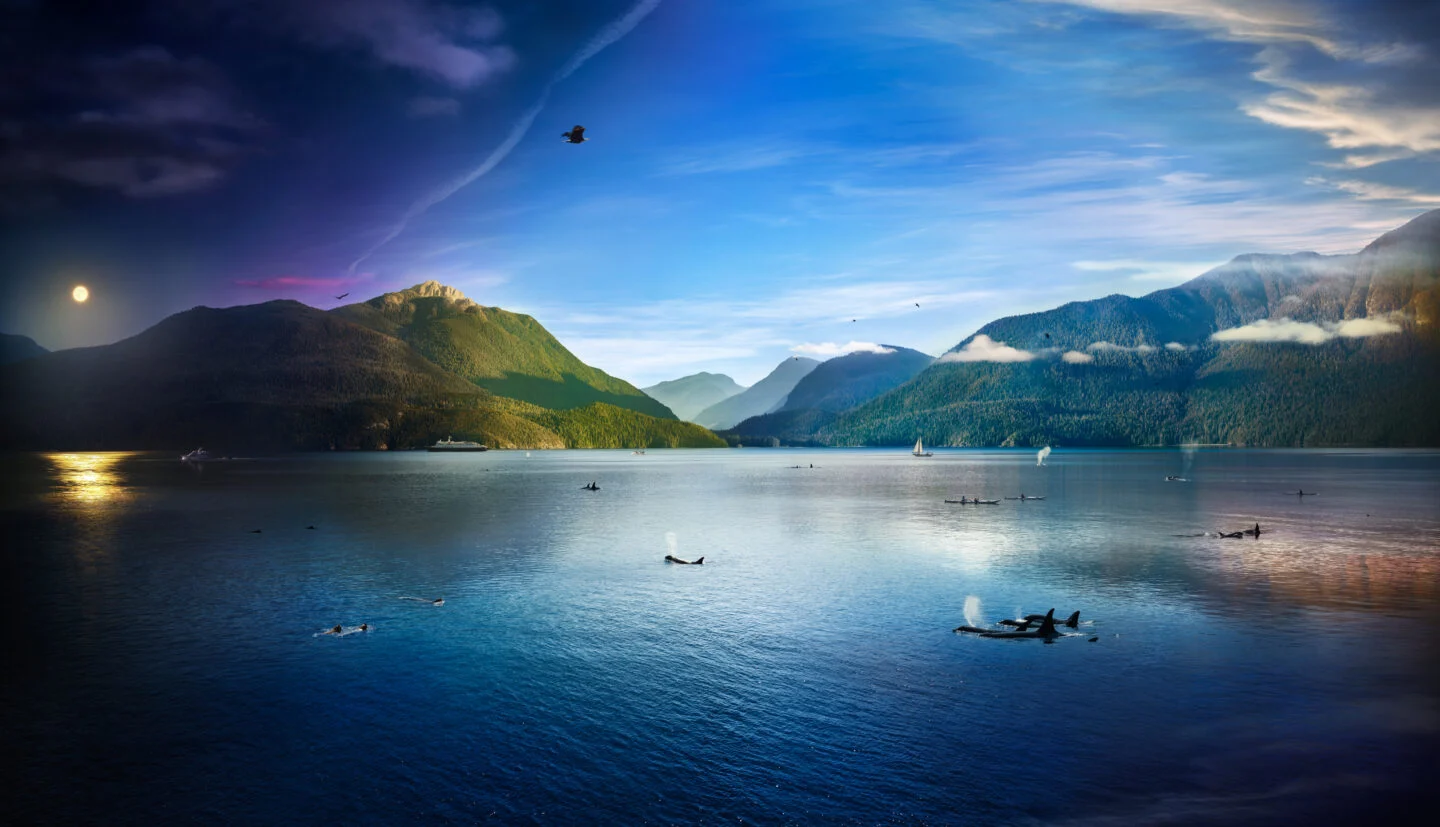
In 2016, Wilkes was approached by the Cetus Research & Conservation Society, a non-profit that works to minimize disturbances to marine mammals in B.C. waters through direct whale monitoring and public education. The organization pitched Wilkes on photographing Robson Bight (Michael Bigg) Ecological Reserve where, year after year, northern resident killer whales return to rub themselves on the rocks, exfoliating dead skin.
““[They] come for a spa treatment basically,” says Wilkes.
Unsure if he would see any whales, Wilkes hunkered down for his usual 36 hours of watching the landscape. What unfolded next was one of the most magical experiences he’s had in Canada, he says.
With access to underwater microphones, Wilkes was able to hear whale families communicating as they came in and out of the bight. He recounts hearing “a huge vocalization that no other orca made” and getting behind his lens just as a humpback whale breached the surface of the water. This is reflected in the final composition by a large visible plume in the right third of the image, toward the back of the water.
The final image depicts a day in Robson Bight: the coming and goings of several orca families, the humpback, swimming sea lions, flying bald eagles and the usual traffic of pleasure craft, fishing vessels, cruise ships and kayakers.
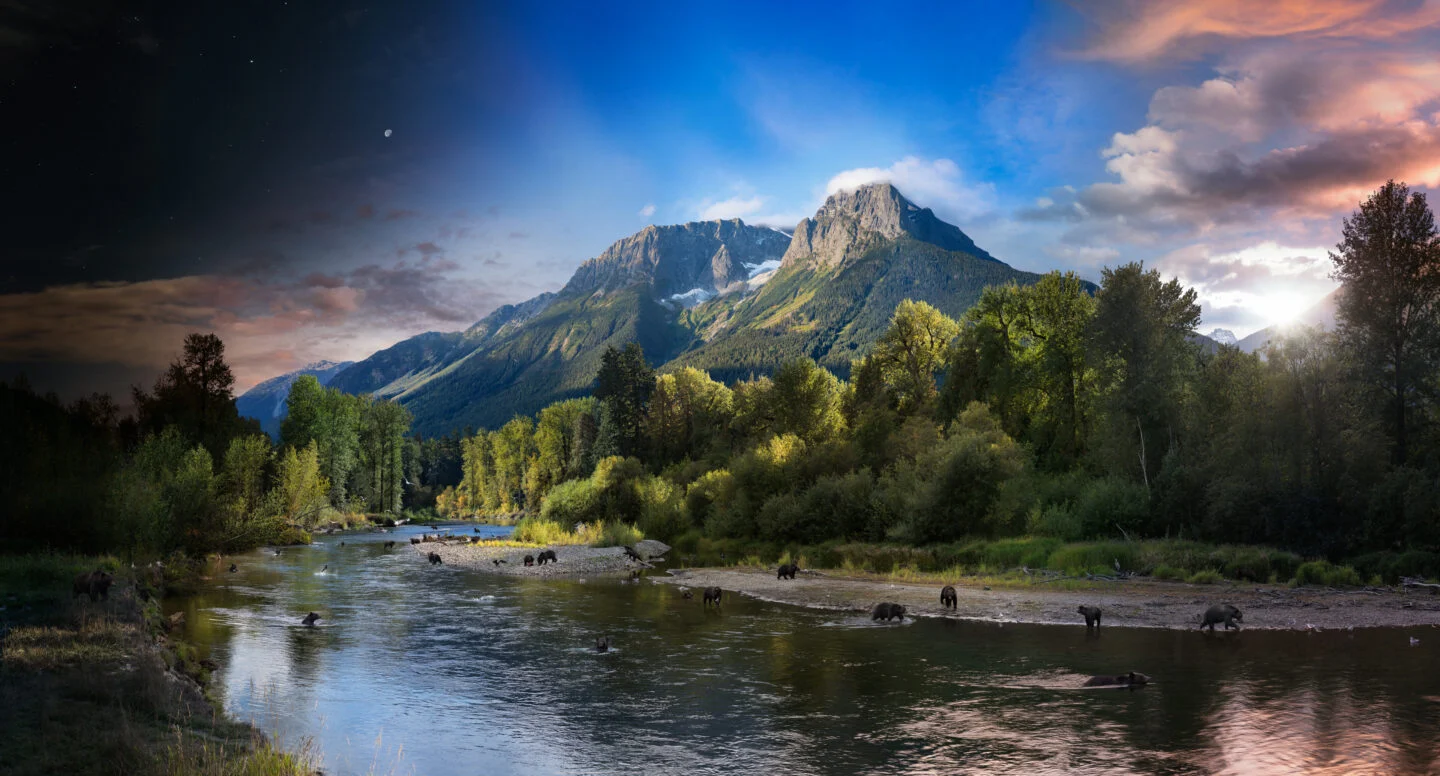
Photographing from a six-metre scaffold over 36 hours, Wilkes captured hungry grizzly bears feasting along the Bella Coola River during the salmon run.
He watched, entranced, as a mother bear scolded her cub for wanting to eat the fish before she was done filleting it. And he had to think quickly when a male grizzly bear, attracted by the scent of the honey-eucalyptus lozenges Wilkes and his assistant were sucking on, approached the scaffold and stood on its hind legs, sniffing the air. “He was so close to me, I could smell his breath,” says Wilkes.
Wilkes threw the lozenges into the river and the bear followed its nose away from the two humans.
Of the bears, Wilkes says, “When they feel that you’re not respecting them, that’s when things can get very scary, and so you have to maintain a certain kind of energy and also a respect. And they have to feel that.” He adds that watching the bears go about their day, hunting and communicating, “I felt like, in a way, I had been invited into their home.”
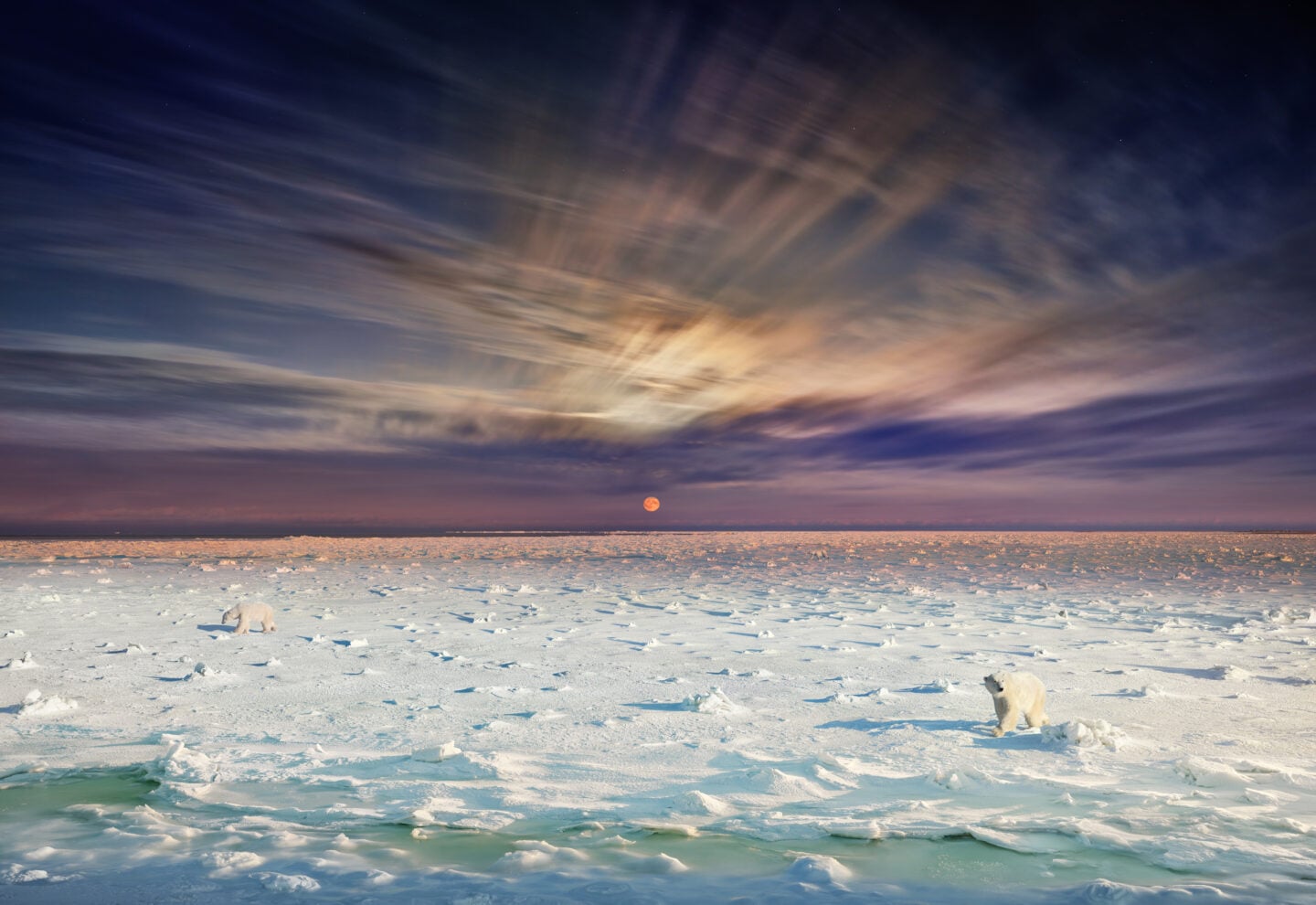
In this image created in Churchill, Man., the day begins at the bottom of the image, where the ice of the Hudson Bay is not yet frozen, travels over the peaks and valleys formed by the freezing ice, past the supermoon in the center of the photo to moon rays at the top of the photo. The light and shadows change, and embedded within the scene are six polar bears, including a hungry male chasing a female with her two cubs.
Wilkes says this image is one of his favourites because “it’s so arresting and has such a powerful message, storytelling-wise” — that of the sea ice being delayed and the impact that has on the bears’ ability to hunt for their preferred food. These bears will need to adapt to this change in their environment to survive.
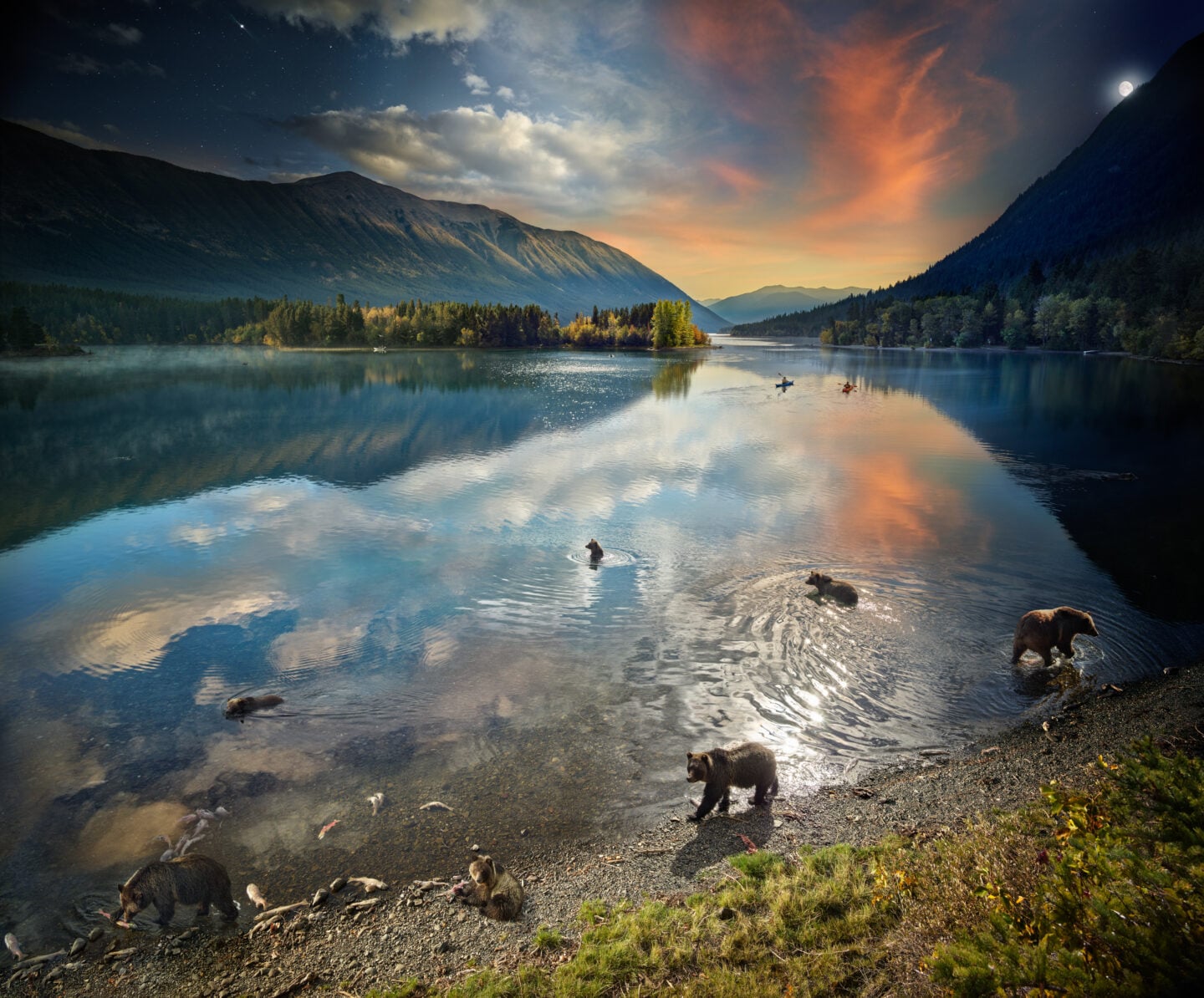
Wilkes returned to B.C. to photograph grizzlies again in 2022. This time, he captured the bears swimming in the glacial waters of Chilko Lake, the largest natural, high elevation freshwater lake in Canada. Shooting from the deck of a camp and looking down on the lake over 36 hours, Wilkes watched “very hardy” bears hike down to the lake to swim and fish for salmon and trout.
“It was frankly magical,” he says of the experience.
Wilkes says his goal with this photograph was to show how people can coexist with bears. In the upper right-hand part of the scene are two kayakers — a common sight on the lake. “People go about their lives,” Wilkes says. “They understand, they respect the bears, the bears respect them.”
Wilkes also wanted to highlight the story of the Tsilhqot’in First Nation, which gained Indigenous title to the land in 2014 and has worked to protect grizzly bears within their territory. Their success is reflected in the way wildlife is “beginning to flourish again in those areas,” he says.
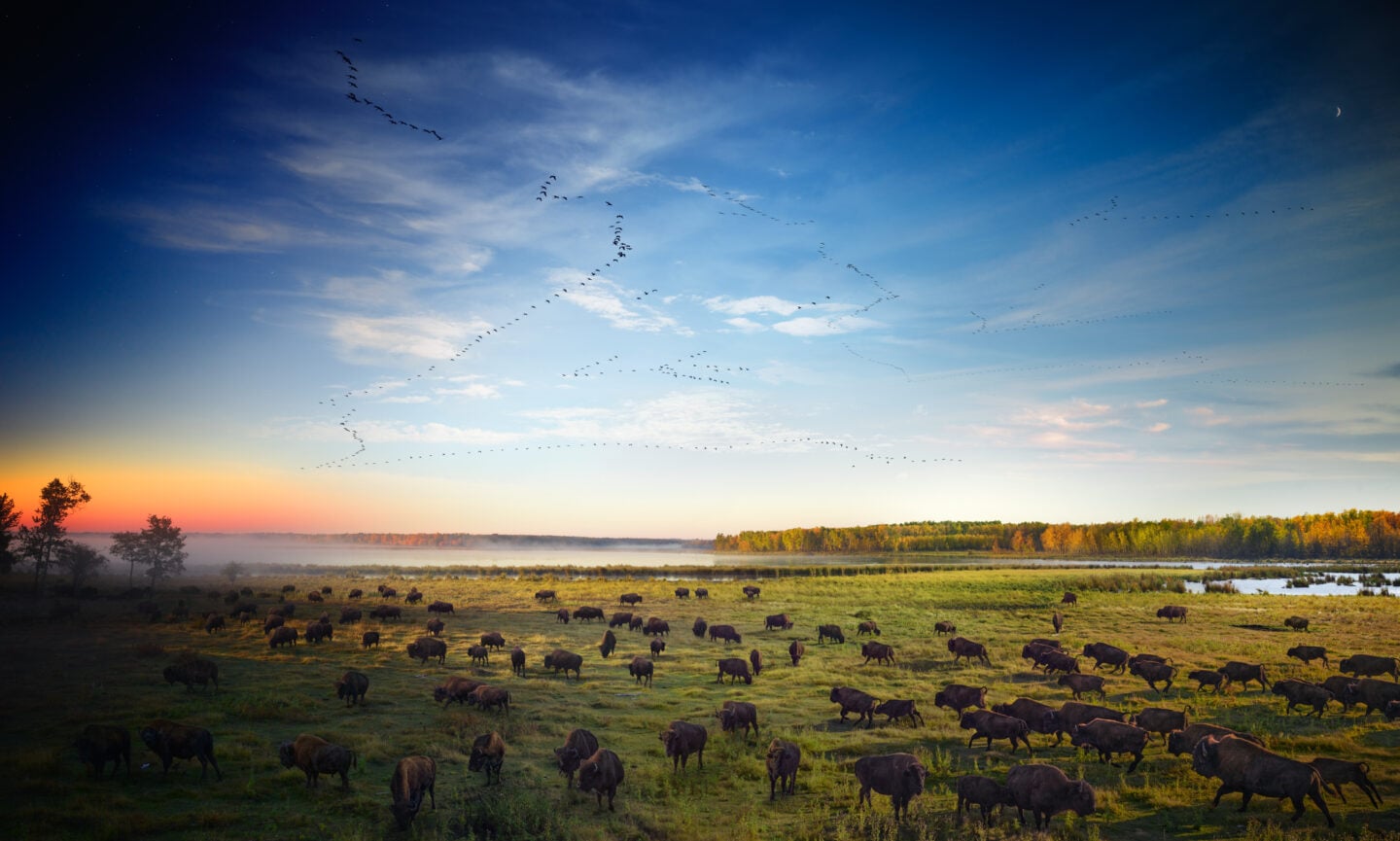
In a bid to save bison from extinction, the Canadian government introduced more than 700 wild bison into Alberta’s Elk Island National Park between 1907 and 1912. Among the trees and rivers of this park close to Edmonton, populations of both plains and wood bison flourished — so much so that according to Parks Canada, the park has transferred more than 2,500 bison to other conservation sites. Wilkes became interested in this successful conservation program and set out to capture an image of the animals in their home.
While capturing the individual images for this composition, Wilkes was surprised at the curiosity of these huge “primordial” animals. “The curiosity of a species really for me becomes a wonderful element because it allows me to see them from different angles and actually see their behaviour change,” he says.
However, he also describes the bison as “incredibly spookable.” To minimize disturbance to the animals, he and his team set up an elevated blind and waited for more than two days for the bison to naturally cross the scene. Wilkes says what he loves most about this image is the sandhill cranes flying through the autumn sky above the park: “They’re just magnificent creatures and it was just such a beautiful addition to all of the things that I’d witnessed with the wood bison.”
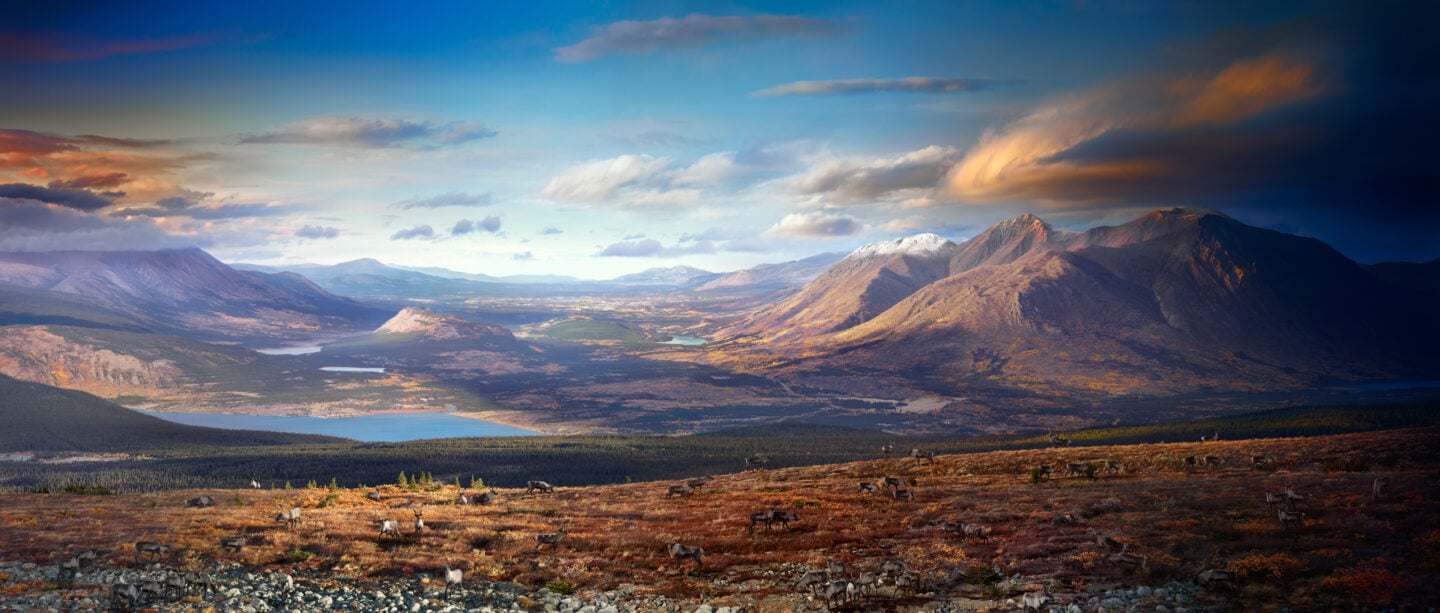
Wilkes describes this image he made of northern mountain caribou in southern Yukon as the most difficult he’s ever shot. He initially built a nearly eight-metre-tall tower overlooking an area where experts predicted the caribou would be passing through on their fall migration.
However, after three days of waiting in the tower, no caribou appeared, so Wilkes decided to return a month later. When he arrived via helicopter, the tower had toppled over in a snowstorm. He and his team rebuilt it only to have it blown over again within a week.
With funds for another helicopter flight in short supply, friends on the ground told Wilkes that caribou were congregating at a dry riverbed he could access by car. So, piling all his equipment into two vehicles, he drove to a place near the town of Carcross. The final image was shot from inside a tent erected on top of a Toyota land cruiser that had just enough room for Wilkes and an assistant to sit with three feet of space above them.
In the end, Wilkes says, it was worth the trouble to document the valley in fall.
“Seeing the golden leaves, the way they contour the mountain range, and then seeing the wind creating these beautiful striations in the cloud formations, it was spectacular,” he says.
Wilkes quips that his motto is “if I’m not uncomfortable, then I’m not working hard enough.”
“I think great creativity happens when you’re challenged,” he says.
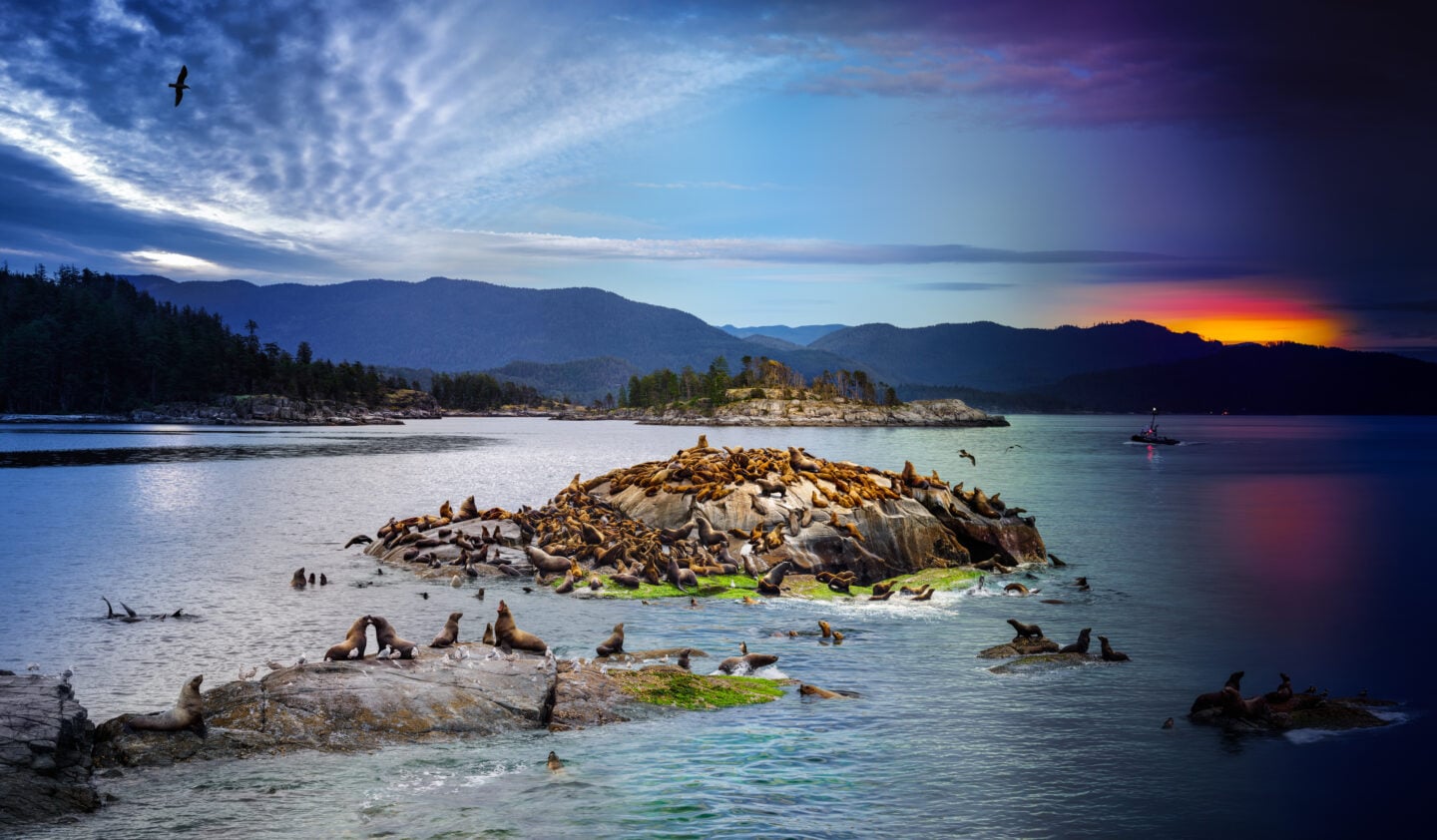
Steller sea lion populations in Canada have rebounded significantly since 1970 when the species was protected under the federal Fisheries Act. This positive story drew Wilkes to Jervis Inlet last spring.
Wilkes captured two days’ worth of images of sea lions playing and battling for prime position on the rocks of tiny McRae Islet. In the final image, each of the rocks has a male fighting for a dominant position on it.
Wilkes also paid attention to the changing tide throughout the day and how that affected the sea lions’ behaviour. On the left side of the image, the tide is high; as the viewer’s gaze drifts across the image from left to right, over the center rock, the tide drops four metres to reveal lush seagrass where sea lion pups are playing. The tide then comes back in, and the sea lions climb back up on the rocks to rest.
Wilkes says he fell in love with the species during their time together and hopes that the success of protection programs for the so-called eastern population of Steller sea lions can be replicated in Alaska and the Aleutian Islands, where the western population is listed as endangered under the U.S. Endangered Species Act.
Wildlife
In the Hudson Bay Lowlands, polar bears have reigned supreme. Increased sightings of a new predator have everyone on high alert.
People & Culture
Depending on whom you ask, the North’s sentinel species is either on the edge of extinction or an environmental success story. An in-depth look at the complicated, contradictory and controversial science behind the sound bites
Places
Nearly wiped out in Alberta in the 1800s, plains bison are making a historic return to Banff National Park
Wildlife
Humans and bears are sharing more landscapes now than ever before. As we continue to invade their world, will we be able to coexist?