Environment
Inside the fight to protect the Arctic’s “Water Heart”
How the Sahtuto’ine Dene of Délı̨nę created the Tsá Tué Biosphere Reserve, the world’s first such UNESCO site managed by an Indigenous community
- 1663 words
- 7 minutes
People & Culture
Great Slave Lake’s giant water spirit; fears over downstream contamination among topics explored by award-winning Dene author Katłı̨̀ą Lafferty in this excerpt from her latest book
Editor's note
Water is our most precious resource. Without water we cannot live. It is what gives life to Mother Earth. We are created from water which is why our bodies are made up of mostly water.
Working on the Mackenzie River Basin Transboundary Water Agreement, a groundbreaking agreement that protects NWT waters from contamination, was the first job I landed after graduating from university. It is where I met my best friend Jennie McPherson. We were on the same file together. Getting the provincial government of Alberta to sign the agreement in 2015 was no easy feat, because the agreement prohibited downstream effects from the tar sands and at the time of signing, the oil industry was at its peak in Alberta, so to have the Alberta premier sign off on the agreement was a victory.
At one of the consultation meetings that we held in-community during the making of the agreement, an Elder was given the microphone and said that one day water will cost more than gas — and that day has come. A liter of bottled water can cost upward of five dollars depending on where you live, while a liter of gas is a dollar fifty at the pumps give or take.
Nowadays a bottle of water isn’t just water. It often contains other ingredients. Water was never meant to be sitting stagnant in a plastic bottle, or even a treatment plant. It is meant to constantly flow over minerals and pick up nutrients as it travels, so that when it is consumed it fills our bodies with the natural minerals that we need.
In the north we have seen extreme water level fluctuations over the years. Some years there is flooding. Other years there is drought. Chiefs from different nations across the NWT get together from time to time for political reasons, and sometimes they are old friends. Chief Fred Sangris says his friend, the Chief of Tulita at the time, phoned him one spring and said “Fred, I’m ready to walk across Mackenzie River to the other side.” He wasn’t joking. The river was the lowest it had ever been, sitting at about two feet and getting lower. The barges had stopped running. Fuel and supplies had to be flown into the community.
How could this be? This is the same river that almost swallowed me on a bus ride from Edmonton to Yellowknife. It was at a time when vehicles had to cross over the ice road, before a bridge was built. It was springtime and the ice was rapidly melting on the river, but the bus driver took a chance anyway and drove across the slush. The water was above the wheels and I thought for sure we were going under. We made it across but the bus broke down soon after we got back on solid ground.
Mary Jane Cazon’s father told her that wherever he went out on the land he would get fresh drinking water from mossy areas. He would remove the moss from the ground, and immediately after he could see fresh water rise to the top. He told her that one day that would no longer happen because the land would be dry. He blamed it on what was happening down south with resource extraction, says Mary Jane. He told her the water system that runs underground would be affected and we would no longer be able to live the way we used to live.
I learned about the importance of groundwater once while visiting Kátł’odeeche First Nation, one of the only reserves in the NWT. I was sipping tea with an Elderly couple in their living room when they explained how groundwater works. Not much is known scientifically about groundwater, but these two had it all figured out. We all know that water and oil don’t mix. Fill half a cup with oil and the rest with water, and you will see that the oil rests on top of the water. Similarly, in nature if you take too much oil out of the ground, or if the permafrost layer above the groundwater melts, the water beneath rises up through the ground until it evaporates, contributing to drought and these past few years have been the driest on record in certain places across the NWT, fueling out-of-control forest fires.
The Kátł’odeeche Dene who live along the Hay River have experienced major flood events but now parts of the river are just a trickle. It used to be that you would have to drive all the way around the river from one end of town to the other to get to the reserve, but now that there is no water it just takes a few minutes to drive across the bank.
I visit Hay River when I can because my sister lives there. In fact, I spent a month in the height of winter living in a small cabin just outside of Hay River on the shores of Tucho while teaching a class about northern journalism. I forgot to plug my mom’s truck in one morning at -50 and it froze like an ice cube. I had to get help to boost the battery.
Even inside the cabin the cold still managed to get in. The wind would howl all night and in the morning a triangle of powder, a miniature mountain, would be piled up in the entryway from the small crack in the door frame.
During that cold spell we had organized a field trip for the class to go out and check nets with the local Elders. My toes froze as we stood under a sun dog on a crisp winter day while one of the Elders showed us how to cut a hole through the ice with an auger and run the netting through to another hole about twenty yards away. When it was time to bring the nets up the next day we had only caught one fish. The Elder said that the fish aren’t in abundance like they used to be and they have changed in appearance due to the effects of the oil sands directly upstream. A direct breach of the transboundary agreement.
With Kátł’odeeche encountering so many significant climate events in the span of a few years, it was almost too much for the small reserve to take. They had been through flood and fire evacuations, a pandemic and severe drought, and as a result many people had lost their homes—and when you don’t have a home it can become so difficult to cope that it can exacerbate social issues. Hay River has a high crime rate for drug related offences and even murder for such a small town. It’s not just Kátł’odeeche, in fact the NWT was listed as the crime capital of Canada more than once and it could be attributed to the hardship of a changing climate.
The next day, as I waited in the airport for the plane, I sat and visited with some acquaintances. We laughed about the big clunky computer that I had to lug around with me everywhere, because I was still working remotely with a law firm that expected me to bring it with me wherever I went. The computer was the size of a small television and slow to start like an old car with an overheating engine and the screen blanked out every once in a while for no reason.
The plane back to Yellowknife was not full. It was only a few people plus a police officer escorting an inmate in shackles. Before takeoff the flight attendant told me I needed to put my computer on the floor in front of me, and I complied after trying to reason with her that it needed its own seat. As we took off, the computer slid down to the back of the plane and landed at her feet. The flight attendant returned it to me thinking it was broken and I hoped it was.
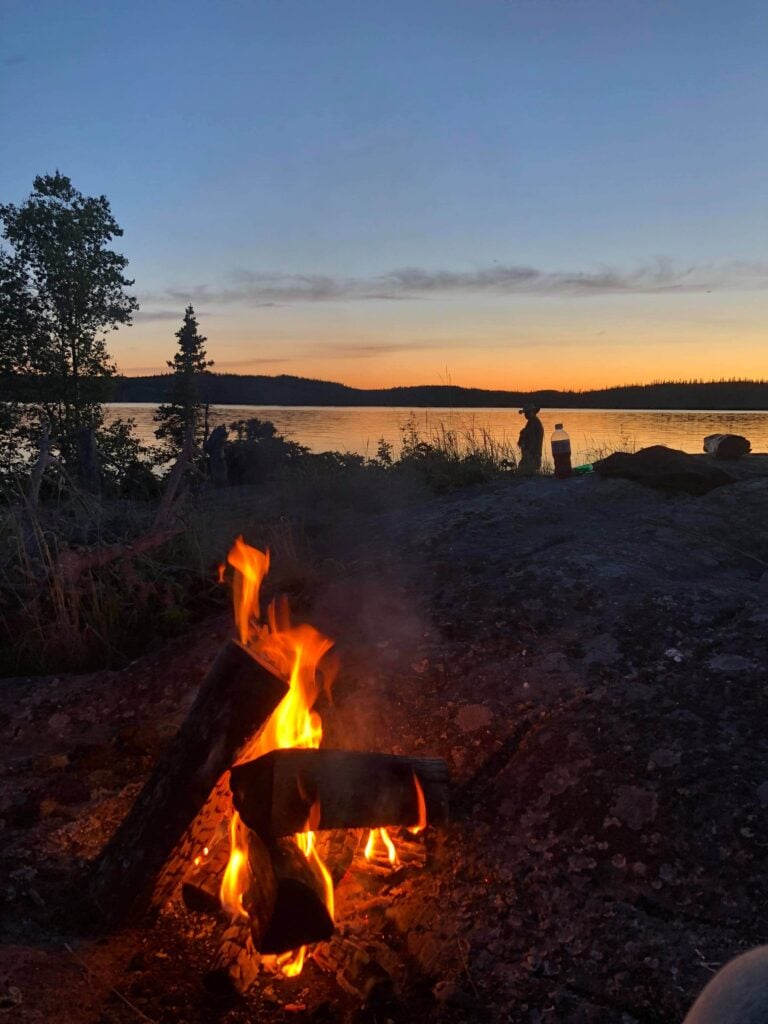
We had to stop in Fort Simpson to pick up a few passengers[MWB1] on our way to Yellowknife. When we landed I got off the plane and put a coin on the ground to pay my respects, because I didn’t have tobacco and I hadn’t been to Łıı́ dlıı̨ ̨ Kúę ̨́ for a long time. The last time I was there I had driven there from Yellowknife to attend the Dene Nation National Assembly. My daughter was with me and she was quite young at the time, but she was brave enough to get up and sing a song in front of everyone at the local talent show. She didn’t win first place but she did win a very stoic looking doll with a headdress. The doll was about four feet tall. She was a bit scared of it and I’m not going to lie, so was I. On the drive home the doll had to stay in the trunk and I don’t know what ever happened to the doll after that.
Łıı́ dlıı̨ ̨ Kúę ̨́, or Fort Simpson, is on the banks of the Dehcho. People say that the water in the Dehcho and the Hay River is low for many reasons not just one. Global warming, the dams upstream, the oil sands, not enough snowfall. But now all of these variables are compounding on top of one another, and as a result, of these cumulative effects, the rivers are running dry. If this keeps up, there will be no need for bridges.
And it’s not only the Dehcho, all rivers in the north are becoming compromised. As Chief Fred says, “The worst is yet to come if humans don’t do anything. If they want to save the Earth, they have to work fast otherwise the old prophet is speaking the truth.” As Fred reiterates this warning, a raven squawks in the background echoing his words.
All the major rivers once had roaring rapids right up until August, Fred recalls. There used to be a lot of rain in the north. When he was a child all the children in the community used to go out in the rain and dance. That type of heavy rain hasn’t returned for almost a decade. If it does rain, it’s usually a quick downpour and it’s over in the blink of an eye.
The Dehcho and the Liard River, meet just outside of Gilbert and Mary Jane’s front door. Directly across from their home is an island called Gros Cap. People would meet and gather there, says Gilbert. There would be a drum dance day and night. From there, some people would go further down the river all the way to the Arctic Ocean and trade with the whalers.
With global warming comes extreme and unpredictable climate events. In a drought the last thing you would think would happen is a flood but that’s what happened to the community of Łıı́ d́ lı̨ı̨ Kúę ̨́ during the Covid lockdown and the entire community had to evacuate. Mary Jane and Gilbert’s house is on high ground, so they didn’t lose their home like some other people in the community. As a result of the flooding there was a food shortage and the shelves were empty because the barges couldn’t run. It took a long time for the community to clean up the mess after the flood and everyone pulled together to help one another even with the difficulty of having to social distance.
These present-day climate catastrophes are a long way away from the days that Mary Jane remembers spending with her father as a child floating in the middle of the river and checking fish nets without a care in the world.
She remembers seeing a layer of film on the surface of the water for the first time as a child. Just past Black Water, there was a creek where she used to pick rosehips with the Elderly women while the men were checking their fish nets. She saw something brown seeping out from the creek. Her father and brother went for a walk to see where the sheen was coming from and they saw a cluster of bent willows. Her brother chopped at the willows until he hit metal. “There was a whole bunch of army jeeps that were buried in that creek.” The jeeps were buried next to forty-five-gallon barrels, and the contaminants from the machines were seeping into the soil and water, polluting everything in its wake. The vehicles were left behind from World War II, when the army had been in the area transporting fuel and supplies to their bases. “A lot of machines that they used were never brought back, so they just buried them up here,” says Mary Jane.
To prevent our northern waters from being dumping grounds for industry and military, the NWT needs to raise the alarm on the transboundary water agreement to prevent further cumulative impacts in our waters in the north. Even if enforcement mechanisms are put to use, the concern is that punitive law is not working as it should be. Industry can easily pay their way out of fines and not change their ways. Now that the military is starting to turn their attention back to the north for opening the arctic corridor, industry is racing to the rich oil deposits on the ocean floor which means we need to hurry up and bring back our oral Indigenous stories to protect our lands and waters. Indigenous stories can do more to save our planet than any agreement on paper ever can, because Indigenous stories are able to transform hearts and minds. Indigenous stories show us that nature has the right to exist unharmed. We must not forget that just like humans have human rights so does water. Water has the right to be clean and flow freely. During my time working on the negotiations team, we often referred to the agreement as the “kraken”— a giant water creature — because it was such a large, complicated project to undertake. But the transboundary agreement is not the only giant water entity that exists in the north, there’s another one much more mysterious and elusive and this one is not found in the boardroom, it lurks in the deepest depths of Tu Nedhé, the Great Slave Lake.
George Mandeville encountered the large lake creature three times in his life. I got the percolator figured out and poured him a strong cup of coffee, just as he finished telling me about his near-death experience with quicksand and was about to start in on his lake creature sighting story. “Delicious” he says after taking a sip.
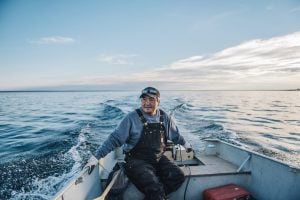
I’ve heard George tell his lake creature story before, but I ask to hear it again and he retells it the exact same way every time. The first time he saw it, was in the East Arm of Tu Nedhé, the big lake as George calls it, when he was with his wife and one of his grandchildren on their way home from the Dene National Assembly that was being hosted in Łutsël K’é. It was stormy. They probably should have stayed another day to wait for calmer weather, but they took off back to Yellowknife as soon as the gathering was over, following and keeping close to the shoreline. They were halfway to Red Cliff, and two- thirds of the way to Ɂetthën Island—meaning “caribou point” in Dënë Sųłınë́ Yatı—̨́ in a channel that almost looks like a river. “We were cruising along there, full speed.” And that’s when he saw it. “To me it looked like an elephant’s back. It just appeared about fifty feet in front of me.” Either that or it looked like an upside-down canoe he says.
It was about three feet out of the water and about thirty feet long. “I didn’t want to run into it, so I cranked the wheel of the boat as hard as I could to the left.” His wife started screaming. His grandson was in the back not knowing what the commotion was about. It happened so fast, remembers George. They almost crashed into the wall of the cliff but he had to try to get around whatever it was in front of them. “It looked huge, and I had to act fast otherwise I would have slammed right into it.” It was dark-colored. He circled around but didn’t want to go back to see what it was because it unnerved him. He quickly explained to his wife what he saw. She couldn’t see it because she didn’t have a windshield wiper on the passenger side.
I wonder out loud if this is the same lake creature that Tanya Lantz told me she saw, and George is surprised that I know about her sighting. He knows about it too and says that Tanya saw it about three kilometers past the same point just a few days before. Tanya happened to see it on her way to the Dene assembly. It must have been in that area for a few days, George guesses.
“What do you think it could be?” I ask. That’s when he starts to describe the second encounter when back out in the North Arm of the big lake. “George Tuccaro and I were fishing close to Utsingi.” It was a beautiful day, and “the lake was like glass.” George was puttering along at about 10 kilometers an hour, just a bit above trolling speed and Tuccaro happened to be having a nap. George always looks out at his surroundings when on the water, and that’s when he noticed something was swimming behind the boat to the left of its wake. George said it looked like it had a large frog head because it had eyes on the top of its head. The creature was so large that its eyes were spaced about two feet apart, and the eyes themselves were about two feet in diameter, like the headlights on a semi-truck says George.
George woke up Tuccaro and asked, “What the hell is that following us?” Tuccaro turned around and saw the water creature keeping up with the speed of the boat and asked George the same question right back. “Pass me my binoculars,” George said to Tuccaro. Just as he was passing the binoculars to George, the creature disappeared back down into the water.
In her thirty years of working up and down the Mackenzie Valley, Tanya Lantz has heard stories from the Elders about when the north was a tropical territory. “We had different trees here,” she says. The Elders told her it was very warm and that it might be tropical again one day in the north. Some of the Elders she spoke with, who have since passed on, told her that evidence of old trees would be found when they mined the earth and dug into the ground, and they were right once again.
Celine Marlowe has a large photo of her late husband George hanging on her bright green living room wall. George once told her that a long time ago he used to hear the Elders say that the north was once a jungle and that one day it will probably be like that again. Celine hopes it won’t be in her lifetime. She would take the cold over the heat any day. Celine tells me that her husband was working at the Ekati diamond mine—Ekati meaning “fat lake” in Tłıc̨ hǫ Yatıì—when they found an ancient tree. It was way, way underground under many layers of earth.
Rumor has it that when the driver of the excavator drew the claw back and exposed the earth, he had a strong whiff of cedar and got out of his machine to take a look. That’s when he spotted an ancient tree stump. The tree is confirmed to be a 50-million-year-old fossilized piece of redwood cedar located 315 meters below the earth’s surface to be exact, preserved to near perfection. It was tropical here in the north thousands of years ago and our ancestors knew this. How could they have known this without someone having witnessed it and passing on down the line? Science says that humans are only roughly 300,000 years old, but the findings of this tree and the knowledge that it was there as told by Dene Elders is persuasive evidence that we are much older than we have been made to believe.
With all that we know about the history of the north once being a tropical oasis, it’s quite possible that the lake creature could have survived that time period. Whether it be tropical or prehistoric, George Mandeville is not entirely sure that what he saw that day in the water was the same creature he saw the first time, out in the storm with his wife and grandson, but he’s not ruling it out.
George tells me that he talked to a man who had employed two divers to search for a body in that same area, after a person fell through the ice and drowned. When the divers came up, they were adamant that they weren’t going to dive back down. “They saw something huge that bumped one of them.” The divers described it as the size of a whale. “They figured it would circle around them and take a bite out of them,” George says with a laugh.
It makes me wonder how many sightings there have been over the years. Even one of the community priests saw it. The late Father Jim Lynn said he spotted it just off T’èɂehdaà Point, not far from the little church where he conducted mass every Sunday. “It’s been reported for thousands of years passed on. Every generation has seen it,” George says. He has spent a lot of time on the big lake, which makes it more probable for him to have seen it more than once.
There are canals and underground tunnels underneath the lakebed. There is also a theory that the two great lakes—Great Slave Lake otherwise known as Tu Nedhé, Tucho or Tindee, depending on what language you prefer to use, and Great Bear Lake, Sahtú, are connected through underground tunnels. George says that the two lakes were once joined. “It was the biggest lake on earth.”
I believe that the two lakes in Dënéndeh are still connected through tributaries and groundwater. Could it be that the giant living lake creature is an inhabitant of both the NWT’s great lakes?
The third time George encountered a large unidentifiable creature in the water, his wife and her friend saw it. They thought he’d run over a reef that appeared out of nowhere but it was there and then gone again. The depth finder in that area read 600 feet—they were just before the turn at Devils Channel. It is in that area where an offering is often made by the Dene to cross the lake safely, and the creature that George describes has been spotted in that area several times by many people according to George’s friend, the late Alfred Lockhart. Tucho has 300-foot cliffs sheathed in the world’s oldest rock, and known depths of up to 2,000 feet. Take away the water and you’re standing on top of a mountain. But there are also parts of the lake that are extremely shallow. George tells me that he measured the North Arm of the lake once when he was guiding a team of biologists who were collecting soil samples. He tied a string to an axe handle and lowered it off the side of the boat. It was eleven feet deep in all directions consistently across the whole bay. Even though it is only a few feet deep, the current is strong and can sweep a person away if they go overboard. This could explain why no sightings of the lake creature have ever been documented in the North Arm area—it’s too shallow for a creature of that magnitude.
Every time I hear an account of the lake creature being spotted it is in deep water, except for the time Tanya Lantz saw it. Before she relives the story of what she witnessed in the water, Tanya wants to make it very clear that “not all stories are meant to be shared.” Our Elders used to tell us what stories we could tell and what stories we shouldn’t share to just anyone because not everyone will respect them. I am thankful that Tanya was willing to share with me what she saw that day in the water. It is important that we tell our stories on our own terms when the timing is right. For far too long, our stories have been culturally appropriated. But how do we know which stories are to be shared and which ones aren’t? Dr. Nicole Redvers makes a valid point when she asks: “At what level of crises do we need to be in before we decide to break protocol. Do we break protocol in those instances or do we not?” That is the kind of question that we are grappling with as Indigenous people. So when do we pull the trigger on sharing our most sacred stories in order to help tackle the climate crisis? I am treading very carefully in unchartered waters.
The only ways to know which stories can be shared are by asking permission from the storyteller first of all and secondly by creating more opportunities for dialogue on when to expand the threshold of protocol and sharing, says Dr. Redvers. Now, in our time of crisis, it is time to open that dialogue a bit more, and so Tanya has so graciously shared with me her story trusting that I will carry it with care.
It was a couple weeks into the summer. There was a Dene National Assembly scheduled in Łutsël K’é. Tanya and her group were traveling by boat from Yellowknife to the gathering. The day before they traveled the lake ice had broken up. Tanya had hired a community guide to bring her, her daughter, her friend, her colleague and her colleague’s daughter by boat. There are different ways to travel to Łutsël K’é. She chose to travel through the islands.
“As we were getting close to the community, I decided that it was time for lunch. We were hungry and wanted some lake trout. We drove into a bay. The water was quite shallow. It was a super-hot day and the lake was like glass. We fixed up our fishing rods and cast into the water, and as soon as that hook hit the water we got a trout. Not just a small trout but a good- sized trout. We pulled it in. We were excited and happy we scored some lunch. There were two children in the boat so we cast another line for the other child hoping we would catch another one, and as soon as that hook hit the water we caught another really good-sized trout. We did it again a third time just to see if it would happen again and it did. As soon as that hook hit the water we caught another big trout. At that point I turned to the guide and said what’s going on? There shouldn’t be big trout in a shallow bay in this hot water. Something’s chasing them here and we’re in the middle of it. He agreed and said it’s not quite normal.”
It was then that Tanya suggested they go to the shore and have a shore lunch and be on their way, but after that third trout was caught she had what she describes as a heightened sense of awareness. An awareness that they were not alone, that something was there with them. Tanya chalks it up to a woman’s intuition. “We went to the shore and the guide that was with us went to the tree line to look for dead wood to start a fire. My daughter was still on the boat and that was when Tanya heard the sound of rushing water. “I never heard a whale spout before . . . but it sounded like a spout.”
She turned around to look at the lake and saw a huge creature as big as a house. It was dark and not far from shore. She says, “Everyone froze for a minute and they were all staring at it and couldn’t figure out what it was. The guide came running down the hill and he was ready to push the boat out. I didn’t think it was a very good idea. That if we had the privilege and the honor to see something like this it wasn’t for us to go investigate further.” Tanya did not want to bother it and convinced the guide not to go out onto the water by boat to get a better look. “It was way bigger than the boat and we had children with us. So we stood on the shore and watched it swim in between two points until it went away.” The creature was so big it created its own waves. “When it was gone, we finished our lunch and waited before taking off on our journey. Until we felt good and safe to go.”
Before that day, Tanya had only ever heard of one other person who saw the water creature —or “water spirit,” as she refers to it — and that person is the late George Marlowe from Łutsël K’é, Celine’s husband. He told Tanya that when he was a young boy he saw it and the Elders at the time told him not to bother it or investigate it. He informed Tanya that it usually means something in your life will happen one way or the other.
There is talk of trenches, tunnels and underwater caverns in the lake, says Tanya. “I really do believe now that this creature or spirit lives down there.” No one knows how far those passageways go, but Tanya recalls Elders talking about tunnels. She often wonders about what other people’s experiences are in the area near Betsıı̨ g̨ hıé. “It’s a very special corner that you have to go around. The waves go straight up because they come from both sides. It’s very scary. If the water is not calm people go around it.
Tanya knows about the divers that George spoke about as well who, rumor has it, even quit diving indefinitely after the incident. A couple decades ago there was a tragedy there, she tells me. Someone drowned. They sent drivers to retrieve the body. When the divers went down they saw something much bigger than them and they never dove again. “That was the last dive that they made in their lifetime. The body was never retrieved.”
Tanya herself remembers being anxious about the water. “I didn’t go out on the lake for a little bit after that. I didn’t go out on the lake without having the deepest respect every step of the way.” Tanya says it took her a few years to process what she saw that day. In the north, news travels fast. “When we got to the community, the story got out of what we witnessed.”
Because Tanya had built up a relationship with the Elders, her story carried credibility among the community — but there was a reporter there that scoffed at the story, she says. It didn’t bother Tanya as much as it bothered the Elders. “I’m not here to convince anyone of what I saw,” she explains. The reporter was not from the community and didn’t have the respect that she should have had. The Elders didn’t appreciate the reporter’s blatant and outspoken disregard and because of that the reporter wasn’t welcome back to the community Tanya says.
Steven Nitah who was the Chief of Łutsël K’é at the time of Tanya’s sighting says, “There are places where we have to be very respectful and quiet and feed the water. There are places where sightings have taken place for generations.” The creature has been seen. Photographs have been taken. The Elders said that any photos of the lake creature should be destroyed because they didn’t want the outside world to get excited about it. So why then am I telling this story? I ask myself for the hundredth time and all I keep coming back to is what might happen to that water spirit if the lakes continue to recede or become contaminated. Would the creature die and wash up on shore?
If you ask Alec Rabesca he will probably tell you that the lake creature is a mammal. He and his brother were traveling by skidoo on Stark Lake when they came across a large gaping hole in the ice where thousands of shards of candle ice were bobbing in the water in Tinde’e, near Łutsël K’é. The hole was about ten feet in diameter. “I’m pretty sure something was there.” Alec recalls that it was as if something came out of the water and broke through the ice and then went back under. “I got an eerie feeling when I went close to it, so I didn’t want to hang around.” Could it have been the same water spirit that Tanya and George saw? If it has to come up for air to breathe as mammals do, then it would have had to break through the ice. And in that case, it would make sense for it to live in areas of the lake where there is open water year-round—and there are portions of Stark Lake that are open all the time. Stark Lake is connected to Tinde’e through a small river system that the water creature could easily swim through right down the hill from the Łutsël K’é airport.
The only prehistoric amphibian I could find that might be close to what George, Tanya and Alec describe is a Phiomicetus anubis, that’s a mouthful to pronounce but the simple meaning of the term is a prehistoric whale. With the detail in Tanya’s account about the sound of a spout I wouldn’t be surprised if the creature had the features of a whale — which could explain why it would have to come to the surface from time to time to breathe. There is also the frilled shark that has been found alive off the coast of Portugal. It has 300 teeth, can grow up to seven feet long, has a fin at the very end of its tail and moves like an eel. This 80-million-year-old species has somehow survived mass extinction events so it is possible that our lake creature is also prehistoric.
Will world-class fishermen be even more attracted to the north after hearing about the lake creature? Would they be foolish enough to try to bait it? Possibly, but they would be hard-pressed to get past the Thaidene Nëné guardians—also known as the Ni Hat’ni Dene Rangers. Ni Hat’ni Dene means “watchers of the land” in Dëne Sųłıné. The rangers assert their Dene rights and authority in the park through their presence and activity on the land and water, maintaining the integrity of their cultural sites and the environment forever.
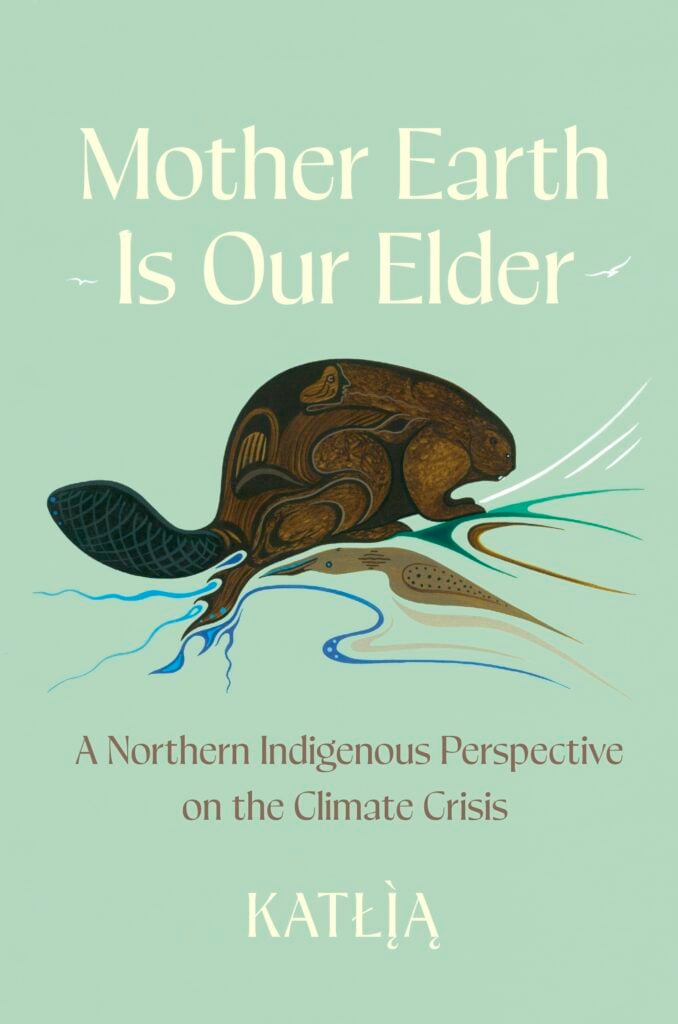
Maybe the water creature rising to the surface is trying to tell us something. Is it trying to warn us? Should we be honoring and celebrating the water spirit and not be afraid of it? Or could the creature perhaps be a giant beaver that wasn’t killed off by Yamǫǫ̀zha? Could the sound of the spout actually have been the sound of a beaver tail slapping the water? When a beaver slaps its tail it causes a splash, and beavers swim with their eyes above water—just as the creature’s eyes were above water when George spotted it. Either way, it would be wise to keep our ceremonies about the water spirit alive because our Diné relatives in the south believe that when the ceremonies stop the world will end.
Who would have known that in working on the transboundary water agreement I wasn’t only helping to protect pristine northern waterways, I was also helping to protect an ancient water spirit?
The water agreement should have included the words of the late great Dene prophet Ayah from Délın̨ ę, who warned that the Sahtú would be the last freshwater lake in the world and that people would flock to it from all across Mother Earth for refuge. He envisioned many people along the shoreline of the lake.
Could Ayah have also known what the lake looks like from above? I have asked around about why the lake is named Great Bear and the most obvious response is that there are lots of grizzlies and black bears around the lake. The other answer is that it is shaped like a bear from above. I can see how it might look like the hide of a stretched bearskin on a map, but in the days before maps how would the Dene have known that it was shaped like a bear from above? My friend Jennie says they most likely used medicine power to transform into a bird to see the lake from above.
I could not write about Great Bear Lake without first actually being on it, and that is why I went with Jennie and James on their annual fall trip to the cabin. Being gifted a caribou was just the first of many gifts from Creator that I received on that trip.
Getting out to the cabin was a journey in itself. I had to fly from Yellowknife to Le Gohlini, or Norman Wells, a town that was built solely for the purpose of extracting oil. Jennie and
James live in Norman Wells but Jennie is from Délın̨ ę and James is from Tulita. Both communities are located in the Sahtú Region just down the river from one another, and their cabin is located in between their birthplaces.
When I first arrived in Norman Wells, Jennie gave me the grand tour, which only took a few minutes because the town is so small. Then we went for a nice hike through a path of lined birch trees. The next morning, we were to travel the Mackenzie River, the original highway of the north before roads. We would travel up the Sahtúdə́ meaning Bear River, which leads into Great Bear Lake where their cabin is located. It was a beautiful day for a boat ride. Before pushing off from the dock, Russo, their dog, that looks more like a bear than a dog, decided to go for a plunge. He jumped in the boat and gave a good shake that we couldn’t escape, blessing us before heading down the Dehcho. “Russo.” Jennie cried and we all laughed. I looked back at Norman Wells as we left the shore and saw three islands in the middle of the river, Jennie said they are artificial islands built by the oil and gas company to extract oil out of the river.
We were warned that the Dehcho was extremely low, and it was. There are parts of the river less than a few feet deep and it’s possible to get stuck up on a sandbar. Because of this, James drove the boat very slowly just in case but he didn’t mind because he was also on the lookout for moose. A large rock in the distance started to become larger and larger and when we got right in front of it the magnitude of it was spectacular. It was Kweteniæaá—Bear Rock. The place where Yamǫ́rıa chased the giant beavers, killed them and dried their pelts in the sun. The three giant Tsàcho pelts are a different color from the rest of the rock. They are red and they face the community of Tulita.
The rock is quite massive, and sometimes you can see musk ox climbing its jagged surface. At the very top, there is a large cave that looks like an eye looking back at you. A bear must have once lived in there or maybe still does. Jennie and James sometimes take tourists for a hike up that rock.
Just before Tulita we turned left onto Sahtúdə́. “Bear River has a different feel hey?” said Jennie, and I nodded in agreement. It was clear with a rocky bottom, not murky and silty like the Mackenzie River. When I asked her where we were on the map, she pulled up her sleeve and showed me a map of the lake tattooed on her forearm. There’s no need for a paper map or GPS with Jennie as your guide.
We came upon Bennett Field, an open meadow with a backdrop of vibrant yellow trees. It is where Jennie and James got married. Russo jumped out of the boat and onto the wooden board that served as a plank, but he nearly lost his balance and almost fell into the river. James refueled the gas tank and we were on our way again in no time. James and Jennie had warned me that the Sahtúdə́ rapids were just around the corner and to brace myself, but I didn’t really know what to expect. All I knew was to try not to be alarmed if we hit a rock or two.
I’d never been river rafting before but I’d been down rapids in a lazy river, so I didn’t think it was going to be as intense as it was. Before entering the rapids Jennie and I switched spots, I sat in the front and she sat in the back on the makeshift bed that James made for us to be comfortable. James had to stand up and stick his head out the wind flap to see in front of him so as not to hit a boulder, and I can’t be sure but he might have had a cigarette hanging out the side of his mouth. When I looked through the clear plastic window all I saw were huge pink boulders everywhere in the water. We were literally skimming the surface of the water at top speed. Only a speedboat traveling light would make it through those waters. I felt like we were hovering. It seemed impossible. We were only in a few inches of water in some spots. James’s depth finder wasn’t even picking up a measurement, because when the water is that shallow it doesn’t work.
I held onto the bar at my side tightly and wanted to cover my eyes and tuck my head into my life jacket so I couldn’t see. I was afraid we would hit a boulder and go flying. I looked over at Jennie who had a very serious look on her face staring straight ahead. I wanted to hold her hand like the time we went to a trendy Nordic spa in the city and cold plunged into a large tub of ice-cold water for a minute straight. If we were to hit a rock and go overboard this would have been a whole different kind of cold plunge experience. Jennie saw the fear on my face and mouthed the words “it’s okay” and I tried not to move so as not to rock the boat. I felt like I was in the movie Jungle Cruise. We were in a no-man’s-land without any cell phone service, completely secluded. To top it off we were suddenly under an eerie dark cloud and the rain set in around us helping to put out the small smoldering fires on both sides of the river that were still burning from that summer’s forest fire season.
The rapids went on for a very long time. We were traveling at about forty kilometers an hour for twenty minutes straight without slowing. When we made it through the rapids the sun came out again, and we continued on at a reasonable pace the rest of the way to Sahtú through a winding channel. Jennie and I took a big sigh of relief that we made it through as James carried on like it was an everyday occurrence. The man deserves a medal.
We came to a small sign in the trees at the end of Bear River with an eagle perched just above it. The sign read “Sahtú” and pointed to the lake. The eagle flew low in front of us once it saw our boat — a greeting perhaps, a good sign. On land I shook my head in disbelief that we had made it, and Jennie said, “I’m not sure how much longer we’ll be able to do that.” With the water setting lower and lower each year it may not be long at all. Rapids are the filter of rivers and lakes. They breathe life into water. Without them, water becomes stagnant. I’m afraid that with the low water the Bear River rapids will be no more which doesn’t bode well for the connecting tributaries. Not being able to cross the rapids severs the ability for the Dene in the area to travel through that area and with the water levels getting lower each year there’s more chance of an accident as well, which can easily become a life- and-death situation—especially when there’s no one around for miles and miles to come to the rescue.
We didn’t have to travel on Sahtú for very long once we came out the mouth of the river before we reached Délın̨ ę, with the sunset in our rearview. I was finally on Great Bear Lake. I had been looking forward to this trip for a long time.
When I stepped foot on the dock in Délın̨ ę I took out some dzǪdiì, muskrat root, from my medicine bag and placed it in the water, to thank Creator for a safe journey and two little muskrats swam up next to it thinking it was food. At the same time, I overheard James and an Elder talking at the boat launch about how someone recently went across the bear river rapids and hit a few boulders.
We overnighted in Délın̨ ę before heading to the cabin. That night I slept alone in a bed and breakfast. I had two vivid grizzly bear dreams, back-to-back. Whenever I dream of an animal it is usually a bear which leads me to believe that I am related to the bear. Délın̨ ę is known to be a very spiritual place and every time I go there it feels as though there is a strong spiritual energy. The first dream I had was that I was out camping with my grandma and a big grizzly came sauntering over to us. I stood in front of my grandma to protect her. The bear had a log in its mouth. I grabbed the log out of the bear’s mouth and threw it and the bear fetched it like a dog. There was another grizzly to the right of us where the log landed, and the two grizzlies became distracted by one another which gave me enough time to run. I wanted it to chase me so it would leave my grandma alone and the bear did follow me. I pulled out the knife I brought with me for the trip in case the bear attacked me but it never did. Then I woke up and realized that it was my grandma’s birthday. She had come to visit me in my dreams. It was the middle of the night so I fell back asleep and that is when I had another bear dream. This time I was in a busy restaurant and I was outside looking in through a big glass window. There was a bear outside dancing — it was trying to dance like Elvis but didn’t quite have the moves. I thought it was me for a moment but there was also a cub next to it. The larger bear was shapeshifting, morphing into a human, in front of my eyes. It seemed to be trying to get the attention of the people inside the building but no one cared. It was like it was trying to entertain them.
I told these dreams to Jennie and her aunt in the old church where Prophet Ayah spent time, before heading back out on the lake the next day to the cabin. Her aunt warned that I should not talk about bears while out on the land because they can hear when they are being talked about and will come around and so I never spoke of bears again that whole trip.
On our last day at the cabin before packing up the boat all three of us and Russo had walked to Grannies Point. On our way there I found a flat stone and tried my luck at skipping it across the water. I’ve never been good at skipping rocks. The most I might get is three skips if I’m lucky. Well, for some reason I got about ten skips and was super impressed with myself. On our way back, in almost the same spot that I found the flat stone I found a loon feather. I picked it up and brought it back to the cabin and flattened it in a book. I knew the feather carried a message but I didn’t know any Dene stories about the loon and hoped to learn more. I got the answer I was looking for when visiting with Elder Lawrence Casaway a few days after getting home from Great Bear Lake when I sat with him on his front porch with the sun shining down and the sound of wind chimes blowing in the breeze. I had not told him I found a loon feather and was hoping to find out what it meant. It was like he read my mind because the last story he told me that day was a story about a loon.
Lawrence, like me, was raised by his grandparents. He wanted to tell me the story that his grandfather had told him in Dëne Sųłıné because it is better told that way. Indigenous stories are much more powerful when told in the language because there are words that English just can’t describe, but because I cannot understand my language — through no fault of my own, he warmly reminds me — he resorts to telling me it in English.
“Loon has a good heart. Loon was once pitch black, no markings.” One day Loon came across an Elderly man who was blind. The man was sitting on a rock by the water and Loon could see that the man was sad. The man was listing to the birds in spring and all the sounds around him. Loon came up to the Elderly man and asked, “Why are you sad?” The man said, “I can hear you but I can’t see you.” Loon then said, “Hold onto my wings,” and the man did what Loon instructed and held onto his wings and Loon dove down into the water. When they came up to the surface Loon asked, “What do you see?” The man said he could only see a blur. Loon dove down under the water again with the man and when they came back up Loon said, “Now what do you see?” and the man said, “I can see a little bit.” Loon dove once last time and brought him to the rock he had been sitting on. The man opened his eyes and cried, “I can see!” Loon made a beautiful calling sound and flapped his wings in the water out of joy. The Elderly man was so thankful to Loon for giving him the gift of sight that he wanted to gift Loon something in return, but all he had was a bone necklace. He tossed the necklace out into the water where Loon was and it landed on Loon’s neck and circled around it a few times until it settled. That is why Loon has a beautiful design on its neck and is more beautiful than all the other winged ones on the lake.
On the boat ride back to Délın̨ ę we cruised under a blue and pink sky in the wake of a boat that was long out of sight. I pointed to the ripples in the water and over the sound of the loud engine Jennie said “water holds memory.” I couldn’t help but think that if Ayah’s water prophecy were to come true, at least I had a friend for the end of the world.
Environment
How the Sahtuto’ine Dene of Délı̨nę created the Tsá Tué Biosphere Reserve, the world’s first such UNESCO site managed by an Indigenous community
Wildlife
In the Hudson Bay Lowlands, polar bears have reigned supreme. Increased sightings of a new predator have everyone on high alert.
Places
The new Thaidene Nëné National Park Reserve in the Northwest Territories is the heart of sacred Denesǫłiné homeland and a prophesied final refuge of clean water and ecological integrity in North America
People & Culture
Depending on whom you ask, the North’s sentinel species is either on the edge of extinction or an environmental success story. An in-depth look at the complicated, contradictory and controversial science behind the sound bites