People & Culture

A riveting journey to the frontlines of Canada’s most devastating wild fires

In this captivating excerpt from Wild Fire: Dispatches from a Country Ablaze, award-winning journalist Jesse Winter invites readers into a detailed scene from a Canadian wildfire, while introducing some of the valiant individuals facing the devastating inferno 

  • May 28, 2026
  • 1,560 words
  • 7 minutes
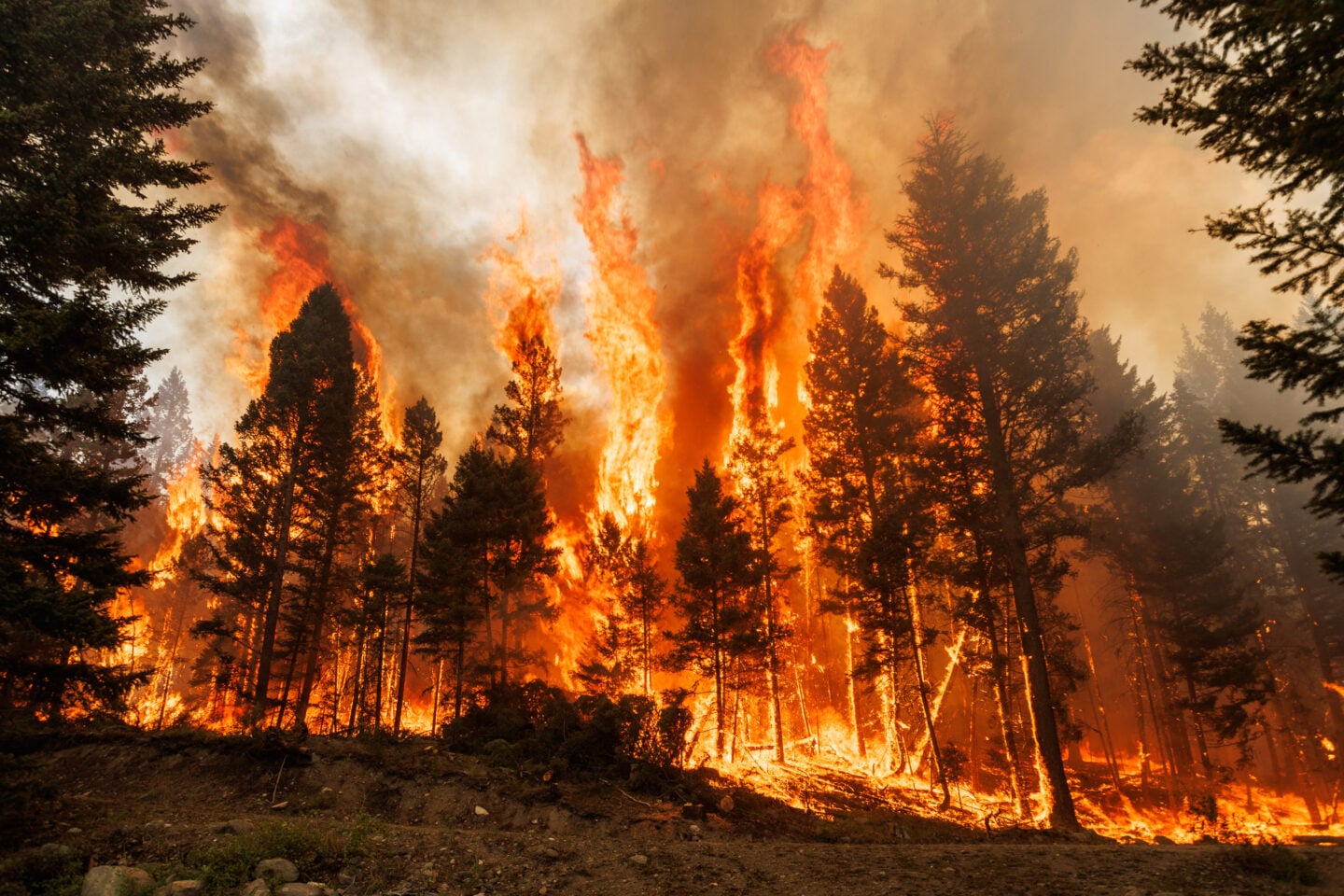
A planned ignition displays rank 5 fire behaviour after an unexpected wind shift on the Rossmoore Lake wildfire in the community of Knutsford, B.C. in July, 2023. (Photo: Jesse Winter)
Expand Image
Advertisement
Advertisement

Excerpt from Wild Fire: Dispatches from a Country Ablaze by Jesse Winter ©2026. Published by HarperCollins Canada. All rights reserved.

A cold rain splatters my windshield as I scan the gravel roadside for the driveway Terry Jessup told me about. An inky storm cloud rises over the rolling cattle pastures of Knutsford, B.C. in almost the exact same place a giant smoke column blotted out the sun as I drove these same roads nearly two years before. Back then, in August 2023, I was covering the Rossmore Lake wildfire, a 114-square-kilometer fire that threatened the ranching community of Knutsford and the 100,000 residents of Kamloops barely 20 kilometres north of here. By early August the fire was so big it took almost an hour to drive its perimeter.

Expand Image

Now, in May of 2025, I’m searching for Jessup and his crew from the Knutsford Initial Response Team, a group of community volunteers that banded together to fight wildfires themselves. I’d spent the past two years interviewing dozens of firefighters, and talking with fire behaviour experts, Indigenous fire stewards, and local residents who, like Jessup and his crew, wanted nothing more than to help defend their communities. The sum of all that research had led me here, to an abandoned-looking ranch house nestled in a saddle between Knutsford’s rolling hills.

The front door is ajar and guarded by two large horses. I approached the horses gingerly, clicking my cheeks so they didn’t startle at my presence. I really didn’t want to get kicked.

“C’mon in!” Jessup’s shout echoes from somewhere inside. I find Jessup wrestling with a cranky ink jet printer in a back bedroom of his de facto headquarters. As his crew arrives, he passes around newly-printed radio and incident command manuals and together they dive into the details of radio communication policy and etiquette. There’s even a page detailing each of the terms in the phonetic alphabet; the Alpha, Bravo, Charlie, Delta and so on that soldiers—and firefighters—use when communicating over patchy, static-choked radios. They go over how to make an incident report to BC Wildfire using this military jargon before heading outside for the evening’s hands-on drills.

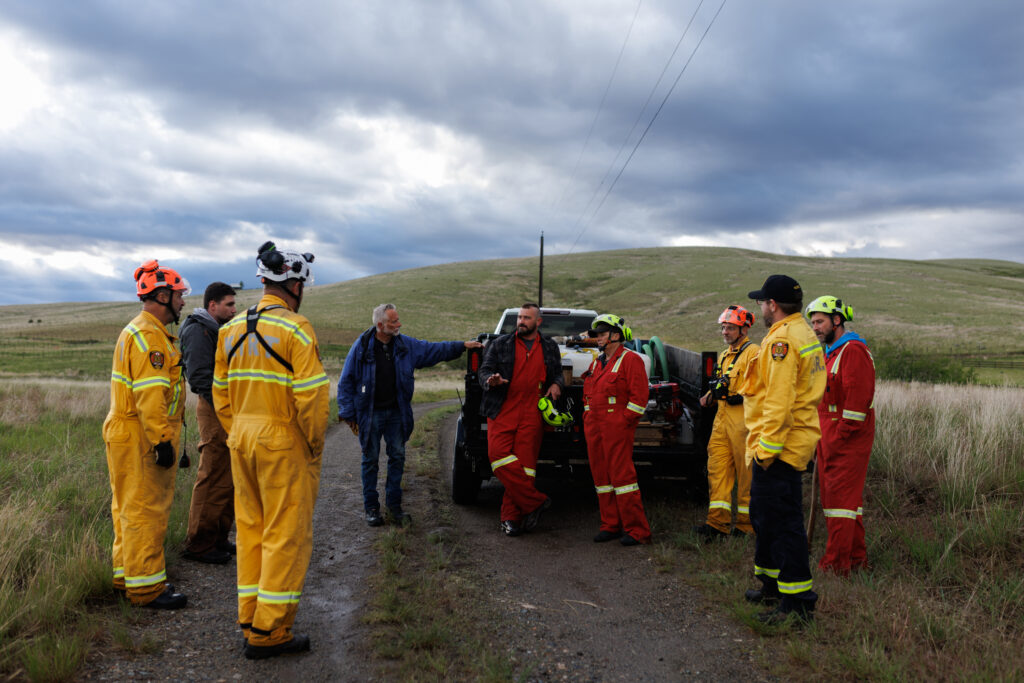
The setting sun has managed to peak under the storm clouds, refracting through fat rain drops to cast a rainbow against the nearby mountains and bathing everything in a warm, golden glow. Jessup and Craig Palmer, his second in command, sketch out the parameters of their exercise: A new ‘wildfire’ start has been reported in the grass and shrubs behind the house-turned-headquarters. The crew has one 1,000-litre tank and a pump. Their job is to run out a section of hose, split it in two and surround the imaginary ‘fire,’ attacking it from the flanks while being careful not to tread across its head.

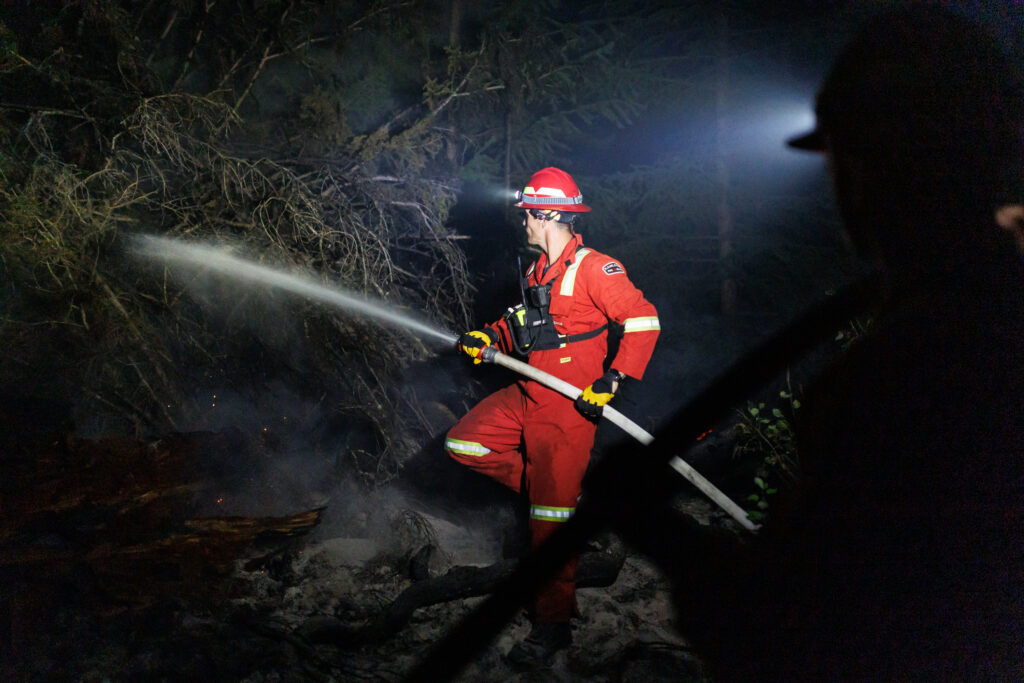
A firefighter from the Kamloops fire department hunts for hotspots on the Rossmoore Lake wildfire in the community of Knutsford, B.C. in July, 2023. (Photo: Jesse Winter)
Expand Image

As the crew unfurls tightly coiled fire hose and lays out their water lines, the pump clatters to life with a deafening roar. Soon water is surging through the hose lines. From a few hundred meters away, Jessup calls into his radio for each crew member to check-in. There’s no real risk right now — Jessup can see everyone from where he’s standing — but the point is to test their abilities with the radios. In a real fire, with smoke and embers swirling, it can be easy to lose track of crew members, and failing to respond to radio calls can easily lead to a ‘firefighter down’ mayday call.

Many of KIRT’s volunteers have already seen first-hand the dangers of the fireline. In late July 2023, Karl Thorson saw the lightning bolts that sparked the Rossmore fire. They shattered the sky, crashing down into the dense ponderosa, lodgepole pine and Douglas Fir forests in the hills around his family’s ranch where they care for dozens of retired horses.

As his mother, Lea, raced to coordinate evacuating their animals, Karl and other locals tried to fight the fire head on. For the first few days, it was madness, he said. Most had no idea what they were doing, and they made the kind of simple but dangerous mistakes people who’ve never fought a major wildfire before are likely to make: driving a convoy of pick-up trucks down a cattle trail into the fire without stopping to consider escape routes. Parking those trucks facing into the fire instead of out of it. “We did some stuff that was really, really dumb,” Lea said, looking back. “I was the guy in sandals at one point, thinking I’m invincible,” Karle added. It was exactly the kind of scene that infuriates professional wildland firefighters.

But another kind of scene was playing out just 15 kilometres east. Jessup, a retired paramedic who’d already spent years doing the tedious legwork to set up a volunteer fire brigade, was driving towards the Scuitto Creek fire with a B.C. Wildfire Service initial attack crew hot on his heels. They arrived at the fire almost simultaneously. Jessup jumped out of his truck and quickly introduced himself. “Whatever’s in my truck is yours to use,” he told the crew of firefighters. “What do you need?”

“Well, we need water,” the crew leader replied.

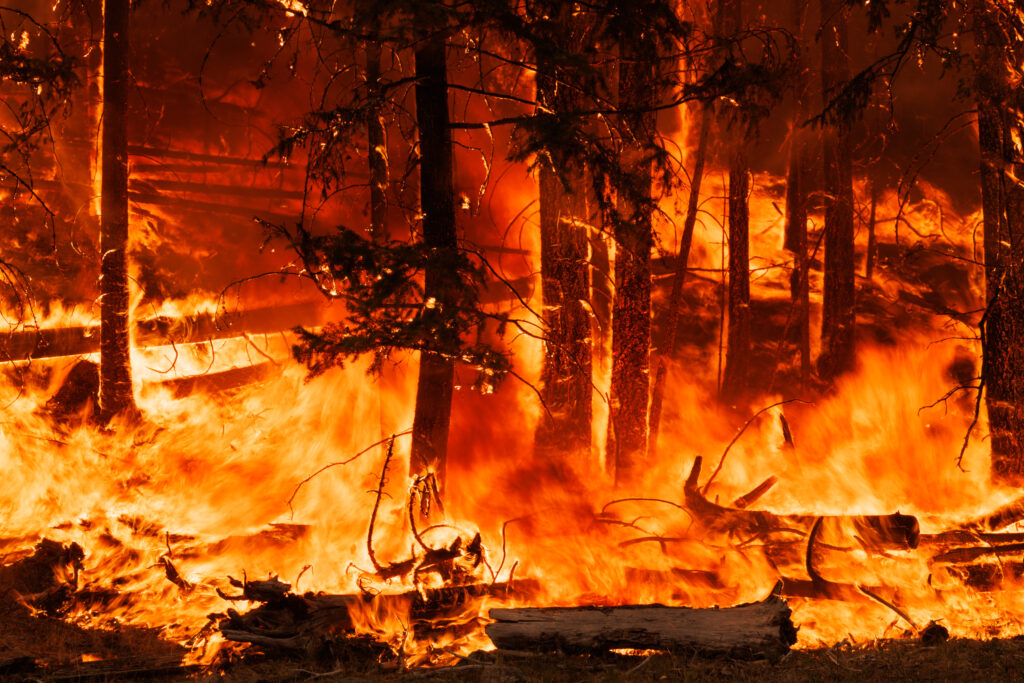
A planned ignition burns on the Rossmoore Lake wildfire in Knutsford, B.C. in July, 2023. (Photo: Jesse Winter)
Expand Image

Jessup dropped the tail gate on his truck. Within minutes, the IA crew members were pumping water out of Jessup’s tank.

When he realized they’d need even more water Jessup pulled out his cell phone and started making calls. Another community member arrived in a 15,000-litre tanker. Another came minutes after that. By the time a structural fire crew from Kamloops arrived, the fire was well on its way to being contained. It was an example of near-seamless cooperation between professional firefighters and amateur ones, and though no official recognition was given, to Jessup it still felt like a win.

After helping knock down the Scuitto Creek fire, Jessup and Palmer approached the BC Wildfire Service about getting their volunteers designated as statutory hires, bringing them under the fire service’s official umbrella, providing pay and even insurance coverage. The fire service agreed. At first, Jessup’s crew, which Thorson and some of his neighbours soon joined, were assigned mostly to mop-up and other lower-risk jobs, freeing professional firefighters to focus on more stubborn parts of the fire. But as the days and weeks rolled by, Jessup says the fire service came to rely on them more and more.

But this kind of hand-in-glove cooperation between professional wildland firefighters and locals is often the exception in western Canada, particularly in rural communities that prize their independence and can often be distrusting of centralized governments. As fire seasons have worsened, and the impacts on communities continue to mount, examples of that trust breaking down are growing. Trying to force communities to “obey” hasn’t been working, which makes cooperation with local volunteers ever more critical, especially as fire seasons get longer and more extreme.

Knutsford Initial Response Team members debrief after a wildfire response training session in Knutsford, B.C. in May, 2025. (Photo: Jesse Winter)
Expand Image

In the three years since the Rossmoore Lake fire, KIRT’s work has been such a success that other municipalities often ask Jessup to give talks and workshops about how they did it. KIRT has been such a successful model that it helped inform the creation of the B.C. Wildfire Service’s Cooperative Community Wildfire Response program in 2024. The program is a set of formal guidelines that communities can follow to create societies like KIRT if they want to help fight nearby fires. While the program’s been met with fanfare in some areas, some communities have pushed back against the cost and bureaucratic burden for small municipalities and questioned whether volunteers would ever be seen as full partners.

Jessup and Palmer spent their lives working alongside other first responders — invaluable experience for building up a community fire brigade. They understood incident command structures, were cool under pressure and—importantly—they could speak the same emergency response language as the B.C. Wildfire Service.  If one thing is clear from KIRT’s experience it’s the importance of trust. As Jessup said, KIRT opted to follow the BC Wildfire Service’s lead, and in return they slowly earned the service’s trust to do more complex and important tasks. “We played nice in the sandbox,” Jessup said. It sounds simple — almost trite — but it works. Especially when the consequences of going the other way can be deep, and long-lasting.

If there is one thing I’d learned in my years-long effort to better understand wildfires, it’s that our time-tested ways of managing them are no longer enough. We need to completely rethink our relationships with fire. We need to put more power, agency and money back in the hands of local communities. We need to devote more money to research and prevention, and we need to listen to what frontline firefighters are trying to tell us.

There are clear answers to this crisis, but not necessarily easy ones. For any of this to work, we have to accept our current reality—one that experts tried to warn us about for decades—and we need to work together. We don’t all need to learn how to run Mark 3 pumps like Jessup’s crew has, or dig hand guard or read fire behaviour models. Some of us just need to clean out our rain gutters or trade our cedar privacy hedges for azaleas. But we had better learn how to do it together, and fast.

Advertisement

Help us tell Canada’s story

You can support Canadian Geographic in 3 ways:

Related Content

People & Culture

Rekindling hope: Kanaka Bar’s climate evacuees

As wildfire seasons worsen, residents of British Columbia’s southern interior have been repeatedly evacuated. They may be climate evacuees, but this hasn’t stopped them finding solutions, Canadian Geographic writer David Geselbracht reports in his new book Climate Hope.

  • 6869 words
  • 28 minutes

Environment

A wildfire expert on the nuances of wildfire fighting

Fire detection, forecasting, management — and how decisions are made

  • 2139 words
  • 9 minutes

Environment

Opinion: Environmental racism and Canada’s wildfires

Ocean Bridge Ambassadors address the burning injustice of the climate crisis on marginalized communities

  • 1036 words
  • 5 minutes

Mapping

Digital map shows Alberta wildfires in near real-time

An interactive map released by Esri Canada allows users to track wildfires and see where they are most active

  • 584 words
  • 3 minutes
Advertisement
Advertisement