Travel
A first-timer’s journey through Banff and Jasper
In the aftermath of the Jasper Wildfires, this five-day journey through iconic Alberta towns reveals a region rebuilding and ready to welcome back travellers
- 2430 words
- 10 minutes
People & Culture
A year after the devastating Jasper wildfires, a reflection on the recovery process — and how disaster frays the fabric of community
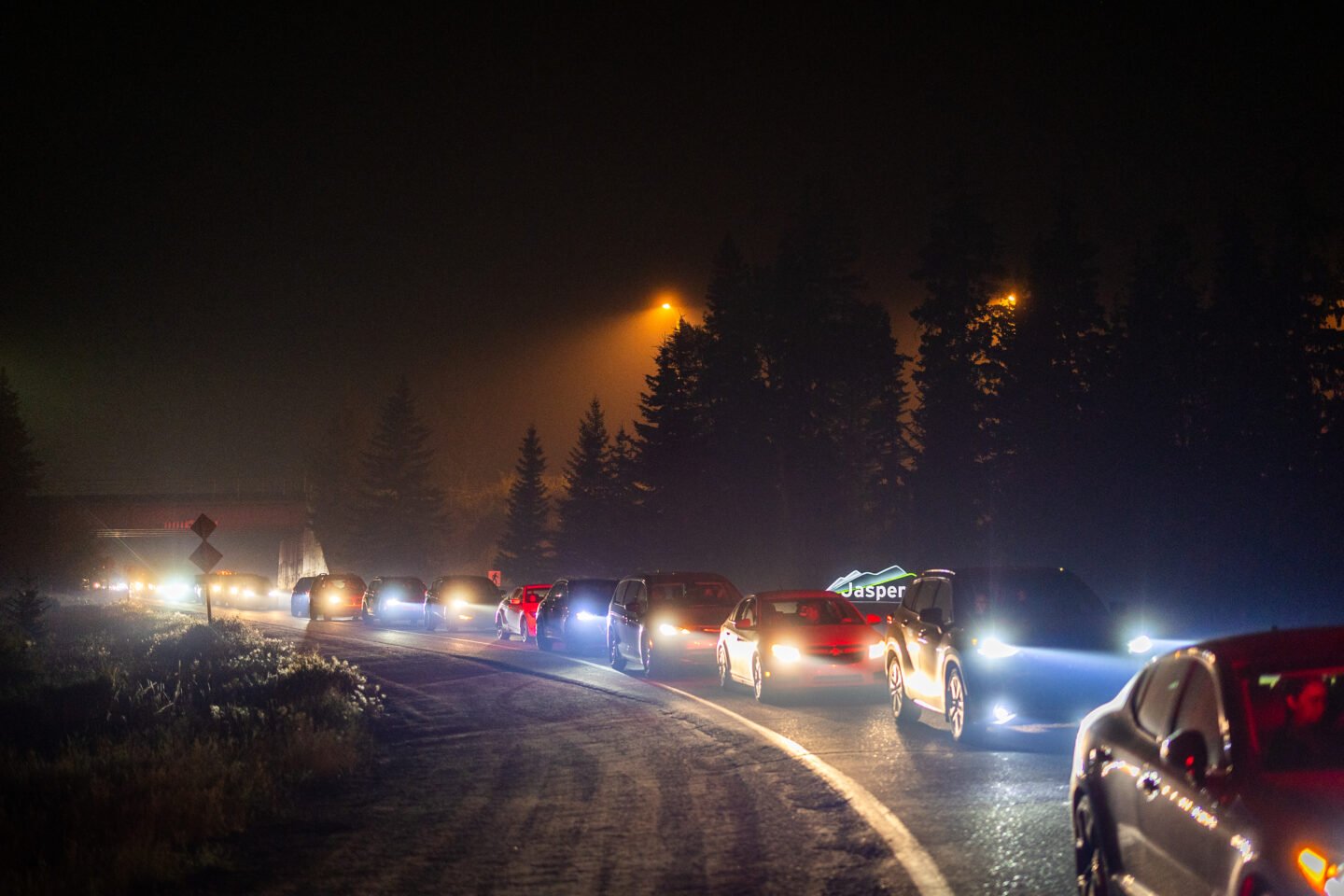
At 3 a.m. on the morning of July 23, 2024, it was 27 C and too hot to close the car windows. Frail-bodied moths with white paper wings crawled in and made their frantic way across our gray-carpeted car ceiling. There were thousands of moths there under the bludgeoning bright lights of the highway rest stop. Next to me, my then 19-year-old son’s breathing finally fell into the rhythm of sleep, his forehead slicked with sweat. He was recovering from COVID, and a late-night evacuation from our home in Jasper, Alta., wouldn’t ease his lingering symptoms. His 6’2” frame was tangled in a sleeping bag to keep our winged friends at bay, and at those angles he didn’t sleep long. But some sleep was better than none. We’d already been driving for six hours through the crackling night as lightning spidered across the sky and appeared to strike tall trees. Ridgetops glowed orange as powder-dry forests fuelled growing flames.
In that 24-hour period, lightning struck 38,000 times in British Columbia and more in Alberta. Fires exploded into being, and others reanimated and spread in the heat and wind. As we made our way to Calgary via Kamloops, we saw smoke curling from the ridge above Sicamous. Seeking food in Revelstoke, we found the town’s power had been knocked out and many of the restaurants and grocery stores closed. Grabbing gas in Golden, we learned the town had been issued an evacuation alert that day. About half an hour outside Golden, we got stuck behind a car accident. We sweltered in the 35 C heat on the highway for an hour, worrying we were trapped near a fire.
That trip was a year ago. I couldn’t believe it was happening, or fathom that our town would actually catch fire. But on July 24, we watched with the rest of the world as images of Jasper burning looped on the major television channels: the WickedCup café ablaze just two blocks from our home, the parapets of the Anglican Church disappearing in a rage of lapping orange.
This year, as I watch news of other communities evacuating and burning, I am filled with dread for two reasons: that they will have to go through those initial traumatic stages of wildfire displacement and disaster, but also because I know better what will follow. I write this with the hope that they don’t feel alone — and that they know they are now in the difficult process of recovery and healing. It’s a long road.
It will begin with heartbreak as news of the losses rolls in. Some people will no longer have homes, and many will have to process what’s happened outside the supports of their community. Almost everyone will be forced up a steep learning curve on insurance claims, restoration cleaning and toxicity testing. It is complicated and overwhelming. Those who lost their homes will spend hundreds of hours cataloguing their losses and grieving the irreplaceable items that tether us to memory — a wedding ring, a great aunt’s artwork, the growth of the kids notched into a doorway. People whose homes survived might feel guilty. Others will be displaced from their community — some, like those in many remote and Indigenous communities in the boreal forest, for long periods of time. Many choose not to return at all.
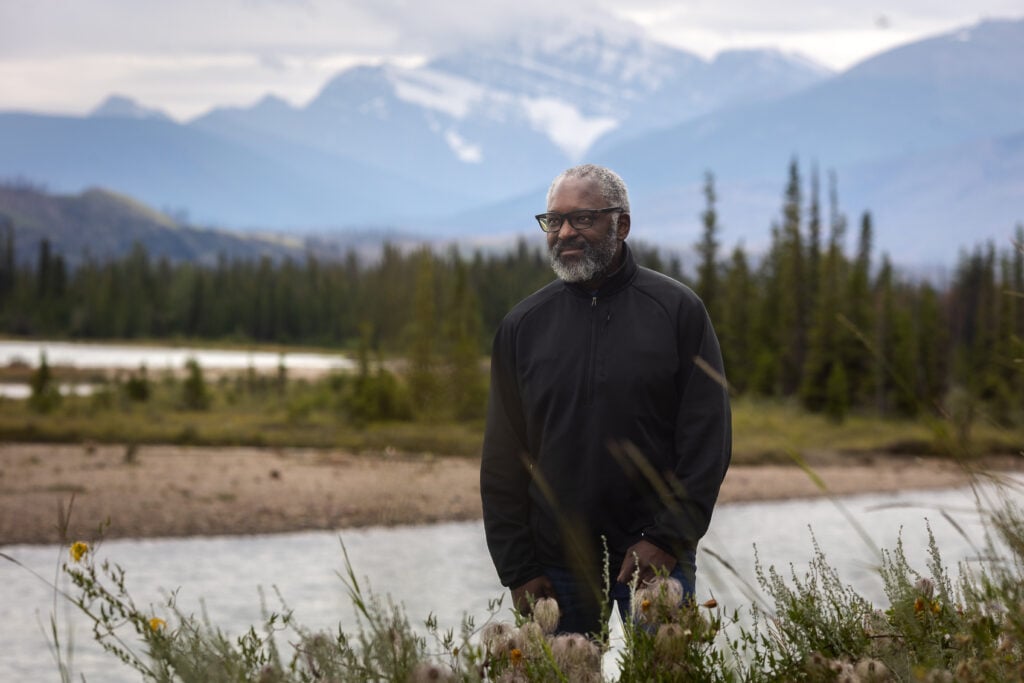
There will be a tyranny of “to do” lists. It can be exhausting. Disaster recovery is hard emotional work for communities, says Michael Higgins, the national project director of climate readiness, risk and recovery with Colliers Project Leaders. He helps communities like Jasper structure their recoveries, drawing on his experience from his work in the Canadian military, as a wildland firefighter and in regional disaster planning and recovery in British Columbia. When he arrives in a community soon after a fire, he shows them a graph with recovery timelines that he says “looks a bit like the EKG of a heart being able to absorb a shock.” It’s an emotional roller-coaster with big highs and lows before it returns to a regular rhythm after several years.
Fire-affected communities will continue to be more common as climate change exacerbates forest conditions that fuel large, unstoppable fires. We are learning that fire recovery follows a somewhat predictable pattern. The re-entry is hard, says Higgins. People see proof with their own eyes of what they have learned from afar: homes reduced to the rusted shells of washing machines and the twisted metal of old house siding. Businesses bulldozed to the ground. But Higgins says the community also comes together over their shared experience as evacuees. “There is a sense that everyone is behind us, we can do this, there is support,” he says. But then, soon after, the community enters an emotional low as people come to grips with what has happened. “There’s a little bit less community cohesion, because people are dealing with their individual circumstances.”
As people see progress like debris cleanup, there’s an uptick in morale, says Higgins. People feel a bit of momentum as things physically move forward. At this point, the community starts to gel again. I remember the feeling of relief I had when I saw the first cleared sites in the heavily affected community of Cabin Creek West.
But at around the year mark, says Higgins, morale tends to be low again. “Community cohesion around that second summer really starts to pull [apart].” Progress is slower than people anticipate. Many people are angry and frustrated — in some cases, this leads to conflict.
Here in Jasper, tensions are particularly acute because although a tremendous amount of work has been put into recovery efforts — to rehouse people, demolish buildings, build community mental health capacity and much more — people aren’t seeing many houses built.
Meanwhile, the process of healing from trauma can be challenging in tourism-based economies as frontline workers field usually well-meaning questions and concern from visitors, says Higgins. While some locals may want to talk about their experiences, others struggle to discuss their losses over and over again. They are “reliving the trauma for someone else’s awareness,” says Higgins. “This tends to anchor people to the time, date and place of the event, which sometimes can inhibit their ability to move past it.”
This should not deter visitors from coming. Tourism is an important and essential part of Jasper’s economy, and the town is ready and eager to host. But visitors should know that it’s okay not to ask about it, says Higgins — it’s not insensitive if you don’t bring it up.
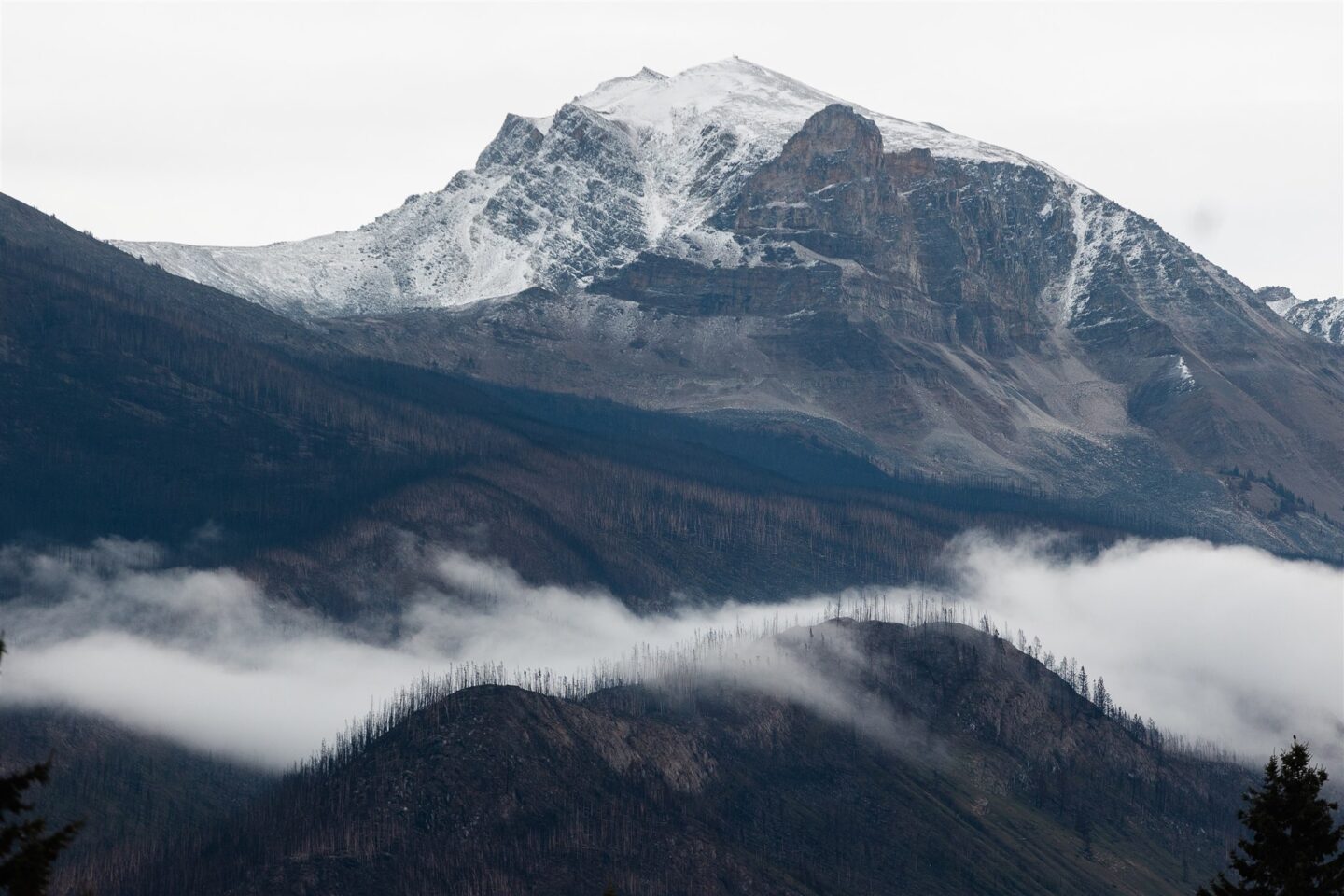
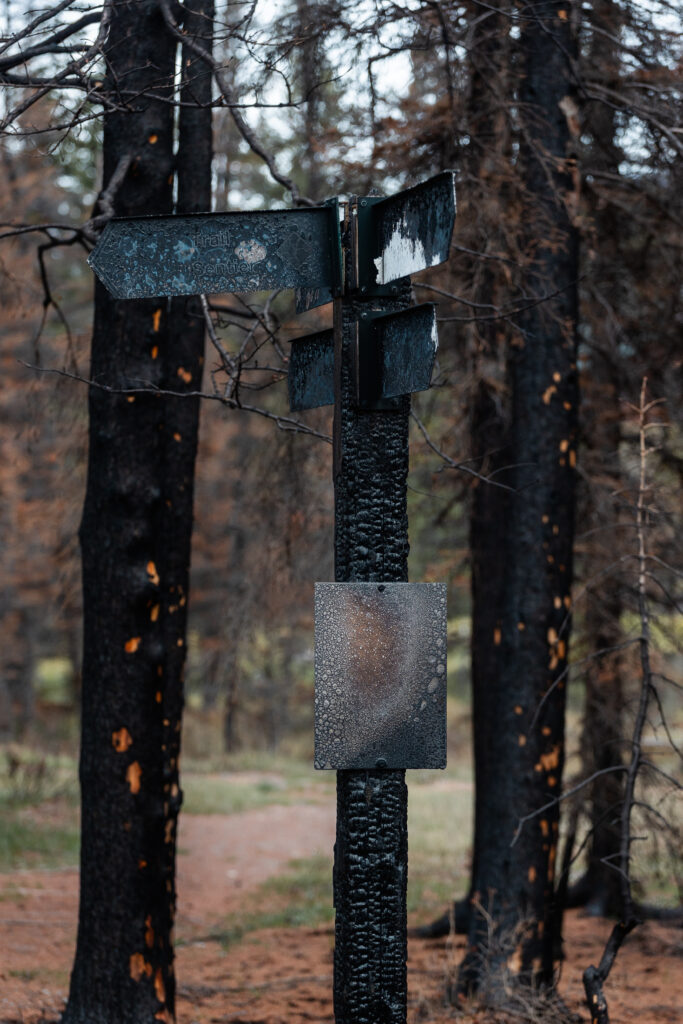
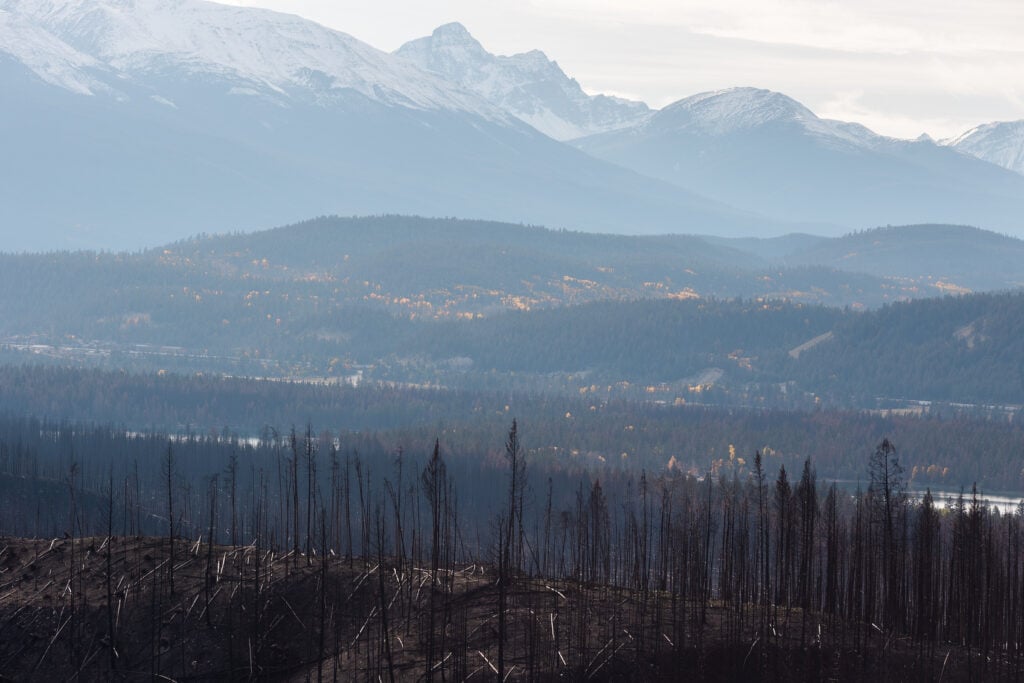
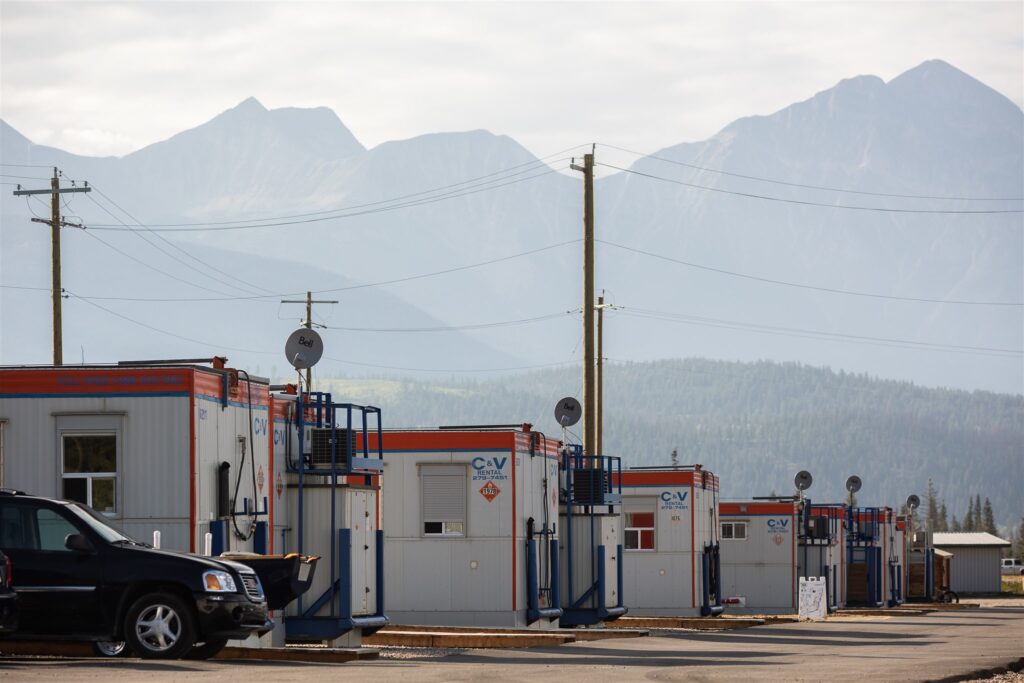
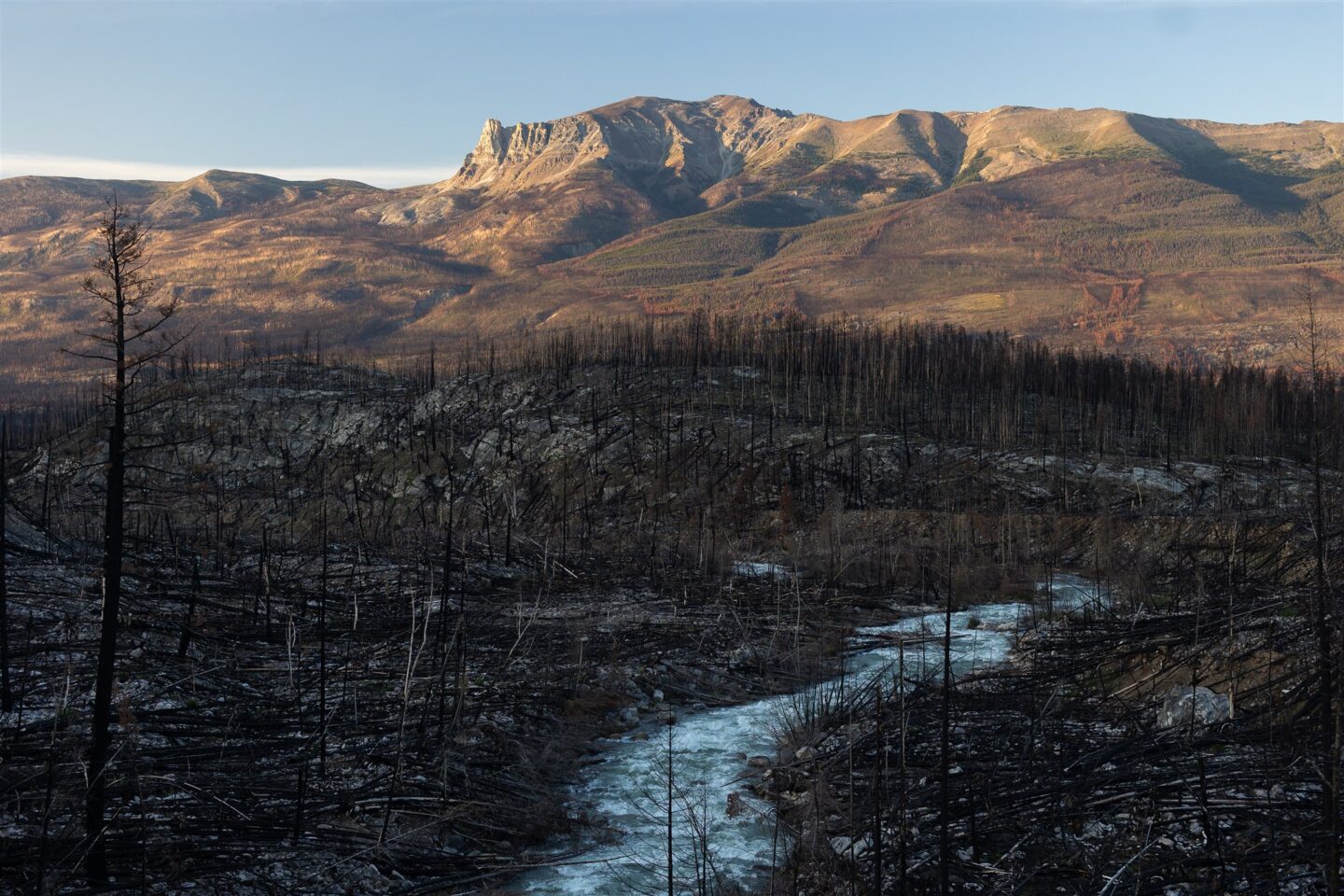
At Whistlers Campground at the base of Whistlers Peak, a series of white trailers are arranged in neat lines in what used to be Marmot Meadows group camping. Trees have burned away on the face of the mountain, revealing crumbling cliffs and newly green slopes. Salvaged wood from the removal of dead trees sits in large piles near the site’s entrance.
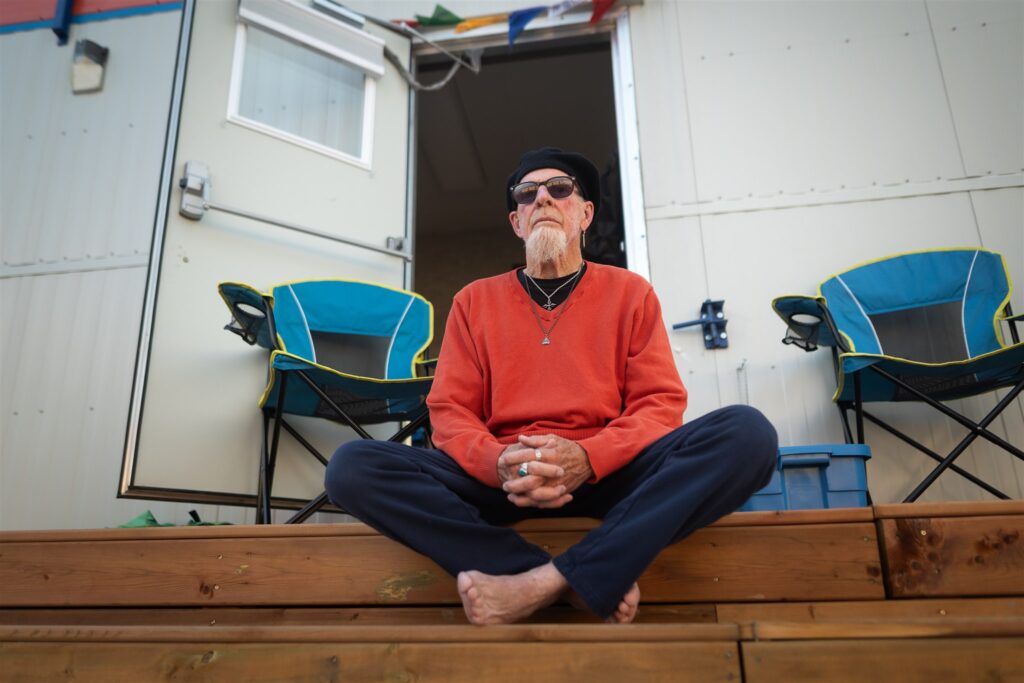
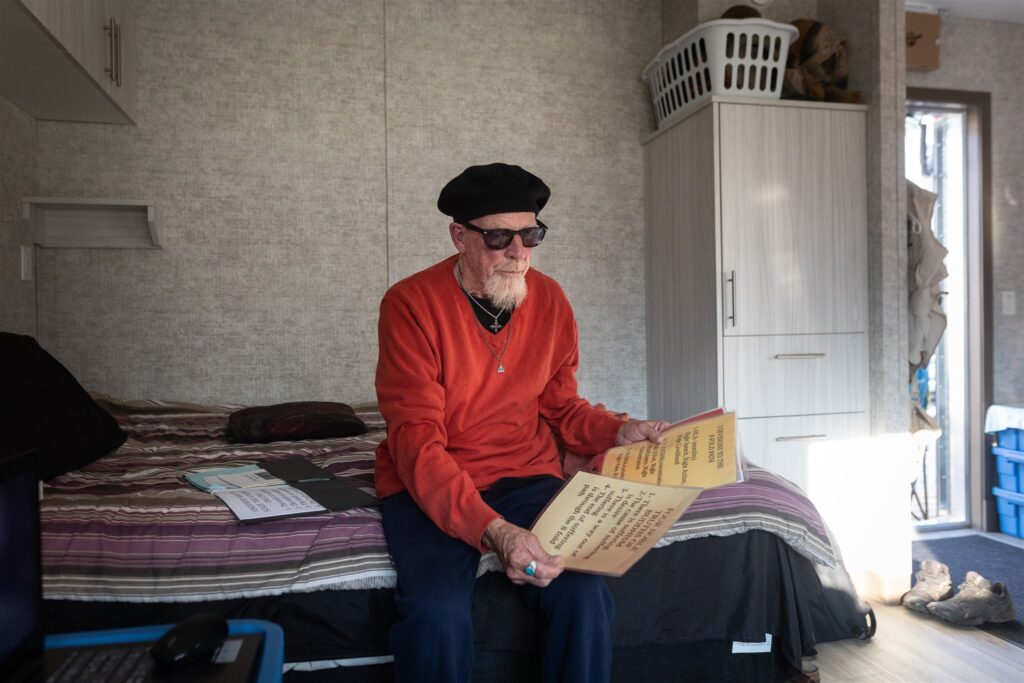
Patrick Mooney lives in a one-room unit in a trailer triplex. It’s one of 260 units housing roughly 510 individual residents in villages run by the Red Cross here and in the Jasper townsite. Just inside and above the door, a Doc Martens shoebox lid is taped over the exit sign to block its eerie green glow over the room at night. To the right is a neatly made double bed. Two steps to the left is a La-Z-Boy recliner that came with the room. Mooney is happy about the recliner: “Better for my back than a couch.”
Above the recliner is a stunning piece of stained glass depicting a raven on a tree branch, a gift from friends after the fire. Mooney points out his window to the power and septic lines snaking around his trailer with some concern about how they will perform in winter. He is grateful to have a small kitchenette in his unit — a stove, sink and small cupboard. Other renters share kitchens, he says.
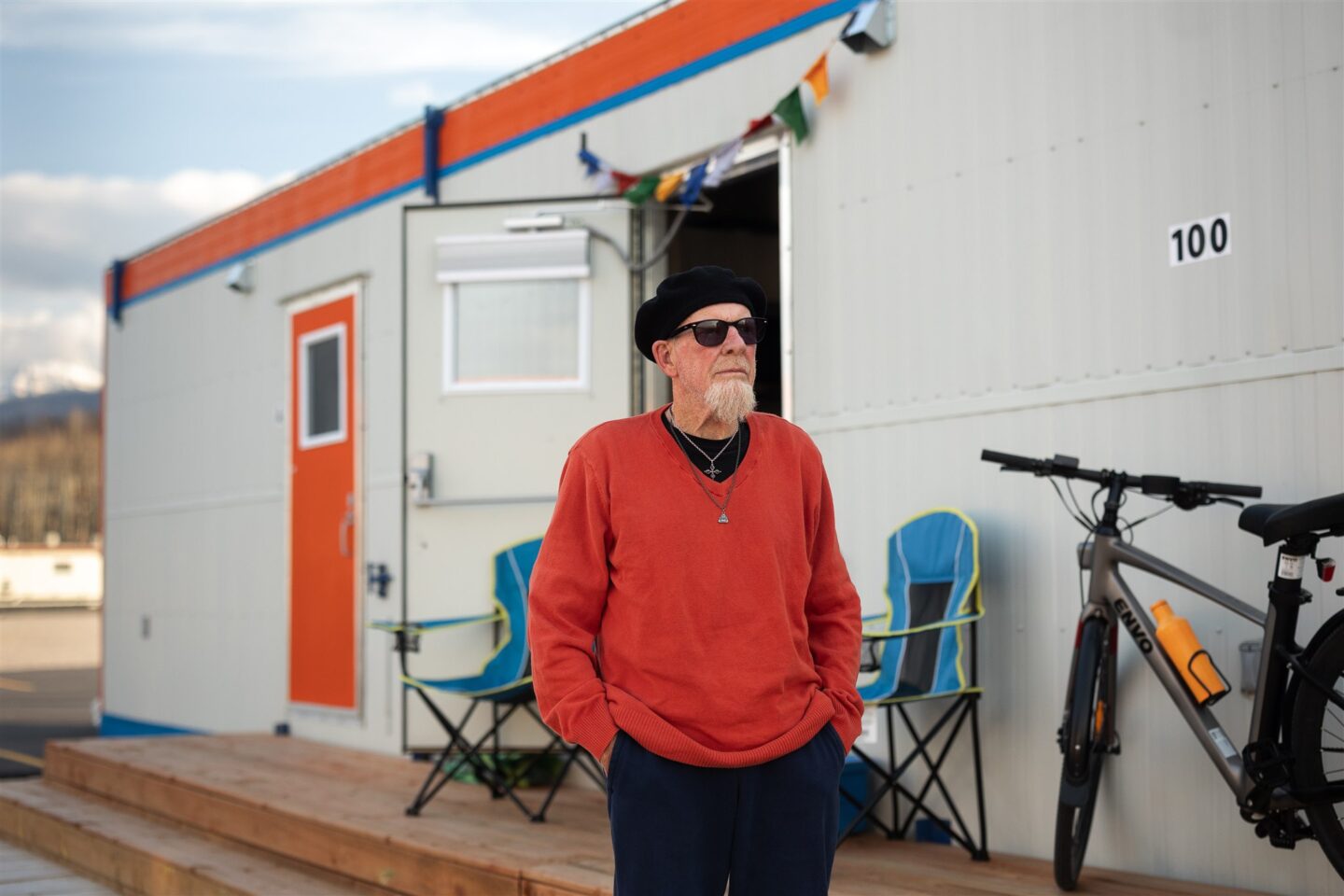
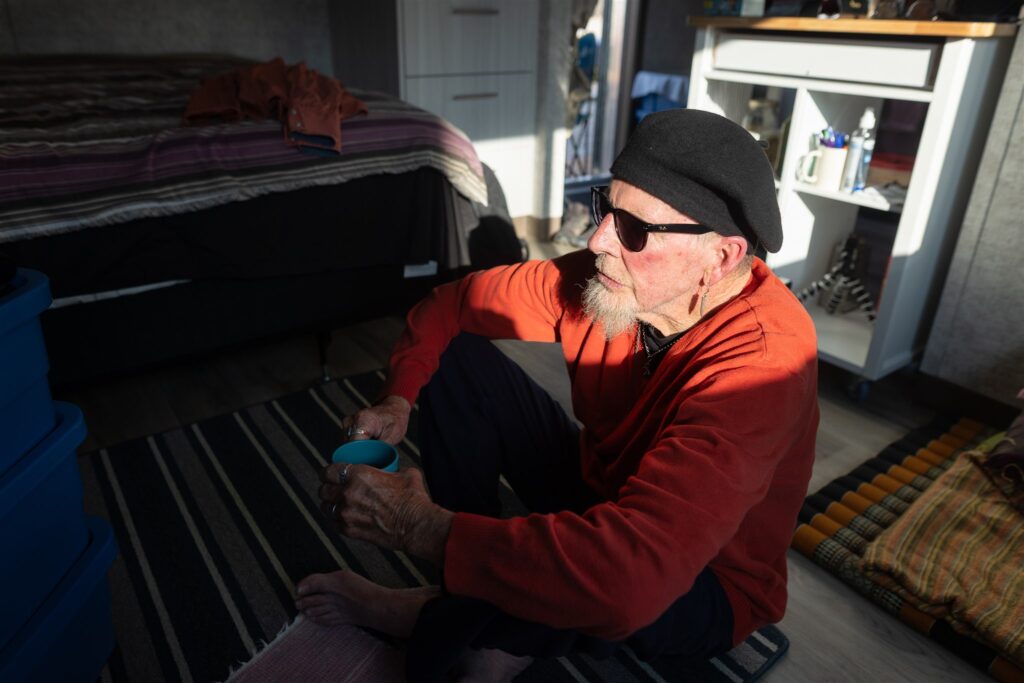
At 71, Mooney is retired from his work as an adult outreach worker at Jasper Community Outreach Services. He lost his long-term rental home of 15 years in the fire. There, he tended his garden of wildflowers daily. He lost his bike taxi, called Dhamma Wheels, that was parked in the garage — the name a nod to the Buddhist principles he credits with starting him on a better path two decades ago.
“I have everything I need,” he says. “I’m … flabbergasted and amazed at what the Red Cross has done and the help we’ve gotten.” But the fire has taken a toll. Mooney has serious health concerns, like heart and lung disease, that have worsened in the upheaval of the past year. “I would not survive another evacuation,” he says. He sometimes wonders about his safety — he says the police and firefighters have both been called out to the site over the past months. The trailers are equipped with exterior alarms that light up and wail when the septic is down or someone sets off the smoke alarm in their kitchen. “That can be a bit triggering,” he says. Mooney doesn’t know when he’ll leave temporary housing. When I ask him how he deals with uncertainty these days, he shares a Buddhist mantra he uses to ground himself: “Right now, it’s like this.”
Higgins explains that community recovery is not a steady climb away from the event but instead a journey punctuated by triggering events and setbacks. When smoke from boreal forest fires in Manitoba and Saskatchewan rolled into town for a few days this spring, Nataliia Zakharenko says she felt it in her body, like pain. “When I feel this smoke, I will always remember what happened,” she says.
Zakharenko has been through a lot in the past three years. When Russia invaded Ukraine in 2022, she left her home in Kremenchuk and landed in Jasper after two-and-a-half months in Poland. She says she knew this was the place for her when she found out she’d be working at Home Hardware, because the word “Home” was in the name of the business. The owners of Home Hardware, Ross and Megan Derksen, set her up in their basement apartment, and they’ve become close. “I am really happy here,” says Zakharenko, “because I have family — Ross, Megan and the kids — they love me, and I have this beautiful place.”
Home Hardware burned down in the fire. Ross’s parents and his brother and family also lost their homes. Zakharenko says she offered to move to make room for them, but the Derksens encouraged her to stay. Having a home and support is key for Zakharenko as she continues to navigate both the fallout of the fire and the ongoing war back in Ukraine. She still has family there, and sometimes gets texts from them simply stating, “We are alive,” after Russia bombs the cities they live in. Her sister, brother-in-law and niece live in Kyiv. “I feel sorry for them, because they sleep in a hallway between two walls,” says Zakharenko.
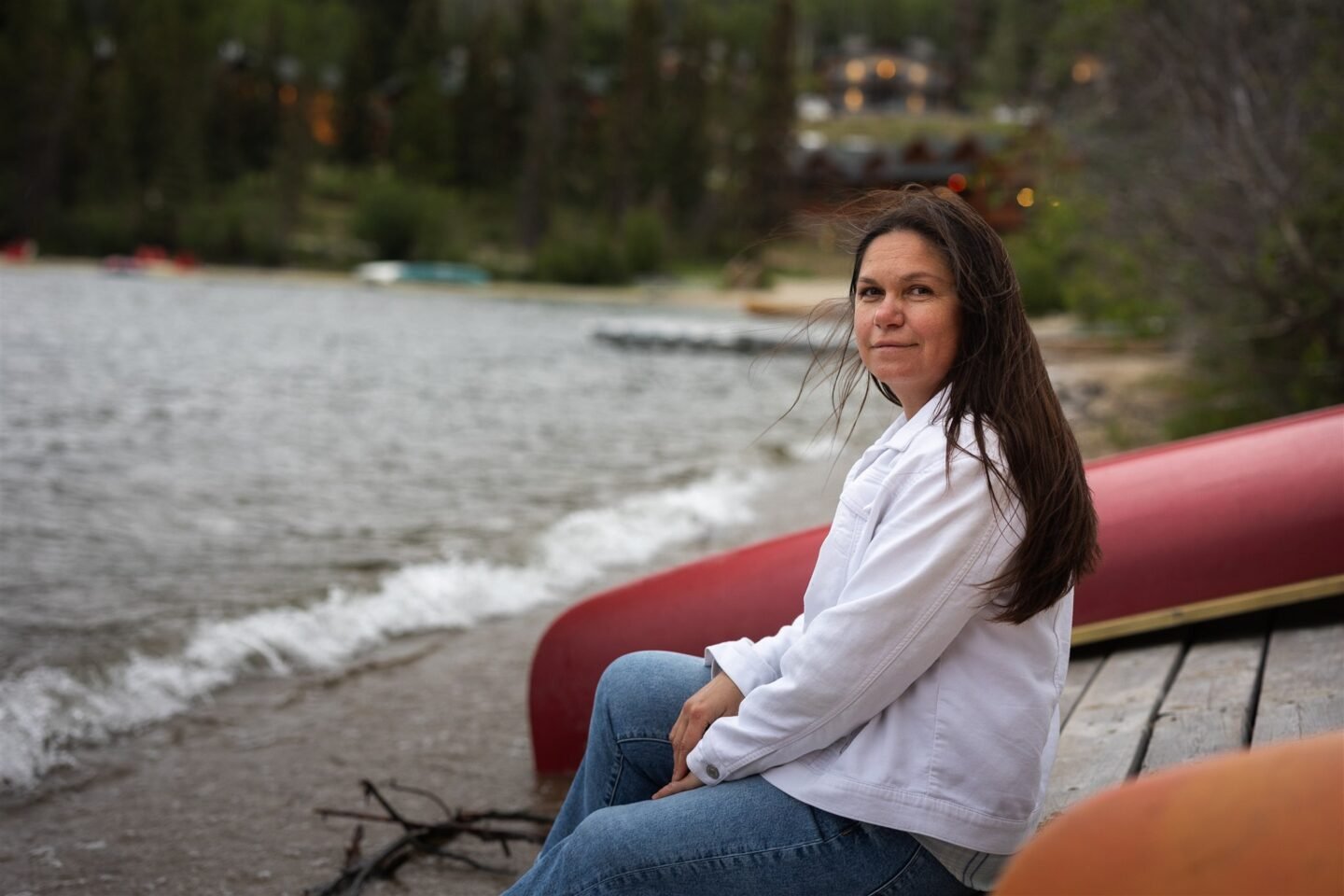
She drove me up to one of her favourite spots at Pyramid Lake to drink coffee on the dock overlooking the water. With windows down, we cruised the windy tree-lined road in her Toyota Rav4. “Smells new,” I said. She explains that last year, she didn’t have a car to evacuate in. Doreen Zenner, the manager of Home Hardware, picked her up along with Yuri, a 21-year-old Ukrainian son of a friend, and drove them to Zenner’s parents’ house in Athabasca, Alta. Zakharenko says Zenner made room for her and Yuri in place of taking more things from her home. “I feel so sorry because she lost her apartment,” she says.
So this year, Zakharenko bought a nice car. For her, it’s worth working extra hard to have one she feels is reliable, in case she needs to evacuate again. Though much of the area around Jasper has burned, the west valley and Pyramid Bench remain untouched by fire. Her daughter Anna, 22, has finally been able to join her from Poland this year, and she looks out for Yuri — a request made by his mother, who passed away from cancer last year in February. “They are depending on me,” she says.

Every time I visit Kristin Robinson, I come back with better hair, excellent new podcast recommendations and a heart full of meaningful, no-bullshit conversation. Two hours with her is its own form of therapy — a safe place to let my guard down and be cared for by someone I trust. Robinson has been my hair stylist for years and more recently became my yoga instructor. She was one of a handful of instructors operating in a space donated this past winter by local business owner Silvie Walsh to create much needed self-care capacity in town. I was unsurprised when Robinson donated the proceeds of all her classes to recovery efforts.
Robinson lost both of her family’s small businesses to the fire and firefighting efforts. “The past 12 months have truly been the worst 12 months of my life,” says Robinson. “But then in equal measure, it’s probably been the best, which is hard to reconcile, but there is that yin and yang, always, you know?”
Before the fire, Robinson was already evaluating whether she wanted to continue to grind so hard at the hair salon, Trademark, and café, Sun House — businesses she owned and operated with her husband and business partners. The past five years have been gruelling, with closures due to the COVID pandemic, the financial hit from a two-week closure due to power outages linked to the Chetamon fire in September 2022 and other ventures that stretched her family’s capacity. “Summer of 2024 was supposed to be the light at the end of the tunnel where we were finally going to catch our breath.”
Instead, what followed were some dark months, she says. Not only were she and her husband now navigating insurance and the uncertainty of their future income, but she found herself cut off from the community that came to the salon.

There are a thousand threads that weave a community like Jasper together, gossamer thin yet strong as spider’s silk. Disasters fray the community web in ways that are hard to predict.
For Robinson, things improved when, through a chance encounter, she learned of a location opening up that would be perfect for a new salon. Unlike Trademark, this one was above ground with big windows and wheelchair accessibility — something she had always wanted. Earlier in the day, she’d been out at the local cemetery, visiting the graves of her grandparents, something she and her family hadn’t done for years before the fire. “I think they were looking out for me,” she says.
She secured the space that day and opened her new business, Jasper Hair Collective, in November. The salon is now another place people open up about their fire experiences, sometimes with laughter, sometimes with tears. “What an honour it is for us to be able to have this space where people feel comfortable enough to be that vulnerable,” says Robinson. “Maybe they feel a tiny bit better when they leave after a nice scalp massage or someone giving them a cup of tea.”
Through lessons learned from shifting relationships, business and insurance, she says, “I’ve had a lot of ‘aha!’ moments.”
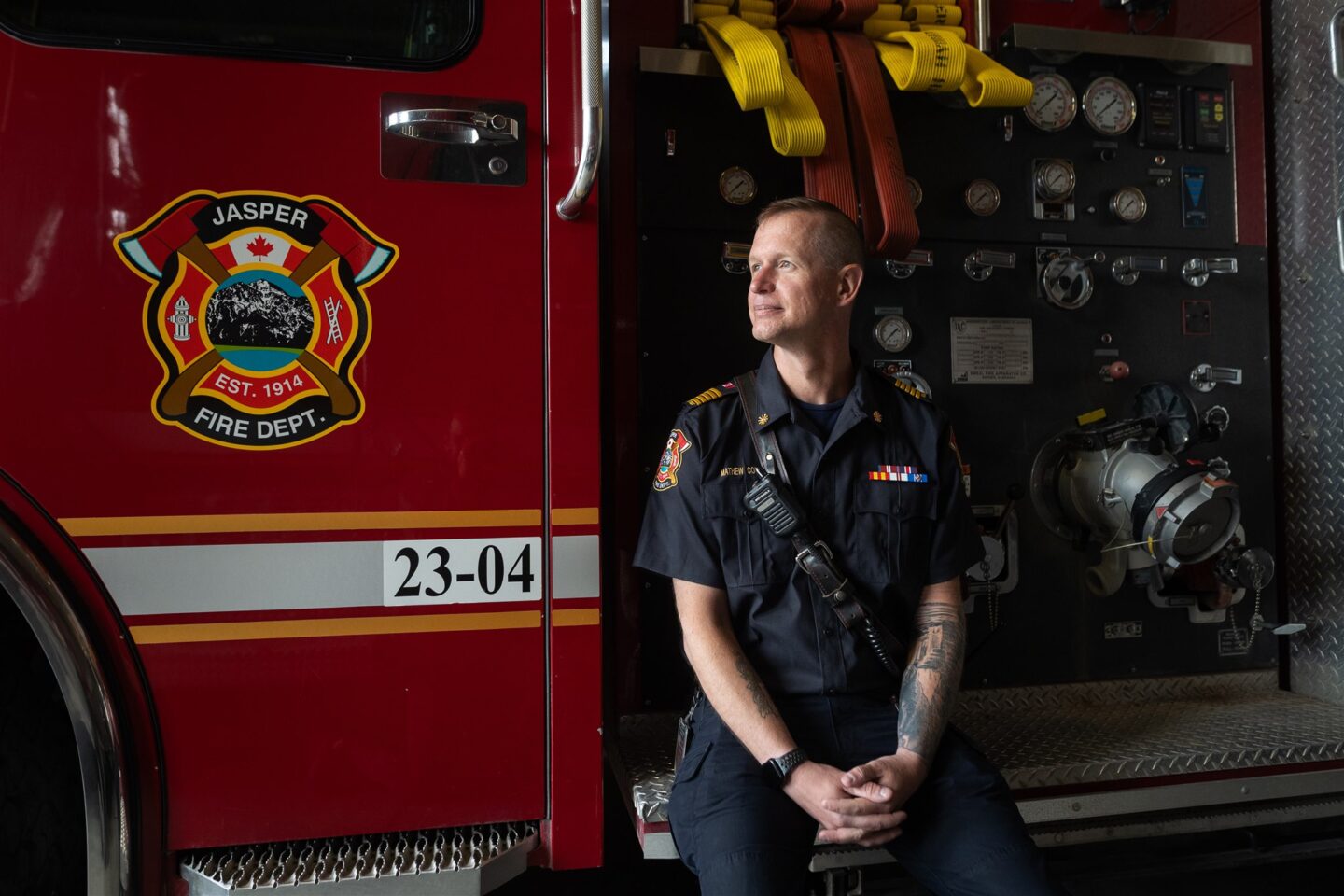
There’s been a lot of learning. And while many people are still reeling from and navigating the fallout of the 2024 fire, fire chief Mathew Conte encourages Jasperites to have one eye on preparing for future fire risk. This includes installing sprinkler systems, reviewing insurance and following other recommendations from federal and provincial FireSmart programs to make their communities more resilient to wildfire.
Conte and his family lost the home they rented in the fire. Losing all their belongings had a big impact on his kids’ lives, he says. Their family is trying to get all their stuff replaced so that things can feel normal again, but it’s a lot of work. “You don’t realize how much stuff you have and what it costs to actually replace everything … until the time comes.”
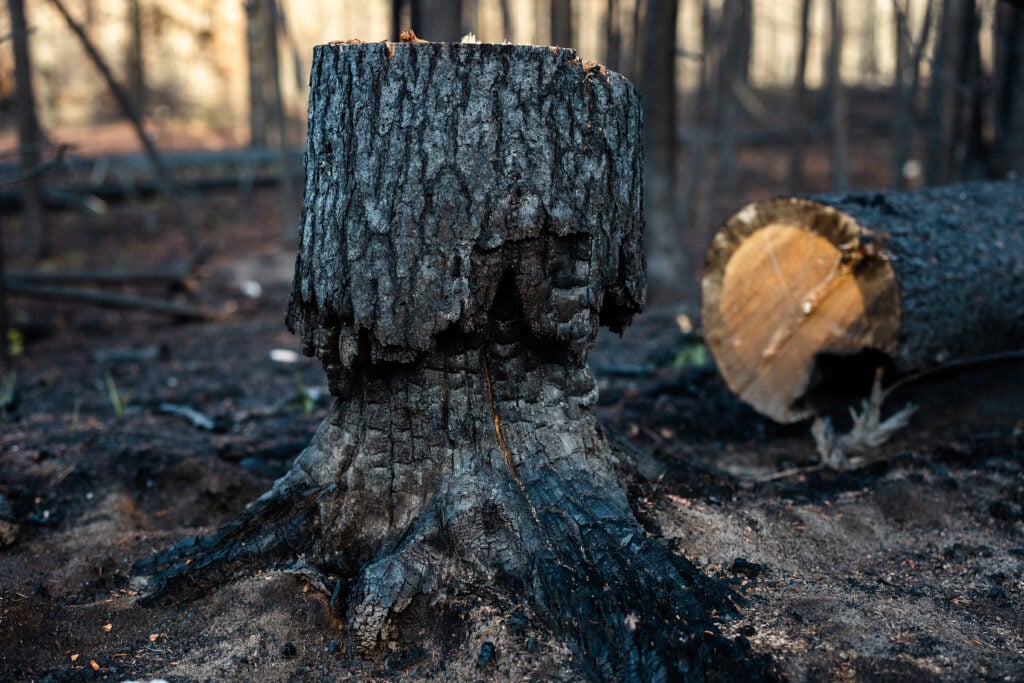
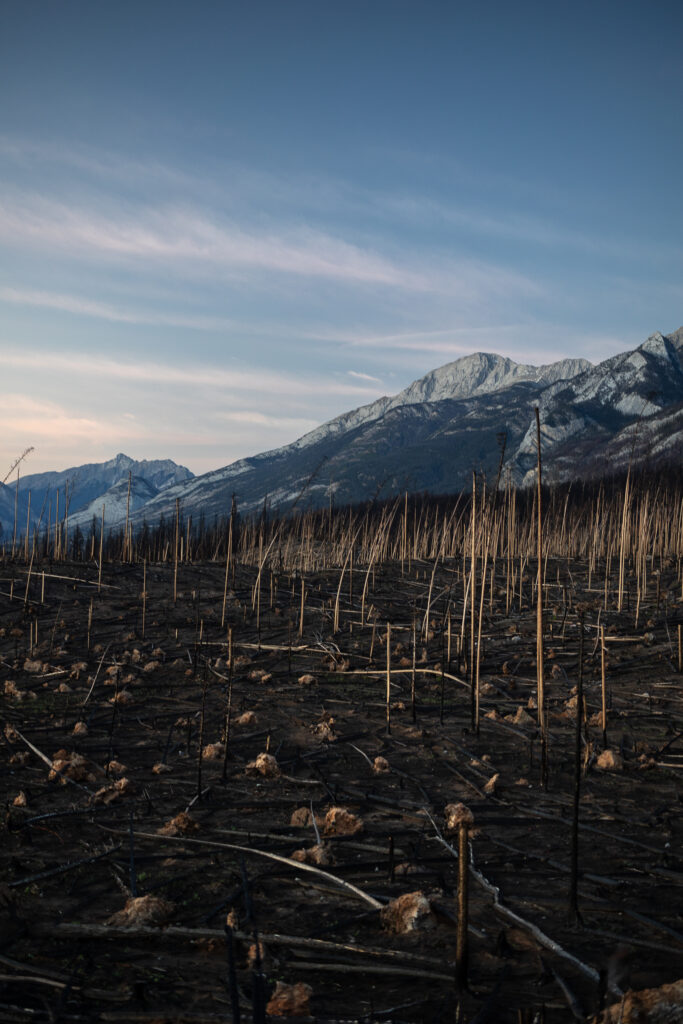
Eight members of the 29-person Jasper Fire Department lost their homes. I think about them when I stand in my backyard here in the Patricia Place condominium community, where even a year later, the earth is still black in places where the fire burned deep into the soil behind my fence. During the blaze, firefighters moved up and down the adjacent creek side, putting out fires spreading from embers and burning buildings as quickly as they could. I try to imagine what that was like, as 12 of our neighbours’ condos burned down around them. I have little doubt they saved my home and many others, even as their own homes burned.
Nine years after the 2016 Fort McMurray fire, teacher Kitty Cochrane has her fire box packed. In it, bowls that were her grandma’s, her oldest family albums and other things that can’t be replaced. Cochrane has been evacuated twice for fire and once for a flood that damaged her home.
A post she made on the Jasper evacuees Facebook page detailing the practical and emotional details of what to expect following the fire was a lighthouse for me this year. This is how it ends: “Ultimately, you will be okay. Everyone will be okay. The artists will make art, the storytellers will write stories, the photographers will gather photos, the cleaners will clean, builders will build, new things will be gathered, new homes created, new memories and mementos made, nature will instantly pop up flowers amongst the char. You will be okay.”
It’s advice I hold close, especially in these times where more people will likely have to live through fire. We have to look after each other. “There’s comfort in knowing that there’s an end, no matter how long it takes,” Cochrane says now.
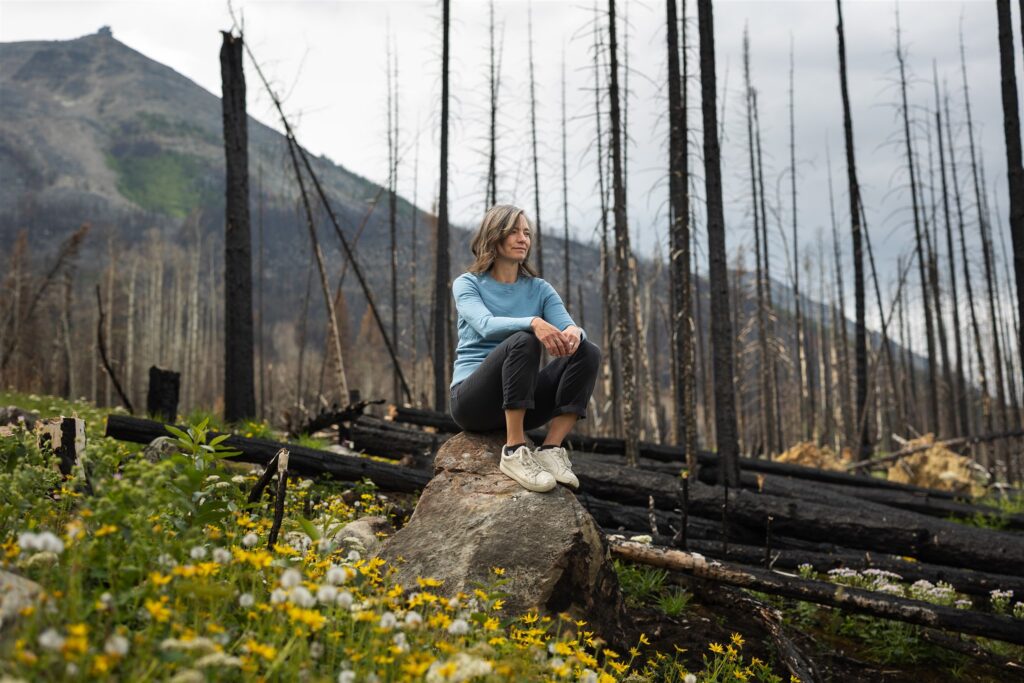
This spring, as we moved into the reality of another fire season, it took me longer than usual to pack my fire box for evacuation. After processing the events of the past year, it was hard to get my head around the idea that this could happen again. The box holds different things now. There are still the important documents and passports, but what I’ve learned from Cochrane and friends who lost their homes is to pack the things that are irreplaceable: my son’s childhood stuffies, cards from my husband, my grandmother’s jewelry — the locket her brother sent her before he died in the Second World War. This time, I stuff in the quilts my mom made so that in the months following another disaster, I can wrap them around me.
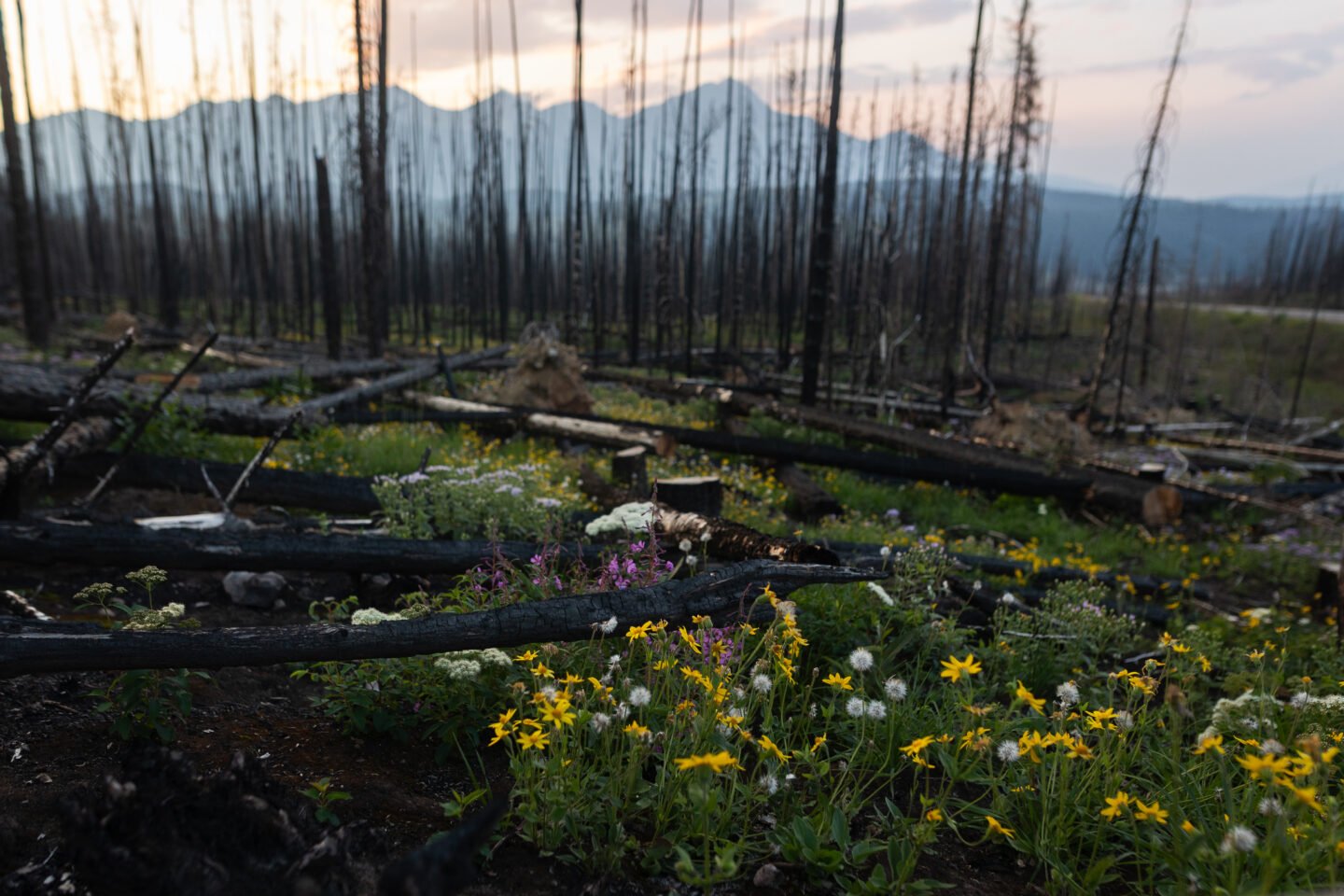
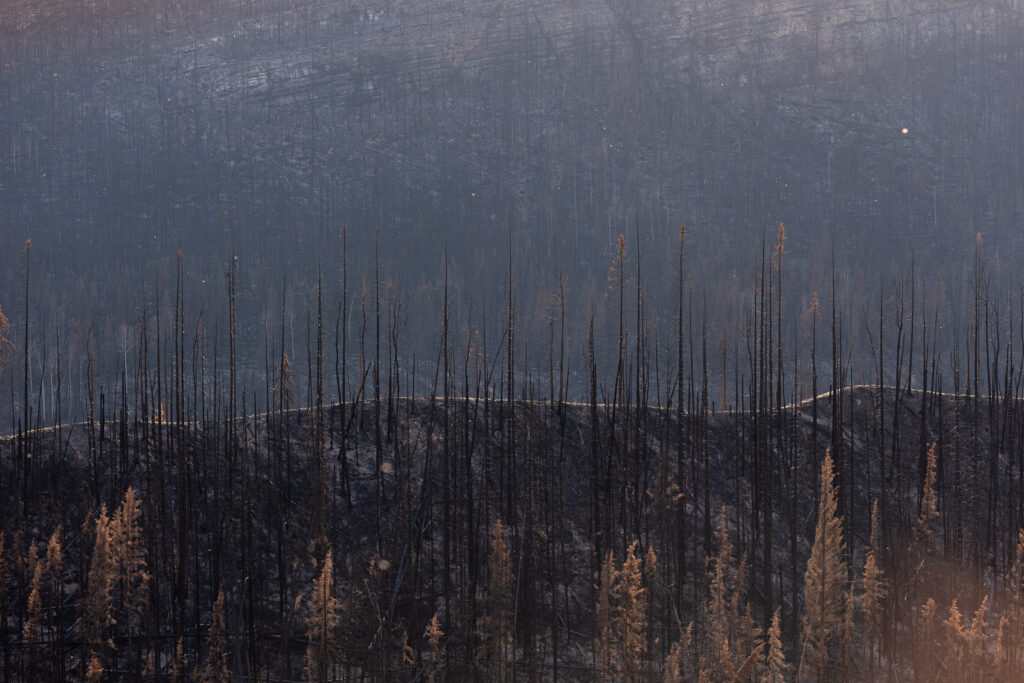
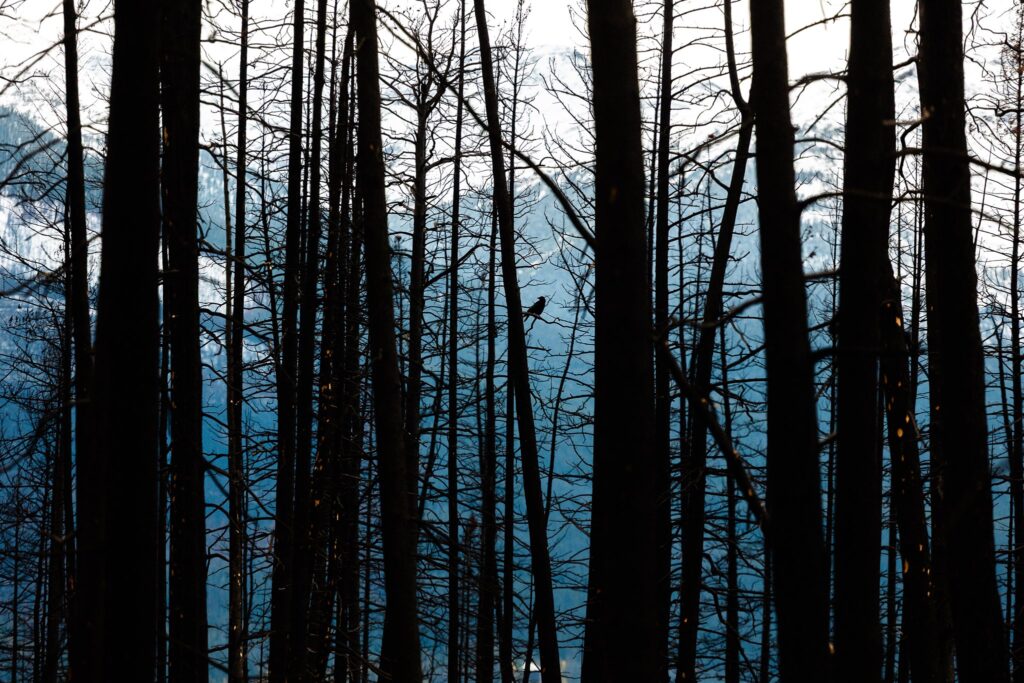
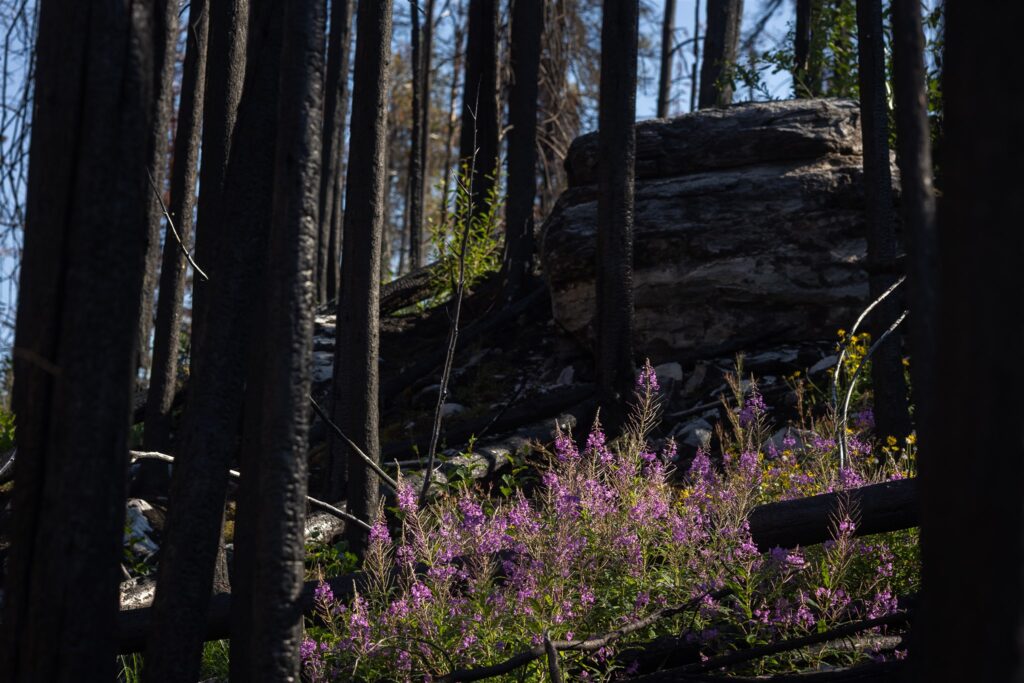
When I worry about fire, I walk in the burn. Right now, carpets of heart-shaped arnica are erupting on the high slopes, the yellow flowers like stars against the blackened soil. Elk graze on glowing green grass. In the evening light, moths flitter by, unhurried, not frantic like those crawling around our car a year ago at the rest stop. Nature is carrying on, and though it’s been a challenging year for Jasper, we will too.
Travel
In the aftermath of the Jasper Wildfires, this five-day journey through iconic Alberta towns reveals a region rebuilding and ready to welcome back travellers
People & Culture
As wildfire seasons worsen, residents of British Columbia’s southern interior have been repeatedly evacuated. They may be climate evacuees, but this hasn’t stopped them finding solutions, Canadian Geographic writer David Geselbracht reports in his new book Climate Hope.
Travel
Smoky air, closed roads, and evacuations are on the rise, but awareness and adaptability can see you through

Places
Banff-based travel writer Meghan J. Ward reflects on her love of Jasper and the impact of the devastating wildfires