Saskatchewan Whooping Cranes with Canadian Geographic
October 3 – 9, 2026
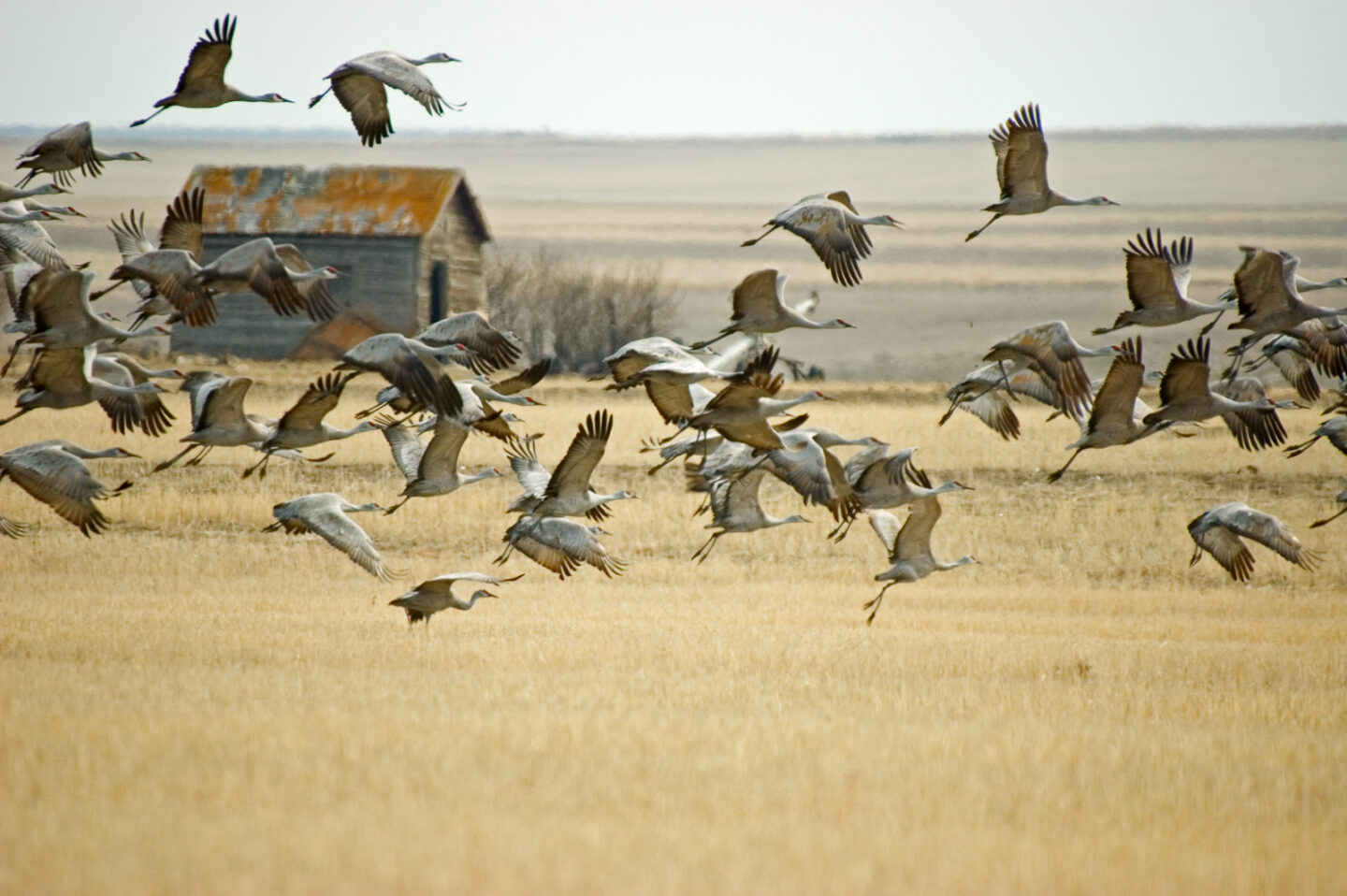
In October, sandhill cranes migrate by the thousands south across southern Saskatchewan, stopping at various localities to refuel before continuing their journey. With them are a handful of whooping cranes, coming south from breeding grounds in Wood Buffalo National Park in the Northwest Territories.
We have a good chance of finding whooping cranes on our birding tour as there is a fine network of field observers scouting the area for these legendary birds. Along with cranes, tens of thousands of snow geese and Canada geese, with lesser numbers of Ross’s, greater white-fronted and cackling geese, are pouring through, as well as other waterfowl, shorebirds, raptors and passerines, especially large flocks of lapland longspurs with snow buntings and possibly northern shrikes.
If time permits and we have seen whooping cranes well, we will venture to Prince Albert National Park and the boreal forest, where we will have chances for boreal specialties like spruce grouse, pileated, black-backed and American three-toed woodpecker, Canada jay, boreal chickadee, bohemian waxwing, and occasionally pine or evening grosbeak, or white-winged crossbill. We also have the possibility to see moose, elk and sometimes river otter.
Itinerary:
Day 1: Meet in Saskatoon for dinner and a discussion of your upcoming adventure.
Days 2-3: Visit whooping crane locations east of Saskatoon, around Blackstrap Lake and near Prince Albert National Park. Many other species will be visible as well.
Day 4: After birding in Saskatoon, travel to Prince Albert National Park to experience the boreal forest and look for the many species that make the park home.
Days 5-6: Continue exploring Prince Albert National Park. Return to Saskatoon.
Day 7: Return home from Saskatoon.
Meet your RCGS Travel Ambassador

Myrna Pearman
Myrna Pearman was raised on a farm northeast of Rimbey, Alberta. A Fellow of the Royal Canadian Geographical Society, she became interested in photography while in high school and her love of nature was inspired by a local self-taught naturalist, Fred Schutz.
In 1987, Myrna started a dream career as Biologist and Site Services Manager at Ellis Bird Farm (EBF). Under her leadership, EBF became an internationally recognized conservation, education and research centre. She retired in 2020 and is now the Resident Naturalist for Chin Ridge Seeds in Taber, Alberta and Coordinator of the Nature Central program for the Red Deer River Naturalists.
Myrna has received recognition for her conservation and education work from the Red Deer River Naturalists, Nature Alberta, the North American Bluebird Society, the Alberta chapter of the Wildlife Society and the Roger Tory Peterson Institute. She was made a Fellow of the RCGS in 2019.
Her extensive writing and public speaking experience, management expertise, and her long-term efforts to showcase and promote the Indigenous, cultural and natural history of Central Alberta emulates the RCGS’s core goal of “making Canada better known to Canadians.”
Myrna writes a monthly photo essay in the Red Deer Advocate and is a columnist for Nature Alberta and The Gardener. She contributes to several wildlife and photography Facebook groups and has a growing social media following. She has authored or co-authored several scientific publications and has written several books.
Myrna has traveled extensively (always with her cameras) and is especially interested in photographing — and sharing— her love for wildlife and wild places. She is in demand as a speaker and enjoys mountain biking, kayaking snowshoeing and spending time at her cabin.