Environment
Inside the fight to protect the Arctic’s “Water Heart”
How the Sahtuto’ine Dene of Délı̨nę created the Tsá Tué Biosphere Reserve, the world’s first such UNESCO site managed by an Indigenous community
- 1663 words
- 7 minutes
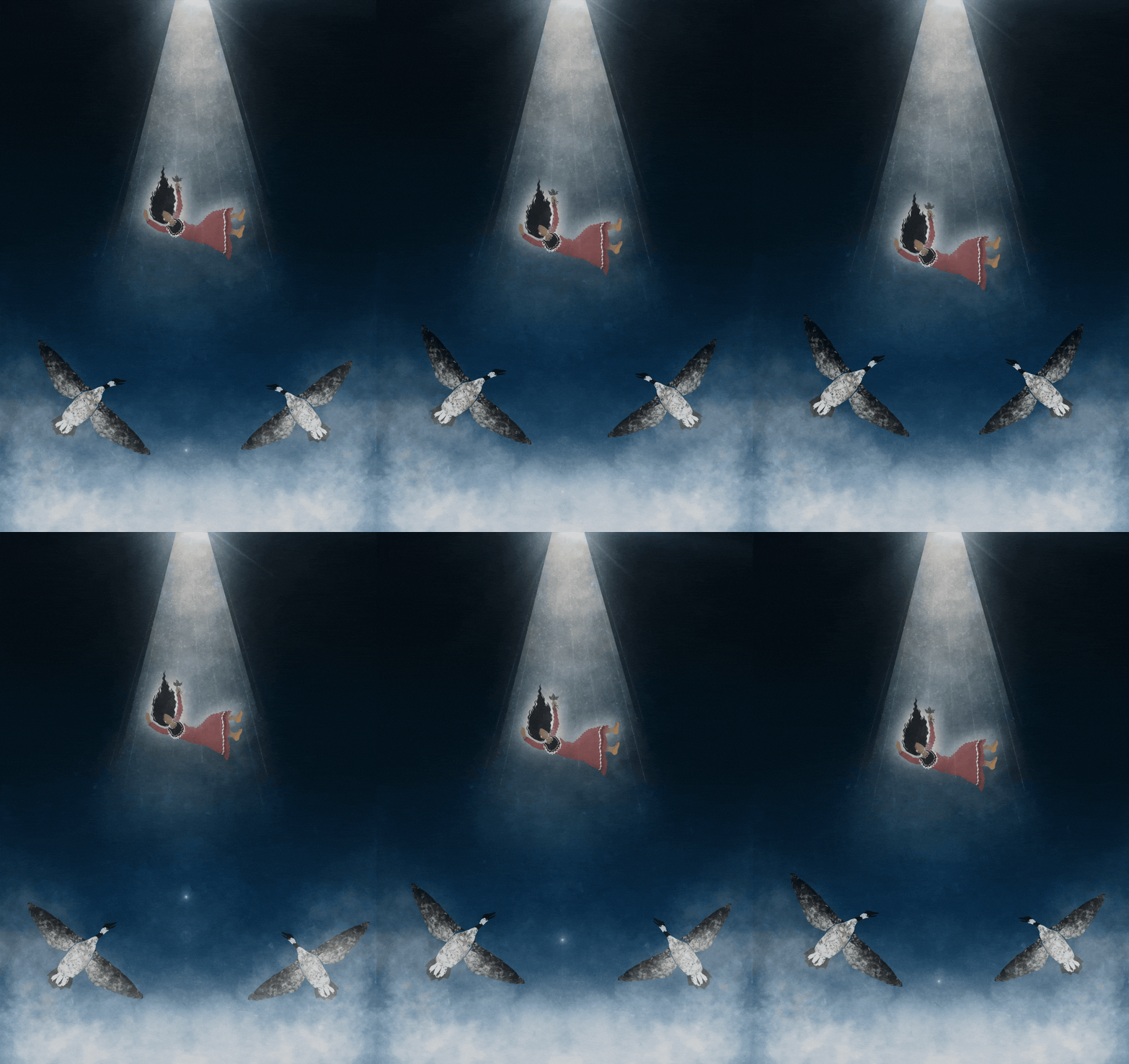
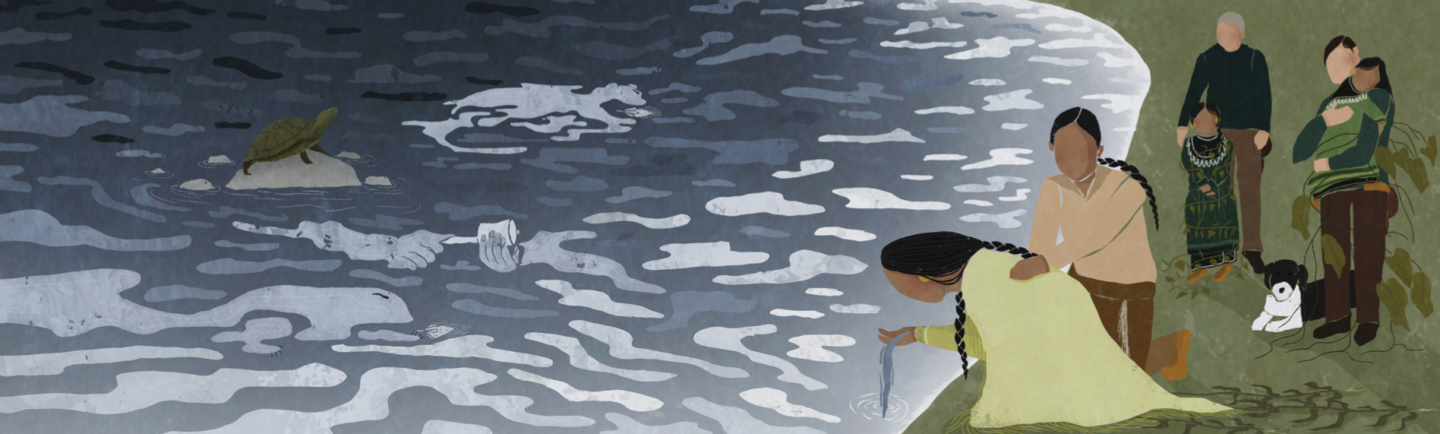
We Haudenosaunee say we descend from celestial beings. We’re in relation with Elder Brother Sun — our Creator — as well as ancestral relatives who are the stars, Mother Earth and Grandmother Moon, who came to our world in her human form, carrying life in the water of her womb. Skywoman, as she was known back then, was a divine being who fell through a hole beneath a towering white pine in the Skyworld where, at the base, grew strawberries and sacred tobacco. As she plunged into the expansive darkness below, Skywoman grasped at the roots of the plants above, hands searching out any piece of home that she could cling to, bringing with her the seeds she would sow for humankind.
Our planet, at that time, was wholly water, with no light from sun or moon in the sky. On a turtle’s back, Skywoman danced the Earth into being — a turtle island for her descendants. And, for the second time, a hole opened up, and a girl fell from the spirit world into ours, from the water of Skywoman’s womb to the turtle’s back. When the girl grew into a woman, she was visited in the night by the West Wind, who would make her into the mother of creation.
Skywoman’s daughter became pregnant with twins who would represent the eternal contention between good and evil. From their inception, these two beings fought inside their mother as each sought to dominate the other. When it came time to be born, the good twin chose to come out the usual way. But his evil brother was impatient. He tore his way up through his mother’s body, killing her as he burst through her underarm.
But a mother’s love is powerful. In the death of her human form, the mother’s body became one with Turtle Island. Alongside her daughter’s burial, Skywoman planted the seeds she had brought from the Skyworld, and plant life burst forth from her body, and she became Yethinihstenha tsi Ohwentsya:te, our Mother Earth, who continues to nurture life to this day.
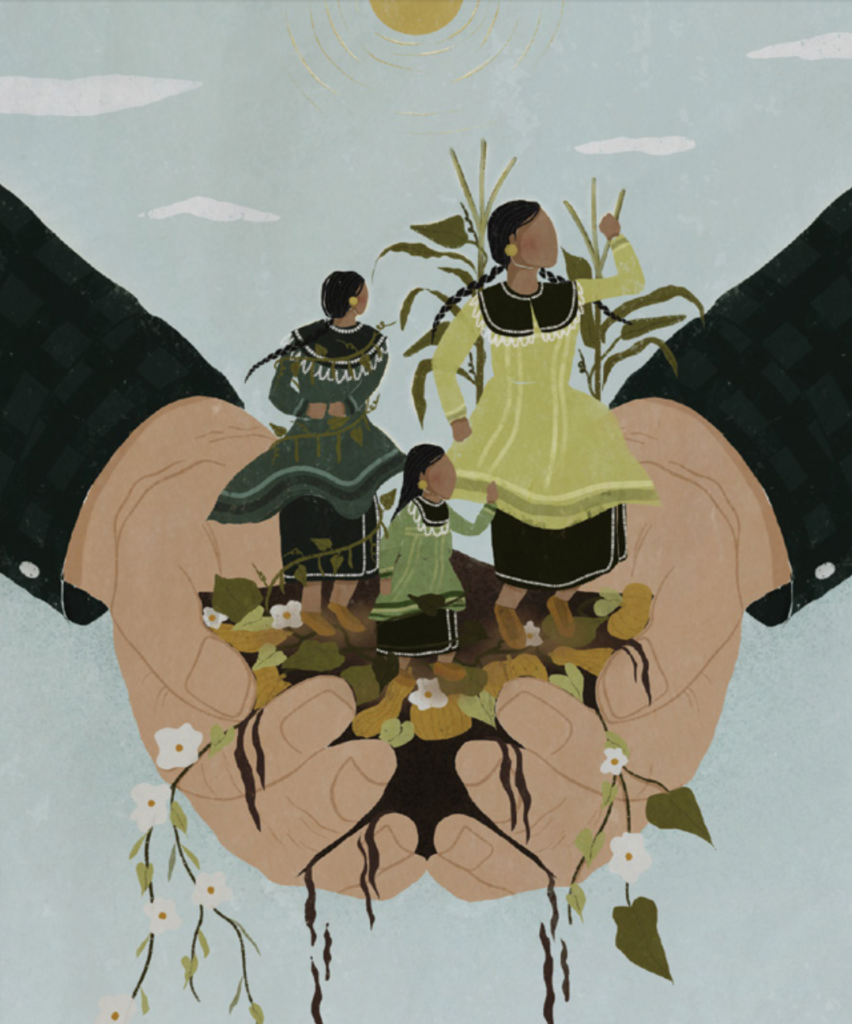
Among the berries, the four sacred medicines and other plant life grew the Three Sisters. In time, the good twin instructed the sisters that they would be tyonnhehkwen ne ne áhsen nikontate’kén:’a — the three sisters who sustain life — once human beings came around. In turn, the people would follow their own instructions from the Creator: to take care of Yethinihstenha tsi Ohwentsya:te, to give thanks to all of creation and to maintain the natural balance between good and evil. Every living thing received a role in keeping peace on Earth.

European settlers arriving in North America brought many novel things with them, but the concept of agriculture wasn’t one of them. Haudenosaunee and Huron-Wendat cultivation of corn, beans and squash (collectively known as the “Three Sisters”), as well as sunflower and tobacco, on the shores of Lake Ontario and the St. Lawrence River long predated colonization of the Americas. Jacques Cartier, on the first recorded up-river voyage on the St. Lawrence River by a European in 1535, noted the “good and large fields of corn” being grown by the Haudenosaunee people living in what is present-day Montreal. The Old Farmer’s Almanac still calls the Three Sisters “companion planting at its best,” as the trio grow “symbiotically to deter weeds and pests, enrich the soil, and support each other.”
Of course, left alone, the Earth has no trouble supporting all manner of flora and fauna. Agriculture is simply the process of managing that growth and of directing resources into plants and animals we want to use. Western farming practices have exacerbated that control, through a cycle of creation and disruption: a crop is planted into a prepared seedbed, nursed to maturity and harvested, after which the field is readied for another planting through tilling into the soil. Done to extremes, this works to the detriment of natural systems, leaving soil compacted, exposed to erosion and leached of nutrients. Some farmers hope to alleviate those effects and to change the agricultural question from “What is the soil worth?” to “How can I contribute to the soil’s value?” One answer to that question is regenerative farming.
Norm Lamothe, who farms near Cavan, Ont., is one of those farmers — and he looks to the forest for answers. “The forest doesn’t need fertilizer,” he says. “The forest can produce trees. It can produce nuts. It can produce the species that thrive and survive in that ecosystem without any external influences. We’re trying to mimic as much of that diversity as we can.”
His family’s 500-acre property, Woodleigh Farms, is a sundry of agricultural trappings: fields of corn, soybeans, wheat and oats are rotated over a layer of cover crop (plants sown not for harvesting but for secondary benefits), 100 Barbados black belly and Katahdin sheep graze on pastureland, their maple stands produce organic syrup, and their greenhouse supports a small market garden. Most recently, Lamothe introduced a biomass recovery service, turning unwanted trees into carbon-rich “biochar” that is worked into the farm’s fields. While Lamothe is hesitant to ascribe a label to himself or his farm (unlike organic agriculture, regenerative has no standardized oversight or certifying bodies), his concentration on soil and ecological stability hews close to regenerative principles of producing crops in a way that allows natural systems to be retained and only minimally disturbed.
By using methods, some new, others time-tested, that prioritize soil health and maintain ecological biodiversity — zero-tillage, cover cropping, diverse crop rotations and livestock integration — regenerative farming aims to work with nature rather than wrestle against it. Think deep-rooted plants, multi-species fields, little to no bare ground and grazing animals — all of which can aid nutrient cycling, water filtration, erosion prevention and carbon fixing.
“We spent so much time in agriculture focusing on the bushels and the yields above the ground,” Lamothe says. “But very little attention has been paid to what’s happening under the plants.”
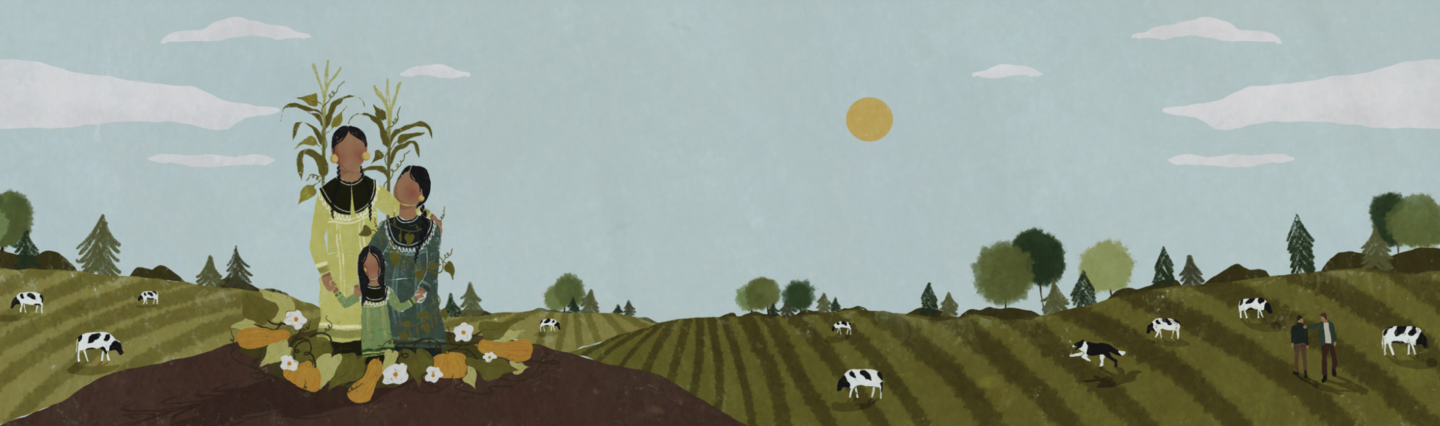
Every year, Ó:nenhste, Corn, is the first sister to return — tall, slender and stoic, with silky yellow hair that glistens in the July sun. Her ambition to stretch for the sky sets her apart, earning her the posture of confident authority that eldest sisters tend to have. After all the growth she achieves, Ó:nenhste watches over her sisters from above and guides them to grow in their own ways. Her strong will and even stronger stalk make her a natural-born leader, helping and inspiring her sisters to fulfil their original instructions.
Ohsahè:ta, Bean, is the second sister. As a wandering spirit, she winds her way from place to place; opportunity to opportunity, blindly sending tendrils in every direction. But without someone or something to cling to, many of them would wither and die, wasting her precious energy. When, instead, she finds the eldest sister, her purpose to sustain life is emboldened. She clings to Ó:nenhste and, with the support of her sister, climbs to new heights. Using stalk as trellis, Ohsahè:ta will gift a bountiful harvest that far exceeds what she could have grown along the ground by herself.
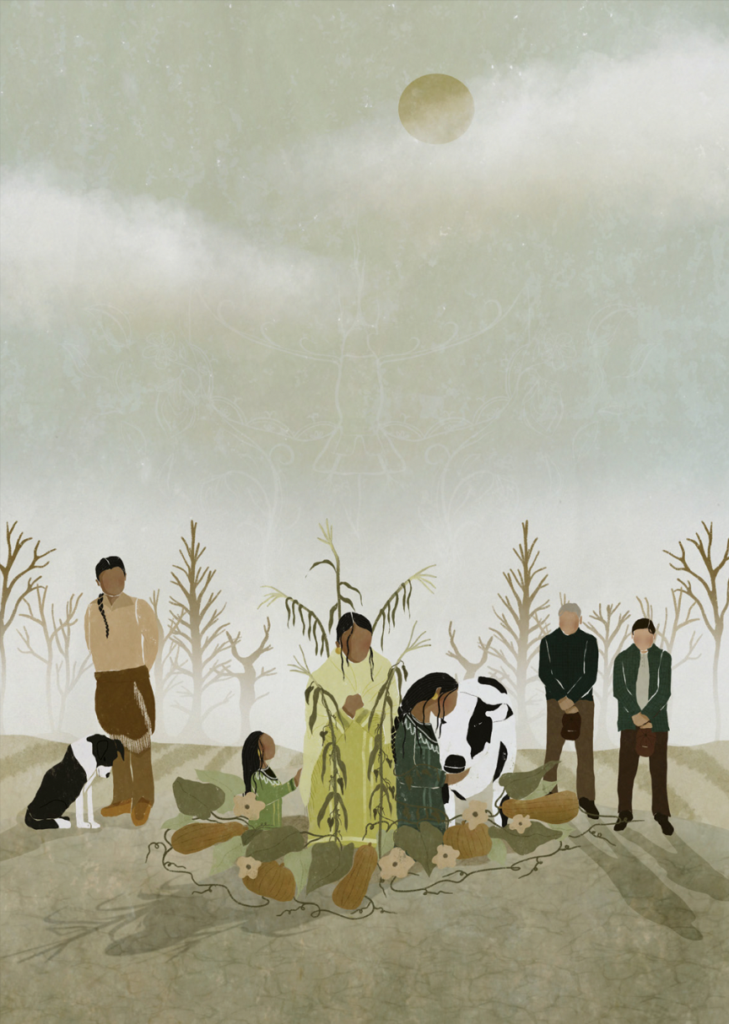
Ohsahè:ta has a secret gift, invisible to the naked eye. As the Three Sisters grow, they feed on limited nutrients in their little mound of earth. Ohsahè:ta, an understated mediator who builds connections in her travels, hosts bacteria in her roots. These bacteria can capture more nutrients from the air and return them to the ground below, fuelling the growth of our life sustainers, and maintaining the quality of the soil for the next growing season. Ohsahè:ta reminds her sisters to accept help when they need it and offer it when they can.
Onon’ónsera, squash, is the youngest sister, a sensitive and short-tempered girl who holds her mother the Earth close. She has unmatched love for her family, content to bloom where she is planted, rather than seek out the open sky like Ó:nenhste and Ohsahè:ta. Onon’ónsera makes the sisters strong as a unit, protecting them with all that she is. Her leaves grow wide and thick, shielding her sisters’ roots from baking under the heat of the sun and saving water in the soil from evaporating in the process. Her vines are often prickly, keeping ground predators away.
The Three Sisters know they are stronger together and rely on each other to best fulfil the responsibilities given to them by the Creator, proudly sustaining the Haudenosaunee for generations. In return, the Haudenosaunee uphold their vows to Mother Earth, protecting and respecting all of creation, including the Three Sisters. Our people offer greetings and thanks to those life sustainers in a daily prayer and continue to plant them together in one mound the way Creator instructed so long ago.
At the spring seed ceremony, the Haudenosaunee thank their plant relatives for sustaining them over the winter and humbly ask them to grow again that year. Each family takes home heirloom seeds to plant together in small mounds, with fresh thoughts of their responsibilities to care for the Three Sisters — to plant them in a good place, offer them thanks and nourish them so the sisters will want to keep nourishing us in the way they have always done.
Nourishment and good management of the soil are not always a certainty in agriculture. We need look no further back than the 1930s, with its dust storms and failed crops, to know that poor farming practices can turn good soil into what one Canadian farmer at the time called, a “dust-choked perdition… dried out, lifeless expanses of sun-smitten prairie.” Alongside releasing stored carbon into the atmosphere, excess tillage leaves soil vulnerable to wind, sun and water, hastening erosion and the loss of nutrients. Chemical fertilizers swept away during that accelerated erosion and introduced into water systems have been linked to eutrophication, algal blooms and the death of aquatic life.
Blake Vince operates a 1,200-acre farm near the shores of Lake Erie, producing corn, winter wheat, soybeans and cattle. Vince chose to shift his operation towards regenerative techniques after learning of the detrimental effects pollutants have on water systems. And he was no longer comfortable with his crops being put towards non-edible products like ethanol, plastic and biodiesel. “I recognized that I was growing commodities. I wasn’t growing food.”
Already a no-till operation since the 1980s, he switched to using primarily non-GMO seeds, planted cover crops, installed water monitoring equipment and purchased a small herd of grazing cattle. Like Lamothe, Vince is hesitant to ascribe himself any labels. “I don’t want to hitch myself to a wagon. I’m not about buzzwords. I’m doing it because I believe it’s the right thing to do. It makes sense physically, psychologically and financially.”
Readdressing agriculture is as much a social change as a technological one, as rooted in emotions as it is in economics.
For many farmers across the Great Lakes-St. Lawrence watershed, finances were a consideration on par with the environment. Yet the annual cost of soil erosion in Canada from reduced crop yield alone is estimated to be in the billions, and the cost of fertilizers is substantial. Sébastien Angers, an agronomist in Nicolet, Que., says these costs could be minimized if we stop practising agriculture through an “empty space” mindset. In conventional agriculture, he says, “we destroy and create a vacuum into which the weeds come.” It takes time and money to clear that space by applying pesticides and herbicides. Angers, who is also a farmer and practises regenerative techniques on the commercial pumpkin fields of his Ferme de l’Odyssée, says the ecological structure created through regenerative techniques allows farmers to limit inputs like pesticides and herbicides while buoying a crop’s natural resilience.
Farmers lead chancier lives than most, their income relying heavily on structures far beyond their influence, including the global economy and the weather. It stands that farmers desire to control what they can, be it by using ever-improving mechanical equipment, irrigation practices, hybrid and genetically modified seeds, and chemical fertilizers and pesticides. It’s through these techniques that the total yield for key crops like potatoes, corn and barley has increased more than twofold over the past 20 years. As long as high yields are the metric used to measure successful agriculture, conventional farmers have little reason to alter their methods.
While the commercial farmer bases their income on high volumes of product, and the organic by demanding a higher price, Angers thinks the value of a regenerative farm should be measured by what natural systems it is able to retain. While it may be a little esoteric to put a dollar price on biodiversity, water and soil health, it creates a major incentive for farmers. He is hopeful that as more farmers apply these techniques, data gleaned from their efforts can go toward creating roadmaps to help farmers optimize any particular crop they want to grow in concert with their farm’s natural biodiversity. “A lot of people think I’m crazy,” he said. “I’m just 25 years too early.”
Though Angers’ work may seem inchoate to some, it is an endeavour to modernize and scale practices that have existed for millennia, an attempt to refashion techniques that were standard in pre-contact North America, such as the Three Sisters.
There was a dark time in Haudenosaunee history, when people forgot how to live in accordance with their original instructions. They were so preoccupied with warring against local and European nations, fighting for territory, power and even money, that they harmed the land in the process without care. In the new world, many Haudenosaunee stopped conducting ceremonies, taking care of their mother and even giving thanks to the life sustainers. The rest of creation began to take notice of their wicked ways.
Feeling that their hard work was unappreciated and unreciprocated, the sisters wanted to end their lives on Earth and return to the Skyworld. In a vision, they met a Haudenosaunee man called Kaniatario, Handsome Lake. He, too, was feeling hopeless after surviving a gruesome attack from a more powerful nation (America) and deeply mourned the state of the world in constant despair. Kaniatario and the Three Sisters prepared to journey to the other side of the sky together.
Before they could leave, Kaniatario saw that his people had forgotten their instructions and that was the reason for such bloodshed and fear. He convinced the Three Sisters to stay with him on Earth and vowed to re-teach his people the old ways. The sisters agreed, and Kaniatario fulfilled his promise. To this day, Haudenosaunee still plant the Three Sisters in one mound and offer them our thanks and appreciation.
As life on Earth changes rapidly and new environmental threats emerge, so too do our responsibilities to protect the natural world that sustains us. When Haudenosaunee gather, we begin by bringing our minds together as one, akwé:kon énhska entitewahwe’nó:ni ne onkwa’nikòn:ra, to offer our thanks and greetings to the natural world as a collective voice. We recognize the work the life sustainers do to allow life to thrive and ask that they continue. Our stories teach us that everything we need is freely given to us by creation. Now we need to pull that wisdom from the old ways and use it alongside settler agriculturalists to collaboratively respect the land we’ve borrowed from future generations and ensure the life sustainers never want to leave us again.
There are some 190,000 farms in Canada, and of the roughly 62 million hectares they cover — about six per cent of the country’s land base — it’s unclear how many use regenerative practices. Régénération Canada, a non-profit that organizes workshops and connects farmers, scientists and consumers across the country, works directly with around 500 farms and indirectly with up to 3,000. It’s worth mentioning that some regenerative techniques are used by self-styled conventional farmers; my father’s farm and many other farmers I know in southern Manitoba use swidden agriculture (burning to promote growth), rotational cropping (moving crops from field to field), livestock grazing and multi- or polycropping without invoking the regenerative name.
“Farmers are going to do what farmers do until they can do it better,” Lamothe says. “No one goes out every day and says, ‘I’m going to go pollute the water,’ or ‘I’m going to taint the creek with my manure application.’ They’re going [to] do what they think is best given their circumstances and given their knowledge and practices, and to the best of their abilities. They don’t want to lose money. They don’t want to hurt the environment. They don’t want to hurt animals. They don’t want to endanger the population.”
The disconnect between farmer and non-farmer today is large enough to render farming something of an abstract concept — something that happens over there under vague circumstances. Farmers are under pressure to bridge the gap between nostalgic perceptions and modern realities. “I remember my father-in-law saying that, when he was farming, it was 95 per cent art and five per cent science,” said Lamothe. “Today, it’s the complete opposite. We’re looking at a system that’s 95 per cent science and five per cent art. I don’t wake up in the morning and look at the moon, smell the soil or listen to what birds are chirping to decide what I’m going to do that day or how I’m going to plant my crops. I’m looking at weather patterns and soil temperatures, at the soil analysis that I get from my GPS soil sampling points, at hybrid results from trial plots — and things of that sort to decide what kind of practices I’m going to use to grow my crops and improve my soil.”
Technologies are moving agriculture towards a future where sustainability encompasses both economics and the environment. Recent innovations have included heavy machinery that is less disruptive to the soil, smart seeds that read soil composition, and the use of microbes that remove methane from the soil and others that fix nitrogen. Yet readdressing agriculture is as much a social change as a technological one, as rooted in emotions as it is in economics.
In his 1733 work “An Essay on Man,” the English essayist Alexander Pope was already alluding to the battle between human desires and nature’s capabilities, writing “Where grows? — where grows it not? — If vain our toil, We ought to blame the Culture, not the Soil.”
Culturally, western nations have become accustomed to a worldwide agricultural system that prioritizes our eclectic tastes over the fair distribution of food globally, the treatment of agricultural workers and impacts on the climate. Grabbing a banana in Toronto in January today goes without a second thought. Philip Loring, the global director of human dimensions science for the Nature Conservancy’s global science team, suggests that changing this mentality is not merely about the facts but about rethinking how a farm works. “What is a farm for? Is it for producing commodity crops? Or is a farm for producing food?”
Loring, whose Conservation of Change initiative looks to Indigenous cultures around the world for examples of how communities can work with nature to survive over hundreds of generations, points to agricultural systems like those of the Haudenosaunee, who, Loring says, practised “great diversity in the food system, seasonal eating and a willingness to give space for aspects of the environment to heal.” Many studies, including several involving Loring, have shown that traditional polycropping techniques, along the lines of the Three Sisters, are sustainable and cost-effective.
“Regenerative thinking,” Loring says, “is asking people to realize that for us to get what we need, we need to leave space in that system for things that we don’t need, that aren’t for us.” “Many farmers now have been coerced onto a treadmill of supporting seed and chemical companies — and getting locked into bank notes and cycles of debt and finance. It’s almost a subservience to the commodity market they are selling into. Imagine getting out of that!”
The dual role of farmers as both scion and arbiter of the social direction was explored by the American naturalist writer Aldo Leopold in his 1949 book A Sand County Almanac. Leopold appealed to farmers’ sense of social responsibility when proposing the idea of a land ethic, which he envisioned as a widened notion of community, including the health of all soil, waters, plants and animals — and thereby extending to them the same social conscience we impart and expect of others to make coexistence peaceful and progressive. If not quite bestowing personhood upon creeks, dandelions and frogs, it was at least suggesting that minding them was an act of civility and good conscience.
As “ethic” implies, Leopold’s philosophy tended toward the moral, not the practical: “A thing is right when it tends to preserve the integrity, stability, and beauty of the biotic community,” he wrote. “It is wrong when it tends otherwise.” Still, Leopold was not ignorant of the schism between a farmer’s pragmatic approach to land and the public’s remove from it, nor did he turn a blind eye to economics. Rather, he appealed to their “time, forethought, skill, and faith.”
Because of consolidation and an aging farmer population, the number of small farms (those under 2,000 acres) in Canada has dropped steadily since 2001, according to the National Farmers Union, while large farms (those over 3,500 acres, roughly 14 square kilometres) have nearly doubled. There is more pressure on fewer people to produce the food we need. “It’s very difficult to have a long-term vision,” said Lamothe. “A lot of land is leased; a lot of land is about to change hands or has already changed hands. There’s a tremendous generational shift.” The National Farmers Union also reports that 60 per cent of farmers are over 55, and only 12 per cent of farms reported having a succession plan in place for what happens to that land next. Some would rather their kids not farm because of the tight economic margins and long working hours.
Agriculture is looking over a precipice. If it is true that the methods used by industrial farms today, whether it is pesticides or continual tillage, are indeed harmful then that, too, has meaning. Those who choose to farm regeneratively are making that wager and doing what they can to improve the land around them.
Being on the edge of an agricultural shift can be lonely, but Vince finds solace in the global regenerative community. “Knowing that I have like-minded people, not necessarily my immediate neighbours, but other people who make this transition and implement it with success, gives me the only validation that I need.”
Lamothe waits ready for when anyone wishes to join them. “I’m very careful not to preach or push my practices or ideas on anybody. All I can do is hope that they see the success that we’re having on our farm and approach us with a query, or inquisitive mind, about why we’re doing it.” Lamothe is the sixth generation to operate his family farm, and his goal is to leave the soil better than he found it. “I can’t think of anyone that’s going to be upset with me for having done that when I pass the farm on to, hopefully, another generation.”
*Corn illustration by Denis Pisarovskiy Via Vecteezy

This story is from the Biinaagami Special Issue 2025 Issue
Environment
How the Sahtuto’ine Dene of Délı̨nę created the Tsá Tué Biosphere Reserve, the world’s first such UNESCO site managed by an Indigenous community

People & Culture
Announcing a new initiative to connect to and protect the Great Lakes-St. Lawrence watershed

Mapping
Biinaagami, a CanGeo collaborative initiative seeking to connect people with the Great Lakes-St. Lawrence watershed, has released a suite of educational materials, including a Giant Floor Map, augmented reality experiences, lesson plans and more

People & Culture
Indigenous knowledge allowed ecosystems to thrive for millennia — and now it’s finally being recognized as integral in solving the world’s biodiversity crisis. What part did it play in COP15?