History
The hatchery crutch: How we got here
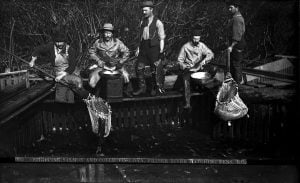
From their beginnings in the late 19th century, salmon hatcheries have gone from cure to band-aid to crutch. Now, we can’t live without manufactured fish.
- 4255 words
- 18 minutes
Wildlife
As wild Atlantic salmon numbers plummet, Hawkins is using powerful imagery to bring attention to one of Canada’s most threatened fish
On a brisk morning at the end of March, Nick Hawkins arrives at the fish hatchery in South Esk, N.B., carrying an empty kalamata olive jar and a cooler. Mist rises from the snow-patched grounds as Hawkins sips from a to-go cup of tea, an auburn beard framing his face beneath his tuque.
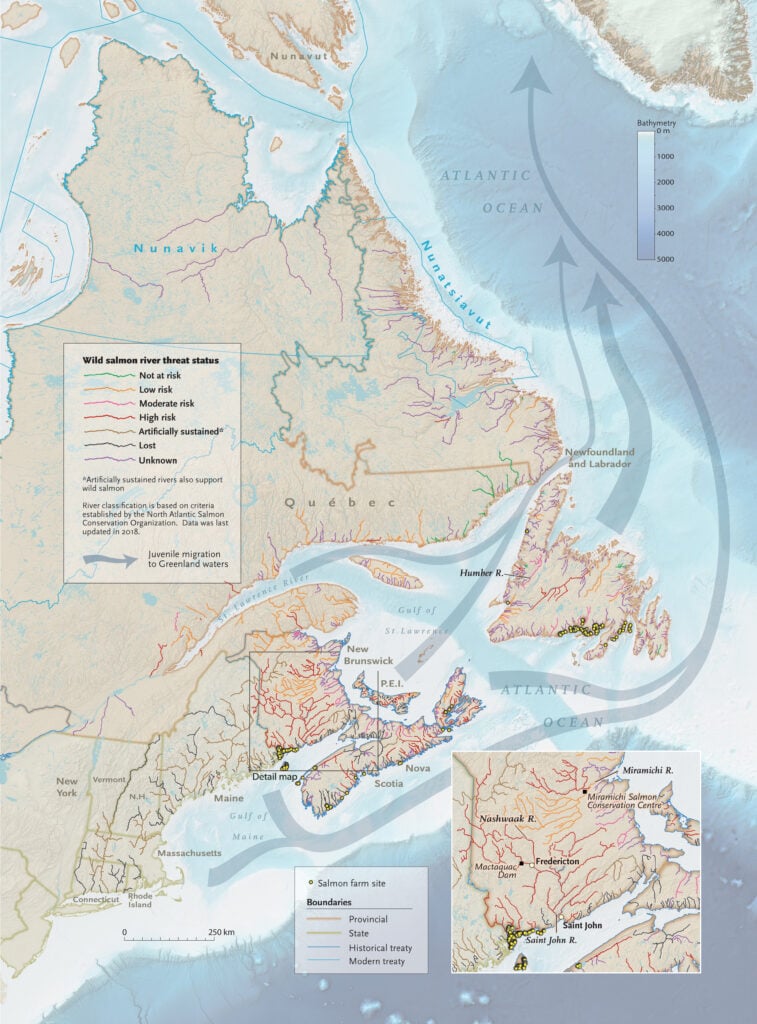
The Miramichi Salmon Conservation Centre, the oldest operational fish hatchery in Canada, sits like a small village among the trees beside the Northwest Miramichi River. This slow-moving river, fed by tributaries flowing through dense forests, once teemed with wild Atlantic salmon.
But the hatchery’s 150-year history illustrates the salmon’s long and turbulent journey from abundance to scarcity. The federal government built the hatchery in 1873 to restore salmon populations already in decline from habitat loss due to dam construction for log drives and an intense commercial fishery. A century-and-a-half on, human development and ecosystem changes have continued to reduce annual salmon runs throughout the watershed, leaving them at a fraction of their former numbers.
Hawkins heads toward the 1940s-era egg building, where hatchery manager Holly Labadie greets him among rows of shallow fiberglass troughs, each housing tens of thousands of bright reddish-orange salmon eggs. The one-storey building hums with the sound of rushing freshwater from neighbouring Stewart Brook, a tributary of the Northwest Miramichi. The water cycles through the simulated riverbeds, maintaining the delicate conditions needed for the eggs’ survival.
“The gauntlet these fish face is formidable.”
Today, Hawkins will collect 200 Atlantic salmon eggs in his olive jar and transport them to a freshwater tank at his home in Douglas, N.B., about 160 kilometres southwest of the hatchery. There, the eggs will continue to develop, from nesting to hatching to eventually swimming to the surface to feed — all under the watchful eye of Hawkins’ camera.
“I like to think I have good fish husbandry, but this will be the test,” says Hawkins to Labadie with a chuckle.
Raising salmon eggs requires patience and persistence. Seven days a week, hatchery staff measure oxygen and temperature levels and remove any eggs that have blanched — the telltale sign an egg has died. The hatchery regularly provides eggs to local schools through its “Fish Friends” program, giving middle-school students a chance to nurture eggs into fry before releasing them back into their natal rivers. Today, the hatchery is extending that educational mission to Hawkins, a wildlife cinematographer who specializes in marine life.
Capturing these early life stages will complete his latest project: documenting, in unprecedented detail, the extraordinary journey of Atlantic salmon throughout their entire geographic range, which spans Canada, Greenland, coastal parts of Scandinavia and Europe and the United States, from freshwater spawning grounds to ocean feeding areas and back again. By opening a window onto the invisible, Hawkins hopes to advance Atlantic salmon education and conservation and help to reverse their precipitous decline. The 200 eggs destined for his olive jar are more than a new logistical challenge for a conservation filmmaker who has pioneered innovative techniques for capturing his underwater subjects. They’re a symbol of hope in the face of an unfolding ecological tragedy, and the raw material for images that may help determine whether future generations will ever witness the return of Atlantic salmon to Maritime rivers.
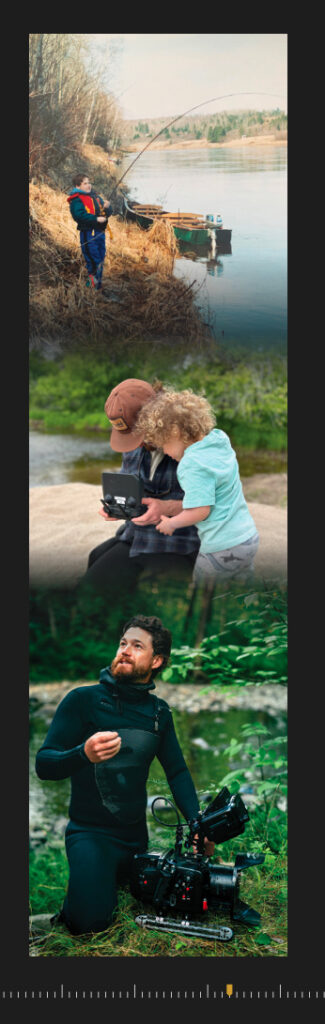
Hawkins was 15 when he realized Atlantic salmon were in serious trouble — and he needed to help. He had grown up angling with his father, Mac, in the iconic salmon rivers around his childhood home in Upper Kingsclear, outside Fredericton. Father and son mostly fished the nearby Nashwaak River, one of seven tributaries of the Saint John River, but by 1998, the federal Fisheries and Oceans department had banned salmon fishing in the Nashwaak, following a pattern of closures due to sharply declining salmon returns that began in the 1990s in the Saint John River watershed.
The pair moved to the Miramichi, but that watershed, too, showed troubling signs. Salmon returns peaked in the early 1990s, followed by a major decline from that period into the 2010s and to the present day.
According to the Committee on the Status of Endangered Wildlife in Canada, an independent panel that provides advice to the Canadian government on which animals to list on the species at risk registry, six of the 16 distinct wild Atlantic salmon populations in Canada are endangered or threatened, while another four are assessed as a special concern. Of the two North American populations found outside Canada, in the Gulf of Maine and the Kapisillit River in West Greenland, only the Maine population is imperilled, listed as endangered under the U.S. Endangered Species Act and facing a high risk of extinction.
The Saint John River, which originates in separate streams in Maine and Quebec, forming part of the Canada-U.S. border before flowing into New Brunswick and the Bay of Fundy, was once considered the Rhine of North America for its diversity and abundance of fish. Where the watershed saw salmon return by the hundreds of thousands a century ago, today the salmon runs are functionally dry, with only a few hundred fish counted in recent years. In the neighbouring Miramichi watershed, which comprises two major branches and dozens of tributaries, salmon runs plummeted from 186,000 returning adults in 1992 to just 5,315 in 2024, a 97 per cent decline in three decades.
Atlantic salmon are a product of their environment, from the rivers where their lives begin to the ocean where they migrate in adulthood. Unlike Pacific salmon, which die after spawning, having expended all their energy in a single reproductive event, Atlantic salmon can survive spawning and make the journey from river to ocean and back again multiple times, though few do.
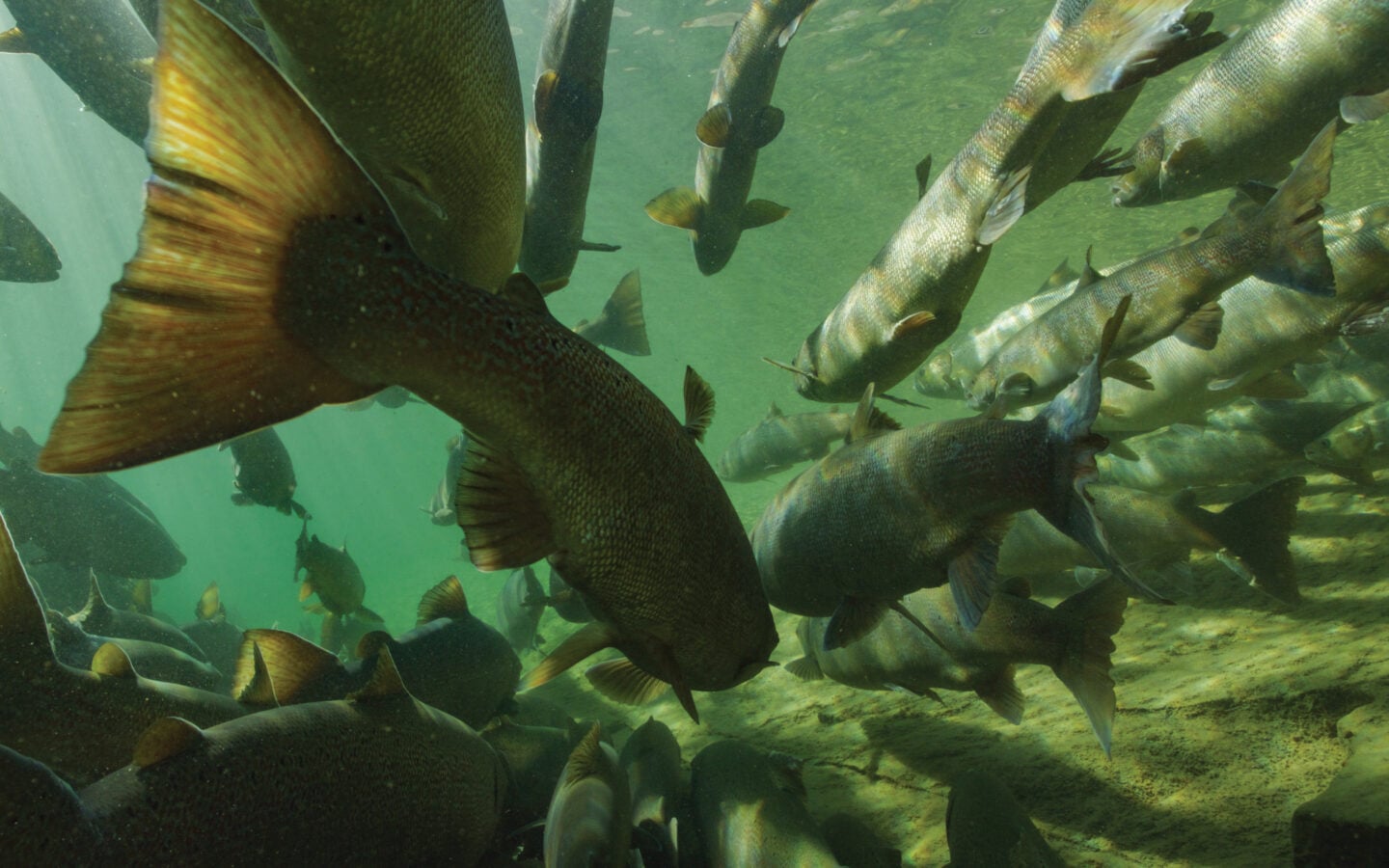
The gauntlet these fish face is formidable. Dams block access to historical spawning grounds, particularly in the Saint John River, where three hydro-electric dams built between 1925 and 1965 have severed salmon from vast stretches of upstream habitat. Warm-water species like smallmouth bass prey on young salmon in their nurseries, while warming waters due to climate change create ecosystem imbalances, shifting species ranges and intensifying predation by striped bass in the Miramichi River and seals in marine habitats. Escapees from fish farms introduce genetic pollution and parasites like sea lice into wild populations. Decades of overfishing — first through intensive commercial fisheries in rivers and estuaries, then through high-seas catches — decimated returning adults before fishing bans were imposed in the mid-1980s. Even now, with the commercial harvest eliminated, the cumulative effects of habitat degradation from forestry and agriculture, changing ocean conditions and the legacy of past exploitation continue to suppress populations.
Seeing fewer salmon returning to his favourite fishing pools on the Miramichi year after year, Hawkins started questioning his hobby. Where he had once enjoyed worry- free fly fishing and the chance to connect with his dad, he now felt deep concern. “Fishing was a pursuit to bring us out of whatever stresses we had in our lives, but it was no longer doing that,” he says.
“He was always very concerned about why we were seeing declining numbers,” says his father, Mac. Hawkins began advocating for stronger conservation measures, starting at home. “‘We’ve got to put more back,’ he would tell me,” says Mac.
“He kind of guilted me into it,” adds his mother, Debbie, laughing. “I’d say, ‘If you go fishing, at least bring one for the barbecue.’ But he put the pressure on — we couldn’t keep any more fish.”
Instead, Hawkins took photographs. Debbie still has the receipt for Hawkins’ first point-and-shoot camera, which he saved for at age 10. Over the years, Debbie and Mac watched their son’s interest in conservation develop into a career. A pivotal moment occurred during Hawkins’ final year studying biology at the University of New Brunswick, when he opened a National Geographic magazine and saw Brian Skerry’s powerful image of bycatch: a fisherman cupping the few shrimp he caught after towing his net for an hour, backdropped by a heap of dead animals destined for discard. Hawkins realized that effective conservation has to start with compelling visuals that help people establish an emotional connection with species at risk.
To raise awareness of the plight of the critically endangered North Atlantic right whale, he learned how to free whales tangled up in fishing gear and secured a species at risk permit to join rescue missions and document the whales. His unprecedented footage of a right whale disentanglement was recently featured in an episode of the Apple TV docuseries The Wild Ones.
Atlantic salmon are not unlike right whales in the sense that they’re hard to find and harder to photograph well. “We haven’t broken that line of being able to get great visuals beyond fly-fishing and holding fish in the water,” says Hawkins.
Hawkins wanted to showcase the iconic fish in its natural environment. Typically, when people think of salmon, they picture Pacific species: grizzly bears perched on rocks, waiting to pounce on bright red sockeye. Atlantic salmon lack that association. Without compelling imagery, the species is invisible in the cultural imagination. Hawkins saw an opportunity to change that, to create a visual archive that would fuel conservation storytelling for decades — showing the fish not as a menu item but as a remarkable animal undertaking an extraordinary journey.
Inside the hatchery in South Esk, Labadie uses a net to gently scoop the eggs into Hawkins’ olive jar, then hands it over. He caps the jar, twists it tightly, then places it in his cooler, stuffing an old blanket around it for stability. Outside, he scoops snow and packs it around the top to keep the eggs cool before zipping it closed. Labadie knows the value of what Hawkins is attempting; she’s seen first-hand how conservation efforts struggle without the public attention that captivating visuals can generate.
“We’ve been trying for so long to have a successful program to help with conservation, but salmon don’t have time. They don’t have time for more meetings and more policies and more protocols,” says Labadie. “In the next five to 10 years, maybe even less than that, Atlantic salmon could be gone from this area. It’s heartbreaking.”
Without compelling imagery, Atlantic salmon are invisible in the cultural imagination.
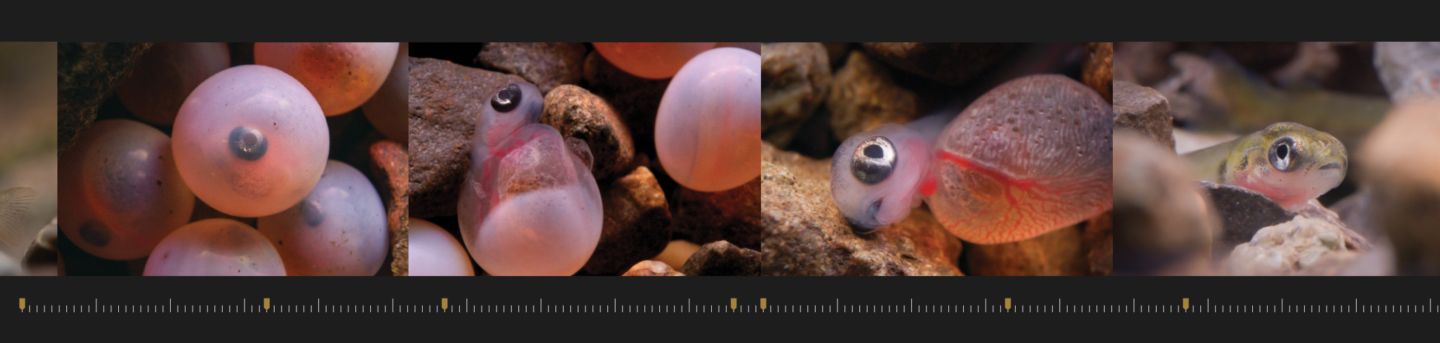
While Hawkins could easily film the beady-eyed eggs at the hatchery, his goal is to capture the critical early moments of the fish developing inside them. Filming in the rivers is logistically impossible — they’re mostly ice-covered at the end of March, and even in ideal conditions, the eggs nestle out of sight, buried in riverbed sediments in salmon nests called redds. When the eggs hatch as tiny fish, called alevins, with large yolk sacs still attached to their bellies, they remain hidden under gravel. Only once the salmon have absorbed all the nutrients from their yolk sacs do they emerge from stone cover as free-swimming fish called fry.
Inside his garage aquarium, Hawkins has assembled a redd using pebbles and sediments gathered from nearby rivers. He will film through the glass as the eggs develop and hatch into delicate, wriggling alevins. Then, with a bracket-and-arm camera system positioned above the tank, he will capture overhead shots of the fry as they swim to the water’s surface to feed. Throughout the process, he will slowly raise the water temperature to mimic the warming that follows the spring ice break-up.
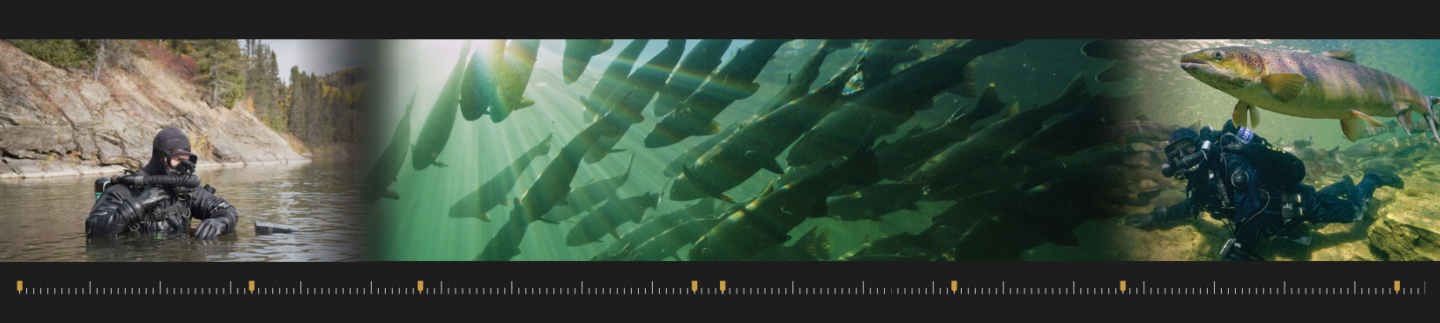
This meticulous home documentation will complement footage he’s already captured across the Atlantic salmon’s vast range. In Quebec’s Gaspé region, Hawkins filmed parr — the freshwater juvenile stage that follows the fry stage — and returned later to document adult salmon and their spawning behaviour in the same waters. In the Miramichi River, he captured smolt, the critical stage that follows parr and prepares salmon to adapt to the salinity of the ocean in advance of their migration. And in Maine’s rivers, he produced the first high-quality underwater footage of adult Atlantic salmon in U.S. waters.
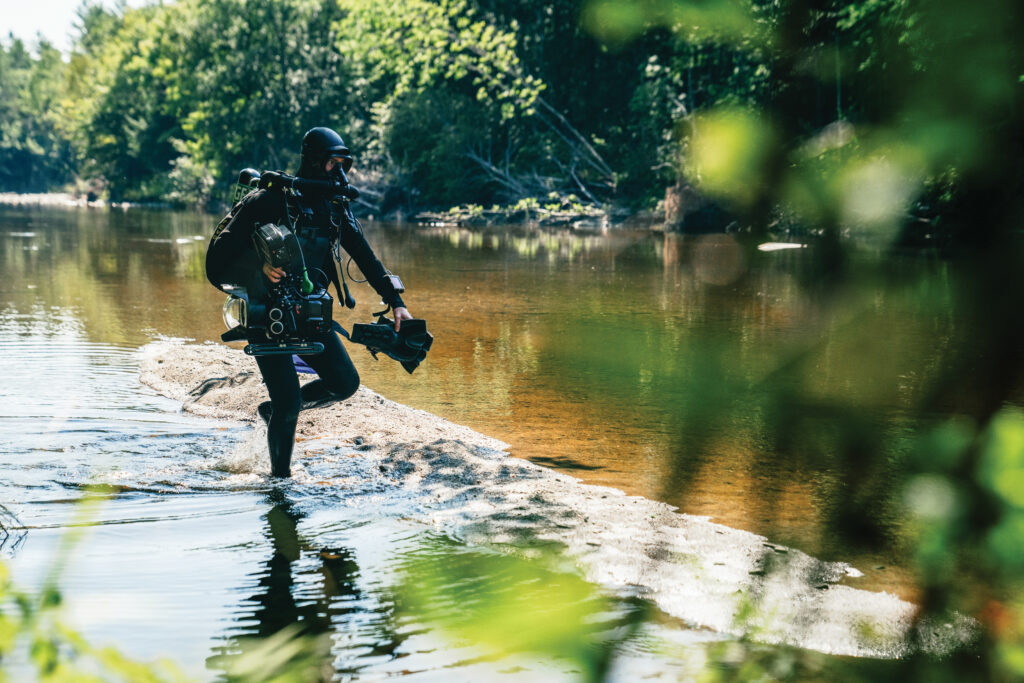
To film salmon in rivers, he dives with a closed-circuit rebreather system that recycles his exhaled air without releasing bubbles, allowing for silent extended underwater sessions without startling the naturally wary fish.
Atlantic salmon from throughout North America migrate to the fiords of western Greenland as juveniles to feed, returning to their home rivers up to three years later as mature adults. Hawkins captured footage in those Greenland waters. His ambitious to-do list includes documenting adults leaping up waterfalls in Newfoundland’s Humber River — the best place in North America to film Atlantic salmon exhibiting this iconic behaviour.
All this footage will feed into a documentary film that Hawkins is producing in partnership with the Atlantic Salmon Federation. Funded by a Trebek Initiative grant from the Royal Canadian Geographical Society and National Geographic Society, the project aims to create the world’s richest archive of natural history footage of Atlantic salmon, opening a window to the invisible, revealing the iconic species’ lifecycle with a breadth never before captured on film. Beyond the documentary, Hawkins will retain ownership of the imagery, ensuring it can fuel Atlantic salmon education, conservation storytelling and advocacy efforts for decades to come.
“In the next five to 10 years … Atlantic salmon could be gone from this area. It’s heartbreaking.”
For the Atlantic Salmon Federation and other conservation groups that have long worked to protect the species, the footage is a critical tool: a way to make the salmon’s remarkable journey — and its precarious future — visible to a world that has largely forgotten these fish exist in the wild.
Neville Crabbe, vice-president of communications for the Atlantic Salmon Federation, says one of the biggest challenges for fish conservation is that the fish dwell out of sight, underwater. Large, charismatic animals such as polar bears are visually striking and easily impress, fuelling the fundraising and advocacy efforts that support their protection. Salmon don’t have that advantage, although the species’ remarkable journey — migrating thousands of kilometres from river to ocean and back again, battling rapids and waterfalls to return to the exact stream where they were born — carries an inherent drama that resonates with people once they witness it.
“What Nick has been able to do is to go under the surface and capture Atlantic salmon in their most intimate moments, which engenders a real appreciation for the skills, abilities and unbelievable character of this fish species,” says Crabbe.
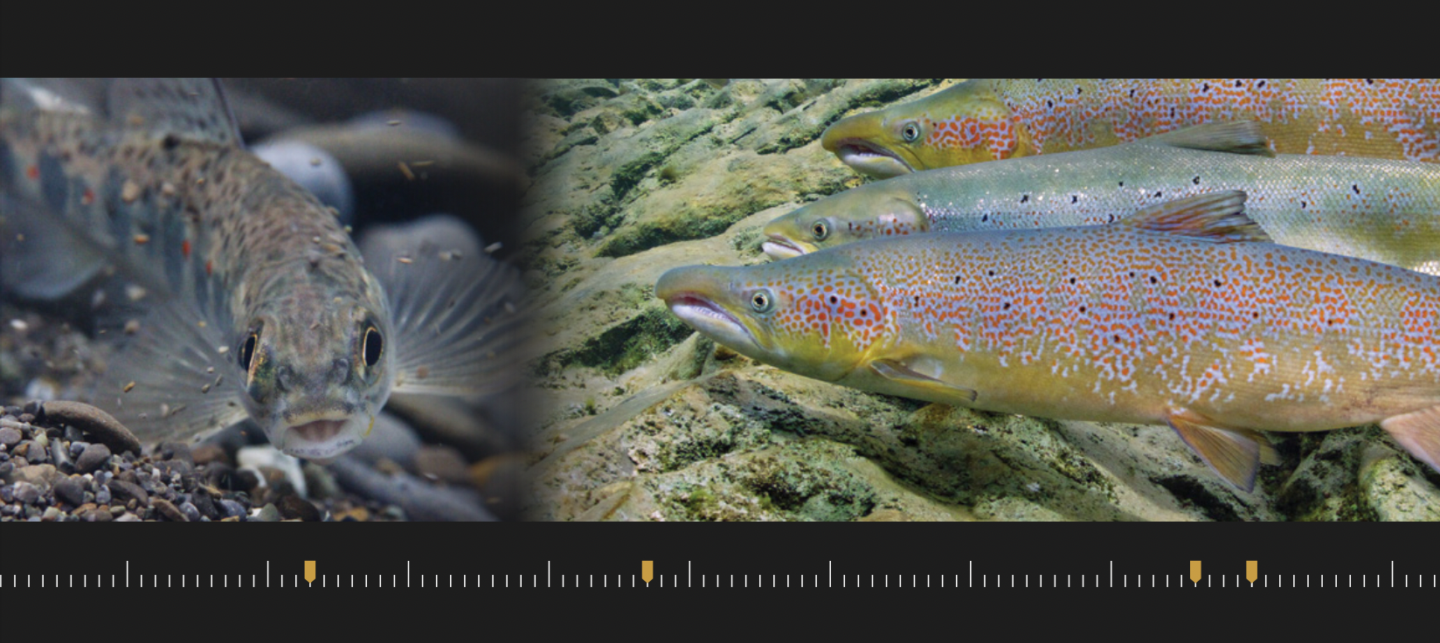
By June, the salmon eggs in Hawkins’ tank have transformed into fry — active, feeding, ready for the next phase of their journey. The successful documentation up to this stage has been the result of months of patient observation and meticulous care.
According to his wife, Andrea Tapia, a biologist he met while on assignment in her native Ecuador — who now frequently assists him on shoots as a field producer — this genuine investment sets Hawkins apart in his field.
“He’s not out there trying to make money; he’s really concerned about these species,” she says, adding it deeply affects him to see wildlife suffering. Tapia has seen this same sensitivity in their three-year-old daughter, Gaia, who has been on boats with her parents while Hawkins films whales and sharks. She’s “been in places that a one-year-old normally doesn’t go,” experiencing a childhood where marine research and wildlife documentation are simply normal life.
“She thinks that this is the norm,” Tapia says. “I think she’s going to have a shock when she goes to school, or to other people’s houses, to see they don’t live like that.”
Come early fall, Hawkins will transition the fry to a larger tank that includes other species — like benthic invertebrates — that salmon would naturally interact with in their native waters in the Miramichi watershed. Hawkins is particularly excited about documenting the critical process of smoltification. This is the stage where the fry transform into silver smolts, preparing for their journey to the ocean. “It’s really the last life stage that I haven’t captured yet,” he explains. “Finding smolts in the wild is extremely difficult. Once they hit the ocean and turn silver, they become very elusive.”
It’s one small but significant contribution to a species fighting for survival — another frame in his mission to save wild Atlantic salmon, one life stage at a time.
This story is from the January/February 2026 Issue
History
From their beginnings in the late 19th century, salmon hatcheries have gone from cure to band-aid to crutch. Now, we can’t live without manufactured fish.
Wildlife
Salmon runs are failing and grizzlies seem to be on the move in the islands between mainland B.C. and northern Vancouver Island. What’s going on in the Broughton Archipelago?
Wildlife
“We just knew no fish would get by. Not without our help.” Behind the scenes of the epic campaign to save a Fraser River salmon run.
Environment
Struggle and success in Atlantic Canada, where aquaculturists strive to overcome climate change and contamination while chasing a sustainable carbon footprint