Wildlife
Unpacking the mystery of grizzly bears in Wapusk National Park
In the Hudson Bay Lowlands, polar bears have reigned supreme. Increased sightings of a new predator have everyone on high alert.
- 5236 words
- 21 minutes
Wildlife
In her latest book, journalist, filmmaker and frequent Can Geo contributor Trina Moyles reflects on loss, kinship, and coexistence — between species, siblings and a land under pressure
I heard the bear before I saw it. The sound of a branch breaking, of pawed feet stirring leaves on the forest floor. It was early May and the aspen stood like broomsticks, empty of leaves. I looked down from the fire tower. It should’ve been easy to locate the source of the sound, a pedantic shuffle through the leaves, indicating the maker was something with a long stride. Something not small. Something not in a hurry.
Bear. There.
A small, shaggy black bear was moving along a shadow cast by a huge spruce tree. From above, it appeared like a gymnast walking the high beam. The bear seemed to be using the cover of shadow to remain hidden. It strolled to the edge of the forest and collapsed, as though exhausted, and draped its front paws over a decaying log, as if contemplating its next move.
I lifted my binoculars to get a closer look at its face. The head was small. Big ears sprouted from its skull, almost rabbit-like. I noticed the sharp geometry of its hindquarters. A skinny bear. A spring bear. Bears lose nearly one-third of their body mass in the den over the winter.
As the bear lifted its nose to scent the air, I noticed the birthmark on its chest: two white crescent moons. It came to me as a small shock that I recognized the small bear, the same way one might recognize the younger sibling of a friend after many years apart. The yearling cub was no longer a cub, but a two-and-a-half-year-old bear.
I was relieved to see it had survived. Had it denned with its sibling? I scanned the bushes for another bear, but it appeared very much alone. The bear had come back on nearly the same day to the exact same spot to which its mother had led it. Only last year, the dandelion leaves had already sprouted. This spring was far cooler than last year’s hot, dry conditions.
The bear gazed out at the dead, half-frozen grass.
“Soon,” I whispered down to it.
The small bear heaved itself up on all fours and stepped into the clearing as if toeing the frigid waters of a lake. Out of the forest, it appeared exposed and vulnerable.
A flock of robins startled up into the nearby trees and the bear skittered back, as if afraid. No kidding it was scared, I thought, reflecting back on the many ways I’d tried to deter them. The air horn. The rubber bullets. The birdshot. I felt a pang of regret.
The bear paused at the boundary of the forest, its nose tilted skyward, as though reassessing the risk.
“You’re okay,” I whispered.
It tried again, tentatively walking into the open, beneath the boughs of noisy robins. It didn’t stay longer than a minute or two. An hour later, I saw the bear balanced in the branches of an old poplar — the same tree they’d climbed the spring before — feasting on tender green buds.
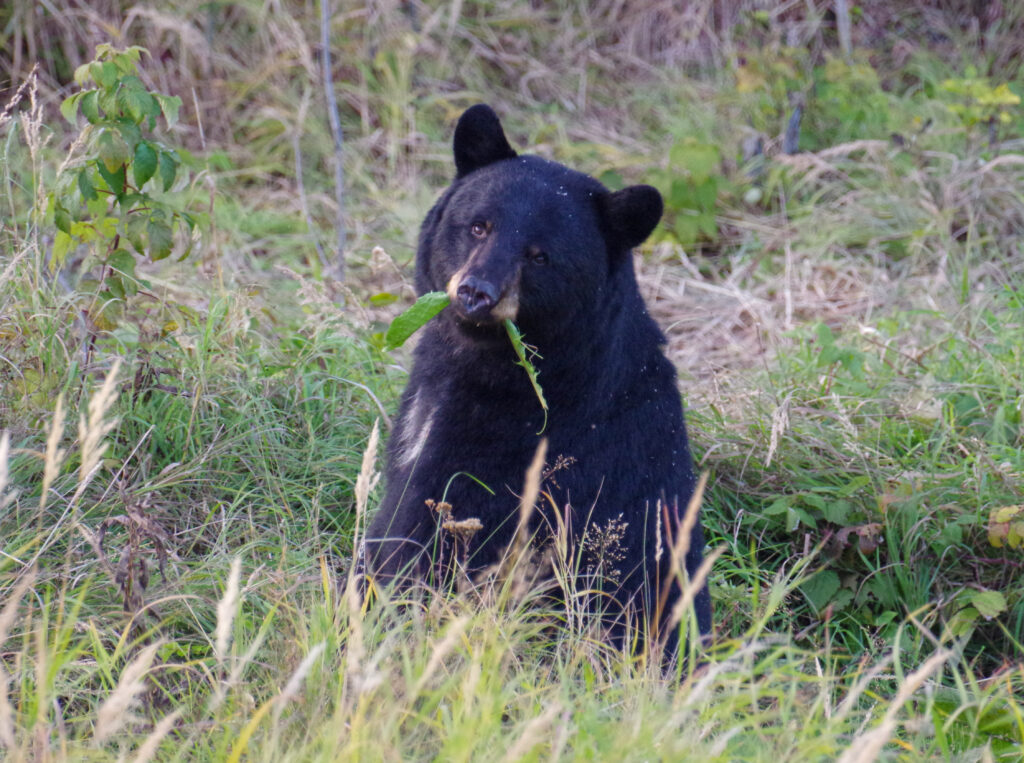
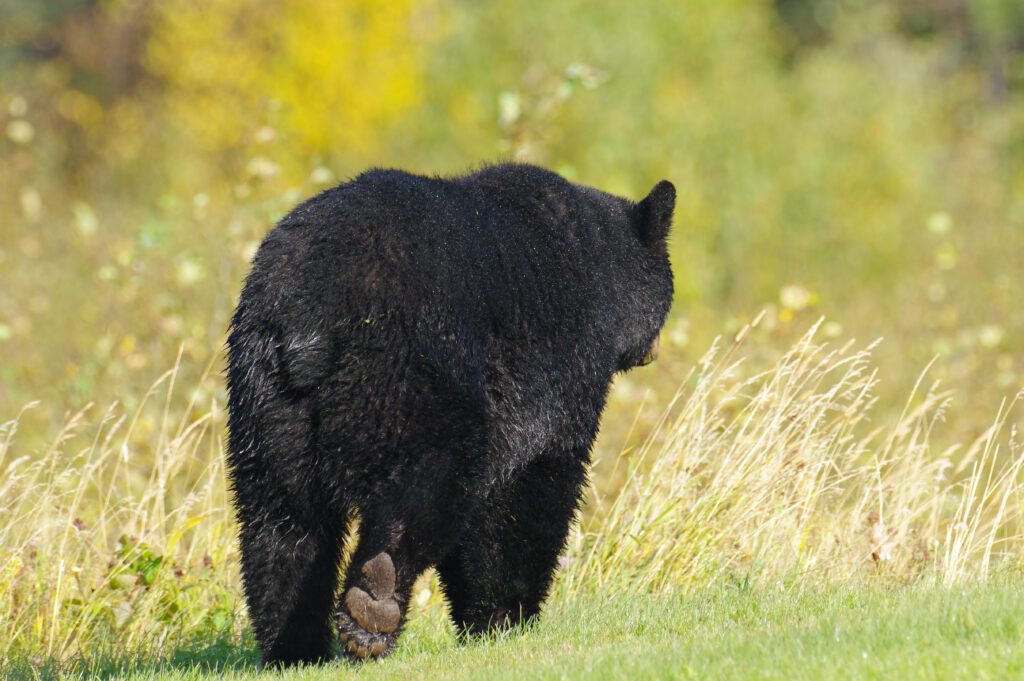
My eyes became habituated to look for the bear, if only fragments of it, nearly camouflaged by the landscape. I scanned for variations of the colour black, glowing onyx in the morning light, sooty beneath an overcast sky, not black but blue after the sun had dropped below the horizon. I always saw colour before my mind registered bear. The shy bear would not show itself fully to me, however. I spied triangular ears bobbing above the budding alders. A small, pointed snout protruding from a yellow curtain of tall, cured grass. A mound feeding on small purple spears of fireweed in the cutblock.
When I stitched together these fragmented sightings, I formed the image of the young bear in my imagination, one that seemed to me cautious, even fearful of overstepping boundaries, and yet also very much at home in the way it navigated the landscape. I recognized the bear was following a pattern, one I’d seen before, the same schedule of feeding that the mother bear had followed the previous season. First, the fireweed in the cutblock. Then, the balsam poplar buds high up in the trees. Next, the dandelions on the slope. This observation felt like a small marvel to me. Nothing about the bear’s behaviour was random. Biologists call this “site fidelity,” when an animal returns to the same location every year to feed, mate, and den. I thought of my brother and me, the way we’d both wandered back home to Peace River.
I speculated that the bear was female, based on what I’d recently read about black bear behaviour. Whereas males tend to roam widely, taking more risks to seek out breeding grounds, females stay close to the places where they are born, where the food resources are familiar, a strategy for reproductive survival.
I sensed that I could not live beside the creature for much longer and refer to it so generally: bear. For the bear was not just any black bear. The bear was its own bear, just as I was my own person. And I was not like most of the women I knew in my life. Thirty-five. Solitary. No offspring. Habitually living alone in the woods for half a year. I’d spent nearly two of the past five years alone with my dog in the boreal forest. I did not represent all women any more than the small bear represented all bears.
Osa. Spanish, feminine of Oso, for bear. The name surfaced in my mind and stuck.
A part of me felt hesitant to name the bear. To name the bear was to project myself onto it as though it was one of the velveteen dolls I dressed up and played with as a child. My father always instilled in us, as kids, the danger of anthropomorphizing wild animals. “Bears are not your friends,” he reiterated. He pointed out the inaccuracies of Walt Disney films and their romanticized portrayal of animals. In Brother Bear, for example, a male bear adopts an orphaned cub. “In the wild, males are known to prey on cubs,” he explained.
Anthropomorphize is a verb that derives from the Greek words anthropos (“human”) and morphe (“form”), meaning to attribute human traits, emotions, or desires to non- humans. It’s a bit of a sinful word amongst Western biologists and scientists, whose methods rely on observable evidence, studying what they can see, weigh, measure, and count.
Wildlife managers have always been more comfortable assigning numbers to bears rather than names. Problem bears, for example, receive identification numbers, and their information is entered into a database. Years ago, my dad told me, officers would tranquilize a bear and spray-paint a neon-coloured number onto its side. Today they use plastic ear tags, or radio collars and GPS trackers. Numbers create a kind of distance between people and wildlife, a buffer zone that prevents us from caring too much about the individual. It’s easier to take out a number than a name, after all.
What’s the loss of one black bear when there’s forty thousand more out there?
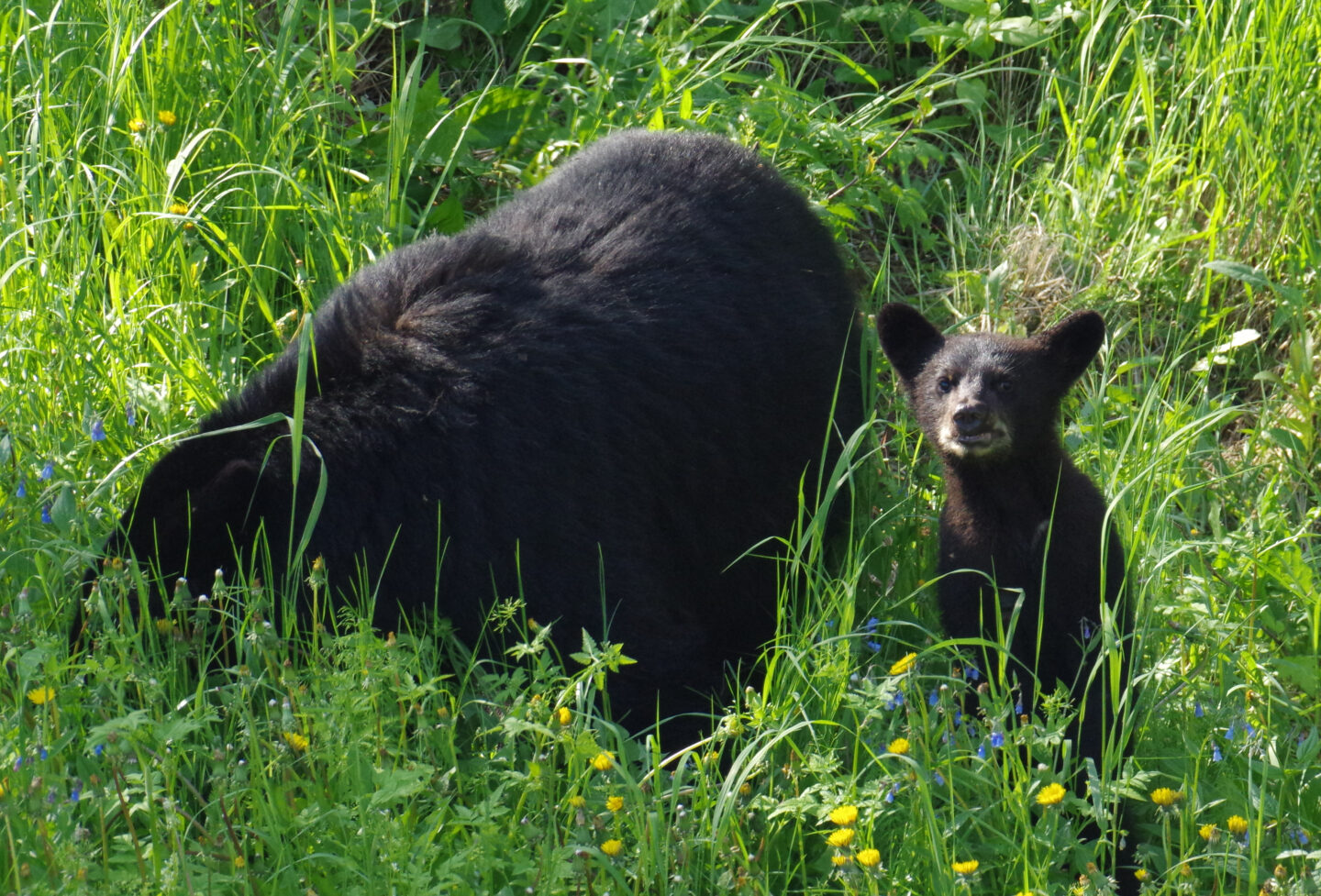
Naming the small bear — a bear who ebbed and flowed so unobtrusively around my tower, a bear who asked nothing of me — now felt necessary. If I saw a human neighbour as frequently as I saw the bear, I would eventually stop them in the street and ask for their name.
Language, writes Robin Wall Kimmerer in Braiding Sweetgrass, is “a mirror for seeing the animacy of the world, the life that pulses through all things.” She points out how the English language tends to rob the natural world of agency. “In English, we never refer to a member of our family, or indeed to any person, as it. That would be a profound act of disrespect. It robs a person of selfhood and kinship, reducing a person to a mere thing.”
By not naming the bear, by referring to the bear as it, I could not move any closer to understanding the bear. Objectifying nature and wildlife puts “a barrier between us,” writes Kimmerer. “Saying it makes a living land into ‘natural resources.’” If a bear is an it, we can pull the trigger, we can bulldoze down habitat. If the bear is a her, we may think twice.
“Those of us that have been taught through the Western system and come out as biologists, we need to be deprogrammed because we have such an objectified view of nature,” Kevin had admitted to me over the winter. “We’re not supposed to identify with bears? Well, why not? I think you should name more of your bears. People might then care more about them.”
I thought back to the orphaned bear cub in the basement, the way my naive biology allowed me to empathize with the bear — to feel connected to her — without fear or question.
Every time I saw the young bear feeding in the grass that lengthened in the light, I whispered her name. Osa.
Wildlife
In the Hudson Bay Lowlands, polar bears have reigned supreme. Increased sightings of a new predator have everyone on high alert.
People & Culture
Depending on whom you ask, the North’s sentinel species is either on the edge of extinction or an environmental success story. An in-depth look at the complicated, contradictory and controversial science behind the sound bites
Wildlife
Humans and bears are sharing more landscapes now than ever before. As we continue to invade their world, will we be able to coexist?

Wildlife
The ice bears of Klukshu have been living with people and salmon for millennia. Is this age-old balance under threat?