Environment
Inside the fight to protect the Arctic’s “Water Heart”
How the Sahtuto’ine Dene of Délı̨nę created the Tsá Tué Biosphere Reserve, the world’s first such UNESCO site managed by an Indigenous community
- 1663 words
- 7 minutes
Wildlife
Slithering, splashing, and swamp stories from Sagamok. Researcher, herper, and mother Chevaun Toulouse discusses growing up in Sagamok Anishnawbek First Nation, her journey into herpetology and the path she’s forging for future generations
This article originally appeared at biinaagami.org, a change-provoking initiative seeking to uplift the stories of the Great Lakes-St. Lawrence watershed.
In the swamps and streams of Sagamok Anishnawbek First Nation, Chevaun Toulouse spent her childhood searching for salamanders, wrangling snakes, and tracking nesting turtles with her brother. Her love of the outdoors ultimately led her down a path of conservation and advocating for the protection of slithering and scaly creatures in her Nation’s territory. Her stories from the field tell of nature’s resilience, the connection between lands and language, and how traditional stories provide insight into animal behaviour and physiology.
Now she’s inspiring the next generation, including her son, to take up the torch by recounting traditional stories with youth, and resources where animals bear their original names in Ojibwe, encouraging youth to learn their language on and with the land.
Growing up, I remember watching a lot of Steve Irwin, Crocodile Hunter. He got so much joy out of running out on the land and catching different things. I never thought that was a possibility in my life. I thought that was a different part of the world and I never thought it was like a career or anything I could pursue.
So, I ended up going to school for esthetics. I knew immediately it was the wrong program for me. As soon as I graduated, I took Fish and Wildlife at Sault College and that seemed to be more working in the outdoors. I was getting closer to what I wanted and liked. I was figuring it out. For my Co-op, I worked in forestry with the Ministry of Natural Resources and Forestry and anytime we had a spare moment, they’d let me run out and look for reptiles and amphibians, getting closer and closer to my dream.
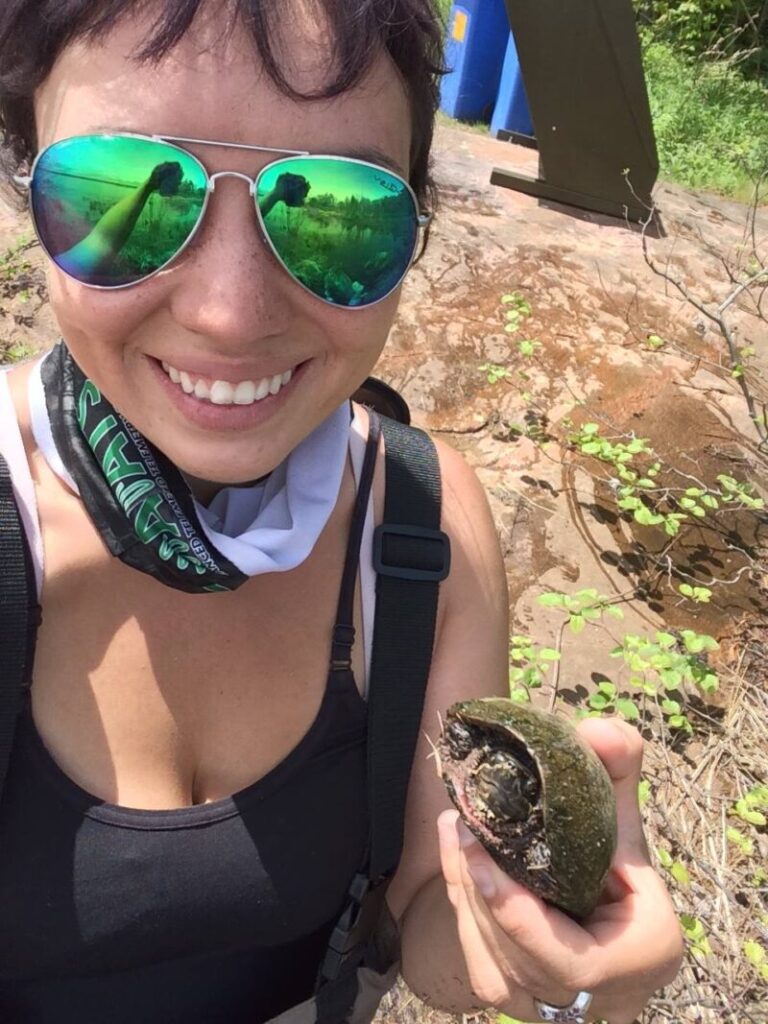
I kept sending my resume to the Toronto Zoo because Turtle Island Conservation [one of the zoo’s programs] visited my community once and I thought what they did was amazing. I never thought they would ever hire me, but I kept sending my resume. I got the call. I did the interview. They told me I got the job. Working in a swamp and getting to track turtles was like dream come true. Since then, that’s all I want to do. I just get so excited being out there. I feel like a kid again. Even when I did the bio blitz and my partner had to push my kid in the stroller because I just took off into the woods. I get the same excitement as when I was four years old, and I’m turning 32 now and I love it. I love being out in the environment.
Now I’m living back in my community, Sagamok Anishnawbek First Nation, and I want to create employment like that for others and I just want to share that feeling I get with everybody else.
I loved looking for turtles, snakes and salamanders in the summer time. My dad was kind of the one that took me out and showed me. He wanted to show my older brother Alan that you don’t need to be afraid of snakes. He held one. Now me and Alan are the real herp nerds. We love looking, but we still look under boards today if we get a chance.
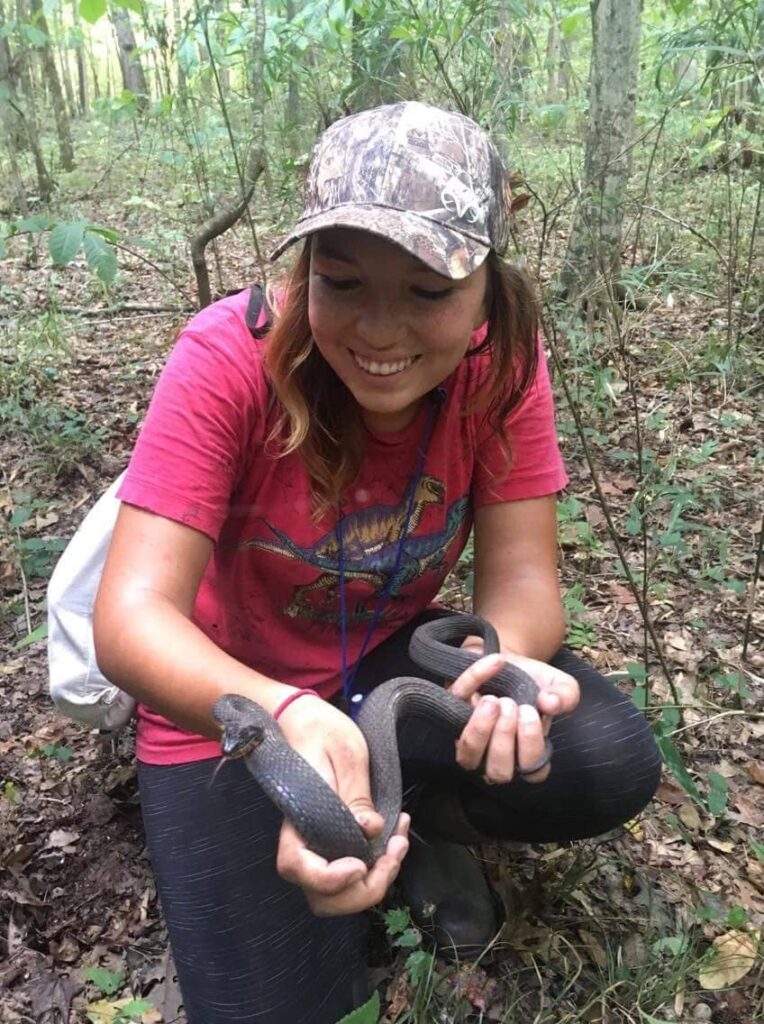
I think I caught my first snake when I was four years old and I thought, “These are the most incredible animals I have ever seen!” It was probably just a red belly or a garter snake. But I just saw it and, I don’t know, I just loved them. Ever since then, snakes have been my favourite. Water snakes are now my favourite ones.
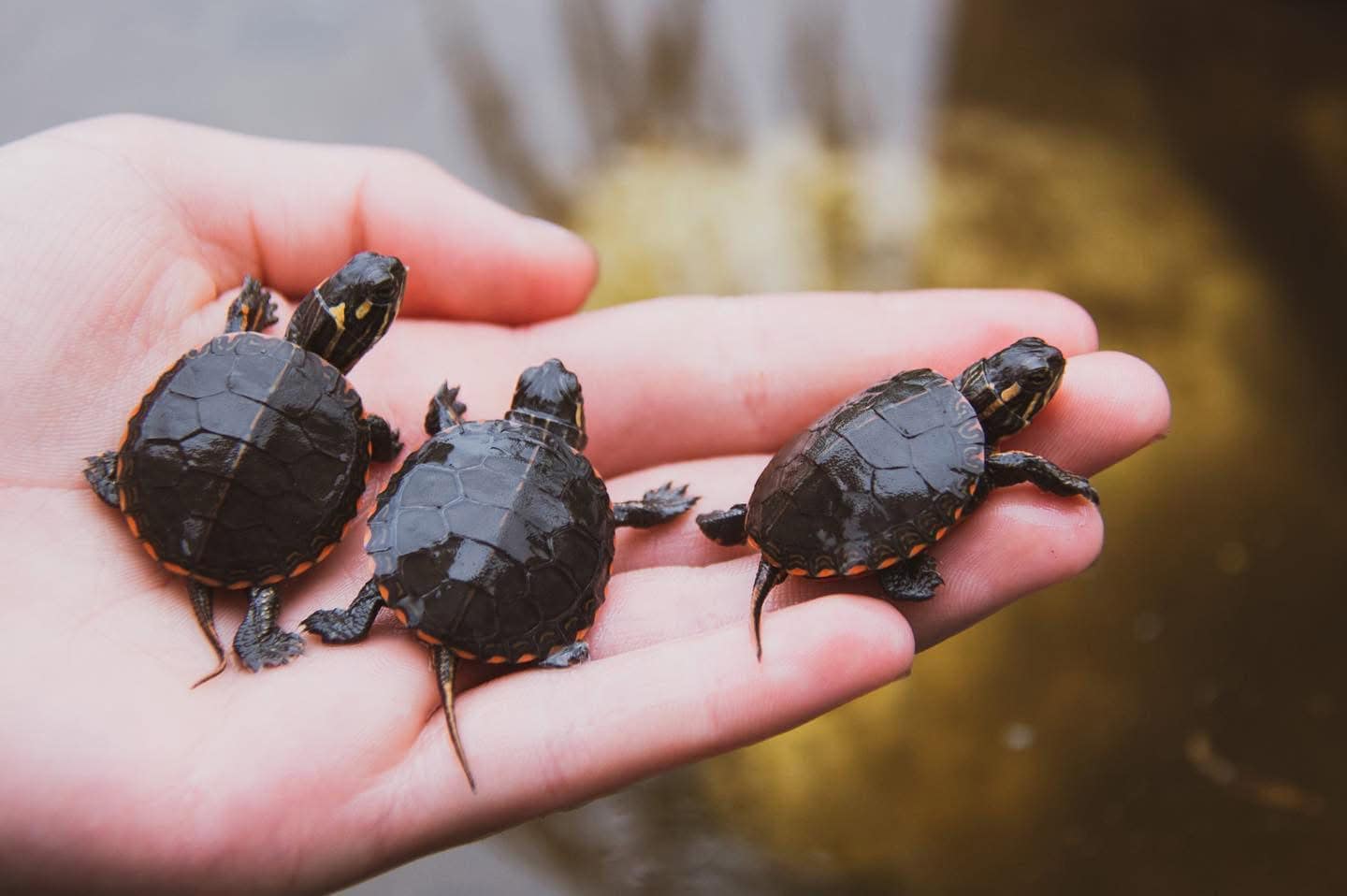
I would always notice turtle nesting season. I noticed the difference between snapping turtle eggs and painted turtle eggs and I loved looking for turtles in the summer time. Snapping turtle eggs roll better, they’re perfectly round. Every summer, me and my friends would be at the swamp and we would see them nesting — just learning when they nested and where, and the different eggs and how many they lay. I was getting to learn that just by running around Sagamok as a kid with my friends.
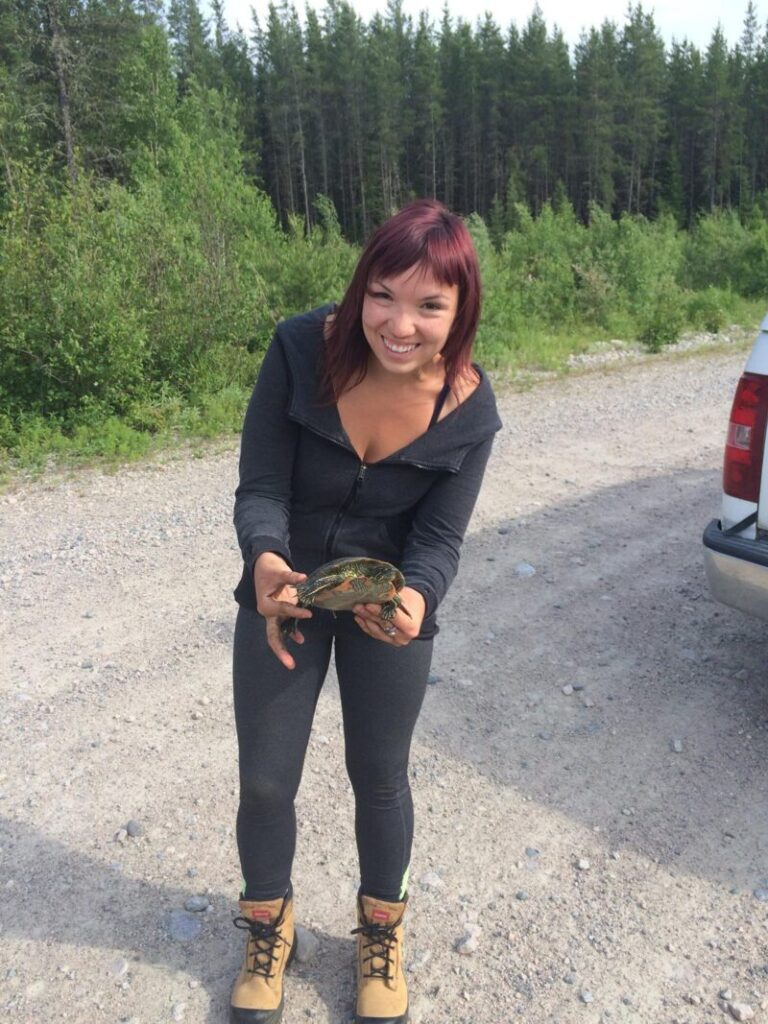
I remember when I was working with Magnetawan, we were hoping to find turtle eggs for the head starting program. We ended up finding a painted turtle and she’d been hit by a car. She was… yeah, not alive. I’d never had this experience, but I could feel there were eggs inside of her. So I used an old hunting knife and I managed to get them out. They felt really hard, so I didn’t think they were developed, but we got them back to the incubation station at Magnetawan. Seven babies hatched and I was like, “Oh my God.” I felt so great, and I got to release them into the wetland. So that was probably my one turtle moment where I felt like I really contributed.
And even like another nesting time, I got to see a female blanding turtle going to nest. Her shell was completely caved in. It was an old injury, but she’d clearly been hit. It was a tire that had caved in her whole shell. But she was out nesting. It really showed me how tough turtles are. I couldn’t believe she would have walked away from that and healed somehow. I can’t believe she was out nesting again, and it was like she’d healed from this.
My grandma, even though she went to residential school, was a really big advocate for speaking the language and really wanted me to speak the language so that’s something I’m trying to pass on to my son and learn myself. So I kind of felt this need to have my son know it as early as possible, just so it’s easier for him to know.
My son loves being outside and he loves the animals. He’s not talking, like having conversations. His whole thing is just naming off animals right now. He knows every name for everything. I got him so many nature books and while we were reading them, I bought a label maker and I was putting Ojibwe names onto everything I could find. I’m constantly researching and finding more names that I can label his books with. That’s been the real source of my motivation and inspiration for all the words I’ve been finding. He makes me say them every day. He’ll go through my field guides from college and point at every single bird and I have to say it’s a name [in Ojibwe] or he gets really mad.
I find a lot of the names for wildlife are descriptive of their appearance or their behaviour so the names for animals are really intriguing and interesting to learn in Ojibwe. Recently I was reading about the name for leeches, which is “it draws blood through its mouth.” It’s very descriptive and there’s a lot of words in there. I feel like it’s an interesting way to learn the language when you’re also learning about wildlife. I’m able to go out on the land with my son and we can name everything out there.
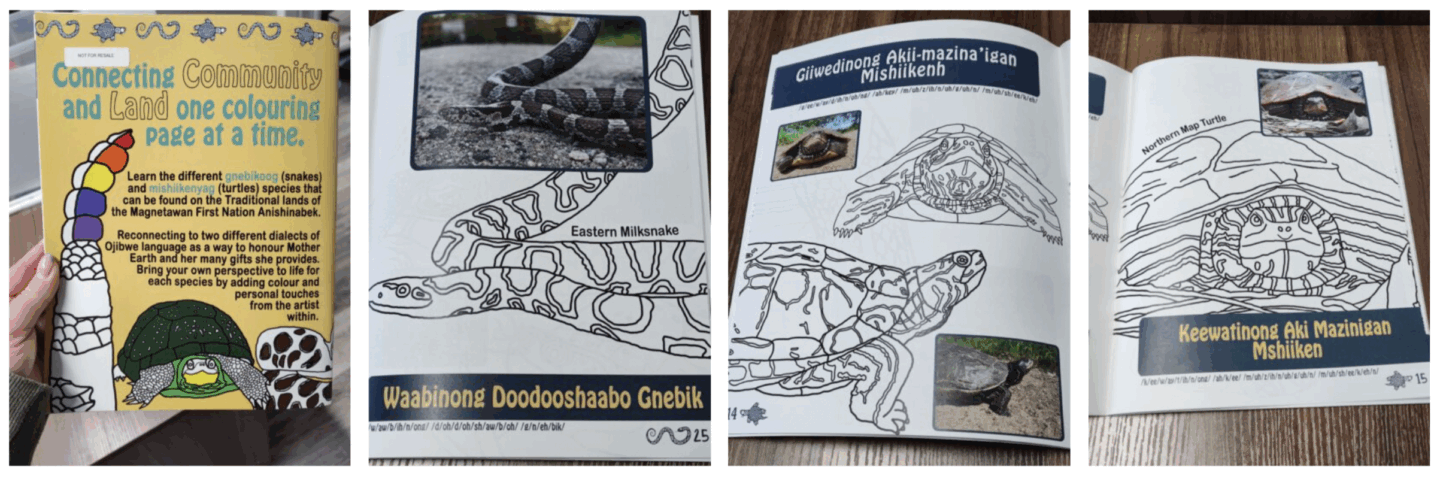
I just really love incorporating the land and the language and trying to bring back the language and help other communities. I sent my list [of species names] to the Saugeen Valley Conservation Authority and they were able to make that the bird series with graphics and I love those. I’m hoping to continue working with them and work on a new series. And the Magnetawan colouring book was a dream come true. Like I would have loved to have had that colouring book when I was a kid. I have a few copies that me and my son get to colour and I get to read it to him. And there’s some of my photography in there as well. It’s really nice to share it with my son and I’m so grateful to Magnetawan for creating that resource.
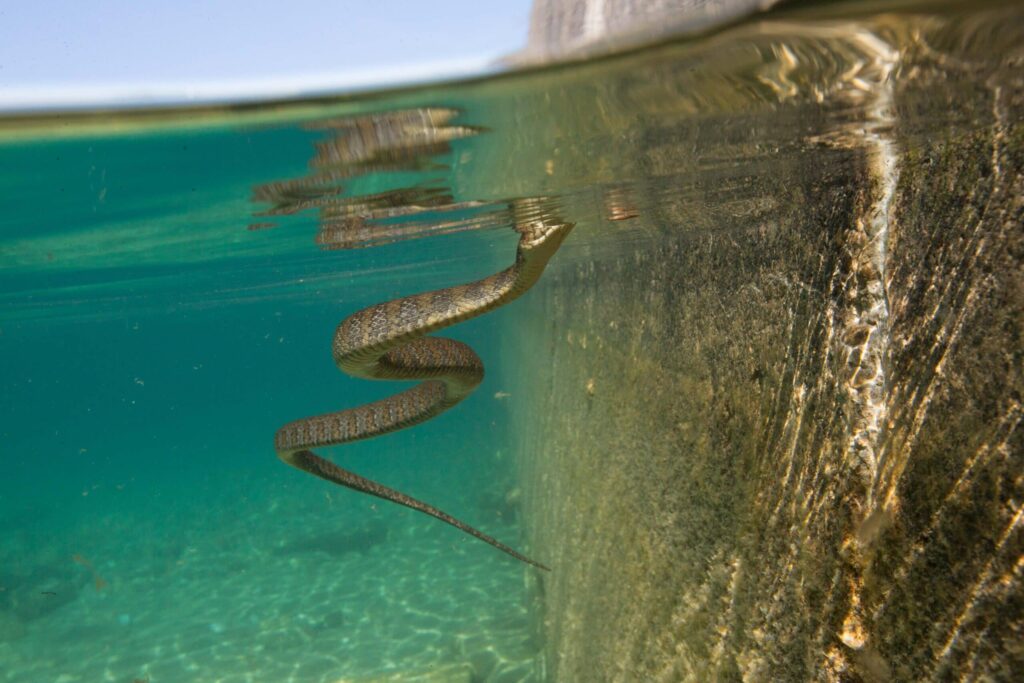
I was doing reptile handling with the Wapole Island First Nation youth and I needed to find a snake to handle. So, we were looking all over the place and I heard, “Water snake! Water snake!” I went running over and it was taking off and out into the water so I thought quickly. I know water snakes are really curious, they generally kind of come over splashing. So, I just tapped my hand on the water really quickly and the snake turned around and it came back to the shoreline where I was And just in that moment I was able to jump, bring it back and catch it and show it to them and do their reptile handling.
What really cemented my love of water snakes was when we were looking for turtle nests and I could see that there was something on the road way up ahead, outside of the range where we would be looking. I just thought I’d check it out. It was a big water snake basking on the road. Normally I’m used to snakes leaving, they just take off. But it stayed there. I got close enough, I actually sat down near it and I put my hand out and it came to me like a dog. It was smelling my hand and stuff. But then I saw a car coming and I scared it off the road. I thought it was a really neat moment where it wasn’t afraid of me and I got to get up close to it.
I would always hear my grandma and others tell stories in the community about the serpent — giant snake that, in some stories, carved the waterways with its body. It’s like a water spirit. It’s very connected to the movements of the water.
But one of my favourite ones was from a book. It’s an old story where this man has a dream that his son is going to kill him, so he takes his son and leaves him on this island. This kid is on the shoreline and feeling really alone and doesn’t understand what’s happening. Then the serpent shows up and it tells them that it will bring him back to the mainland. The only condition is that the son needs to tell him if he hears thunder because that means the Thunderbird is coming. The Thunderbird is the main antagonist to the great serpent, just like hawks and snakes. You always see hawks carrying them off. The boy agrees, and the serpent starts taking him back to the mainland.
The serpent checks in, “Is everything okay” and the boy says “Yeah, everything’s fine.” The boy starts to hear thunder, but he’s so close to the mainland so he doesn’t tell the serpent. The serpent drops him off on the mainland and the Thunderbird attacks the serpent and kills it. The boy feels so devastated that he lied and he didn’t tell the serpent.
The serpent was helping him. There’s blood on the beach from the attack and out of the blood comes every snake in the world and they all disperse. I just thought that was such a cool story and one where the Serpent’s not a villain. Also, when I’ve told snake biologists, they tell me snakes can’t really hear. So, it kind of makes sense that the serpent asks the boy to tell it if he hears the thunder.
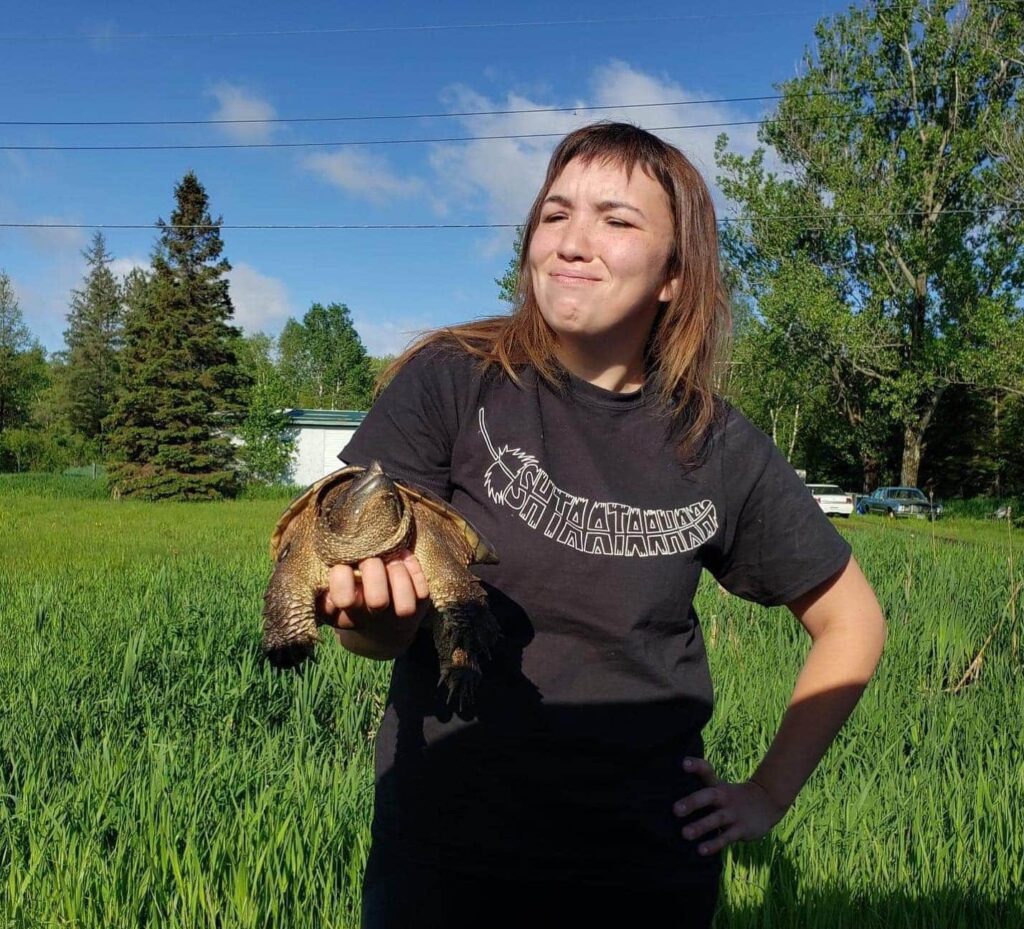
I hope to lead by example. I remember being at our culture camp and I was supposed to be there to learn teachings. But once again, I was obsessed with using snakes, and I was out there catching them constantly and some of the Elders thought it was neat that I was doing this when I was a girl or a woman. But most of the teams I’ve worked on are usually all women. I’m hoping to create more environmental programming and to help lead it and teach it and get more Indigenous youth then Indigenous girls out there catching swamp critters.
I’m hoping after I have this last child that I can get back into the field and get back in my waders. I really miss being in the swamp and I am really looking forward to getting programming going like that in my own community, in Sagamok, because we have a large land base, lots of species at risk and lots of different wildlife. I feel like trying to heal the environment helps you heal yourself too at the same time. I think mental health and being out on the land are so interconnected.
I really wonder if my son’s going to have the same experience that I’m going to have. In our culture we’re supposed to think seven generations ahead. And I don’t know what’s going to be left seven generations ahead.
I like to just stress the importance of wetlands because I feel like they’re like the first pick for a place to be filled in and built upon. But they are so important to the ecosystem and the wildlife. Wetlands are so vital. It just breaks my heart every time I see a wetland get filled in to be like a parking lot. There was so much life there, and wetlands support so much life. There’s going to be a plethora of wildlife out there, like flora and fauna. There’s so many amazing things out there if you just go and take a look.
Environment
How the Sahtuto’ine Dene of Délı̨nę created the Tsá Tué Biosphere Reserve, the world’s first such UNESCO site managed by an Indigenous community

People & Culture
Announcing a new initiative to connect to and protect the Great Lakes-St. Lawrence watershed

Mapping
Biinaagami, a CanGeo collaborative initiative seeking to connect people with the Great Lakes-St. Lawrence watershed, has released a suite of educational materials, including a Giant Floor Map, augmented reality experiences, lesson plans and more
History
A look back at the early years of the 350-year-old institution that once claimed a vast portion of the globe